Great St. Martin Church: Cologne's Romanesque Landmark Above the Rhine
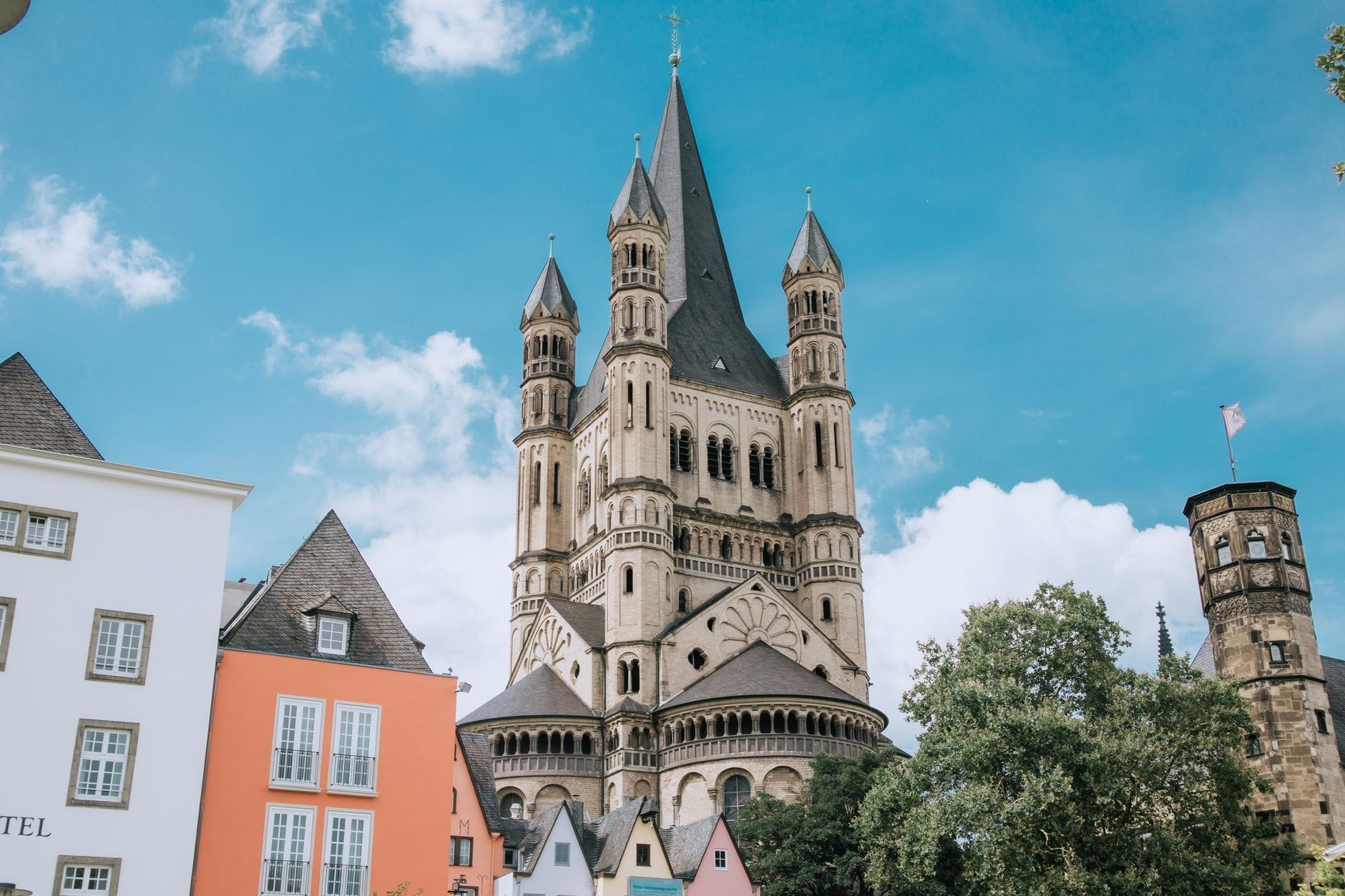
Great St. Martin Church anchors the Cologne Old Town skyline with its distinctive clover-leaf apse and massive crossing tower. Built between 1150 and 1250 on foundations stretching back to 960 AD, it is one of the finest Romanesque churches in Germany and one of the few still active as a monastic-style church today. Entry is free, and the atmosphere inside is unlike anything you will find at the nearby Cathedral.
Quick Facts
- Location
- An Groß St. Martin, 50667 Köln, Altstadt-Nord (Old Town)
- Getting There
- Cologne Central Station (Köln Hbf), approx. 7-minute walk. Multiple KVB tram and bus lines stop at Dom/Hbf.
- Time Needed
- 30 to 60 minutes for a leisurely visit; longer if you attend a prayer service
- Cost
- Free entry
- Best for
- Architecture enthusiasts, history lovers, travelers seeking quiet away from the Cathedral crowds
- Official website
- www.romanische-kirchen-koeln.de
What Great St. Martin Church Actually Is
Great St. Martin Church (Groß St. Martin in German) is a Roman Catholic monastic church in the heart of Cologne's Old Town, positioned just steps from the Rhine riverbank between the Fischmarkt square and the Altstadt's tangle of cobbled lanes. Its distinctive profile, a massive crossing tower flanked by four corner turrets rising above a trefoil (clover-leaf) apse, has defined the city's skyline alongside the Cathedral for centuries. It is one of twelve Romanesque churches in Cologne, a concentration of pre-Gothic ecclesiastical architecture found nowhere else in Germany at this density. You can read more about this remarkable group in our guide to Cologne's Romanesque churches.
Unlike many European churches that survive purely as monuments or tourist attractions, Great St. Martin functions as a living monastic church. Since 2009, it has been the home of the Monastic Fraternities of Jerusalem (Fraternité de Jérusalem), a French-founded community that follows a rhythm of daily prayer services including Lauds and Vespers. The church is open to visitors between those services, which means the building carries a quietude and spiritual purpose that you can feel the moment you step inside.
ℹ️ Good to know
Opening hours (subject to change): typically open daily during the late morning and afternoon, with a mid-day closure on some days. The church is sometimes closed on Mondays. Hours vary frequently with public holidays and liturgical events. Always verify with the church directly before visiting: +49 221 27794747.
A Thousand Years of History on a Former Rhine Island
The story of this site begins around 960 AD, when a Roman chapel stood on what was then a small island in the Rhine. The river's course has since shifted, but the ground beneath the church still holds Roman remains, including traces of a warehouse complex from the ancient city of Colonia Claudia Ara Agrippinensium. Excavations beneath the church have uncovered layers of occupation stretching back to the Roman period, making the crypt one of the more archaeologically significant spaces in the city.
The Romanesque church visible today was built progressively between approximately 1150 and 1250 as part of a Benedictine abbey. The construction spans the high point of Rhineland Romanesque architecture, and the building represents mature thinking about how mass, tower, and apse should work together. The crossing tower in particular, rising to around 75 metres, was one of the most prominent vertical landmarks in medieval Cologne, competing visually with the Cathedral's Gothic spires centuries before those spires were completed.
The church was almost completely destroyed during World War II bombing raids on Cologne. What stands today is a careful reconstruction completed in 1985, following decades of painstaking work to restore the Romanesque forms from the ruins. The rebuilding is faithful rather than inventive: the intention was to recover what existed rather than to reinterpret it. This is worth knowing before you visit, because the interior feels both ancient in proportion and notably clean in surface detail, the inevitable consequence of 20th-century reconstruction rather than uninterrupted medieval survival.
Tickets & tours
Live prices and dates from our booking partner. If you book, we may earn a commission at no extra cost to you.
Cologne haunted places and ghost stories: interactive city game
From 8 €Instant confirmationFree cancellationFood Tour Cologne Sudstadt
From 44 €Instant confirmationFree cancellationCologne brewery tour including 3 Kolsch beer
From 28 €Instant confirmation2-hour afternoon cruise in Cologne at Christmastime
From 25 €Instant confirmationFree cancellation
The Exterior: Reading the Church from the Outside
Most visitors approach from the Fischmarkt side, the historic fish market square that opens directly toward the church's west front. This is the correct place to begin. Stand at the edge of the square and look up: the crossing tower with its four subsidiary turrets creates a silhouette that photographers return to repeatedly, particularly in the late afternoon when the sandstone takes on a warm amber tone and the Rhine light bounces off the surrounding buildings.
Walk around the building if you have time. The eastern apse end, the trefoil arrangement of three semicircular apses, is architecturally the most accomplished element of the exterior. The blind arcading along the apse walls, rows of shallow decorative arches carved into the stone surface, shows the Rhineland Romanesque style at its most refined. Early morning light from the east catches these reliefs cleanly, which makes the short detour worthwhile for anyone interested in architectural photography.
💡 Local tip
For the best exterior photographs, position yourself at the Fischmarkt in the late afternoon for warm golden-hour light on the tower. For the apse detail, aim for morning when eastern light defines the blind arcading most clearly.
The Interior: Scale, Stillness, and What to Look For
Step inside and the first thing that registers is the scale and the silence. The nave is tall and relatively narrow by Gothic standards, drawing the eye upward along thick, rounded piers toward a barrel-vaulted ceiling. The proportions are Romanesque through and through: weight rather than lightness, mass rather than transparency. After visiting the Cologne Cathedral, where Gothic engineering strains to dissolve walls into glass, the interior of Great St. Martin reads like a deliberate architectural counterargument.
The crossing, the point where the nave and transept intersect beneath the tower, is the spatial climax of the building. Stand here and look up into the tower lantern and you understand why this structural arrangement was considered a significant achievement in 12th-century church architecture. Light filters down from windows set high in the tower walls, creating a gentle, diffuse illumination that changes character through the day.
The crypt beneath the church is accessible and worth seeking out. Roman foundations are partially visible, and the low stone vaults create an atmosphere markedly different from the brightness of the main nave. If you are interested in comparing the crypt experience across Cologne's Romanesque churches, the St. Gereon Basilica and Museum Schnütgen (itself housed in a Romanesque church) offer complementary experiences.
How the Experience Changes Through the Day
Visiting at different times produces meaningfully different experiences. On weekend mornings, when the church opens at 10:00, the Fischmarkt outside is already filling with weekend market activity and tourist foot traffic. You can step into the church and find it almost empty, the contrast between the noise outside and the quiet inside arriving immediately. Midday visits on weekdays, after the 12:15 opening, tend to draw more passing tourists, particularly from groups walking between the Cathedral and the Rhine waterfront.
Late afternoon on a weekday is arguably the most rewarding time. The crowds thin, the light through the upper windows moves into a warmer register, and the community's rhythm of prayer means that the building is being used rather than merely displayed. If a Vespers service is approaching, you may hear quiet preparation: candles being lit, monks or nuns moving through the space. Even non-religious visitors typically find this atmosphere genuinely affecting.
⚠️ What to skip
The church may close without advance notice during liturgical events or community services. If you have traveled specifically to visit, call ahead: +49 221 27794747. Respectful behaviour during any ongoing prayer is expected; photography during active services is not appropriate.
Getting There and Getting Around the Neighbourhood
Great St. Martin Church sits in the northern part of Cologne's Old Town, a seven-minute walk from Cologne Central Station (Köln Hbf). From the station, cross through the Cathedral square, walk past the Hohenzollern Bridge approach, and head south along the waterfront or through the Old Town streets. The church tower is visible from several points along the Rhine promenade, making it a reliable visual landmark.
The surrounding Altstadt is compact and walkable. Within a five-minute radius you will find the Fischmarkt, the Old Market (Alter Markt), and several stretches of Rhine promenade. The Cologne City Hall (Rathaus) is a few minutes' walk to the southwest, and the Wallraf-Richartz Museum is an easy walk from the church for those combining history with art.
Accessibility information for the church interior is not comprehensively documented in official sources. The Old Town streets in this area include cobblestones and uneven surfaces, which can be challenging for wheelchair users. Visitors with specific accessibility requirements are advised to contact the church directly before visiting.
Who Will Love This, Who Should Skip It
Great St. Martin rewards travelers who bring some interest in medieval architecture, religious history, or the kind of quiet that a functioning monastic church produces. It is not a spectacle in the same sense as the Cathedral; there is no treasury, no famous artwork on the scale of a major museum, and no audio guide infrastructure. The value here is architectural and atmospheric, and it is real.
Travelers on a tight itinerary who are prioritising galleries and major museums may want to weigh this against other options. For a broader overview of how to structure your time, the 2 days in Cologne itinerary places Great St. Martin in context with the rest of the city's highlights. Visitors specifically interested in Cologne's wider Romanesque heritage will find it essential, and those who find the Cathedral overwhelming in scale or tourist density will appreciate this as a more measured, contemplative alternative.
Travelers who are not interested in churches, who find reconstructed historic buildings unsatisfying compared to unaltered originals, or who are visiting with young children looking for interactive experiences will likely find 20 minutes here sufficient before moving on. That is not a criticism of the church; it is an honest description of what it is and what it is not.
Insider Tips
- The Fischmarkt square directly in front of the church is one of the better spots in the Old Town to sit with a coffee and look at the tower without tour-group congestion. Early weekend mornings, before 10:00, are particularly calm.
- The church's monastic community holds Vespers in the early evening. Check the schedule if you want to attend a service: the choral prayer is open to visitors and the acoustics in the nave reward it.
- The view of the church tower from the Rhine promenade to the east, across the water toward the Old Town, is one of the classic Cologne compositions. It works best at dusk when the tower is lit and the river reflects the light.
- Do not overlook the crypt. Many visitors walk the nave and leave without descending. The Roman foundations visible in the crypt make the 1,000-year claim feel tangible in a way the cleaned-up nave surfaces cannot.
- Great St. Martin pairs naturally with a walk south along the Rhine waterfront to the Chocolate Museum. The combination of ancient church and contemporary museum makes for a morning that covers a satisfying range of what Cologne offers.
Who Is Great St. Martin Church For?
- Architecture enthusiasts interested in Rhineland Romanesque design and the 12th-century building tradition
- History-focused travelers who want to engage with Cologne's pre-Gothic and Roman-era layers
- Visitors seeking quiet and atmosphere away from the Cathedral's large tourist crowds
- Travelers combining a walking tour of the Old Town with Rhine waterfront time
- Anyone curious about active monastic life in an urban European setting
Nearby Attractions
Other things to see while in Altstadt (Old Town):
- 4711 House (Dufthaus 4711 / Haus Mülhens)
The 4711 House on Glockengasse is the home of the 4711 Original Eau de Cologne, the famous citrus fragrance developed by Wilhelm Mülhens from 1792 (the earlier Farina fragrance from 1709 is generally considered the original 'eau de Cologne'). Part flagship store, part fragrance museum, and part architectural curiosity, it offers a compact but interesting stop in Cologne's Altstadt-Nord for anyone curious about the city's most famous exports.
- Cologne City Museum (Kölnisches Stadtmuseum)
The Kölnisches Stadtmuseum traces Cologne's extraordinary 2,000-year arc from Roman outpost to Rhine metropolis. Reopened in a striking new home on Minoritenstraße in March 2024, it offers an affordable and intellectually rewarding afternoon in the city's Altstadt.
- Cologne Cathedral (Kölner Dom)
Cologne Cathedral, officially the Hohe Domkirche Sankt Petrus, is Germany's most visited landmark and one of the great Gothic structures on earth. This guide covers tourist ticketing, tower access, the Treasury, and how to make the most of your time there.
- Cologne City Hall (Kölner Rathaus)
The Kölner Rathaus is Germany's oldest city hall, a layered architectural landmark in Cologne's Old Town that spans Gothic, Renaissance, and modern styles.
Planning a trip? Discover personalized activities with the Nomado app.