Museum Schnütgen: Medieval Christian Art Inside a Living Romanesque Basilica
Museum Schnütgen is Cologne's dedicated museum of medieval Christian art, housed inside the 12th-century Romanesque basilica of St. Cäcilien. From carved ivory devotional objects to monumental stained glass, the collection spans roughly a thousand years of sacred craftsmanship, displayed in a setting that is itself a work of art.
Quick Facts
- Location
- Cäcilienstraße 29–33, 50667 Cologne
- Getting There
- Neumarkt station (KVB lines 1, 3, 4, 9, 16, 18; bus 136, 146) — 5-min walk
- Time Needed
- 1.5 to 2.5 hours for the permanent collection
- Cost
- €6 adults / €3.50 concessions; combined ticket with Rautenstrauch-Joest-Museum €10 (€7 concessions)
- Best for
- Medieval art enthusiasts, architecture lovers, quiet museum seekers
- Official website
- www.museum-schnuetgen.de/en
What Museum Schnütgen Actually Is
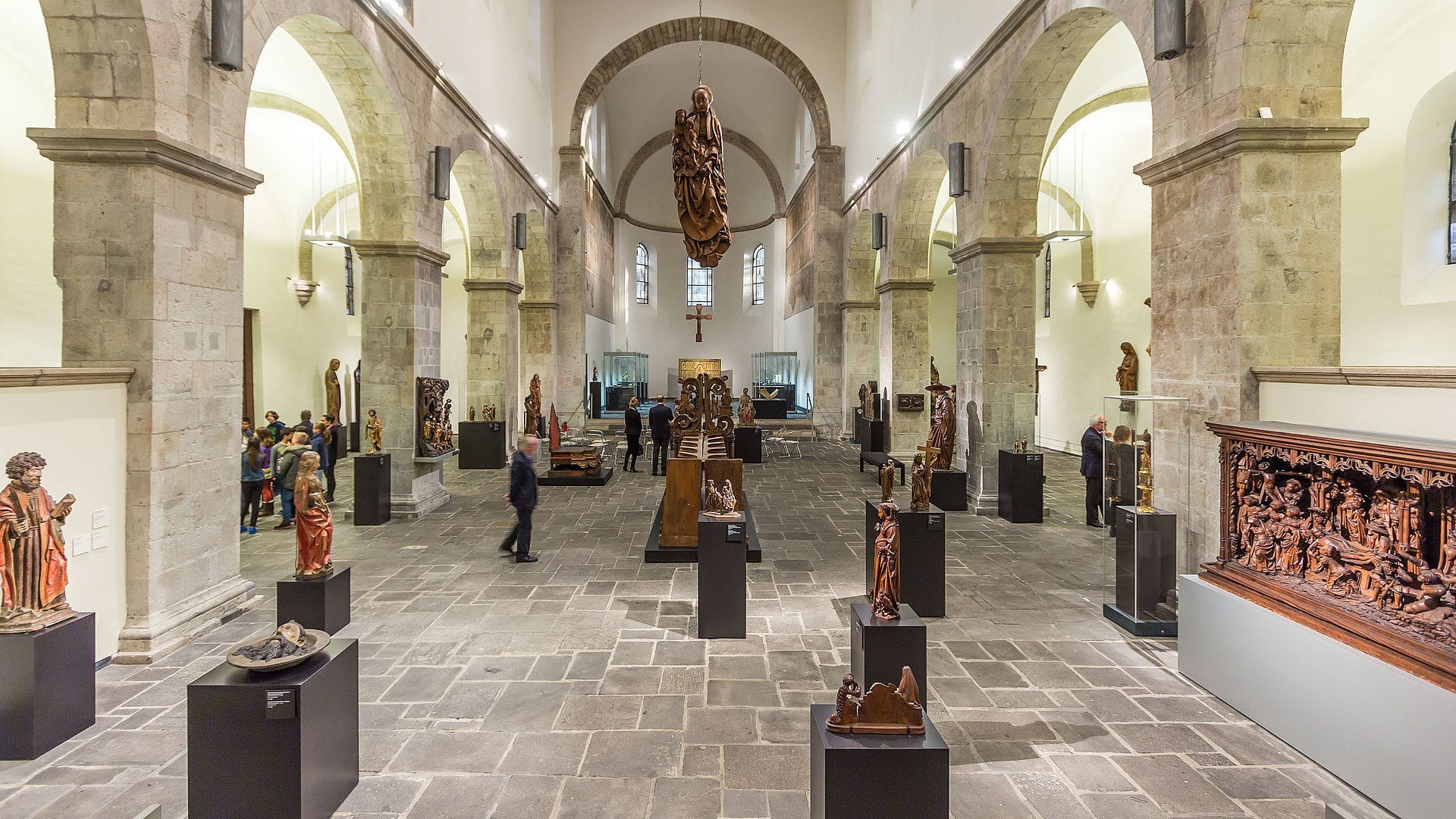
Museum Schnütgen is one of those rare institutions where the container and the contents are inseparable. Since 1956, the museum has occupied the Romanesque basilica of St. Cäcilien, a 12th-century church on Cäcilienstraße in Cologne's Altstadt. The collection it holds focuses entirely on Christian art from the early medieval period through the late Gothic era, covering sculpture, ivory carvings, textiles, reliquaries, metalwork, and stained glass.
This is not a broad decorative arts museum. The curatorial focus is tight and deliberate: sacred objects made for liturgical use or devotional contemplation, displayed in a space that was itself built for those same purposes. That specificity is exactly what makes it worthwhile for the right visitor, and exactly why it won't appeal to everyone.
The museum shares the Kulturquartier am Neumarkt cultural quarter with the Rautenstrauch-Joest-Museum, Cologne's ethnology museum. A combined ticket for both permanent collections costs €10 per adult, making a back-to-back visit genuinely good value for a full afternoon in this part of the city.
💡 Local tip
Thursday is the best day to visit: the museum stays open until 20:00 (and until 22:00 on the first Thursday of each month for KölnTag). Evening light filtering through the basilica's clerestory windows creates entirely different viewing conditions than a weekday morning.
The Building: A Romanesque Basilica as Exhibition Space
The basilica of St. Cäcilien is one of Cologne's surviving Romanesque churches, a building type the city has in greater concentration than almost anywhere else in Germany. The structure dates primarily from the 12th century, with the characteristic rounded arches, thick stone walls, and restrained ornamentation that define the style. Walking through the entrance foyer of the modern annexe on Cäcilienstraße and then stepping into the nave for the first time tends to stop people mid-stride.
The stone floor is uneven in places, worn smooth by centuries of foot traffic. The nave's proportions are modest compared to Cologne Cathedral, but that human scale is part of what makes it effective as a museum. Crucifixes, carved reliefs, and devotional figures are displayed at eye level along the nave and in the side aisles, without the distance that a large modern gallery would impose. You are close to the objects.
For broader context on Cologne's Romanesque heritage, the network of twelve surviving Romanesque churches scattered across the old city is covered in detail in the guide to Cologne's Romanesque churches. Museum Schnütgen represents a natural complement to visiting those churches in person, since it holds many of the portable sacred objects that once furnished similar buildings.
Tickets & tours
Live prices and dates from our booking partner. If you book, we may earn a commission at no extra cost to you.
Cologne haunted places and ghost stories: interactive city game
From 8 €Instant confirmationFree cancellationFood Tour Cologne Sudstadt
From 44 €Instant confirmationFree cancellationCologne brewery tour including 3 Kolsch beer
From 28 €Instant confirmation2-hour afternoon cruise in Cologne at Christmastime
From 25 €Instant confirmationFree cancellation
The Collection: What You Will Actually See
The permanent collection runs chronologically and by medium, though the chronology is not always strictly enforced. The oldest objects push back to the early medieval period; the collection's core strength is in the Romanesque and Gothic centuries, roughly 1000 to 1500 CE. Among the highlights are ivory diptychs small enough to hold in one hand, their carved surfaces depicting scenes from the Passion with a precision that still reads clearly despite a millennium of handling. Reliquaries in gilded copper and enamel occupy lit cases in the nave aisles, their forms sometimes literally shaped like a head, arm, or foot to correspond with the relic housed inside.
The textile collection includes embroidered vestments, altar cloths, and liturgical hangings. These are displayed in lower-light conditions to protect the dyes, which means they reward patience. Give your eyes time to adjust and the color and fine stitching become legible in ways that a quick walk-through would miss entirely.
Stained glass panels, removed from churches across the Rhine region over the centuries, are mounted in the clerestory and in purpose-built frames that allow backlighting. The effect on a bright afternoon, with Rhine Valley sunlight passing through 13th-century glass, is genuinely remarkable. This is not a manufactured effect for tourism; it is the glass doing what it was designed to do.
Wooden sculpture occupies a large portion of the floor space. Carved Madonnas, crucifixes, and altarpiece figures range in scale from palm-sized to over two meters tall. Some retain original polychrome paint; others have been stripped to bare wood, either by time or by previous owners who preferred the paler aesthetic. Both conditions are represented honestly in the display labels.
How the Experience Changes by Time of Day
A Tuesday morning visit, shortly after opening at 10:00, is likely to be quiet to the point of near-solitude. The stone walls hold the night's cool well into mid-morning, and the ambient sound is almost entirely footsteps and the faint hum of climate control equipment. This is an excellent time for photography without other visitors in frame, and for spending time with individual objects without pressure.
Weekend afternoons draw more visitors, particularly from families and school groups during term time. The nave can feel crowded around the central exhibits during peak hours on Saturdays. If you are coming on a weekend, arriving at opening time or after 16:00 tends to reduce congestion significantly.
Thursday evenings, especially during the extended Cologne Day hours until 22:00, attract a different crowd: more local, often younger, sometimes using the visit as a pre-dinner cultural stop. The basilica's atmosphere changes noticeably under artificial lighting. Warm spotlights on the carved stonework and gilded metalwork read differently than daylight. Some visitors find this more dramatic; others prefer natural conditions for reading detail. Both are legitimate experiences of the same collection.
ℹ️ Good to know
The museum is closed on Mondays, 24–25 December, 31 December, 1 January, Weiberfastnacht (Women's Carnival), and Rosenmontag (Shrove Monday/Rose Monday). During Cologne's Karneval period, check the schedule carefully before planning a visit.
Practical Walkthrough: Getting There and Getting Around
The museum's address is Cäcilienstraße 29–33. The entrance is through the annexe foyer on that street rather than directly into the basilica, so first-time visitors occasionally walk past the main door expecting something more ecclesiastical-looking from the outside. Look for the modern building attached to the church, not the church facade itself.
Neumarkt station, served by KVB tram lines 1, 3, 4, 9, 16, and 18 as well as bus lines 136 and 146, is the most convenient stop. The walk from Neumarkt to the museum entrance takes about five minutes on a direct route along Cäcilienstraße. From Cologne Central Station (Köln Hauptbahnhof), Neumarkt is two stops by tram.
If you are spending more time in the Altstadt, the museum fits naturally into a walking route that includes the Cologne Cathedral and the Wallraf-Richartz Museum, which holds Cologne's major collection of medieval panel paintings. Together, the three institutions give a thorough picture of sacred art production in the Rhine region from the Romanesque period through the Baroque.
Inside the museum, the floor plan is not complex, but the transition between the annexe and the historic basilica can be slightly disorienting on a first visit. Pick up the floor plan at the entrance desk. There are seating areas in both the annexe and the nave for resting; the stone floor is hard on feet after an extended visit.
Photography is generally permitted in the permanent collection without flash. Tripods are not normally allowed without prior arrangement. The museum's own photography policy should be confirmed at the desk on arrival, as conditions occasionally change for temporary exhibitions.
Who Should Visit, and Who Might Not
Visitors with a genuine interest in medieval art, Christian iconography, or the history of sacred craftsmanship will find Museum Schnütgen exceptional. The collection's depth in ivory carving and goldsmithwork is particularly strong, and the quality of individual objects regularly surprises people who expect a regional museum to hold second-tier material. It does not.
Architecture enthusiasts who want to see the interior of a Romanesque basilica without attending a religious service will also find the visit worthwhile. The building itself justifies the entrance fee before a single object is examined.
Visitors looking for a broad introduction to Cologne's art scene, or those primarily interested in modern and contemporary work, are better served elsewhere. The collection covers a specific millennium of religious art, and it makes no attempt to be anything other than that. Young children may find the pace slow and the subject matter abstract; there is limited interactive programming compared to larger family-oriented institutions.
For a broader overview of Cologne's museum landscape, the guide to the best museums in Cologne sets out which institutions suit which interests, and helps avoid the common mistake of trying to cover too many in a single day.
⚠️ What to skip
The museum is housed in a historic stone church with multiple levels. Physical accessibility varies between the historic basilica section and the modern annexe. Confirm specific accessibility requirements directly with the museum before your visit, as the official sources do not fully detail all provisions.
Insider Tips
- The combined ticket with the Rautenstrauch-Joest-Museum next door costs €10 for adults. If you have three or more hours available, this pairing makes strong thematic sense: sacred medieval objects at Schnütgen, then world cultures at Rautenstrauch-Joest. Buy the combined ticket at either entrance.
- Cologne Day (first Thursday of each month) extends opening hours until 22:00. Evening visits to the basilica under warm artificial lighting reveal textures in the carved stonework and gilded metalwork that are much less visible in flat daylight conditions.
- The annexe foyer on Cäcilienstraße is the actual entrance, not the old church facade. First-time visitors consistently approach the wrong door. Look for the newer building attached to the basilica on the right side as you walk from Neumarkt.
- The textile gallery requires patience in low light. If you walk through quickly, the colors and fine needlework will not register properly. Give yourself ten minutes in that section specifically, and let your eyes adjust.
- If you hold a KölnPass, admission to the permanent collection at Museum Schnütgen is free. The KölnPass also covers public transport within Cologne, making it genuinely useful for multi-attraction days.
Who Is Museum Schnütgen For?
- Travelers with a specific interest in medieval European art or Christian iconography
- Architecture enthusiasts wanting to see a 12th-century Romanesque basilica interior without a church service
- Museum visitors who prefer depth and focus over breadth, and are comfortable spending time with individual objects
- Couples or solo travelers looking for a quiet, contemplative alternative to Cologne's busier attractions
- Anyone combining a visit with the Rautenstrauch-Joest-Museum next door for a strong half-day cultural itinerary
Nearby Attractions
Other things to see while in Altstadt (Old Town):
- 4711 House (Dufthaus 4711 / Haus Mülhens)
The 4711 House on Glockengasse is the home of the 4711 Original Eau de Cologne, the famous citrus fragrance developed by Wilhelm Mülhens from 1792 (the earlier Farina fragrance from 1709 is generally considered the original 'eau de Cologne'). Part flagship store, part fragrance museum, and part architectural curiosity, it offers a compact but interesting stop in Cologne's Altstadt-Nord for anyone curious about the city's most famous exports.
- Cologne City Museum (Kölnisches Stadtmuseum)
The Kölnisches Stadtmuseum traces Cologne's extraordinary 2,000-year arc from Roman outpost to Rhine metropolis. Reopened in a striking new home on Minoritenstraße in March 2024, it offers an affordable and intellectually rewarding afternoon in the city's Altstadt.
- Cologne Cathedral (Kölner Dom)
Cologne Cathedral, officially the Hohe Domkirche Sankt Petrus, is Germany's most visited landmark and one of the great Gothic structures on earth. This guide covers tourist ticketing, tower access, the Treasury, and how to make the most of your time there.
- Cologne City Hall (Kölner Rathaus)
The Kölner Rathaus is Germany's oldest city hall, a layered architectural landmark in Cologne's Old Town that spans Gothic, Renaissance, and modern styles.
Planning a trip? Discover personalized activities with the Nomado app.