Rautenstrauch-Joest Museum: Cologne's Window onto World Cultures
The Rautenstrauch-Joest Museum – Kulturen der Welt is Cologne's municipal ethnological museum, housed in a contemporary building near Neumarkt since 2010, and it presents objects, stories, and perspectives from cultures across six continents in a way that challenges as much as it informs. Housed in a contemporary building near Neumarkt since 2010, it presents objects, stories, and perspectives from cultures across six continents in a way that challenges as much as it informs.
Quick Facts
- Location
- Cäcilienstraße 29–33, 50667 Köln (Kulturquartier am Neumarkt, Altstadt)
- Getting There
- Neumarkt station (multiple Stadtbahn and tram lines), short walk
- Time Needed
- 1.5 to 3 hours depending on depth of interest
- Cost
- Permanent exhibition €7 (reduced €4.50); combined ticket with special exhibition €9 (reduced €7); free for children under six, schoolchildren, trainees, and KölnPass holders
- Best for
- Culture-curious adults, families with older children, rainy-day visits, museum enthusiasts
- Official website
- rautenstrauch-joest-museum.de
What Is the Rautenstrauch-Joest Museum?
The Rautenstrauch-Joest Museum – Kulturen der Welt is Cologne's ethnological museum, founded in 1901. It holds a collection of more than 65,000 objects gathered from cultures across Africa, the Americas, Oceania, Asia, and the Arab world. The current building on Cäcilienstraße opened in 2010 as part of the Kulturquartier am Neumarkt, a deliberate cultural cluster in the city centre that also houses Museum Schnütgen directly next door.
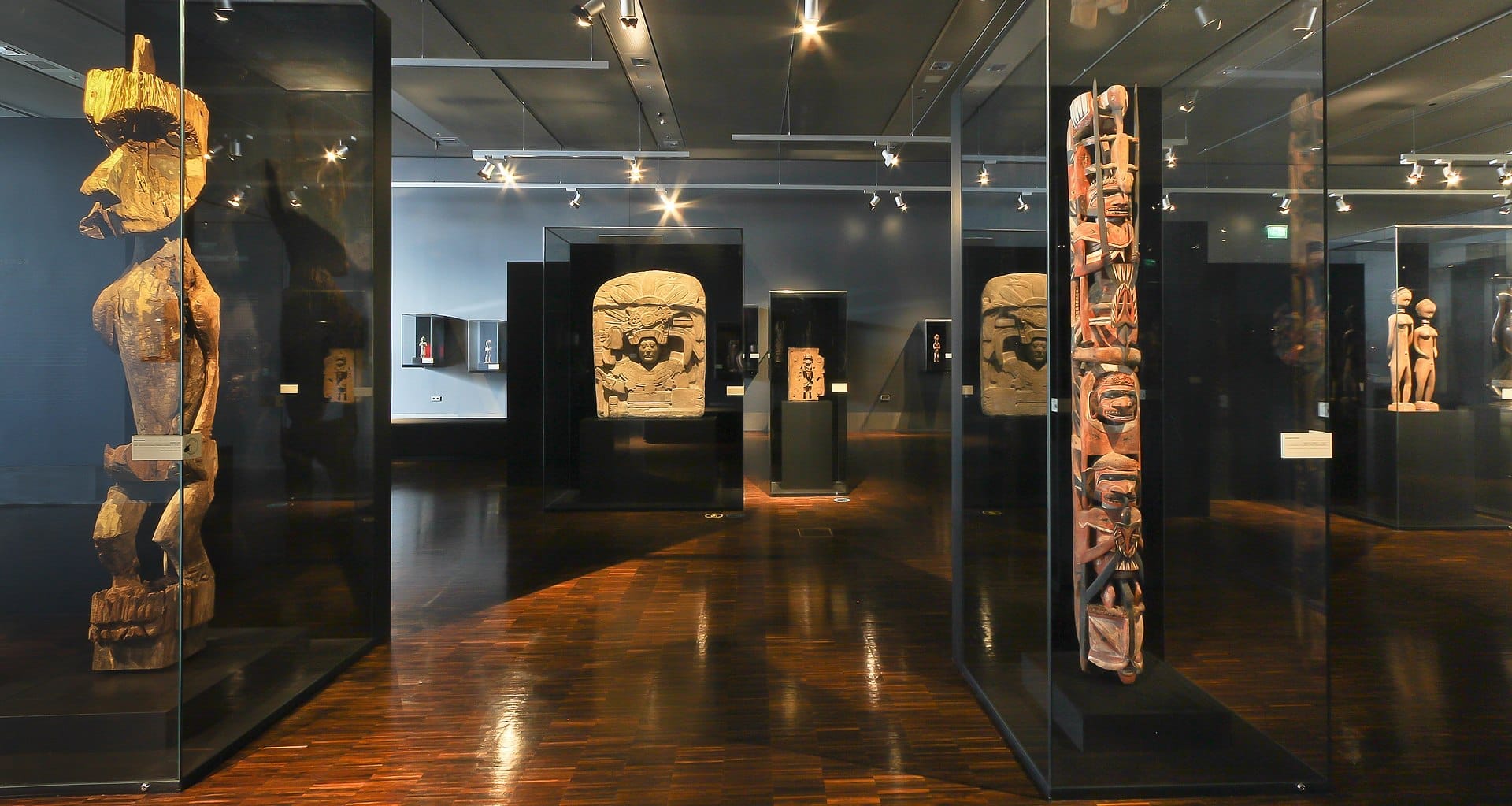
The museum's full German name tells you what it prioritizes: Kulturen der Welt, cultures of the world. That framing is intentional. The permanent exhibition is not arranged by geography or era in the conventional sense. Instead, it is structured around universal human themes: birth and death, the body, the sacred, migration, trade, and identity. Objects from a Peruvian textile workshop and a Congolese ceremonial mask can sit in dialogue with each other because the organizing logic is thematic rather than colonial-cartographic.
💡 Local tip
The combined ticket covering both the Rautenstrauch-Joest Museum and Museum Schnütgen (medieval art, right next door) costs €10 reduced to €7 and is worth considering if you have half a day. The two museums share a building complex and make for a well-rounded afternoon without extra travel.
The Permanent Exhibition: How It Actually Feels Inside
The ground floor introduces you to the museum's curatorial philosophy before any objects appear. There is a deliberate decompression zone near the entrance where context panels explain the history of ethnological collecting in Europe, including the uncomfortable parts: how objects arrived in European institutions, what was lost in translation, and how the museum is now engaging with source communities on questions of repatriation and representation. This reflexivity is not common in older ethnological institutions, and it changes the register of the visit.
Moving deeper into the exhibition, the spaces shift dramatically in feel. The section on the dead and the afterlife is dim and hushed, with objects arranged around a central mummy case and funerary vessels that draw visitors into a slow, contemplative walk. By contrast, the section exploring body adornment and identity is brighter, with hands-on elements that families tend to cluster around. Lighting is used deliberately throughout: warm amber tones in spaces dealing with ritual, cooler white light where the emphasis is comparative or analytical.
The centerpiece of the permanent collection is a full-scale reproduction of a Toraja house from Sulawesi, Indonesia, which rises through multiple floors of the museum's atrium. It is genuinely arresting on first sight. The structure is built to real dimensions and its painted geometric facade commands the space. Audio guides and labels explain not just what the house is but how it functions socially, who builds it, and what it represents in a living culture. This is the moment that tends to separate visitors who came half-expecting a storage cabinet of curiosities from those who leave convinced they underestimated the museum.
Tickets & tours
Live prices and dates from our booking partner. If you book, we may earn a commission at no extra cost to you.
Cologne haunted places and ghost stories: interactive city game
From 8 €Instant confirmationFree cancellationFood Tour Cologne Sudstadt
From 44 €Instant confirmationFree cancellationCologne brewery tour including 3 Kolsch beer
From 28 €Instant confirmation2-hour afternoon cruise in Cologne at Christmastime
From 25 €Instant confirmationFree cancellation
Opening Hours, Tickets, and Getting There
The museum is open Tuesday through Sunday, 10:00 to 18:00. On Thursdays it stays open until 20:00, and on the first Thursday of each month it extends to 22:00. It is closed on Mondays. It also closes on 24 December, 25 December, 31 December, 1 January, Carnival Thursday (Altweiber), and Carnival Monday. If you are visiting during Cologne's Karneval season, check ahead.
Admission to the permanent exhibition is €7, with a reduced rate of €4.50. A combined ticket covering both the permanent and any current special exhibition costs €9 (reduced €7). Children under six, schoolchildren, trainees, and KölnPass holders enter free. If you are traveling on a tight budget, the Cologne on a budget guide outlines which days and passes offer the best overall value across the city's museum landscape.
Getting there is straightforward. Neumarkt is one of Cologne's main public transport intersections, served by Stadtbahn lines 1, 3, 4, 9, 16, and 18, as well as bus routes 136 and 146. From Köln Hauptbahnhof, any of several tram lines will reach Neumarkt in under five minutes. From Neumarkt, the museum is about a two-minute walk along Cäcilienstraße. The street can be slightly confusing the first time because the building's entrance is set back from the road, but the signage for the Kulturquartier am Neumarkt is visible.
Best Time to Visit and Crowd Patterns
Weekday mornings between 10:00 and 12:00 are consistently the quietest period. The museum attracts school groups, particularly on Tuesday and Wednesday mornings during the school year, so if you prefer to move through the galleries without groups of ten-year-olds clustered around the interactive displays, aim for late morning on a Thursday or Friday, or any weekday afternoon after 14:00.
Thursday evenings are worth knowing about. The extended hours to 20:00 mean you can arrive after the standard tourist circuit has wound down. The museum takes on a quieter, more contemplative atmosphere after 17:00, particularly in the lower galleries. The first Thursday of the month, with opening until 22:00, draws a more local crowd and sometimes includes programming such as talks or film screenings; check the museum's own events calendar before your visit.
Weather has little bearing on the experience, since this is entirely an indoor attraction. This makes it an excellent choice on the grey, damp days that Cologne produces regularly from October through March. The building is well-heated in winter and air-conditioned in summer, so comfort is not a concern regardless of season.
ℹ️ Good to know
The museum is closed on Carnival Thursday (Altweiber) and Carnival Monday. If you are in Cologne for Karneval, plan your museum visit for a different day in the week.
The Building and Its Cultural Context
The 2010 building replaced an older facility that the collection had long outgrown. The architects designed for transparency and movement: there is significant use of glass, connecting bridges between interior levels, and an atrium that allows the Toraja house to be read from multiple angles as you ascend through the building. The exterior is restrained, clad in pale stone that fits the urban grain of central Cologne without competing with the Romanesque churches nearby.
The museum sits within a short walk of several other significant cultural institutions. Museum Schnütgen shares the same building complex and focuses on medieval Christian art. The Kolumba Art Museum is a ten-minute walk north, occupying a building by Swiss architect Peter Zumthor that incorporates the ruins of a Gothic church. Together, these three form a dense triangle of serious museum-going in the city centre.
The neighborhood itself, Altstadt-Cologne, rewards walking. The Cologne walking tour from this area connects the museum to the cathedral quarter, the Rhine riverfront, and the cluster of Romanesque churches that define the city's medieval identity. Plan an hour for the museum and another two hours for the surrounding streets if your schedule allows.
Photography, Accessibility, and Practical Details
Photography for personal, non-commercial use is generally permitted in the permanent galleries, though specific objects may be restricted under loan agreements. Flash photography is not allowed. The Toraja house atrium is the obvious focal point, and the upper walkways provide angles that most visitors on the ground floor miss, so take the stairs or lift before settling on a shot.
The building is fully accessible. Lifts connect all floors, and the entrance level is step-free from the street. The museum is part of the Museen Köln network, which maintains accessibility information on its official pages; if you have specific requirements, the museum's website carries current details. Audio guides are available in multiple languages including English.
There is a museum shop near the exit that stocks academic catalogues, children's books organized by region, and a small selection of craft objects. The quality is above average for a municipal museum shop. There is no dedicated in-museum café, so if you need a break between floors, the Neumarkt area has numerous cafés within two minutes' walk of the entrance.
Who Might Not Enjoy This Museum
Visitors expecting a classic display of exotic objects in glass cases will find the Rautenstrauch-Joest Museum more intellectually demanding than anticipated. The curatorial voice is present throughout, and it asks you to think critically about how objects ended up here and what it means to display them. If you want a passive browsing experience, this may feel like hard work.
Very young children may find the thematic organization abstract, though the interactive elements in certain galleries hold attention reasonably well. Families with younger children might get more consistent engagement at the family-friendly attractions in Cologne that are specifically designed for that age group.
The museum is also not large by the standards of major European ethnological collections. Visitors expecting the scale of the British Museum's ethnographic holdings or the Musée du quai Branly in Paris will find this more focused. That restraint is arguably a strength: the permanent exhibition feels edited rather than overwhelming, and a single visit covers it thoroughly.
Insider Tips
- The first Thursday of each month, the museum opens until 22:00. Arrive around 19:00 and the galleries are near-empty, the lighting in the ritual sections feels more atmospheric, and the Toraja house atrium has a stillness that afternoon crowds never allow.
- Buy the combined ticket for both the Rautenstrauch-Joest Museum and Museum Schnütgen at the entrance desk. At €10 it costs only €3 more than the Rautenstrauch-Joest permanent exhibition alone, and Museum Schnütgen's Romanesque and Gothic collection next door is genuinely impressive.
- The upper walkways around the Toraja house atrium are often deserted even when the ground floor is busy. Walk up to the second or third level and look down into the structure, not just up at it from below. The geometric painting on the facade reads completely differently from above.
- Audio guides in English are available at the desk and add meaningful context to the thematic sections, particularly the one covering funerary practices, where the labels alone don't fully explain the object relationships. Worth the extra cost if this is your kind of content.
- If you are visiting in summer, the Neumarkt square immediately outside has regular markets and street activity in the afternoons. Combining the museum with a slow walk through the surrounding streets and a stop at one of the square's café terraces makes for a well-paced half-day without needing to plan anything beyond the museum ticket.
Who Is Rautenstrauch-Joest Museum For?
- Travelers interested in anthropology, ethnology, or non-Western cultures who want a museum that takes its subject seriously
- Rainy-day visits: fully indoors, well-structured, and substantial enough to fill 2–3 hours without feeling rushed
- Museum-goers who want a complement to Cologne's art and architecture circuit and something that sits outside the usual cathedral-and-cathedral-treasury itinerary
- Families with children aged 10 and older who can engage with thematic and conceptual displays
- Budget-conscious visitors: at €7 for the permanent collection, it offers strong depth-per-euro compared to larger commercial attractions in the city
Nearby Attractions
Other things to see while in Altstadt (Old Town):
- 4711 House (Dufthaus 4711 / Haus Mülhens)
The 4711 House on Glockengasse is the home of the 4711 Original Eau de Cologne, the famous citrus fragrance developed by Wilhelm Mülhens from 1792 (the earlier Farina fragrance from 1709 is generally considered the original 'eau de Cologne'). Part flagship store, part fragrance museum, and part architectural curiosity, it offers a compact but interesting stop in Cologne's Altstadt-Nord for anyone curious about the city's most famous exports.
- Cologne City Museum (Kölnisches Stadtmuseum)
The Kölnisches Stadtmuseum traces Cologne's extraordinary 2,000-year arc from Roman outpost to Rhine metropolis. Reopened in a striking new home on Minoritenstraße in March 2024, it offers an affordable and intellectually rewarding afternoon in the city's Altstadt.
- Cologne Cathedral (Kölner Dom)
Cologne Cathedral, officially the Hohe Domkirche Sankt Petrus, is Germany's most visited landmark and one of the great Gothic structures on earth. This guide covers tourist ticketing, tower access, the Treasury, and how to make the most of your time there.
- Cologne City Hall (Kölner Rathaus)
The Kölner Rathaus is Germany's oldest city hall, a layered architectural landmark in Cologne's Old Town that spans Gothic, Renaissance, and modern styles.
Planning a trip? Discover personalized activities with the Nomado app.