St. Gereon's Basilica: Cologne's Ancient Decagonal Wonder
Built over a 4th-century Roman martyr's grave, St. Gereon's Basilica is one of Cologne's oldest and most architecturally singular churches. Its ten-sided nave and soaring Romanesque dome set it apart from every other medieval church in the city, and it remains largely overlooked by visitors focused on the Cathedral.
Quick Facts
- Location
- Gereonskloster 2, 50670 Köln (Altstadt-Nord, a short walk west of Cologne Cathedral)
- Getting There
- Tram/Stadtbahn lines 12 & 15 to Christophstraße/Mediapark, then ~4-minute walk
- Time Needed
- 30–60 minutes; allow longer if visiting the crypt
- Cost
- Free admission. Guided tours by arrangement with the parish.
- Best for
- Architecture enthusiasts, history travelers, anyone wanting a quiet alternative to the Cathedral
- Official website
- http://www.stgereon.de
Why St. Gereon's Basilica Deserves Your Attention
St. Gereon's Basilica (Basilika Sankt Gereon) is one of the oldest continuously used Christian sites in northern Europe. While most visitors to Cologne funnel straight toward the Gothic spires of the Cologne Cathedral, St. Gereon sits a short walk to the west, centuries older in its foundations and far quieter on any given afternoon. That relative anonymity is both its main appeal and its best practical asset.
The church's defining feature is its decagonal nave: a ten-sided central space covered by a dome that rises roughly 34 meters above the floor. There is no close equivalent to this shape in Germany’s Romanesque architecture. The geometry alone — ten equal sides converging into a ribbed vault — justifies the detour from the more heavily trafficked churches in the Altstadt.
ℹ️ Good to know
Opening hours (subject to change): Mon–Fri 10:00–18:00, Sat 10:00–17:30. The church is generally closed to visitors during Sunday services (10:00 and 11:30). The crypt has more limited access: typically Wed 15:00–17:00 and Sat 10:00–12:00. Confirm current times with the parish at stgereon.de before your visit.
A Church Built on Roman Foundations
The site's history reaches back to approximately AD 380, when an early Christian community built a small oval memorial structure over the grave of Gereon, a Roman soldier martyred for his faith during the Diocletianic Persecution of the early 4th century. That late Roman core — a roughly oval central building constructed in the second half of the 4th century — still forms the structural heart of the church you visit today. Fragments of its original masonry are visible if you know where to look.
The Romanesque rebuilding that created most of the present church took place in a long arc from around 1067 to 1227, spanning roughly 160 years of construction and modification. The decagonal nave was added in this period, expanding outward from the older Roman oval and capping it with the dome that now defines the interior. On 25 June 1920, Pope Benedict XV elevated the church to the status of minor basilica, a canonical designation that recognizes its historical and spiritual significance.
St. Gereon belongs to a group of twelve significant Romanesque churches in Cologne, most of them clustered within the old city walls. If you want to understand Cologne's medieval religious landscape as a whole, the guide to Cologne's Romanesque churches gives useful context for planning a route that takes in several of these buildings in a single day.
Tickets & tours
Live prices and dates from our booking partner. If you book, we may earn a commission at no extra cost to you.
Cologne haunted places and ghost stories: interactive city game
From 8 €Instant confirmationFree cancellationFood Tour Cologne Sudstadt
From 44 €Instant confirmationFree cancellationCologne brewery tour including 3 Kolsch beer
From 28 €Instant confirmation2-hour afternoon cruise in Cologne at Christmastime
From 25 €Instant confirmationFree cancellation
What You Actually See Inside
Entering from Gereonskloster, you pass through a vestibule that gives little away. The transition into the nave is the moment that stops most visitors: the ten-sided space opens upward into the dome, and the scale is genuinely unexpected for a church that sits on an unmarked side street. The walls between the bays are articulated with blind arcading and decorative stonework typical of mature Rhenish Romanesque style, but the geometry of the plan is what holds the eye.
Light enters through windows set high in the drum below the dome. On a clear morning, the interior fills with diffuse, even illumination that reveals the warm color of the stone. On overcast days — common in Cologne from October through March — the space feels darker and more austere, which is not necessarily a disadvantage. The medieval architects designed for candlelight and incense-thick air, and the proportions still work in low light.
The crypt preserves some of the oldest fabric of the building, including sections that date to the Roman-era construction. Access is restricted to specific hours (Wednesday afternoons and Saturday mornings, based on current reported information), so if the crypt is your primary goal, it is worth planning the visit specifically around those windows. The crypt is small and the atmosphere very different from the main church above: lower, stone-vaulted, noticeably cooler even in summer.
💡 Local tip
Photography tip: The interior dome is best photographed from the center of the nave floor, shooting straight upward. A wide-angle lens helps capture the full decagonal geometry. Avoid using flash, and note that tripods may not be permitted inside active places of worship without prior permission from the parish.
How the Experience Changes by Time of Day
Weekday mornings between 10:00 and noon are consistently the quietest time to visit. The interior is cool, the light is at its best if the sun is out, and you are likely to have the nave largely to yourself. A handful of regular churchgoers may pass through, but organized groups are rare at this hour. The smell is familiar to anyone who has spent time in old European churches: cold stone, faint traces of candle wax, and the particular dusty warmth that comes from wooden pews that have been used for decades.
Afternoons on weekdays bring slightly more foot traffic, occasionally including school groups and guided walking tours that include the church as a stop on a broader Romanesque circuit. By late afternoon, the quality of light through the dome windows shifts noticeably, and the western face of the interior becomes more brightly lit. Saturday mornings coincide with limited crypt access, making them the most complete visit in terms of what you can see, though the area outside is marginally busier with weekend pedestrians.
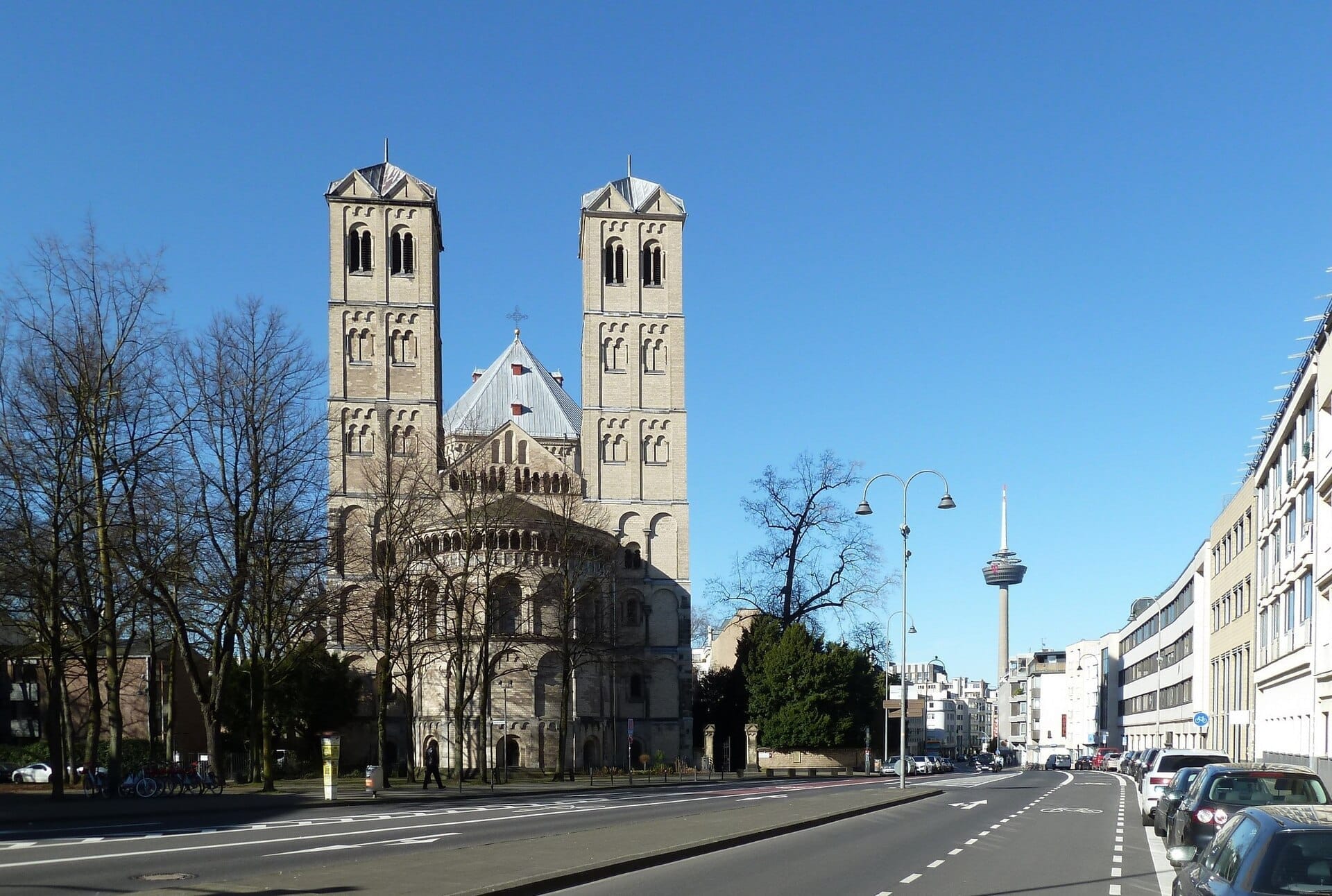
On Sundays, the church is in active liturgical use. Visiting during Mass is not appropriate for sightseeing purposes, and access to the interior for non-worshippers is generally not available during services at 10:00 and 11:30. If you happen to be in the neighborhood on a Sunday morning, the exterior is worth examining regardless: the apse, the patchwork of Roman and Romanesque masonry on the outer walls, and the proportions of the tower are all visible from the street.
Getting There and Practical Details
The basilica is located at Gereonskloster 2 in Altstadt-Nord, roughly a 10-minute walk west of Cologne Cathedral. The most straightforward public transport route uses KVB tram or Stadtbahn lines 12 or 15 to the stop Christophstraße/Mediapark, from which the church is about four minutes on foot. If you are already exploring the Altstadt, St. Gereon fits logically into a walking circuit with several other Romanesque churches.
There is no car park directly at the church. Street parking in this part of the city center is limited and regulated. Cycling is practical: Cologne has a reasonable network of dedicated lanes, and the area around Gereonskloster is flat and easy to navigate by bike.
Wheelchair access is reported as limited. The church's age and listed status mean that full accessibility retrofitting has not been possible. Visitors with mobility requirements should contact the parish directly before visiting to confirm current conditions. The vestibule area is more accessible than the main nave in most configurations, but specific details should be verified with the parish.
⚠️ What to skip
This is an active place of worship, not a museum. Dress modestly and keep voices low inside. If a service is in progress when you arrive, wait or return later rather than entering during liturgy.
Is It Worth the Detour?
St. Gereon's Basilica is not a universally compelling attraction. Visitors who find old churches interchangeable, or who have already seen the interior of Great St. Martin Church and St. Aposteln and are experiencing Romanesque fatigue, may find the detour unnecessary. The exterior is not as visually arresting from the street as some of its counterparts, and the surroundings are unremarkable.
For architecture enthusiasts, historians, or anyone interested in the transition from late Roman to early medieval Christian building, St. Gereon's is a genuinely rare site. The combination of a verifiably Roman-era foundation, a Romanesque decagonal nave with no close parallel in Germany, and free access in a city where most significant attractions charge admission makes it stand out on purely practical grounds.
If you are working through Cologne's major sights on a two-day visit, check the two days in Cologne itinerary for help prioritizing. St. Gereon makes a sensible addition to the second day, especially if paired with other Altstadt churches on a walking route.
Visiting in Context: The Surrounding Area
The streets immediately around the basilica are quiet by Cologne standards. Gereonskloster and the neighboring lanes have a residential and small-business character rather than the tourist-facing density of the riverfront Altstadt. There are a few cafes within a short walk, but no significant concentration of restaurants or shops directly adjacent to the church.
The Mediapark complex, a commercial and media district, sits just to the northwest and provides some orientation: if you can see the cylindrical Colonius television tower in that direction, you are roughly in the right area. For broader context on what else is within walking distance in the old city, the Cologne walking tour guide covers a route that connects several of the major Romanesque churches with the Cathedral and the Rhine waterfront.
Insider Tips
- The crypt has very restricted visiting hours (reportedly Wednesday 15:00–17:00 and Saturday 10:00–12:00). If seeing the oldest Roman-era fabric of the building matters to you, structure your visit specifically around Saturday morning rather than treating the crypt as a bonus.
- The exterior of the apse on the east side of the building is worth examining closely before you enter. The layering of Roman brickwork, early medieval stonework, and later Romanesque additions is visible in the masonry, and it tells the structural history of the building more legibly than most interior signs do.
- Guided tours of St. Gereon require advance arrangement with the parish. For groups or for a more detailed architectural walkthrough, contacting the parish at stgereon.de well before your visit is essential — walk-in guided tours are not available.
- If you visit on a clear winter morning, the low sun angle sends directional light through the high drum windows in a way that is rarely photographed. Summer light at the same hours is flatter and less dramatic for the dome interior.
- The church sits on a slight rise. Standing at the corner of Gereonskloster and Gereonshof and looking back at the tower after exiting gives a clean view of the building's massing that is impossible to get head-on from the entrance side.
Who Is St. Gereon's Basilica For?
- Architecture enthusiasts who want to see a structurally unique Romanesque dome with no equivalent in Germany
- History travelers interested in late Roman Christian building and the physical evidence of Cologne's Roman past
- Visitors doing a full circuit of Cologne's twelve Romanesque churches
- Travelers looking for significant cultural sites that are free to enter and uncrowded
- Photographers seeking interior ecclesiastical architecture without the tour groups that crowd more famous sites
Nearby Attractions
Other things to see while in Altstadt (Old Town):
- 4711 House (Dufthaus 4711 / Haus Mülhens)
The 4711 House on Glockengasse is the home of the 4711 Original Eau de Cologne, the famous citrus fragrance developed by Wilhelm Mülhens from 1792 (the earlier Farina fragrance from 1709 is generally considered the original 'eau de Cologne'). Part flagship store, part fragrance museum, and part architectural curiosity, it offers a compact but interesting stop in Cologne's Altstadt-Nord for anyone curious about the city's most famous exports.
- Cologne City Museum (Kölnisches Stadtmuseum)
The Kölnisches Stadtmuseum traces Cologne's extraordinary 2,000-year arc from Roman outpost to Rhine metropolis. Reopened in a striking new home on Minoritenstraße in March 2024, it offers an affordable and intellectually rewarding afternoon in the city's Altstadt.
- Cologne Cathedral (Kölner Dom)
Cologne Cathedral, officially the Hohe Domkirche Sankt Petrus, is Germany's most visited landmark and one of the great Gothic structures on earth. This guide covers tourist ticketing, tower access, the Treasury, and how to make the most of your time there.
- Cologne City Hall (Kölner Rathaus)
The Kölner Rathaus is Germany's oldest city hall, a layered architectural landmark in Cologne's Old Town that spans Gothic, Renaissance, and modern styles.
Planning a trip? Discover personalized activities with the Nomado app.