St. Aposteln: Cologne's Romanesque Church at the Heart of Neumarkt
Standing at the edge of Neumarkt square since the 11th century, St. Aposteln is one of Cologne's twelve Romanesque churches and among the most rewarding to visit. Entry is free, the architecture is exceptional, and the church doubles as a leading venue for sacred music.
Quick Facts
- Location
- Neumarkt 30, 50667 Köln (central Neumarkt square)
- Getting There
- Neumarkt stop — trams 1, 3, 4, 7, 9, 16, 18 and buses 136, 146
- Time Needed
- 30–60 minutes
- Cost
- Free admission
- Best for
- Architecture lovers, church music fans, quiet city-centre escapes
- Official website
- http://www.st-aposteln.de
What Is St. Aposteln?
The Basilica of the Holy Apostles, known locally as St. Aposteln, is a Romanesque parish church at Neumarkt 30 in central Cologne. It is one of the city's celebrated twelve Romanesque churches, a group of medieval foundations that survived World War II in varying states of damage and were subsequently reconstructed with extraordinary care. St. Aposteln's origins stretch back to at least 1021, when construction is documented to have begun, making it roughly a thousand years old. Its 67-metre west tower is a reliable landmark visible from the Neumarkt square and from several streets in the surrounding area.
Cologne takes its Romanesque heritage seriously. If you want context for St. Aposteln within the wider group of medieval churches, the guide to Cologne's Romanesque churches gives a useful overview of which ones to prioritise and how to plan a route between them.
ℹ️ Good to know
Opening hours: Monday to Saturday, 10:00–19:00; Sunday, 09:00–17:00. Hours are subject to change, especially around religious services and events — check the official website at st-aposteln.de before visiting.
The Architecture: What Makes This Church Different
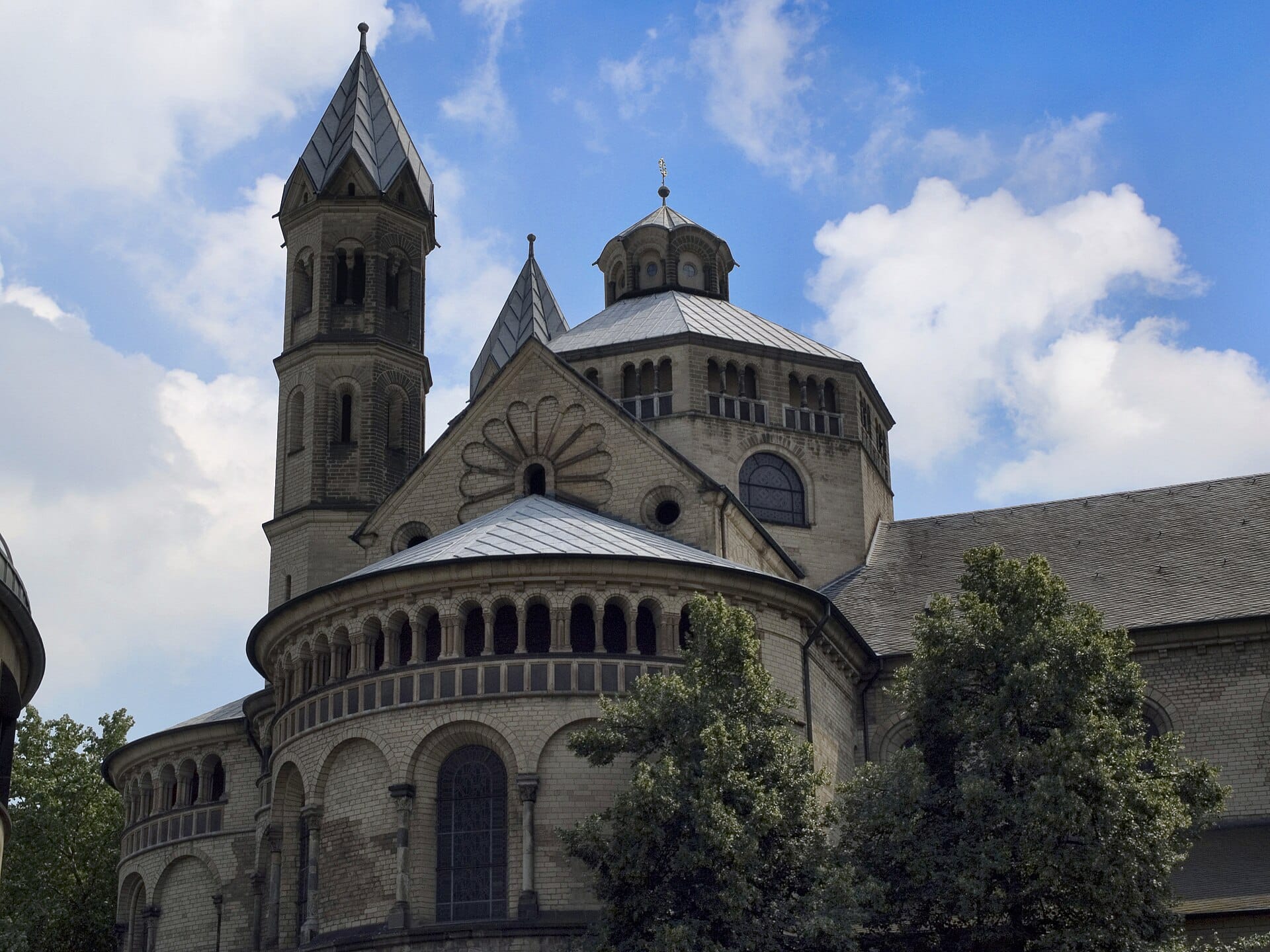
From across Neumarkt square, St. Aposteln presents a silhouette that rewards a long look. The west tower anchors the view, rising in clean Romanesque tiers with round-arched windows and restrained stone detailing. The church follows a trefoil plan, a characteristic form of Cologne Romanesque in which three apses — one at the east end and one on each transept arm — cluster together to create a distinctive massing at the building's rear. Walking around to the east side reveals this arrangement clearly, and it is worth doing before you go inside.
Inside, the nave is calm and relatively spare by the standards of later Gothic or Baroque interiors. The stonework is the main event: thick piers, semicircular arches, and a sense of weight and permanence that no amount of restoration can manufacture. Light enters through relatively narrow windows, so the interior stays dim even on bright days. That quality of light, filtering softly through the upper openings, gives the space an atmosphere quite unlike the soaring brightness of Cologne Cathedral a ten-minute walk away.
For comparison, the Cologne Cathedral is the obvious counterpoint: Gothic, enormous, and perpetually crowded. St. Aposteln offers the opposite experience — a church of similar historical depth but encountered in near-solitude on most mornings.
Tickets & tours
Live prices and dates from our booking partner. If you book, we may earn a commission at no extra cost to you.
Cologne haunted places and ghost stories: interactive city game
From 8 €Instant confirmationFree cancellationFood Tour Cologne Sudstadt
From 44 €Instant confirmationFree cancellationCologne brewery tour including 3 Kolsch beer
From 28 €Instant confirmation2-hour afternoon cruise in Cologne at Christmastime
From 25 €Instant confirmationFree cancellation
How the Visit Feels at Different Times of Day
Morning visits, particularly on weekdays, are consistently the quietest. On most days the church opens at 10:00, and for the first hour it is not unusual to have the nave entirely to yourself or nearly so. The Neumarkt square outside is already busy with trams and shoppers by that point, but the thick walls absorb almost all of that noise. Stepping inside is a genuine shift in register.
Plan for at least 30 minutes inside to do the church any justice. Arriving around 10:15 gives the best combination of quiet, good interior light, and enough time to explore before midday.
Afternoon visits from 15:00 onward bring slightly more visitors, particularly on weekends, as people combine the church with shopping on the Neumarkt and Schildergasse nearby. The light inside changes character in the late afternoon, with a warmer quality that suits photography, especially before the evening closing time.
💡 Local tip
If you are visiting in winter, afternoon light fades quickly after 16:00. Aim for a morning visit between October and February to avoid finishing in near-darkness inside.
Sacred Music: The Church's Living Identity
St. Aposteln has a well-established reputation in Cologne as a church music venue. It hosts regular organ recitals, choir performances, and sacred concerts throughout the year. This is not incidental — the acoustic properties of the Romanesque interior, with its stone vaulting and relatively contained volume, suit choral and organ music particularly well. If you happen to visit on a day when rehearsals are underway, you may hear singers or the organ from the street before you even enter.
Cologne Tourism specifically identifies St. Aposteln as 'the music church' among the Romanesque group. Checking the church's official calendar at st-aposteln.de before your visit is worthwhile if sacred music is an interest. Some concerts are free; others require tickets. Attending a performance here is a qualitatively different experience from a daytime sightseeing visit and genuinely worth arranging if the schedule allows.
For broader classical music options in Cologne, the Cologne Philharmonie is the city's main concert hall and schedules performances across genres throughout the year.
Location and Getting There
Neumarkt is one of the central transport hubs in Cologne's tram network, making St. Aposteln among the most accessible of the twelve Romanesque churches. Tram lines 1, 3, 4, 7, 9, 16, and 18 all stop at Neumarkt, as do bus lines 136 and 146. From Cologne Hauptbahnhof, the tram journey takes roughly five minutes. The church is immediately visible from the square's western edge.
The address places St. Aposteln at the boundary between the city centre and the Belgian Quarter, Cologne's most design-conscious neighbourhood. Combining a visit to the church with a walk through the Belgian Quarter makes for a well-rounded half-day: Romanesque architecture in the morning, independent cafes and boutiques in the afternoon.
Cycling is a practical option. Cologne has a reasonable network of bike lanes, and the Neumarkt area has bicycle parking on multiple sides. If you are walking from the Altstadt or the Rhine waterfront, the route via Schildergasse takes about 10 minutes on foot from the cathedral area.
⚠️ What to skip
Neumarkt square is a major tram interchange. The stop can be confusing if you are unfamiliar with the network layout. Check the direction on the tram platform before boarding — multiple lines depart from the same platform in different directions.
Photography and Practical Notes
The exterior of St. Aposteln photographs best from the northwest corner of Neumarkt square, where the full west tower is visible without obstruction. Early morning is best for exterior shots as the square fills with market activity and trams throughout the day, making a clean foreground difficult. The trefoil east end, viewable from the surrounding streets, is architecturally the most complex and distinctive part of the building and is frequently overlooked by visitors who only photograph the facade.
Interior photography is generally permitted for personal use, but tripods and flash are best avoided out of respect for the active parish. The dim interior requires either a camera capable of high-ISO performance or acceptance that phone photos will need adjustment. The crossing beneath the tower, where the nave meets the transepts, is the most photographically interesting point inside.
Wheelchair access to the church is not clearly documented in available official sources. The Neumarkt area itself is largely flat and tram-accessible, but the interior accessibility of the building should be confirmed directly with the church before planning a visit.
Who Will Not Enjoy This Visit
Travellers looking for an ornate interior filled with gilded altarpieces, dramatic frescoes, or Baroque decoration will find St. Aposteln somewhat austere. The Romanesque aesthetic is deliberately restrained: stone, proportion, and structure carry the weight rather than surface ornament. If that kind of interior does not engage you, the 30-minute visit may feel longer than it should.
Families with very young children will find the church quiet to the point of requiring hush, which can make visits tense. The church is an active parish, not a heritage museum, and the atmosphere reflects that. Visitors hoping to linger, photograph freely, or talk at normal volume will need to calibrate accordingly.
For family-friendly activities in Cologne that work better with children in tow, the Cologne with kids guide covers the most practical options across the city.
Insider Tips
- Walk around to the east side of the church before entering. The trefoil apse arrangement — three curved apses clustering together — is the architectural signature of Cologne Romanesque and St. Aposteln has one of the best examples. Most visitors miss it entirely.
- If your morning runs late, consider visiting in the afternoon rather than rushing a partial visit — the church generally remains open throughout the day.
- Check the concert calendar at st-aposteln.de before your trip. Attending a choir or organ performance here is a fundamentally different experience from a daytime visit and costs little or nothing for many events.
- The Belgian Quarter begins essentially across the street. After visiting, walk west into the neighbourhood for independent coffee shops that are notably less crowded than those immediately around Neumarkt.
- If you are visiting multiple Romanesque churches in one day, St. Aposteln pairs particularly well with a visit to nearby Great St. Martin — the two represent quite different expressions of the same broad architectural tradition and the contrast is instructive.
Who Is Church of the Apostles (St. Aposteln) For?
- Architecture enthusiasts interested in Romanesque design and medieval church-building
- Travellers completing a tour of Cologne's twelve Romanesque churches
- Sacred music and organ recital audiences
- Visitors wanting a quiet counterpoint to the crowds at Cologne Cathedral
- Anyone combining a city-centre morning with an afternoon in the Belgian Quarter
Nearby Attractions
Other things to see while in Belgian Quarter (Belgisches Viertel):
- Stadtgarten
Stadtgarten is Cologne's oldest preserved park, laid out in 1827 at the northwestern edge of what is now the Belgian Quarter. Free to enter, it draws families, office workers, and jazz fans in equal measure, anchored by a respected concert hall and a lakeside restaurant that hums well into the evening.
Planning a trip? Discover personalized activities with the Nomado app.