Montée des Marches: Everything You Need to Know About Cannes' Red Carpet Steps
The Montée des Marches is the most recognisable staircase in world cinema: 24 steps, 60 metres of red carpet, and the front facade of the Palais des Festivals. Free to visit most of the year, these steps are a genuine piece of film history, though access can be restricted during certain events and the Cannes Film Festival.
Quick Facts
- Location
- Front of the Palais des Festivals et des Congrès, La Croisette, Cannes
- Getting There
- Cannes train station (Gare de Cannes) is a roughly 5-minute walk north; Palmbus routes serve La Croisette
- Time Needed
- 15–30 minutes to walk, photograph, and take in the surroundings
- Cost
- Free — no ticket required
- Best for
- Film enthusiasts, first-time visitors to Cannes, photography
What You Are Actually Looking At
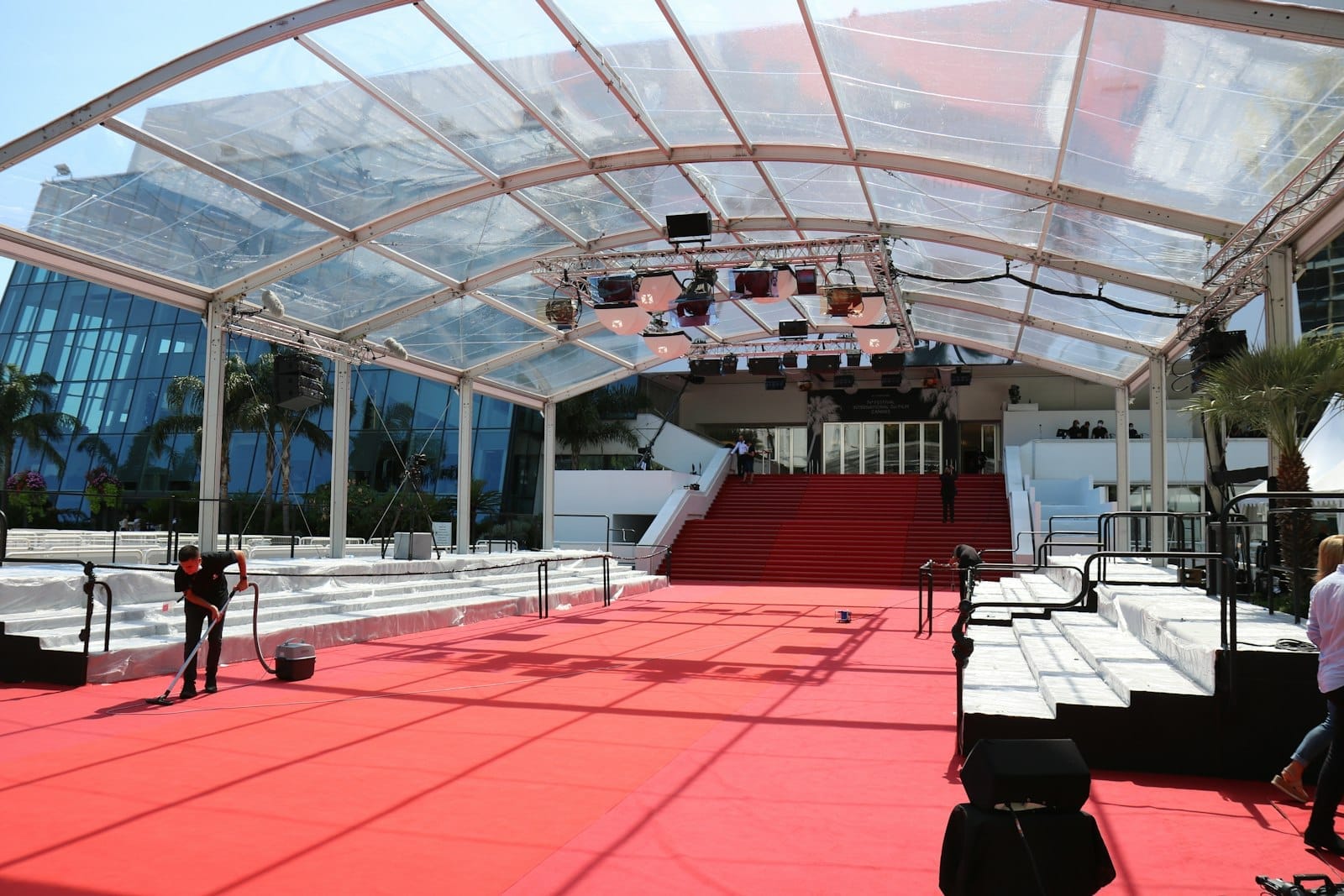
The Montée des Marches, literally 'the climb of the steps', is the ceremonial staircase at the entrance of the Palais des Festivals et des Congrès on La Croisette. Twenty-four steps rise from street level to the main entrance of the building, and during the Cannes Film Festival each May, those steps are covered in 60 metres of deep-crimson carpet that has become one of the most reproduced images in global popular culture. The steps became a formalised component of the Festival's ceremony in 1984, and the carpet tradition has been refined ever since: until 2021 it was replaced three times daily, but now it is refreshed once per day for environmental reasons.
Outside of festival season, the carpet is often removed. What remains is a broad, pale concrete staircase framed by the imposing horizontal bulk of the Palais, which was inaugurated in 1983 and is not, by any objective architectural measure, a beautiful building. That honesty matters here: if you are picturing a classical European palace, reset your expectations. The Palais is a large, functional congress centre. But the steps in front of it carry the weight of decades of ceremony, and standing on them, you feel that history even on a quiet Tuesday in October.
ℹ️ Good to know
During the Cannes Film Festival (typically held over 12 days in May), the steps are in full red-carpet mode but public access to climb them is generally prohibited. You can view and photograph the carpet from the surrounding area, but you cannot walk up it unless you are part of an authorised or accredited event.
The Experience at Different Times of Day
Early morning, before 8 a.m., is when the steps are most usefully quiet. The light from the east catches the pale stone facade and the sea glints in the background if you position yourself correctly. There are almost no other visitors at this hour, which makes it the best window for clean photographs without strangers in the frame. The cleaning crews have usually finished, so the surrounding pavement is fresh.
By mid-morning, tour groups and cruise-ship passengers begin arriving. The steps become a rotating photo stage: couples posing with arms outstretched, groups recreating imaginary red-carpet walks, children running up and down. The atmosphere is cheerful and relaxed rather than solemn. There is often a faint smell of sunscreen and coffee drifting from the café terraces on the nearby boulevard.
At midday in summer, the stone heats up noticeably underfoot and the sun hits the facade directly, washing out the contrast in photographs. The crowd thins slightly as visitors retreat to lunch. This is the least photogenic window of the day. Late afternoon, from around 4 p.m. onward, brings warmer, lower-angle light and a second surge of visitors as the promenade comes to life. In the golden hour before sunset, the steps photograph well and the energy around the Palais is at its most cinematic.
Tickets & tours
Hand-picked options from our booking partner. Prices are indicative; availability and final rates are confirmed when you complete your booking.
Cannes, Antibes and Saint Paul de Vence shared tour from Nice
From 65 €Instant confirmationFree cancellationCannes, Antibes and St Paul de Vence half-day private tour
From 60 €Instant confirmationFree cancellationBoat & snorkeling trip to the Esterel Calanques from Cannes
From 75 €Instant confirmationFree cancellationCannes food tour with full meal
From 105 €Instant confirmationFree cancellation
History and Cultural Weight
The Cannes Film Festival was founded in 1946, though earlier plans were disrupted by the Second World War and the first edition was eventually held in September 1946. For its first decades, the ceremony evolved without a fixed, formalised red-carpet ascent. It was in 1984, when the current Palais des Festivals was already two years old, that the Montée des Marches was formalised as a ceremonial element of the Festival. Since then, every major film premiere at Cannes has sent its cast and crew up those 24 steps in front of photographers and crowds gathered on either side.
The steps sit at the western end of Boulevard de la Croisette, which places them in the symbolic heart of the city's identity as a global film capital. The Palais itself hosts not only the Festival but year-round congresses, trade fairs, and events, which means the steps are in near-constant use as a backdrop, an entrance, and a landmark.
The red carpet used during the Festival is a logistical operation in its own right. Each roll weighs hundreds of kilograms and the daily replacement (now once per day rather than three times) reflects a genuine operational commitment to maintaining the carpet's immaculate appearance for evening ceremonies. The specific shade of red is controlled: it is not a generic crimson but a consistent, deep tone that has been photographed millions of times and is immediately recognisable worldwide.
Practical Walkthrough: How a Visit Actually Goes
You approach the Palais from La Croisette, walking along the seafront boulevard. The building announces itself bluntly: a wide, low structure with a tower section at the western end. The steps face directly onto the esplanade in front, with barriers and signage around them depending on what events are running inside. On a normal day, the steps are open and unguarded. You walk up freely, turn around at the top, and look out over the esplanade toward the sea. The view is pleasant rather than spectacular, but the orientation gives you a clear sense of the Festival geography.
The Palais des Festivals itself offers guided tours on certain dates, which take visitors inside the main auditorium and backstage areas. These tours are time-sensitive and ticketed separately; check the official Palais des Festivals website for current availability before planning around them.
Accessibility is confirmed: the Palais des Festivals is accessible to disabled visitors, and the surrounding esplanade is flat and smooth. The steps themselves are, by definition, a staircase, so visitors with mobility limitations may prefer to photograph from the base or the esplanade level rather than climbing.
💡 Local tip
For the best photograph of yourself on the steps, visit before 8 a.m. or after 6 p.m. in summer. Ask a companion to shoot from the esplanade level looking up, not from the top looking down, as the upward angle captures both you and the Palais facade together.
During the Cannes Film Festival
If you are visiting Cannes specifically for the Film Festival, the Montée des Marches takes on a completely different character. The steps are lined with press photographers and television cameras. Crowds gather behind barriers on both sides of the carpet. For a deeper understanding of what to expect during that period, the Cannes Film Festival guide covers access, accreditation, and how to watch the arrivals as a member of the public.
Even without a festival pass, you can position yourself on the esplanade side and watch the arrivals from a distance. The experience is loud, compressed, and genuinely electric if cinema matters to you. The security perimeter means you will be at least 20 to 30 metres from the carpet itself, but the scale of the ceremony is visible and the atmosphere is unlike anything else in Cannes during the rest of the year.
One practical note for Festival period visits: the surrounding streets, particularly the western end of La Croisette and the roads near the Palais, are subject to road closures and access restrictions in the hours before and during evening screenings. Arriving on foot from the east along the seafront is the most reliable approach.
What the Steps Cannot Deliver
This is a staircase and a facade. Outside of festival season, there is no interior access through the main ceremonial entrance, no exhibition about the history of the carpet, and no dedicated visitor centre attached to the steps themselves. Visitors who arrive expecting an immersive film-history museum will be disappointed. The experience is symbolic: it works if you bring context and imagination, and it falls flat if you do not.
Visitors looking for more substantial cultural depth while in the area should consider Musée des Explorations du Monde inside the Palais, or walk ten minutes north to explore Le Suquet, the old town with genuine medieval character and panoramic views over the bay.
The immediate surroundings of the Palais are also worth noting honestly: the esplanade area can feel slightly corporate outside of events, with parked security vehicles, temporary barriers, and little greenery. It is a civic plaza designed for function, not for lingering. Most visitors spend around 15 to 30 minutes, take their photographs, and move on. That is a completely reasonable approach.
Getting There and Getting Around
Gare de Cannes, the main railway station, is roughly a 10-minute walk from the Palais des Festivals. From Nice, TER regional trains cover the route in approximately 30 to 40 minutes. From Nice Côte d'Azur Airport, regional bus line 81 (Lignes d’Azur/ZOU!) connects the airport area to Cannes in around 45 to 60 minutes. Palmbus city routes serve La Croisette and the central area.
The Montée des Marches is a natural starting point for a walk along La Croisette. From the steps, you can walk east along the seafront boulevard past the grand hotels, beach entrances, and boutiques for as far as your legs allow. The Cannes walking tour uses the Palais steps as its logical anchor point before heading into the rest of the city.
Insider Tips
- The handprints and signatures of past Cannes jury presidents and Palme d'Or winners are set into the esplanade pavement on the Allée des Étoiles du Cinéma around the Palais. Most visitors walk past them without looking down. Take a few minutes to find them before or after photographing the steps.
- If you want to watch a red-carpet arrival during the Film Festival without accreditation, position yourself on the north side of the esplanade by 6 p.m. for evening screenings. Crowds build quickly after that, and latecomers end up with restricted sightlines.
- The steps look most dramatic photographed from directly in front at low angle, not from the sides. The symmetry of the facade frames the staircase well. A wide-angle lens or a phone in portrait mode both work; you do not need specialist equipment.
- Mornings in October and November offer the quietest and most atmospheric visits. The Mediterranean light is still warm, the tourist volume is low, and the surrounding esplanade is used mainly by local joggers and dog walkers.
- The Palais des Festivals offers guided tours on select dates that take you inside the main Louis Lumière Auditorium. These sell out. Check the official Palais des Festivals website well in advance if this is a priority.
Who Is Red Carpet Steps (Montée des Marches) For?
- Film fans wanting a direct, physical connection to the history of the Cannes Film Festival
- First-time visitors to Cannes who want to orient themselves around the city's most iconic landmark
- Photographers looking for a reliable, no-cost, visually strong location along La Croisette
- Travellers combining a short Cannes stop with a broader Côte d'Azur itinerary who want the key image in 20 minutes
- Festival-period visitors who want to understand the geography of the ceremony even without accreditation
Nearby Attractions
Other things to see while in La Croisette:
- Boulevard de la Croisette
Boulevard de la Croisette is Cannes' defining address: a roughly 3-kilometre sweep of palm-shaded walkway running along the Baie de Cannes from the Vieux Port to Port Canto. Free to walk at any hour, it anchors the city's luxury hotels, private beach clubs, and the Palais des Festivals — and looks completely different depending on when you show up.
- Carré d'Or (Golden Square)
The Carré d'Or, or Golden Square, is Cannes' compact luxury district wedged between Rue d'Antibes and La Croisette. Four streets pack in high-end boutiques, aperitivo bars, fine dining, and some of the city's most sought-after nightlife, all within easy walking distance of the Palais des Festivals.
- Centre d'Art La Malmaison
Reopened in January 2025 after a major renovation, Centre d'Art La Malmaison brings contemporary art into one of the most historically layered buildings on Boulevard de la Croisette. With 600 m² of exhibition space, free rooftop terrace access during opening hours, and admission from €6.50 (€3.50 reduced), it offers real cultural depth just steps from the sea.
- Carlton Cannes, a Regent Hotel
Standing at 58 Boulevard de la Croisette since 1911, the Carlton Cannes is the most recognisable building on the French Riviera's most famous seafront boulevard. With its twin Belle Époque domes, a private beach, and a history entwined with the Cannes Film Festival, it draws visitors whether they're booked into a suite or simply curious enough to step inside the lobby.