Boulevard de la Croisette: Cannes' Grand Seafront Promenade
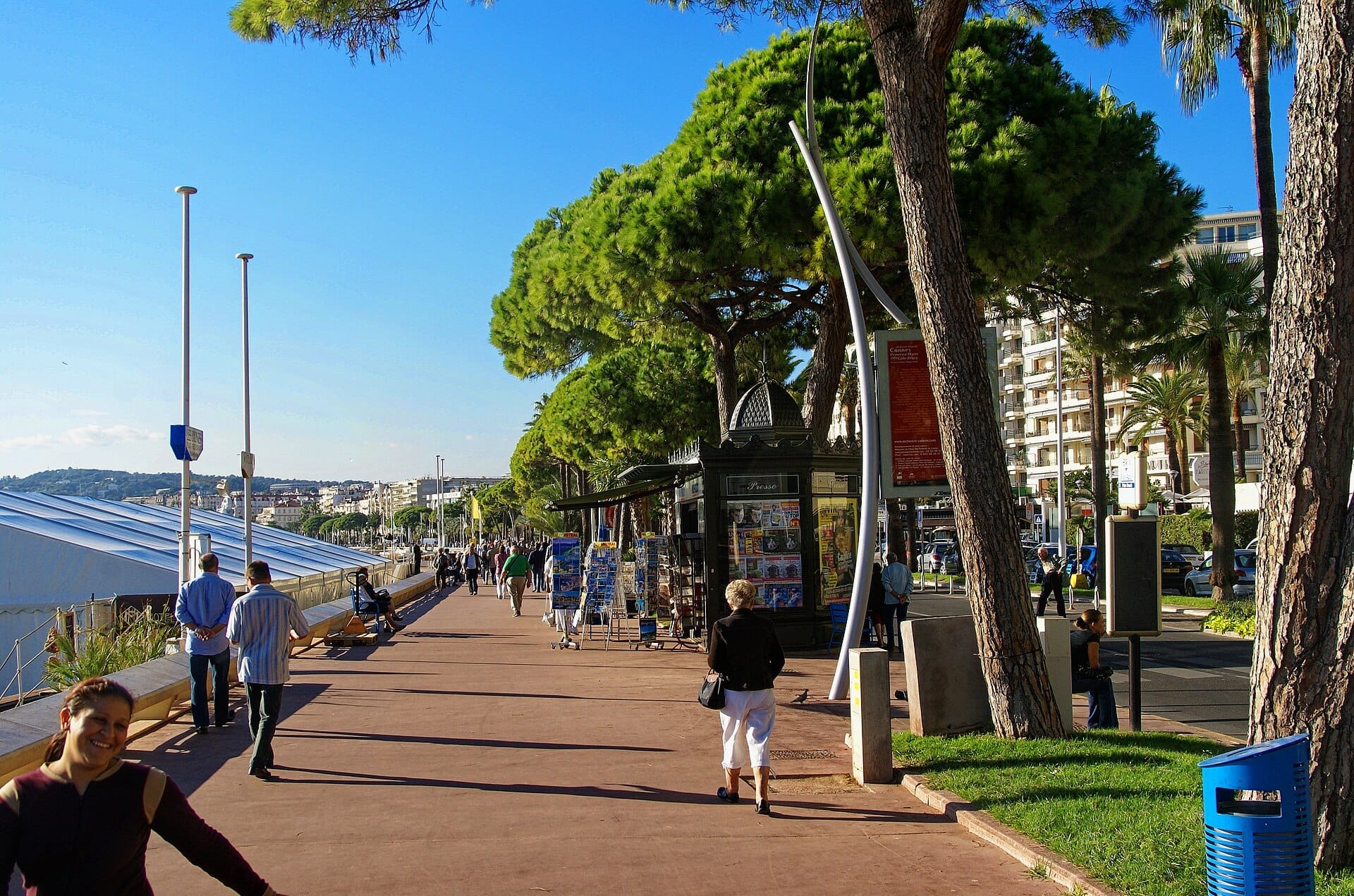
Boulevard de la Croisette is Cannes' defining address: a roughly 3-kilometre sweep of palm-shaded walkway running along the Baie de Cannes from the Vieux Port to Port Canto. Free to walk at any hour, it anchors the city's luxury hotels, private beach clubs, and the Palais des Festivals — and looks completely different depending on when you show up.
Quick Facts
- Location
- Boulevard de la Croisette, 06400 Cannes, France — runs from Vieux Port (west) to Port Canto (east)
- Getting There
- 10-15 min walk south from Gare de Cannes (TER regional trains from Nice in around 25–35 min, depending on service). Bus Palmbus lines stop on or near La Croisette.
- Time Needed
- 45 min to walk end-to-end; 2-3 hours if you stop for coffee, the beach, or the Palais des Festivals
- Cost
- Free to walk. Private beach clubs charge their own fees. Cafés and restaurants range from moderate to expensive.
- Best for
- Evening strolls, architecture, people-watching, photography at golden hour, and orienting yourself in Cannes
- Official website
- en.cannes-france.com/discover-visit/districts/the-croisette/
What Is Boulevard de la Croisette?
Boulevard de la Croisette is Cannes' main seafront boulevard, stretching roughly 2.7 kilometres along the northern shore of the Baie de Cannes. One side faces the sea, lined with a broad pedestrian promenade, public and private sandy beaches, and clear views toward the Îles de Lérins on clear days. The other side is defined by some of Europe's most recognisable luxury hotel façades, designer boutiques, and the concrete bulk of the Palais des Festivals et des Congrès.
It is, in a single sentence, the visual and social spine of Cannes. Every major landmark — the Palais des Festivals, the Carlton, the Majestic, the Martinez — either sits on the Croisette or opens directly onto it. Understanding the boulevard means understanding how Cannes works as a city.
💡 Local tip
The pedestrian walkway runs along the sea side of the road and is separated from vehicle traffic by the carriageway and kerb, with pedestrians and cars using distinct spaces. It is largely flat, well-maintained, and accessible to visitors with limited mobility. Wheelchairs and pushchairs move easily along the main promenade.
A Brief History: From Pilgrims' Path to Promenade
The name Croisette comes from the Provençal word 'crouseto,' meaning 'small cross.' For centuries, a wooden or stone cross stood at this point on the coastal path, marking the route that pilgrims followed to reach the Cistercian abbey on Île Saint-Honorat. A steel cross now commemorates that original marker. This is not just a design flourish: it connects the modern boulevard, with all its wealth and glamour, directly to a medieval religious landscape.
In 1853, local residents petitioned for a proper coastal promenade and collectively funded the construction of a coastal road. By 1863, the boulevard had taken recognisable form. It was extended and reworked significantly in the 1960s, when artificial beaches were created by depositing sand along what had previously been rocky shore, and the pedestrian walkway was widened to its current generous width. The result is a designed landscape that still functions well over sixty years later. For deeper context on how Cannes grew around this axis, the Cannes walking tour guide traces the city's development from Le Suquet to the eastern end of the Croisette.
Tickets & tours
Hand-picked options from our booking partner. Prices are indicative; availability and final rates are confirmed when you complete your booking.
Cannes, Antibes and St Paul de Vence half-day private tour
From 60 €Instant confirmationFree cancellationBoat & snorkeling trip to the Esterel Calanques from Cannes
From 75 €Instant confirmationFree cancellationCannes, Antibes and Saint Paul de Vence shared tour from Nice
From 65 €Instant confirmationFree cancellationCannes food tour with full meal
From 105 €Instant confirmationFree cancellation
What You Actually See Walking the Boulevard
Starting from the western end near the Vieux Port, the first landmark you encounter is the Palais des Festivals, identifiable by its broad concrete façade and the famous red-carpeted steps out front. During the Cannes Film Festival, held each May, this immediate area sees heavy security and restricted access, with certain zones only reachable with accreditation. Outside festival season, the steps are open and visitors queue here for photographs. The surrounding area has handprints of film directors and actors set into paving slabs, the Cannes equivalent of Hollywood's Walk of Fame.
Moving east, the boulevard widens and the hotel facades become increasingly grand. The InterContinental Carlton, opened in 1913, is the architectural showpiece: its two grey domes were supposedly modelled on the breasts of the courtesan Caroline Otéro (La Belle Otero), a story the hotel does not discourage. Whether true or not, the building's Belle Époque proportions are genuinely striking, particularly from the beach side. The Carlton Hotel remains the landmark against which every Croisette photograph is measured.
Continuing east, the boulevard passes a succession of private beach concessions, each with its own colour scheme, branded sunbeds, and restaurant attached. Between these, narrower public access points lead down to free stretches of sand. The quality of the sand is reasonable rather than exceptional: fine, pale, and kept clean, but not the dramatic natural beach you would find further along the Côte d'Azur. The sea is calm in the bay and swims smoothly in summer, with water temperatures typically around 23-26°C in July and August.
The eastern end terminates near Port Canto, a large yacht marina with significantly less foot traffic than the western half of the boulevard. This section feels more residential and considerably quieter, with apartment blocks replacing hotels and a marina backdrop replacing open sea.
How It Changes by Time of Day
Early morning, from around 7am, is the most underrated time on the Croisette. The light over the bay comes in low and golden, the sea is often glassy, and the only people present are joggers, dog walkers, and hotel staff arranging terrace furniture. The smell at this hour is salt air and, from the bakeries a few streets back, bread. The boulevard feels genuinely spacious.
By mid-morning the beach clubs begin setting up and the first guests arrive. From about 11am through to mid-afternoon, the promenade fills steadily. In July and August this becomes dense: slow-moving crowds, ice cream vendors, and a constant background noise of different languages. Temperatures on the promenade in peak summer can be uncomfortably hot because the paving reflects heat and the sea breeze is intermittent. Sun protection is non-negotiable.
The late afternoon and evening transformation is where the Croisette earns its reputation. From about 5pm, the light softens, the heat drops, and a different crowd appears: well-dressed couples, families on evening walks, and the hotel terraces filling with aperitif drinkers. The Carlton and Majestic façades catch the warm light directly. This is the best window for photography and for understanding why this boulevard became so associated with a particular idea of French Riviera leisure.
ℹ️ Good to know
During the Cannes Film Festival (typically held in May), large sections of the boulevard near the Palais des Festivals are restricted to accredited attendees. If your visit coincides with the festival, expect significant crowd pressure and some access limitations. Plan ahead using the official festival calendar.
The Beaches Along La Croisette
The Croisette beaches divide into two categories: private concessions and free public sections. Private beach clubs dominate the stretch in front of the main hotels. Hiring a sunbed at one of these typically costs between about €25 and €50 per day depending on the club and season, and most include use of changing facilities and access to a beach restaurant. The free public beaches are interspersed between the concessions and are signposted; they are adequate for a swim but offer no shade or facilities. For a more detailed breakdown of where to find the best spots and what each section offers, the Cannes beaches guide covers each stretch in practical detail.
Swimmers should be aware that jellyfish appear in the bay intermittently, particularly in late summer. Local beach clubs post warnings when counts are high. The bay is generally calm with no significant currents, making it suitable for children and non-confident swimmers.
Eating and Spending on the Croisette
Prices on the boulevard itself are high by any standard. A coffee at a hotel terrace runs €5-8; a full lunch at one of the beach restaurants will typically be €40-70 per person before drinks. This is not where you come for budget eating. For better value without leaving the immediate area, the streets one or two blocks inland — particularly around Rue d'Antibes — offer a much wider range of price points.
Shopping on the Croisette itself concentrates in the Carré d'Or stretch near the Carlton, where Dior, Chanel, Louis Vuitton, and similar brands have boutiques. Window-shopping here costs nothing and the window displays are often worth a glance, particularly around the film festival when brands mount elaborate installations.
Photography Tips and Practical Notes
The classic Croisette photograph places the Carlton or Martinez in the background with palm trees framing the shot. For this, the beach side of the promenade works best in morning light, when the hotels face the sun. Evening light hits the sea-facing palm trees and the western end near the Palais more effectively.
The boulevard is long enough that mid-range telephoto shots compressing the palm-lined walkway into a tight corridor work well from either end. A 50-85mm equivalent focal length captures the proportions of the hotel façades without distortion. At night, the hotel lights and illuminated palm trees photograph well but require longer exposures if you want the sea in frame.
Regarding weather: the Croisette in winter is quiet, mild (average highs of about 13-15°C in December-February), and often beautiful in the clear light common after rain. It is not a beach destination out of season, but the walk itself remains worthwhile year-round. Spring (May-June) and early autumn (September) offer the best combination of warmth and manageable crowds, and are statistically among the driest months for this stretch of coast.
⚠️ What to skip
Visitors who find luxury-brand tourism alienating or who are looking for authentic local Cannes life will find the Croisette frustrating. It is self-consciously exclusive in tone. For a more grounded experience of the city, the morning market at Marché Forville or the old town quarter of Le Suquet offer something genuinely different.
Insider Tips
- Walk from east to west in the late afternoon. Starting at Port Canto and finishing near the Palais des Festivals means you have the sun behind you for the full length of the walk, giving you better light on the hotel facades and the sea to your left.
- The steel cross marking the original pilgrim route is easy to miss. It stands near the western sector of the promenade, close to the old shoreline route towards the Pointe de la Croisette. Look for it set slightly back from the main walkway.
- Most hotel beach clubs allow non-guests to rent sunbeds subject to availability. Arriving before 10am on a summer morning is the only reliable way to secure a spot at the more popular ones without a reservation.
- The free public beach sections are narrower and less manicured but perfectly swimmable. The clearest access points are marked with blue signage between the private concessions — easy to miss if you are walking quickly.
- During quieter months, the hotel bars on the Croisette occasionally run promotional happy hours in the early evening. The Martinez bar is worth checking. The price difference between happy hour and standard pricing can be significant.
Who Is Boulevard de la Croisette For?
- First-time visitors to Cannes who want to understand the city's layout and character in a single walk
- Architecture and design enthusiasts interested in Belle Époque and mid-century French Riviera hotel buildings
- Evening strollers and people-watchers, particularly during May when the film festival crowds transform the atmosphere
- Photographers looking for golden-hour seafront scenes with architectural backdrops
- Travellers with limited mobility who want a flat, accessible coastal walk with wide, well-maintained surfaces
Nearby Attractions
Other things to see while in La Croisette:
- Carré d'Or (Golden Square)
The Carré d'Or, or Golden Square, is Cannes' compact luxury district wedged between Rue d'Antibes and La Croisette. Four streets pack in high-end boutiques, aperitivo bars, fine dining, and some of the city's most sought-after nightlife, all within easy walking distance of the Palais des Festivals.
- Centre d'Art La Malmaison
Reopened in January 2025 after a major renovation, Centre d'Art La Malmaison brings contemporary art into one of the most historically layered buildings on Boulevard de la Croisette. With 600 m² of exhibition space, free rooftop terrace access during opening hours, and admission from €6.50 (€3.50 reduced), it offers real cultural depth just steps from the sea.
- Carlton Cannes, a Regent Hotel
Standing at 58 Boulevard de la Croisette since 1911, the Carlton Cannes is the most recognisable building on the French Riviera's most famous seafront boulevard. With its twin Belle Époque domes, a private beach, and a history entwined with the Cannes Film Festival, it draws visitors whether they're booked into a suite or simply curious enough to step inside the lobby.
- Palais des Festivals et des Congrès
The Palais des Festivals et des Congrès is the concrete anchor of Cannes' global identity. Home to the world's most famous film festival since 1983, it sits at the western tip of La Croisette where the city's glamour and its working waterfront converge. Whether you visit during the festival frenzy of May or the quieter months when you can actually breathe, this building rewards attention.