Carlton Cannes, a Regent Hotel: The Grande Dame of La Croisette
Standing at 58 Boulevard de la Croisette since 1911, the Carlton Cannes is the most recognisable building on the French Riviera's most famous seafront boulevard. With its twin Belle Époque domes, a private beach, and a history entwined with the Cannes Film Festival, it draws visitors whether they're booked into a suite or simply curious enough to step inside the lobby.
Quick Facts
- Location
- 58 Boulevard de la Croisette, 06400 Cannes, France
- Getting There
- Walk from Cannes train station (approx. 15 min) or take Palmbus city lines; airport transfer from Nice NCE takes 30–50 min by car
- Time Needed
- 30 min for a walk-past and lobby visit; half a day if using the beach or dining
- Cost
- No admission fee; hotel rooms from approx. US$704/night (dynamic pricing); restaurant and bar prices reflect luxury positioning
- Best for
- Architecture admirers, film festival atmosphere, luxury dining, and La Croisette strollers
- Official website
- carltoncannes.com/en
What the Carlton Actually Is (and Isn't)
Carlton Cannes, a Regent Hotel is a working luxury hotel, not a museum or public monument. That distinction matters for how you plan your visit. Non-guests are not charged an admission fee, but the building's interior spaces, including its restaurants, terrace bar, and private beach, operate on a pay-to-use basis. Still, the Carlton rewards anyone who takes the time to stand in front of it, walk along its sea-facing terrace, or step into the lobby during a quieter moment of the day.
The hotel is open continuously, year-round, with 24-hour reception. Individual facilities, particularly the beach club and spa, maintain their own seasonal schedules, so check directly via the official site before building your day around them.
💡 Local tip
You don't need to be a guest to enter the lobby or sit at the terrace bar. During non-festival periods, the public areas are accessible and reasonably quiet before noon. Dress smartly — the front-of-house staff notice.
Architecture: The Two Domes and What They Represent
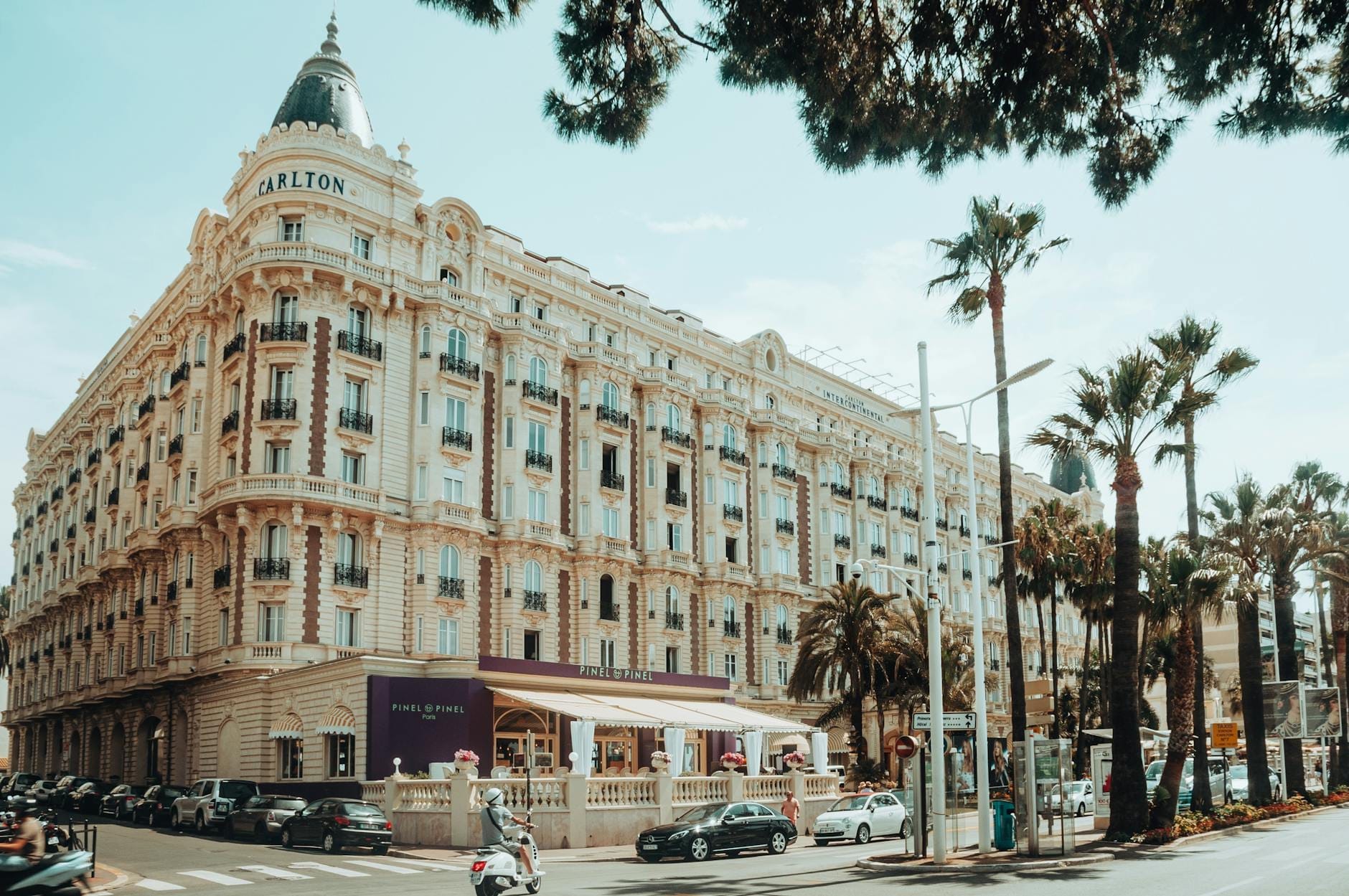
The Carlton's most distinctive feature is immediately visible from the beach side of La Croisette: two symmetrical domes crowning the roofline of a neoclassical, Belle Époque facade. Local legend, repeated in official tourism material from the Cannes Tourist Office, holds that the domes were modelled on the chest of Caroline Otero, the celebrated Spanish-born courtesan and entertainer who was one of the great celebrities of the Belle Époque era. Whether architect Charles Dalmas intended this or whether it became a retrospective story, it has become inseparable from the building's identity.
The hotel first welcomed guests in 1911, with founder Henri Ruhl presiding; many sources give 30 January as the opening date, though this is not universally cited. After more than a century of use, the building underwent a significant renovation that culminated in its reopening on 13 March 2023 under the Regent Hotels brand, now part of IHG. The renovation updated interiors while preserving the facade that makes the Carlton unmistakable from the Croisette promenade.
The best angle for photographing the exterior is from the beach-side path of Boulevard de la Croisette in the morning, when the light comes from the east and the facade is lit without harsh contrast. In the afternoon, the sun moves behind the building and the domes fall into silhouette — still striking, but different in character. During the Cannes Film Festival, the facade is often draped with sponsor banners and film posters, which can obscure the architecture considerably.
Tickets & tours
Hand-picked options from our booking partner. Prices are indicative; availability and final rates are confirmed when you complete your booking.
Cannes, Antibes and St Paul de Vence half-day private tour
From 60 €Instant confirmationFree cancellationBoat & snorkeling trip to the Esterel Calanques from Cannes
From 75 €Instant confirmationFree cancellationCannes, Antibes and Saint Paul de Vence shared tour from Nice
From 65 €Instant confirmationFree cancellationCannes food tour with full meal
From 105 €Instant confirmationFree cancellation
The Carlton and the Cannes Film Festival
The Carlton's position on La Croisette, roughly equidistant between the Palais des Festivals and the eastern end of the main beach strip, has made it the festival's unofficial headquarters for decades. During the Cannes Film Festival, typically held in May, the hotel's lobby, terrace bar, and surrounding pavement become some of the most densely populated and aggressively credentialed spaces in the city. Producers, distributors, press agents, and a smaller number of recognisable faces from the film world cycle through its public areas from morning to well past midnight.
For visitors without festival accreditation, this period is worth experiencing for the atmosphere alone, but it comes with real costs: the hotel and its immediate surroundings are far more crowded, prices across nearby restaurants and bars spike significantly, and La Croisette itself becomes difficult to walk at peak hours. If your main interest is the Carlton as an architectural or historical site, rather than the festival spectacle, visiting outside of May delivers a quieter and more genuinely enjoyable experience. For a broader view of how the festival reshapes the city, see the Cannes Film Festival guide.
⚠️ What to skip
During the Cannes Film Festival (typically mid-May), room rates surge dramatically and the hotel's public areas are extremely crowded. Non-guests may find it harder to access the lobby bar during peak evening hours.
The Beach, the Bar, and What Non-Guests Can Use
The Carlton operates its own private beach section directly in front of the hotel, as is standard for the major hotels along this stretch of La Croisette. The beach is available to paying customers regardless of whether they are hotel guests, which means it is theoretically open to any visitor willing to pay for a sunbed or food and drink service. Prices are in line with other private beach clubs on this stretch, which is to say they are high by most standards.
For those who want the Carlton experience without the overnight rate, the terrace bar is the most accessible option. It faces the sea and the boulevard, and during a calm mid-morning or an early evening, it is one of the better spots on La Croisette to sit and watch the particular theatre of the promenade. The public Plage de la Croisette runs alongside the private sections and is free to use, so combining a beach walk with a drink at the Carlton terrace is a practical and budget-conscious approach.
The hotel has 332 guest rooms across multiple categories, and approximately 1,900 square metres of meeting and event space. This gives you a sense of the scale: it is a large property that functions partly as a conference and events venue, not only a leisure hotel. On days when a significant corporate event or private function is scheduled, the lobby and bar can become unexpectedly busy with non-tourism guests.
How the Carlton Feels at Different Times of Day
Early morning, around 7:00 to 9:00, is when the Carlton's surroundings are at their most photogenic and least crowded. The beach promenade has a handful of joggers and dog-walkers, the chairs in front of the hotel have not yet been claimed, and the pale stone of the facade catches the low eastern light cleanly. The smell of the Mediterranean is noticeable from the road — salt, faint iodine, the occasional diesel note from an early delivery vehicle. Inside the lobby, staff are beginning the day and the tone is calm and unhurried.
By midday in summer, the scene in front of the Carlton shifts considerably. The private beach fills with sunbeds. The pavement tables attract a lunch crowd from the restaurant. Tourists photograph the facade in groups. The noise level on La Croisette rises with traffic and foot movement, and the air carries sunscreen and food from the nearby hotel kitchens. This is the least atmospheric time to visit if you want to appreciate the building or have a quiet drink.
Late afternoon and early evening, from around 17:00 to 19:30, is arguably the best time to experience the Carlton as a social setting. The light turns warm and southerly on the facade. The terrace fills with a mix of guests, business visitors, and tourists with the means and inclination to pay for a Riviera cocktail at the right address. Conversations in French, English, Italian, and occasionally other languages overlap at the nearby tables. The yacht marina is visible in one direction, the old town silhouette in the other.
Practical Notes: Getting There, Dress Code, and Who Should Skip This
The Carlton sits at 58 Boulevard de la Croisette, roughly a 15-minute walk from Gare de Cannes along the seafront. Palmbus city lines serve the broader Croisette area if you prefer not to walk. From Nice Côte d'Azur Airport (NCE), the journey takes 30 to 50 minutes by car or taxi depending on traffic; the express bus line LR 81 connects Nice Airport to central Cannes in approximately 45 to 60 minutes at a fraction of the taxi fare. For more detail on getting around Cannes, the getting around Cannes guide covers all local transport options.
There is no formal dress code for walking past the building or using the public pavement. For entering the lobby, bar, or restaurant, smart-casual is the practical minimum. The hotel does not enforce a specific dress requirement at the door for its public-facing facilities in the way a casino might, but the environment self-selects: guests and staff are dressed well, and arriving in beachwear or athletic clothing will mark you out and may result in a less welcoming reception.
If your interest is purely architectural or historical, be realistic about what the Carlton actually delivers. The facade is genuinely impressive, especially up close, and the building's story is woven into the broader history of La Croisette and the film festival. But the interior, post-renovation, is a luxury hotel interior: high-quality materials, professional service, and prices calibrated to a specific clientele. Visitors looking for Cannes on a realistic daily budget will find the Carlton better appreciated from the outside than the inside. For that kind of trip, the Cannes on a budget guide offers more practical alternatives nearby.
ℹ️ Good to know
Specific accessibility features, including step-free access and adapted room configurations, are not detailed on the hotel's public pages. Contact the hotel directly via carltoncannes.com/en or through IHG if you have specific requirements.
The Carlton in Context: La Croisette as a Whole
The Carlton is the most photographed building on La Croisette, but it exists within a broader boulevard worth understanding on its own terms. The promenade runs for roughly 2 kilometres between the Palais des Festivals in the west and the Palm Beach peninsula in the east, lined with palace hotels, private beach clubs, and intermittent public beach access. The Carlton sits roughly in the central section, making it a natural pivot point for a walking exploration of the boulevard. A complete picture of what the boulevard offers is covered in the La Croisette neighbourhood guide.
Immediately to the west, the Palais des Festivals anchors the boulevard's main cultural and event life. To the east, the boulevard becomes quieter and more residential before reaching the Palm Beach Casino at the far end. Across the bay, visible on clear days from the Carlton's terrace, the Îles de Lérins offer a completely different register of Riviera experience — woodland, silence, and medieval history — accessible by boat from the old port.
Insider Tips
- The Carlton's facade is listed as a historic landmark in local tourism records, but it does not carry full French architectural protection classification — meaning interior renovations can and do change the character of the spaces without public consultation. If you visited before the 2023 renovation, the lobby experience is noticeably different.
- For photography, position yourself on the narrow strip of pavement between the beach access road and the promenade rather than on the beach itself. The slight elevation and distance give you the entire facade including both domes without distortion.
- During non-festival weekdays in spring or autumn, the Carlton's public terrace bar is often quieter than the smaller cafes on Rue d'Antibes and offers a comparable coffee or aperitif experience with a considerably better view — the price difference is real but not as extreme as you might expect outside peak season.
- The Carlton's main entrance faces the sea, but the hotel also has access points from the boulevard side. Arriving from the street rather than the beach approach gives you a less photographed and more architectural perspective on the building's mass and scale.
- If you are in Cannes during the film festival and want to watch the industry at work without accreditation, the Carlton's lobby bar between 10:00 and noon and again between 18:00 and 20:00 is where deal-making conversations happen in plain sight. You do not need a badge to sit there and observe.
Who Is Carlton Cannes, a Regent Hotel For?
- Architecture and history enthusiasts wanting to understand Cannes's Belle Époque legacy
- Film festival followers looking to absorb the industry atmosphere without official access
- Travellers on a multi-day Cannes itinerary who want to tick off the city's most iconic landmark
- Couples looking for a special-occasion dinner or drinks setting with genuine heritage atmosphere
- Photographers working on French Riviera projects who need the definitive Cannes facade shot
Nearby Attractions
Other things to see while in La Croisette:
- Boulevard de la Croisette
Boulevard de la Croisette is Cannes' defining address: a roughly 3-kilometre sweep of palm-shaded walkway running along the Baie de Cannes from the Vieux Port to Port Canto. Free to walk at any hour, it anchors the city's luxury hotels, private beach clubs, and the Palais des Festivals — and looks completely different depending on when you show up.
- Carré d'Or (Golden Square)
The Carré d'Or, or Golden Square, is Cannes' compact luxury district wedged between Rue d'Antibes and La Croisette. Four streets pack in high-end boutiques, aperitivo bars, fine dining, and some of the city's most sought-after nightlife, all within easy walking distance of the Palais des Festivals.
- Centre d'Art La Malmaison
Reopened in January 2025 after a major renovation, Centre d'Art La Malmaison brings contemporary art into one of the most historically layered buildings on Boulevard de la Croisette. With 600 m² of exhibition space, free rooftop terrace access during opening hours, and admission from €6.50 (€3.50 reduced), it offers real cultural depth just steps from the sea.
- Palais des Festivals et des Congrès
The Palais des Festivals et des Congrès is the concrete anchor of Cannes' global identity. Home to the world's most famous film festival since 1983, it sits at the western tip of La Croisette where the city's glamour and its working waterfront converge. Whether you visit during the festival frenzy of May or the quieter months when you can actually breathe, this building rewards attention.