Palermo Cathedral: Nine Centuries of Stone, Power, and Shifting Faiths
The Cattedrale di Palermo is one of Sicily's most architecturally complex monuments, begun in 1184 on the site of a Byzantine basilica that was first converted into a mosque. Its exterior blends Norman, Gothic, Catalan-Gothic, and Baroque elements across its facades, while the interior holds the tombs of Norman kings and a treasury of royal artifacts. A UNESCO World Heritage Site, the main nave is free to enter.
Quick Facts
- Location
- Via Vittorio Emanuele, 90134 Palermo, Sicily, Italy (historic center)
- Getting There
- Walkable from Quattro Canti and Palazzo dei Normanni; AMAT city buses serve Via Vittorio Emanuele
- Time Needed
- 45–90 minutes for nave and tombs; add 30 minutes for rooftop and crypt
- Cost
- Main nave: free. Paid tickets for rooftop, royal tombs, crypt, and treasury (prices vary; verify at ticket office or official website)
- Best for
- Architecture enthusiasts, history travelers, UNESCO site collectors, photography
- Official website
- www.cattedrale.palermo.it
What You're Looking At: A Building That Refuses to Pick One Style
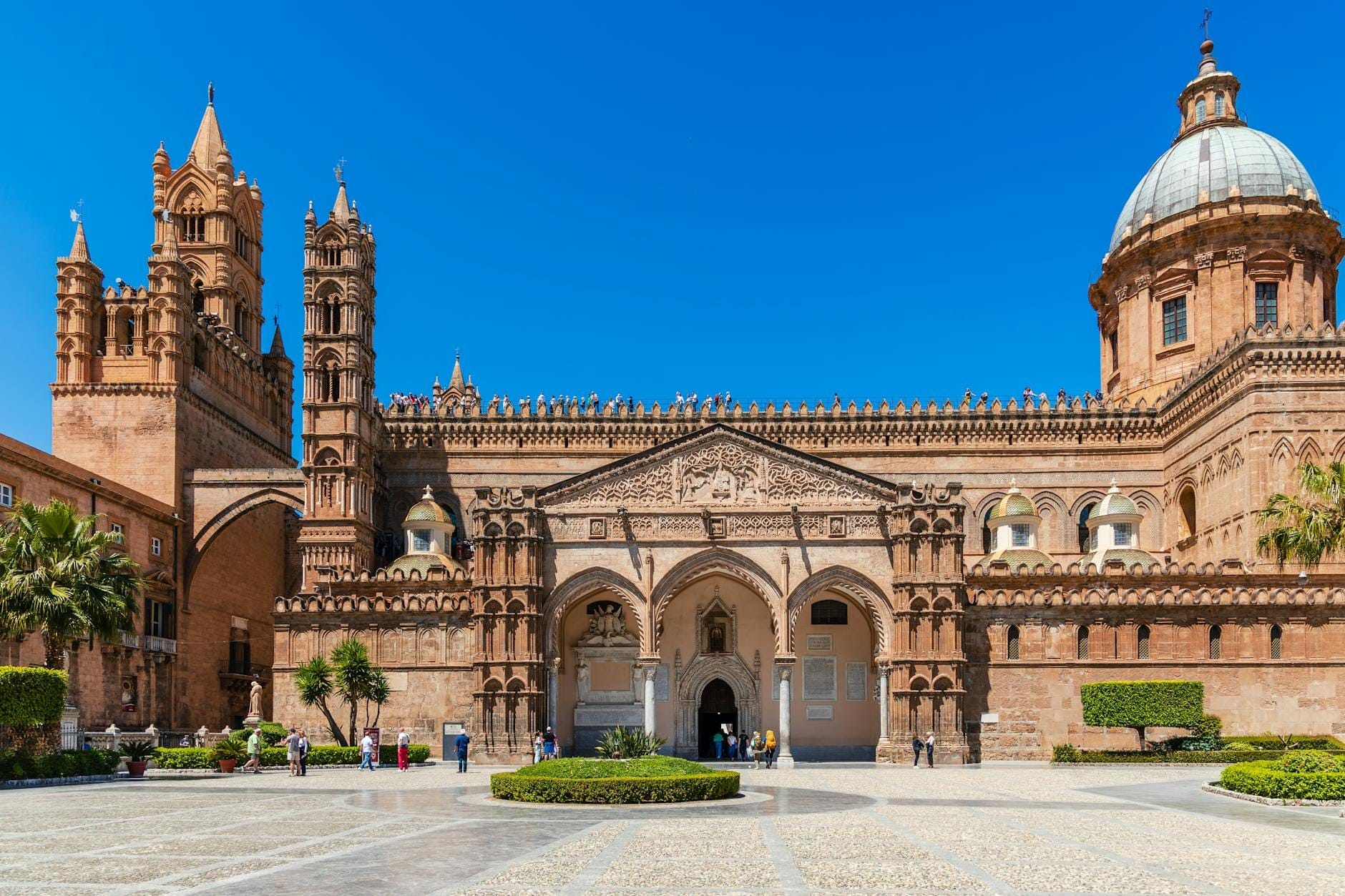
The Cattedrale di Palermo, formally known as Santa Maria Assunta, stands on Via Vittorio Emanuele in Palermo's ancient center and is unlike almost any cathedral in Europe. From the street, the exterior reads as a kind of architectural argument: Norman towers in warm honey-colored stone, a Catalan-Gothic portico added in the 15th century, an 18th-century dome that many architectural historians consider out of place, and Arabic geometric detailing woven into the masonry at the base of the apses. No single school of thought won. The building simply accumulated centuries.
Construction began in 1184 under Archbishop Gualtiero Offamilio, of English origin, serving the Norman court of Sicily, on a site with a remarkable prior history. The plot had held a Christian basilica, which the Arab rulers who controlled Palermo from the 9th to the 11th century converted into a mosque. When the Normans retook the city, they repurposed it again. The current structure, consecrated in 1185 and dedicated to the Assumption of the Virgin Mary, was built over that layered ground. If you look at the northern exterior wall near the apse, you can still see an Arabic inscription on a column repurposed from the earlier mosque. That detail alone is worth a few minutes of close attention.
ℹ️ Good to know
Palermo Cathedral is part of the UNESCO World Heritage Site designated as 'Arab-Norman Palermo and the Cathedral Churches of Cefalù and Monreale,' inscribed in 2015. This designation covers a network of monuments built during the Norman Kingdom of Sicily (12th century), recognized as a unique synthesis of Byzantine, Islamic, and Western European artistic traditions.
The Exterior: Walk Around Before You Go In
Most visitors approach from the east along Via Vittorio Emanuele and enter through the main portico on the south side, but the most architecturally revealing approach is to walk the perimeter first. The south facade, with its 15th-century Gothic canopy and triple-arched porch, is dramatic and photogenic in morning light when the stone glows amber before the sun climbs high enough to bleach it. The north side of the building, facing a quieter lane, shows the Norman apse work in its rawest form, including that Quranic inscription column, and is much less crowded. People rarely linger there.
The four towers at the corners of the complex give the cathedral its distinctive silhouette when seen from a distance, particularly from Monte Pellegrino or from the upper streets of the Capo neighborhood. Up close, the towers show the interlaced blind arcading characteristic of Norman-Sicilian stonework, a style shared with Monreale Cathedral and the Zisa Castle. The dome, added by architect Ferdinando Fuga in the 18th century, sits between the towers and has been criticized since it was built for failing to complement the Norman structure beneath it. That tension is visible and real.
Tickets & tours
Hand-picked options from our booking partner. Prices are indicative; availability and final rates are confirmed when you complete your booking.
Monreale day trip from Palermo
From 20 €Instant confirmationFree cancellationPalermo Cathedral rooftop ticket with audio guide
From 15 €Instant confirmationFree cancellationPalermo and Cefalu guided tour from Taormina
From 75 €Instant confirmationFree cancellation3-hour bike tour of Palermo with streetfood tasting
From 10 €Instant confirmationFree cancellation
Inside the Cathedral: Royal Tombs and a Sober Interior
Entry to the main nave is free and requires no ticket. The interior is large and relatively austere compared to what the facade promises. This is partly because 18th-century renovations stripped much of the medieval interior decoration, a change that remains controversial among art historians. The nave is tall, cool even in summer, and lit by stained glass that casts pale color across pale stone. On summer afternoons, the nave provides genuine relief from the heat outside, and you will notice locals using it exactly that way.
The highlight of the interior, without much competition, is the collection of royal tombs in the right nave. These porphyry sarcophagi hold the remains of Norman and Hohenstaufen rulers, including Roger II, the first King of Sicily, and Holy Roman Emperor Frederick II, one of the most extraordinary political figures of the medieval world. The deep red-purple of the imperial porphyry stone, reserved in antiquity and the medieval period exclusively for emperors and royalty, is striking in a way photographs don't fully communicate. Standing at these tombs, you are looking at the literal remains of a dynasty that ruled the Mediterranean world.
Access to the royal tombs, the treasury, the crypt, and the rooftop requires a paid ticket, available from the ticket office inside the cathedral. The treasury holds crown jewels of the Norman queens, including a jeweled crown recovered from the tomb of Queen Constance of Aragon, and a carved ivory oliphant. These objects are small and extraordinary. Allow time to actually look at them.
💡 Local tip
Visit the treasury before the rooftop, not after. Energy and attention tend to drop once you've climbed to the roof and returned, and the objects in the treasury reward careful, slow looking.
The Rooftop: Palermo Laid Flat Below You
The rooftop terrace is reached by a staircase from inside the cathedral and requires a paid ticket. The access route passes over the nave roofline and around the base of the 18th-century dome, offering close-up views of the Norman towers that you cannot get from street level. The views across central Palermo from the roof are clear and wide, taking in the Capo neighborhood rooftops, the mountains behind the city, and on clear days, the harbor. The perspective also makes the architectural mismatches of the building more legible: you can see exactly where the Norman original ends and the Baroque additions begin.
Morning is the better time for the rooftop. The light comes in from the east and the terrace is shaded on the north side. By midday in summer, the stone surfaces retain heat and the terrace becomes uncomfortable quickly. Photography from the roof is strong in the morning; by early afternoon, the southern exposure creates harsh shadows on the facade below.
⚠️ What to skip
Rooftop access involves uneven stone stairs with no lift. It is not accessible for visitors with significant mobility impairments. The main nave is at street level and accessible via the main entrance on Via Vittorio Emanuele.
When to Visit and How Crowds Behave
The cathedral is open most days from around 09:00 to 17:00, though hours for specific sections, particularly the roof and crypt, may differ and change seasonally. Religious services take place regularly and access to parts of the cathedral is restricted during them. If you arrive and find the nave cordoned off mid-morning, check the schedule posted at the entrance and return after the service concludes, usually within the hour.
Tour groups arrive in force between 10:00 and 12:00, and the south portico and nave fill quickly during that window. Arriving at opening time or after 14:30 gives considerably more room to move and quieter conditions for photography. The area directly in front of the south facade is one of Palermo's main pedestrian axes and is busy throughout the day, but the interior crowds are predictable and manageable outside peak hours.
The cathedral sits on Via Vittorio Emanuele, the main historic corridor that runs from the Norman Palace at the western end to the port at the east. This means it connects naturally with a broader walking itinerary that includes the Palatine Chapel and the Norman Palace to the west, and the Quattro Canti and Piazza Pretoria further east. A focused half-day covering this corridor gives a coherent picture of Palermo's Norman and Baroque layers.
Dress Code, Practical Details, and Who Should Probably Skip It
As an active Catholic cathedral, modest dress is required: shoulders and knees must be covered. Disposable paper shawls are sometimes available at the entrance if you arrive underprepared, but it is better not to rely on this. In summer, carrying a light scarf or overshirt for church visits is standard practice across Sicily.
The cathedral is worth visiting for anyone with even passing interest in medieval history, Norman architecture, or the particular multicultural history of Sicily under its Arab-Norman rulers. Travelers who find the broader context of that period interesting will want to pair this visit with Monreale Cathedral, which preserves its Norman interior far more intact and is one of the great mosaic programs in the world. If you're building an itinerary around Arab-Norman heritage, the Arab-Norman Sicily guide maps these connections clearly.
Visitors primarily interested in Byzantine mosaic art may leave the cathedral interior feeling underwhelmed, since the 18th-century renovations removed most of its original decoration. The Palatine Chapel, a short walk away inside the Norman Palace, offers a far more intact and visually overwhelming example of that tradition. The Palermo Cathedral is most rewarding for those who engage with what it represents historically and architecturally, not as a showcase of continuous medieval interior decoration.
Getting There and the Surrounding Streets
The cathedral is easy to reach on foot from most of central Palermo's accommodation areas. AMAT city buses run along Via Vittorio Emanuele and the surrounding streets; check current route maps at the time of your visit. Taxis and rideshares drop off directly on Via Vittorio Emanuele. There is no dedicated parking adjacent to the cathedral, and driving into the historic center is restricted. Walking is the practical default, and the surrounding streets are worth exploring on foot.
The Capo neighborhood market is a short walk north of the cathedral and is at its liveliest in the mornings, making a natural pairing with an early cathedral visit. The Ballarò market, Palermo's oldest and largest street market, is a ten-minute walk south and represents a completely different register of the city. For a broader sense of Palermo's walkable historic center, the Palermo destination guide covers orientation and neighborhood logistics.
Insider Tips
- The Arabic inscription from the Quran on the repurposed column on the north exterior wall is easy to miss. Walk around the back of the building before entering, look for the decorative column embedded in the lower apse masonry, and you will find it. It is one of the most quietly remarkable artifacts of the Norman period in all of Sicily.
- The ticket for the combined itinerary (rooftop, royal tombs, crypt, and treasury) is significantly better value than buying individual sections. Ask for the combined ticket at the entrance office if you plan to see more than just the nave.
- Arrive before 09:30 if you want the south facade in direct morning light without tour groups blocking the view. The street clears quickly as groups move inside, so even a 15-minute head start makes a difference for photography.
- The crypt is one of the coolest spaces in the building, literally, and also one of the least visited. It preserves architectural fragments and funerary elements from earlier phases of the site. If you are in Palermo in July or August, the crypt provides a reliable 10-minute escape from the heat.
- Do not confuse the cathedral with the nearby Oratorio del Rosario or other Palermo churches: on some mapping apps, multiple historic buildings cluster at this end of Via Vittorio Emanuele. The cathedral is the large complex facing the street with the arched Gothic portico on its south side.
Who Is Palermo Cathedral For?
- Travelers focused on Norman and Arab-Norman architecture and history
- UNESCO World Heritage site enthusiasts working through Sicily's designated monuments
- History travelers interested in the Norman Kingdom of Sicily and its royal figures
- Photographers looking for layered architectural subjects at multiple scales
- Anyone building a full-day walking itinerary through Palermo's historic center
Nearby Attractions
Other things to see while in Palermo:
- Ballarò Market
Stretching through the Albergheria district from Piazza Ballarò to Corso Tukory, the Mercato di Ballarò is Palermo's oldest continuously operating street market, with roots tracing back over a thousand years to Arab rule. It is free to enter, open daily, and unlike anything else in Sicily for raw atmosphere, local produce, and street food.
- Catacombs of the Capuchins
Below a quiet convent on the western edge of Palermo's historic centre, the Catacombs of the Capuchins hold one of the most extraordinary collections of preserved human remains anywhere in the world. Around 2,000 mummified bodies and skeletons line stone corridors carved from tuff rock, dressed in period clothing and arranged by profession, gender, and social status. It is an intimate, unsettling, and genuinely thought-provoking encounter with how a Mediterranean culture once confronted death.
- Church of the Martorana
Built in 1143 by a Norman admiral and decorated by craftsmen from Constantinople, the Church of the Martorana contains some of the most important Byzantine mosaics in the western Mediterranean. It sits on Piazza Bellini in Palermo's historic center, part of a UNESCO World Heritage site, and rewards visitors who arrive early and look up.
- La Kalsa
La Kalsa is Palermo's oldest neighborhood, founded by Arab rulers in the 9th century as the city's administrative heart. Today it is a layered district of crumbling palazzi, Baroque churches, art-filled piazzas, and some of Palermo's most atmospheric street life. Free to explore and walkable in half a day, it rewards those who slow down.