Norman Palace (Palazzo dei Normanni): Palermo's Royal Heart
The Norman Palace, or Palazzo dei Normanni, is Palermo's most historically layered building: a former Arab fortress, a Norman royal court, and now the seat of the Sicilian Regional Assembly. At its core sits the Cappella Palatina, one of the most extraordinary rooms anywhere in the Mediterranean world.
Quick Facts
- Location
- Piazza del Parlamento 1, Palermo, Sicily, Italy
- Getting There
- Walking distance from Palermo Centrale station; local AMAT buses stop near Corso Vittorio Emanuele
- Time Needed
- 2 to 3 hours for the full complex including Cappella Palatina
- Cost
- Full access tickets generally cost between €15 and €19 and include entry to the palace, Cappella Palatina, and gardens; verify current prices before visiting.
- Best for
- History lovers, architecture enthusiasts, UNESCO site collectors, first-time visitors to Palermo
- Official website
- www.federicosecondo.org
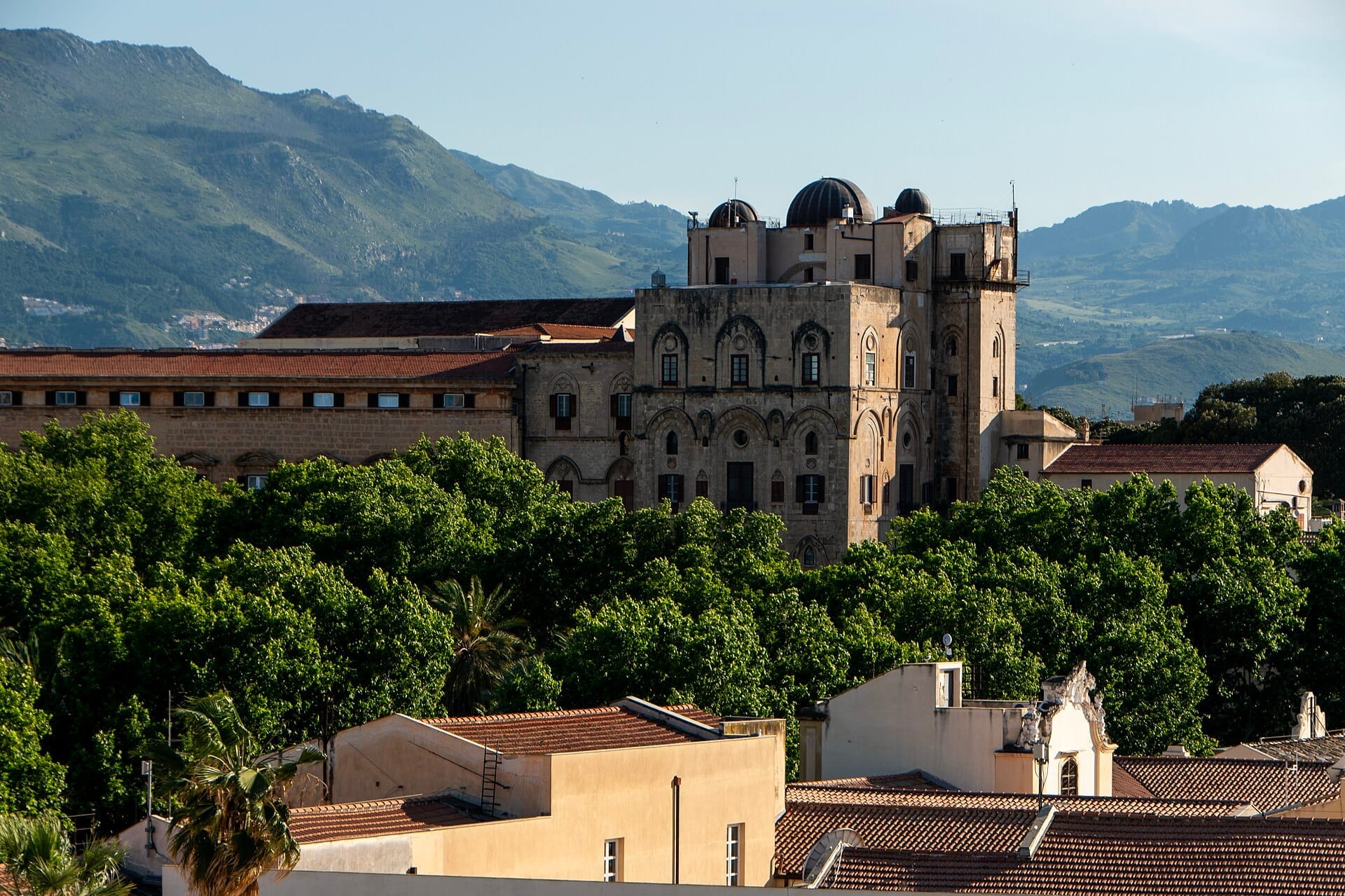
Why the Norman Palace Matters
The Palazzo dei Normanni, officially known as the Royal Palace of Palermo, is not just old: it is old in layers. The site was first fortified by Arab emirs around the 10th century, adapted into a royal seat by Norman kings in the 12th century, restructured by Spanish viceroys in the 16th and 17th centuries, and has housed the Sicilian Regional Assembly since 1947. Each civilization that controlled Sicily left something here, and the building holds all of it simultaneously.
For travelers who have limited time in Palermo, the Norman Palace belongs near the top of any serious itinerary. The Cappella Palatina alone, commissioned by King Roger II and completed around 1143, contains some of the finest Byzantine mosaics in existence. The combination of gold tesserae ceilings, Arab-carved wooden muqarnas, and Christian iconography in a single room is not something you will encounter anywhere else on earth.
The palace and its chapel are part of the UNESCO World Heritage Site known as "Arab-Norman Palermo and the Cathedrals of Cefalù and Monreale", inscribed in 2015. If you want to understand what made Sicily's Norman period so remarkable, start here. You can read more about the broader network of Arab-Norman monuments in our guide to Arab-Norman Sicily.
What You Will Actually See
The Cappella Palatina
The chapel is on the second floor and accessed through a broad stone staircase. When you step inside, the immediate sensory effect is one of compression: the space is not enormous, but every surface from the floor mosaics to the highest point of the ceiling is covered in color, gold, and narrative imagery. The ceiling above the nave is a carved wooden masterpiece in the Fatimid tradition, with honeycomb muqarnas painted with figures, animals, and geometric motifs. This is not decoration added to a Christian chapel; it is an integrated commission, ordered by a Norman king who employed Arab craftsmen alongside Byzantine mosaic workers.
The mosaics depict scenes from the Old and New Testament alongside images of Christ Pantocrator in the apse. They are executed with a precision and richness of color that still impresses visitors who arrive having seen comparable work in Istanbul or Ravenna. The light inside the chapel shifts throughout the morning as sunlight enters through small windows on the south wall, warming the gold ground of the mosaics in a way that photographs do not fully capture.
💡 Local tip
Arrive when the palace opens at 08:15. The Cappella Palatina receives light from its south-facing windows in the morning hours, and the mosaics appear significantly more luminous before midday. Group tours begin filling the space after 10:00.
The Royal Apartments
Access to the Royal Apartments, located in the Pisana Tower, is included in the full ticket and is generally available when the Sicilian parliament is not in session, most often on weekday mornings and some weekends. On Tuesdays and Wednesdays, the Regional Assembly is in session and the apartments are closed to visitors; the Cappella Palatina may still be accessible when not in use for services, but confirm before planning your trip around those days.
Inside the apartments, the Sala di Re Ruggero, or Hall of Roger II, is the most significant space after the chapel. Its 12th-century mosaics feature hunting scenes: leopards, deer, peacocks, and stylized trees against a gold ground. This secular decorative program is unusual for the period and reflects the court's multicultural aesthetic, where Islamic visual traditions were applied to a Christian royal interior without apparent contradiction.
The Astronomical Observatory and the Pisana Tower
The Torre Pisana, one of the oldest sections of the palace complex, is linked to the historic astronomical observatory of Palermo. The core of the palace was first fortified in the Arab period before the Norman conquest, and the tower forms an important physical remnant of that early phase. Its integration into what is now a functioning parliament building is a detail that tends to surprise visitors who had not read about the palace's full history before arriving.
Tickets & tours
Hand-picked options from our booking partner. Prices are indicative; availability and final rates are confirmed when you complete your booking.
Palermo and Cefalu guided tour from Taormina
From 75 €Instant confirmationFree cancellationMonreale day trip from Palermo
From 20 €Instant confirmationFree cancellation3-hour bike tour of Palermo with streetfood tasting
From 10 €Instant confirmationFree cancellationPalermo traditional food tour
From 69 €Instant confirmationFree cancellation
How the Experience Changes by Time of Day
Early morning, in the first hour after opening, the Cappella Palatina can feel genuinely quiet. The stone floors are cool underfoot, there is a faint smell of candle wax from the altar area, and the only sound is often the soft shuffle of other early visitors craning their necks to study the ceiling. This is the version of the palace that rewards planning.
By mid-morning, the courtyard and staircase fill with tour groups. Audio guides in multiple languages create a low ambient noise throughout the upper floor rooms. The chapel becomes more crowded between 10:00 and 13:00, with visitors sometimes queuing briefly at the entrance to the nave. If you prefer to examine individual mosaic panels closely, the afternoon light on Monday, Thursday, or Friday tends to be slightly quieter than weekend visits.
On Sundays, access usually closes around 13:00, which limits the visit significantly. Sunday mornings can also overlap with religious services in the Cappella Palatina, which may restrict independent movement inside the chapel during those times. This is worth factoring into a Sunday itinerary.
⚠️ What to skip
Tuesday and Wednesday visits are limited: the Royal Apartments close for parliamentary sessions. If seeing the Sala di Re Ruggero is your priority, plan your visit for Monday, Thursday, Friday, or Saturday.
Historical and Cultural Context
The Norman Kingdom of Sicily, established in the 12th century, was one of the most culturally sophisticated states in medieval Europe. Its rulers presided over a court where Arab scholars, Greek monks, and Latin clergy worked alongside one another. Roger II, who commissioned the Cappella Palatina, is documented as employing Muslim administrators and scientists at his court and maintaining Arabic-speaking circles around him. The palace is the physical record of that arrangement.
Since 1947, the building has housed the Assemblea Regionale Siciliana, the Sicilian Regional Assembly. The assembly is frequently cited as the oldest parliament in Europe, tracing its origins to the parliamentary body convened by Roger II in 1140. Whether that claim holds up to rigorous historical comparison is debated, but the continuity of political function on this site across nearly nine centuries is not.
Palermo's broader Arab-Norman heritage extends well beyond the palace walls. The Palatine Chapel is the palace's crown jewel, but travelers who want to continue exploring this architectural tradition should also visit Monreale Cathedral and the Church of the Martorana, both within easy reach of central Palermo.
Practical Walkthrough: Getting In and Around
The main visitor entrance is on Piazza del Parlamento. Tickets are purchased at the ticket office near the entrance; it is worth buying in advance through the Fondazione Federico II website during peak season to avoid queuing. The site is wheelchair accessible, with lifts or stairlifts available for key areas; check current arrangements for parking and assistance before visiting. Restrooms are available on site.
From Palermo Centrale train station, the palace is around 20 minutes on foot heading northwest along Corso Vittorio Emanuele. Local AMAT buses also run along this route. Parking in the immediate area is limited; arriving by foot, bus, or taxi is more practical than driving.
Photography is permitted in most areas of the palace, including the Royal Apartments. Inside the Cappella Palatina, photography rules may vary depending on whether a religious service is in progress; check with staff on arrival. The mosaics are best photographed in the morning with natural sidelight from the south windows. A standard wide-angle lens is more useful than a telephoto in the relatively compact chapel interior.
ℹ️ Good to know
Dress code: shoulders and knees must be covered to enter the Cappella Palatina, as it is an active place of worship. Carry a scarf or light layer if you are visiting in summer.
Who Should Consider Skipping
Travelers who find medieval religious iconography tedious or who have limited interest in the political history of Norman Sicily may find the palace underwhelming relative to the ticket price. The experience is intellectually dense rather than visually spectacular in the way that a coastal view or an open archaeological site might be. If you are visiting Palermo primarily for its street food, markets, and energy, the Norman Palace requires a different pace and mindset.
Those with only half a day in Palermo and competing priorities might consider whether the Palermo Cathedral or the atmospheric Ballarò Market better fit their interests. The Norman Palace rewards visitors who come prepared with some context; without it, parts of the visit can feel like a sequence of ornate rooms without a clear narrative thread.
Insider Tips
- Book tickets online through the Fondazione Federico II website before your visit, especially on weekends between April and October. Walk-up queues at the ticket office can run 20 to 30 minutes during peak hours.
- The Sala di Re Ruggero receives very little natural light and can appear darker than expected. Allow your eyes to adjust before taking photographs, and avoid using flash even when permitted.
- The Royal Gardens adjacent to the palace are often overlooked and can generally be added to the ticket for a small supplement (around a few euros). They offer a quiet escape after the intensity of the interior rooms and a reasonable elevated view over the western edge of the city.
- If you are visiting on a Sunday, aim to arrive no later than 08:45. The 12:30 closure is firm, and the entry queue combined with time inside the chapel can easily consume the available window.
- The Fondazione Federico II occasionally organizes evening events and temporary exhibitions inside the palace complex. Check the official website for the current programme if your visit coincides with a cultural festival period.
Who Is Norman Palace (Palazzo dei Normanni) For?
- First-time visitors to Palermo seeking the single most historically significant site in the city
- Travelers following the Arab-Norman UNESCO trail across northern and western Sicily
- Architecture and Byzantine art enthusiasts who want to understand how Norman, Arab, and Greek traditions fused in practice
- History-focused travelers interested in medieval kingship and the political history of Sicily
- Families with older children who have some context for medieval history and religious art
Nearby Attractions
Other things to see while in Palermo:
- Ballarò Market
Stretching through the Albergheria district from Piazza Ballarò to Corso Tukory, the Mercato di Ballarò is Palermo's oldest continuously operating street market, with roots tracing back over a thousand years to Arab rule. It is free to enter, open daily, and unlike anything else in Sicily for raw atmosphere, local produce, and street food.
- Catacombs of the Capuchins
Below a quiet convent on the western edge of Palermo's historic centre, the Catacombs of the Capuchins hold one of the most extraordinary collections of preserved human remains anywhere in the world. Around 2,000 mummified bodies and skeletons line stone corridors carved from tuff rock, dressed in period clothing and arranged by profession, gender, and social status. It is an intimate, unsettling, and genuinely thought-provoking encounter with how a Mediterranean culture once confronted death.
- Church of the Martorana
Built in 1143 by a Norman admiral and decorated by craftsmen from Constantinople, the Church of the Martorana contains some of the most important Byzantine mosaics in the western Mediterranean. It sits on Piazza Bellini in Palermo's historic center, part of a UNESCO World Heritage site, and rewards visitors who arrive early and look up.
- La Kalsa
La Kalsa is Palermo's oldest neighborhood, founded by Arab rulers in the 9th century as the city's administrative heart. Today it is a layered district of crumbling palazzi, Baroque churches, art-filled piazzas, and some of Palermo's most atmospheric street life. Free to explore and walkable in half a day, it rewards those who slow down.