Palatine Chapel (Cappella Palatina): Palermo's Greatest Medieval Interior
Built for the Norman king Roger II in the 12th century, the Palatine Chapel inside Palermo's Royal Palace is one of the most extraordinary rooms in the Mediterranean world. Its ceiling is carved Islamic muqarnas, its walls are layered in gold Byzantine mosaics, and its floor is inlaid Cosmati marble. No other building in Sicily brings three civilizations into a single, coherent space quite like this.
Quick Facts
- Location
- Piazza del Parlamento / Piazza Indipendenza 1, Palazzo dei Normanni, Palermo
- Getting There
- Reachable by AMAT city buses serving Piazza Indipendenza; walkable from central Palermo's historic quarters
- Time Needed
- 1.5 to 2.5 hours (chapel alone: 45–60 min; full Royal Palace complex: 2+ hours)
- Cost
- Full ticket €19.00 | Reduced €17.00 (EU teachers, ages 18–25) | Over 65s €15.00 | Ages 14–17 €11.00 — verify current prices at federicosecondo.org
- Best for
- History lovers, art and architecture enthusiasts, anyone interested in Norman, Byzantine, or Arab-Norman Sicily
- Official website
- www.federicosecondo.org/en/visit
What the Palatine Chapel Actually Is
The Cappella Palatina is the private royal chapel of the Norman kings of Sicily, built inside the Palazzo dei Normanni, the Royal Palace of Palermo, which sits on a fortified hill at the western edge of the historic city center. Construction began around 1130, the year Roger II was crowned King of Sicily, and the chapel was largely completed and consecrated by 1143 — a date recorded in an inscription in the dome itself, although work on the mosaics continued later into the 12th century. What was created in those thirteen years is not easily categorized.
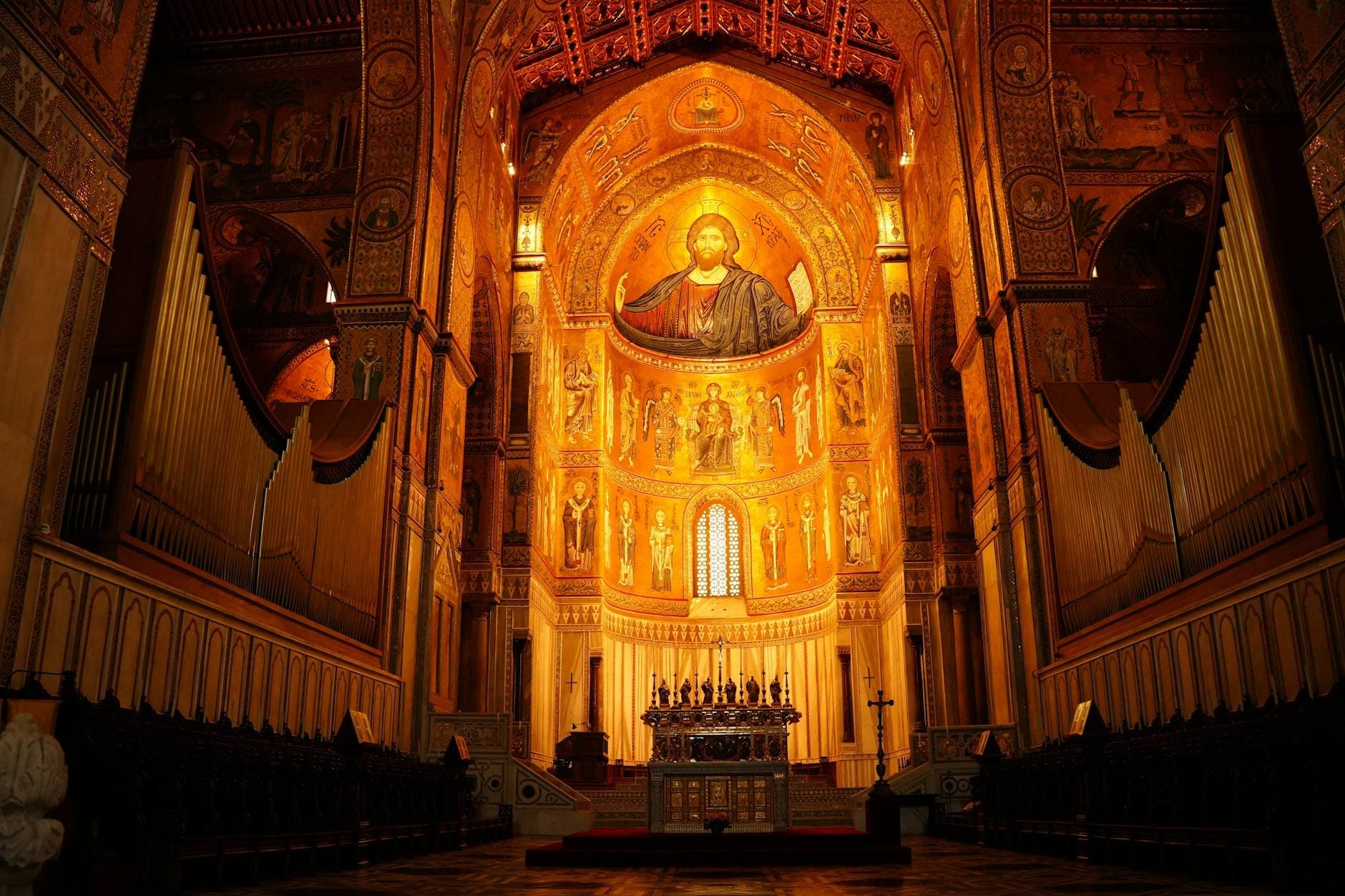
The chapel combines three entirely distinct artistic traditions into one room. The ceiling is a masterpiece of Fatimid Islamic woodcarving, a honeycomb of muqarnas (stalactite-like geometric forms) painted with courtly scenes of musicians, hunting parties, and feasting figures. The walls and vault are covered in Byzantine mosaics executed in gold tessera, depicting Christ Pantocrator, scenes from the life of Saints Peter and Paul, and Old Testament narratives. The floor and lower walls are decorated with geometric Cosmati marble inlay work, a Latin Christian tradition. The Norman kings did not merely tolerate these different cultures in their kingdom; they commissioned all three simultaneously, in a single room, intended for royal prayer.
ℹ️ Good to know
The Palatine Chapel is listed as part of the Arab-Norman Palermo UNESCO World Heritage Site (inscribed 2015), along with the Palermo Cathedral, Monreale Cathedral, and several other Norman-era buildings in and around the city.
Entering the Chapel: The First Few Seconds
You approach the chapel via the Palazzo dei Normanni, entering the complex through the main gate on Piazza del Parlamento. After purchasing your ticket, you pass through parts of the palace before ascending to the chapel level. The approach is functional rather than dramatic. Nothing prepares you for the interior.
When you step through the entrance doorway, the scale stops you briefly. It is not a large room — the nave and two aisles are divided by arches supported on granite columns — but every surface from floor to ceiling is covered in something. Your eye does not know where to settle. The gold of the mosaics catches whatever light enters, and in the morning hours, when sunlight angles through the clerestory windows on the south side, the upper walls seem to generate their own warmth. The air inside is noticeably cooler than the street outside, which on summer days in Palermo is a meaningful detail.
The acoustic quality of the space is also worth noticing. Voices are absorbed rather than amplified, which gives the interior a compressed, concentrated feeling. Tour groups move through in rotation, so there are moments — particularly in the first hour after opening — when the chapel is relatively quiet and the weight of what you are looking at has room to register properly.
Tickets & tours
Hand-picked options from our booking partner. Prices are indicative; availability and final rates are confirmed when you complete your booking.
Palace of the Normans and Palatine Chapel tickets and guided tour
From 49 €Instant confirmationFree cancellationPalatine Chapel and Royal Palace entrance ticket with audio guide
From 30 €Instant confirmationFree cancellationGuided tour of the Sistine Chapel of Sicily in Castelvetrano
From 33 €Instant confirmationFree cancellationPalazzo dei Normanni and Cappella Palatina guided tour
From 79 €Instant confirmationFree cancellation
The Mosaics: What You Are Looking At and Why It Matters
The Byzantine mosaics covering the apse, vault, and nave walls are among the finest examples of 12th-century mosaic art in existence. The central apse holds a large Christ Pantocrator — Christ depicted as ruler of all — a standard Byzantine iconographic type, but executed here with exceptional quality. Greek craftsmen brought from Constantinople are believed to have worked on the chapel, which explains the Byzantine precision of the figural style. The gold background is not decorative filler; in Byzantine theology, gold represents divine light made visible, and it functions here as a theological statement about the nature of sacred space.
Below the upper mosaic zones, the nave walls show narrative cycles from the Acts of the Apostles, particularly the lives of Saints Peter and Paul. The figures have the flat, frontal quality typical of Byzantine icon tradition, but close inspection reveals considerable variation in quality across different sections, reflecting the work of multiple hands over several decades of the 12th century. Mosaics in the side aisles depicting Old Testament scenes, including the stories of Genesis, are thought to be slightly later additions, possibly added during the reign of William I or William II after Roger II's death in 1154.
💡 Local tip
Bring or rent binoculars if you want to study the upper mosaics closely. The detail at ceiling height is extraordinary — individual glass tesserae no larger than a fingernail — but invisible to the naked eye from the floor.
The Muqarnas Ceiling: The Detail Most Visitors Miss
Most visitors spend their attention on the mosaics, which is understandable. But the wooden muqarnas ceiling over the nave is arguably the more unusual survival. Muqarnas ceilings of this type — carved and painted wooden stalactite vaulting — were a hallmark of Fatimid Islamic palace architecture in North Africa and the Middle East. This is one of the very few examples outside the Islamic world, and the scenes painted onto the carved surfaces are explicitly courtly: men playing musical instruments, women, animals, birds, and hunting imagery that reflects the visual culture of the Islamic Mediterranean in the 12th century. There is no religious content in these paintings. They represent the secular, pleasure-oriented decorative language of Fatimid court culture, deployed in a Christian royal chapel.
The ceiling is best seen in the central nave from about midpoint down the length of the room, looking upward and slightly toward the entrance end. The painted figures are small and worn in places, but the honeycomb geometry of the muqarnas structure is immediately legible from below. Take time with it. Most people look at the walls and miss what is directly overhead.
Timing Your Visit: Hours, Crowds, and Light
The Royal Palace complex is generally open daily from 08:30, with last admission at 16:30, though Sunday and public‑holiday hours and access to specific areas can vary and may be shorter. The complex is closed on 25 December and 1 January. The Fondazione Federico II, which manages the site, advises confirming specific access details at the ticket office on arrival, as individual areas within the palace can vary.
The best light inside the chapel is in the morning, particularly between 09:00 and 11:00 on clear days, when sunlight enters through the southern windows and illuminates the gold mosaic surfaces most dramatically. Afternoon visits are still worthwhile, but the light is more diffuse. Midday in summer brings the largest tour groups, typically arriving by coach from cruise ships docked in Palermo's port or on organized excursions from Cefalù and Taormina. If you want relative quiet, arrive at opening or plan for mid-afternoon on a weekday, when most organized tours have moved on.
⚠️ What to skip
Sunday hours are often reduced compared with weekdays, and last admission may be earlier than 16:30 depending on the season and parliamentary schedule. This catches many visitors by surprise. If Sunday is your only option, arrive early and expect larger crowds before noon.
Photography is permitted inside the chapel without flash, though tripods are not allowed. The low light levels in parts of the interior mean that a camera with good high-ISO performance will produce better results than a smartphone in anything other than the brightest window zones. The golden mosaics photograph well in natural light; artificial lighting in the chapel tends to produce orange color casts.
The Broader Context: Arab-Norman Palermo
The Palatine Chapel does not make complete sense without understanding the political world that produced it. The Norman kingdom of Sicily, established in the 11th and 12th centuries, ruled over a population that was substantially Arab Muslim, Byzantine Greek, Jewish, and Latin Christian. Roger II's administration conducted official business in multiple languages, notably Latin, Greek, and Arabic, and documents also attest to the use of the vernacular of his Norman court. The kingdom's coins bore Arabic script. Its civil servants included Muslims, and its architecture synthesized all of these traditions. The Palatine Chapel is the most concentrated expression of that synthesis anywhere in the world. For more on this context, the Arab-Norman Sicily guide covers the full network of surviving buildings across Palermo and its surroundings.
Within Palermo itself, the chapel is best understood alongside the Monreale Cathedral — a later Norman commission with an even larger mosaic program — and the Church of the Martorana, which contains 12th-century mosaics including a portrait of Roger II himself being crowned by Christ. These three buildings together form the core of the UNESCO Arab-Norman World Heritage inscription.
Practical Details: Getting There, Dress Code, and Accessibility
The Palazzo dei Normanni sits at the western end of Palermo's historic center, on a slight hill at Piazza del Parlamento, which connects to Piazza Indipendenza. City buses operated by AMAT Palermo serve this area; several lines stop at or near Piazza Indipendenza. From the historic core of the city — the area around the Quattro Canti or the Ballarò market — the palace is walkable in roughly 15 to 20 minutes on flat streets. Taxis and rideshare services can drop you at the piazza directly.
The Palatine Chapel is a functioning religious site as well as a monument, so modest dress is required: shoulders and knees must be covered. This rule is enforced at the entrance. In summer, carry a scarf or light layer if your clothing does not already meet the standard. The palace complex includes internal stairways and some uneven historic surfaces. Visitors with mobility requirements are advised to contact the Fondazione Federico II in advance via the contact details on their official website, as accessibility provisions in historic buildings of this type can be limited and vary by access point.
Tickets for the full Palazzo dei Normanni monumental complex, which includes the Palatine Chapel, are purchased at the site. The Fondazione Federico II does not appear to offer skip-the-line advance booking in the way that some other Sicilian sites do, though this is worth confirming directly before your visit. Palermo rewards slow exploration; if you have a full day in the city, pair this visit with the Palermo Cathedral a few minutes' walk away, and end the afternoon at the Ballaro or Capo markets.
Is It Worth the Ticket Price?
At €19.00 for a full adult ticket, the Palatine Chapel is one of the more expensive individual attractions in Palermo. For visitors with a strong interest in medieval art, Byzantine iconography, or Arab-Norman history, it is one of the most remarkable rooms in Europe and the price is easily justified. For travelers who are not particularly engaged by religious art or medieval history, the experience may feel overwhelming rather than moving. The density of imagery and the absence of English explanatory panels inside the chapel itself means that visitors without prior knowledge may find themselves uncertain what they are looking at.
An audio guide or a guided tour is genuinely useful here, not just a nice add-on. The interpretive signage inside the chapel is limited. Without some framework — the political history of the Norman kingdom, the theological meaning of the Byzantine mosaic program, the significance of Islamic muqarnas in a Christian context — the interior can seem beautiful but opaque. If you prefer to prepare independently, the Sicily attractions overview provides broader context for how this fits into a Palermo or Sicily itinerary.
Insider Tips
- Arrive at 08:30 on a weekday. The chapel is often almost empty in the first 30 to 45 minutes after opening, before the first tour groups arrive from hotels. This window gives you the rare chance to stand in the nave in near silence.
- Look at the muqarnas ceiling before you get drawn into the mosaics. Most visitors orient immediately toward the apse and the gold walls and never properly look overhead. Walk to mid-nave, stop, and tilt your head back before doing anything else.
- The royal apartments on the upper floors of the Palazzo dei Normanni are included in the same ticket and contain the Room of Roger II (Sala di Re Ruggero), with 12th-century mosaic hunting scenes in a secular context. Most visitors skip this. It is quiet and worth 20 minutes.
- Sunday visiting hours end at 12:30 last admission. If you want to visit on a Sunday, treat it as a morning activity and plan to be at the ticket desk by 09:00 at the latest.
- The palace is also the seat of the Sicilian Regional Assembly, which means parts of the complex can be unexpectedly closed during parliamentary sessions or official events. Check the Fondazione Federico II website for current closures before visiting.
Who Is Palatine Chapel (Cappella Palatina) For?
- Travelers with a strong interest in medieval, Byzantine, or Islamic art and architecture
- Anyone exploring the Arab-Norman UNESCO heritage trail across Palermo and Monreale
- History-focused visitors who want to understand the multicultural character of Norman Sicily
- Photographers working in available light and looking for extraordinary gold and mosaic surfaces
- Slow travelers who want depth over breadth and are prepared to spend time with a single room
Nearby Attractions
Other things to see while in Palermo:
- Ballarò Market
Stretching through the Albergheria district from Piazza Ballarò to Corso Tukory, the Mercato di Ballarò is Palermo's oldest continuously operating street market, with roots tracing back over a thousand years to Arab rule. It is free to enter, open daily, and unlike anything else in Sicily for raw atmosphere, local produce, and street food.
- Catacombs of the Capuchins
Below a quiet convent on the western edge of Palermo's historic centre, the Catacombs of the Capuchins hold one of the most extraordinary collections of preserved human remains anywhere in the world. Around 2,000 mummified bodies and skeletons line stone corridors carved from tuff rock, dressed in period clothing and arranged by profession, gender, and social status. It is an intimate, unsettling, and genuinely thought-provoking encounter with how a Mediterranean culture once confronted death.
- Church of the Martorana
Built in 1143 by a Norman admiral and decorated by craftsmen from Constantinople, the Church of the Martorana contains some of the most important Byzantine mosaics in the western Mediterranean. It sits on Piazza Bellini in Palermo's historic center, part of a UNESCO World Heritage site, and rewards visitors who arrive early and look up.
- La Kalsa
La Kalsa is Palermo's oldest neighborhood, founded by Arab rulers in the 9th century as the city's administrative heart. Today it is a layered district of crumbling palazzi, Baroque churches, art-filled piazzas, and some of Palermo's most atmospheric street life. Free to explore and walkable in half a day, it rewards those who slow down.