Monreale Cathedral: The Byzantine Gold That Covers Every Wall
Perched above Palermo on the slopes of Monte Caputo, the Cattedrale di Monreale is one of the most extraordinary medieval buildings in Europe. Its interior is almost entirely clad in Byzantine-Norman mosaics covering over 6,000 square metres, a scale that photographs simply cannot prepare you for. If you visit one church in Sicily, this is the one that earns the detour.
Quick Facts
- Location
- Piazza Guglielmo II, 1, 90046 Monreale PA, Italy — about 7–8 km southwest of central Palermo
- Getting There
- Bus 389 from Piazza Indipendenza, Palermo (approx. 30 min); alight at Fontana del Drago stop, then a short uphill walk
- Time Needed
- 1.5 to 2.5 hours for the cathedral and cloister; half a day if combining with the town
- Cost
- Cathedral admission fee applies; verify current pricing at the official website before visiting
- Best for
- History lovers, architecture enthusiasts, art pilgrims, and anyone who wants to understand Arab-Norman Sicily
- Official website
- www.duomomonreale.com/en/things-to-see/cathedral-of-monreale
What the Cattedrale di Monreale Actually Is
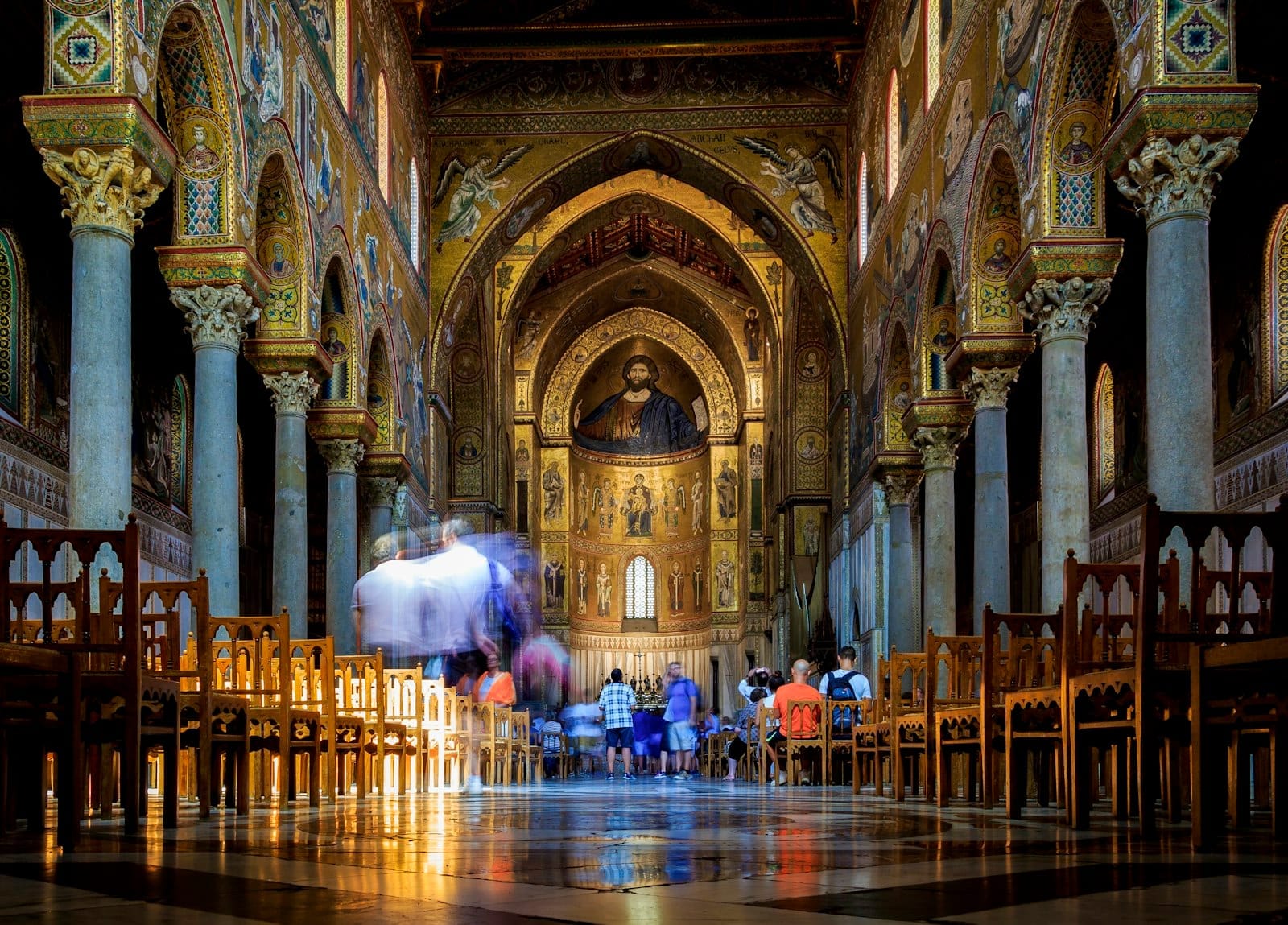
The Cattedrale di Monreale, formally known as Santa Maria la Nuova, is a UNESCO World Heritage Site and one of the finest surviving examples of Norman-Byzantine architecture anywhere in the world. Construction began in the early 1170s, traditionally dated to 1174, under the Norman King William II of Sicily, who reportedly commissioned the building after a vision of the Virgin Mary revealed a hidden treasure that would fund it. Whether or not the legend is true, the result is undeniable: a cathedral whose interior walls, arches, ceilings, and apses are almost entirely covered in golden Byzantine mosaics spanning over 6,300 square metres.
This is not a building that can be reduced to a single talking point. It sits at the intersection of three civilizations: Norman architecture in the structure, Byzantine craftsmanship in the mosaics, and Arab influence in the cloister's carved capitals and inlaid stonework. It is part of the same World Heritage designation that covers the Palatine Chapel and the Norman Palace in Palermo, a cluster of monuments that together define what historians call Arab-Norman Sicily.
ℹ️ Good to know
Opening hours: Monday to Saturday 08:30–12:30 and 14:30–17:00; Sunday and public holidays 14:30–17:00 only (hours may vary on religious feast days). Verify current admission prices at duomomonreale.com before visiting, as fees are subject to change.
Arriving in Monreale: The Approach Matters
The journey to Monreale is part of the experience. Bus 389 departs from Piazza Indipendenza in Palermo, a square that already sits adjacent to the Norman Palace. The ride winds uphill through a tangle of suburban streets before the landscape opens onto the Conca d'Oro, the golden valley of citrus groves that once ringed Palermo. The bus deposits you at the Fontana del Drago stop, and from there a short uphill walk through narrow streets leads directly to Piazza Guglielmo II.
The piazza itself gives little away. The cathedral's exterior, while substantial, is relatively austere compared to what waits inside. There are a few cafes with outdoor seating along the square, useful for a coffee before you enter or a rest afterward. Tour groups tend to gather here in mid-morning, so if you arrive when the doors open at 09:00, you will often have the interior to yourself for the first 30 to 45 minutes, which makes an enormous difference.
💡 Local tip
Arrive at 09:00 on a weekday to experience the mosaics in near-silence. By 10:30, organized tour groups begin to fill the nave, and the acoustic and visual experience changes considerably.
Tickets & tours
Hand-picked options from our booking partner. Prices are indicative; availability and final rates are confirmed when you complete your booking.
Monreale day trip from Palermo
From 20 €Instant confirmationFree cancellationCefalu and Monreale tour from Palermo with optional boat trip
From 99 €Instant confirmationFree cancellationPalermo Cathedral rooftop ticket with audio guide
From 15 €Instant confirmationFree cancellationPalermo and Monreale Tour from Cefalu
From 60 €Instant confirmationFree cancellation
Inside the Cathedral: Gold from Floor to Vault
Nothing prepares you for the interior. Even visitors who have read about Monreale, seen photographs, and visited other Norman-era churches report a moment of arrested movement when they first step through the entrance. The scale is the first thing that registers: the building stretches about 102 metres in length, flanked by columns salvaged from earlier Roman structures. Then the gold resolves itself into figures, stories, faces.
The mosaics were executed primarily by Byzantine craftsmen, likely brought from Constantinople and from workshops already active in Sicily. They depict a systematic visual theology: Old Testament scenes run along the nave walls, New Testament stories fill the transepts, and Christ Pantocrator, an immense mosaic figure of Christ in judgment, dominates the central apse. The Pantocrator at Monreale is one of the largest such images in existence. His expression is not warm; it is composed and absolute, the eyes following you across the floor. The gold tesserae catch light differently depending on time of day, shifting from warm amber in morning light to something cooler and more silvery in the afternoon when the sun moves to the other side.
Spend time in the apses rather than rushing through the nave. The side apses contain mosaics of individual saints with an intimacy the grand narrative cycles above cannot match. Notice how the craftsmen used slight angular offsets in the tesserae placement so that the gold catches light from multiple directions simultaneously, creating the shimmering effect that makes Byzantine mosaic fundamentally different from fresco or oil painting.
The Cloister: Arab-Norman Detail at Eye Level
The cloister adjacent to the cathedral is a separate structure and may require a separate ticket; verify this at the entrance. It is not an afterthought. The cloister consists of 228 paired columns surrounding a central courtyard garden, and nearly every column capital is different, carved with interlacing geometric patterns, figurative scenes, and foliate designs that reflect Arab decorative traditions filtered through Norman patronage. The pairing of carved columns with inlaid colored stonework is extraordinarily precise, a quality shared with the cloister's standalone reputation as one of the finest Romanesque cloisters in Europe.
In the southwest corner of the cloister stands a small fountain pavilion, a column topped by a palm-tree capital from which water once flowed. It is a deliberately Arab formal element placed within a Christian monastery enclosure, a detail that encapsulates the entire spirit of Norman Sicily's cultural synthesis. The cloister is quieter than the cathedral and worth at least 30 minutes of unhurried walking.
How the Light and Crowds Change Through the Day
Morning light enters the cathedral from the east, striking the apse mosaics directly and illuminating the Pantocrator with particular force. If you are visiting specifically for photography, the first hour after opening on a clear weekday morning is optimal. Bring a camera with good low-light capability; flash photography is typically prohibited, and the interior, despite its gold, is not as bright as it appears in photographs taken with professional equipment.
The midday closure from 13:00 to 14:00 is strictly observed. Visitors who arrive after 12:45 will be turned away. After the afternoon reopening at 14:00, light becomes diffused, which some visitors prefer for slower, more contemplative study of individual mosaic panels. Crowds thin again by 16:00 as organized tours depart. Sunday afternoons, with the morning session closed entirely, can feel surprisingly peaceful inside despite being a day when more locals visit.
⚠️ What to skip
Dress code is strictly enforced. Shoulders and knees must be covered for all visitors regardless of gender. Disposable cover-ups may be available at the entrance, but carrying a scarf or light layer avoids any delay.
Practical Walkthrough and Getting There
Monreale is not technically within Palermo but sits about 8 kilometres southwest of the city centre in the hills above it. Bus 389 from Piazza Indipendenza is the most straightforward public option and is the route used by both tourists and local residents. The ride takes approximately 30 minutes depending on traffic. Taxis and private transfers from Palermo are available and practical for small groups. Monreale can also be combined with a morning in the Norman Palace as a logical half-day, since both share the Piazza Indipendenza as a starting point. For those exploring Palermo over several days, this pairing makes excellent geographic and thematic sense.
The cathedral fits naturally into a broader itinerary exploring Arab-Norman Sicily, a theme that connects Monreale with the Palatine Chapel, the Zisa Castle, and the churches of La Martorana in Palermo. Spending two to three days with this UNESCO ensemble as a focus gives a more complete picture than any single visit can provide.
There is no dedicated parking area within the immediate piazza. Visitors arriving by car should park in the town and walk to the cathedral. The approach streets are narrow and pedestrian priority applies in the immediate vicinity of the square. Accessibility information for wheelchair users was not confirmed in official sources at the time of writing; contact the cathedral administration directly via the official website for current details.
Who Should Reconsider This Trip
Monreale is genuinely extraordinary, but not every travel style suits it. If your interest in religious architecture is limited, the scale of the iconographic programme can feel overwhelming rather than inspiring after the initial impact. The cathedral functions as an active place of worship, which means behaviour norms apply throughout, and extended photography sessions or loud conversation are out of place. Visitors with very limited time in Sicily who are already covering Palermo's city centre may find the 30-minute bus ride each way tips the balance if the day is already full.
Families with young children can absolutely visit, and the visual drama of the mosaics holds children's attention well, particularly the Old Testament narrative scenes. But the cathedral offers no interactive elements, no audio guide for children, and the midday closure means timing needs to be managed carefully. For broader family planning in Sicily, see the guide on Sicily with kids for more context on how Monreale fits into a family itinerary.
Insider Tips
- The rooftop terrace above the cathedral's nave offers a panoramic view over the Conca d'Oro valley and the hills above Palermo. Access is typically via a separate ticket and involves a staircase; ask at the entrance if the terrace is open on the day you visit.
- The mosaics in the left aisle include a portrait believed to depict William II himself presenting the cathedral to the Virgin Mary, one of the few surviving royal portrait mosaics from Norman Sicily. It is easy to walk past without noticing.
- The town of Monreale has a small but good weekly market and several local pasticcerie. If you time your visit to arrive at 09:00 and exit by noon, you have time to eat lunch in the town before the afternoon session begins, avoiding both midday crowds and the bus rush hour back to Palermo.
- Binoculars are useful inside the cathedral. The upper mosaic registers, particularly the Old Testament cycle near the clerestory level, are genuinely difficult to read in detail from floor level without optical assistance.
- Bus 389 tickets are purchased at tabacchi shops or ticket points near Piazza Indipendenza; on-board purchase is not always available and may cost more or be restricted. Validate your ticket immediately on boarding to avoid a fine.
Who Is Monreale Cathedral For?
- Art historians and anyone with a serious interest in Byzantine or medieval art
- Travelers exploring the Arab-Norman heritage trail across Palermo and its surroundings
- Photographers working in available light who prioritize iconic, technically demanding interiors
- First-time visitors to Sicily wanting a single building that encapsulates the island's layered cultural history
- Slow travelers willing to spend two or more hours in a single space rather than ticking off a list
Nearby Attractions
Other things to see while in Palermo:
- Ballarò Market
Stretching through the Albergheria district from Piazza Ballarò to Corso Tukory, the Mercato di Ballarò is Palermo's oldest continuously operating street market, with roots tracing back over a thousand years to Arab rule. It is free to enter, open daily, and unlike anything else in Sicily for raw atmosphere, local produce, and street food.
- Catacombs of the Capuchins
Below a quiet convent on the western edge of Palermo's historic centre, the Catacombs of the Capuchins hold one of the most extraordinary collections of preserved human remains anywhere in the world. Around 2,000 mummified bodies and skeletons line stone corridors carved from tuff rock, dressed in period clothing and arranged by profession, gender, and social status. It is an intimate, unsettling, and genuinely thought-provoking encounter with how a Mediterranean culture once confronted death.
- Church of the Martorana
Built in 1143 by a Norman admiral and decorated by craftsmen from Constantinople, the Church of the Martorana contains some of the most important Byzantine mosaics in the western Mediterranean. It sits on Piazza Bellini in Palermo's historic center, part of a UNESCO World Heritage site, and rewards visitors who arrive early and look up.
- La Kalsa
La Kalsa is Palermo's oldest neighborhood, founded by Arab rulers in the 9th century as the city's administrative heart. Today it is a layered district of crumbling palazzi, Baroque churches, art-filled piazzas, and some of Palermo's most atmospheric street life. Free to explore and walkable in half a day, it rewards those who slow down.