Church of the Martorana (Santa Maria dell'Ammiraglio): Palermo's Byzantine Jewel
Built in 1143 by a Norman admiral and decorated by craftsmen from Constantinople, the Church of the Martorana contains some of the most important Byzantine mosaics in the western Mediterranean. It sits on Piazza Bellini in Palermo's historic center, part of a UNESCO World Heritage site, and rewards visitors who arrive early and look up.
Quick Facts
- Location
- Piazza Bellini 3, Palermo historic center (next to San Cataldo church)
- Getting There
- Walkable from Quattro Canti and Palermo Cathedral; served by multiple AMAT city bus lines through the historic center
- Time Needed
- 30–45 minutes inside; allow extra time to also visit San Cataldo next door
- Cost
- Around €2 (indicative; verify locally — reduced ticket often available with other sacred sites)
- Best for
- History enthusiasts, architecture lovers, photography, and anyone tracing Palermo's Arab-Norman heritage
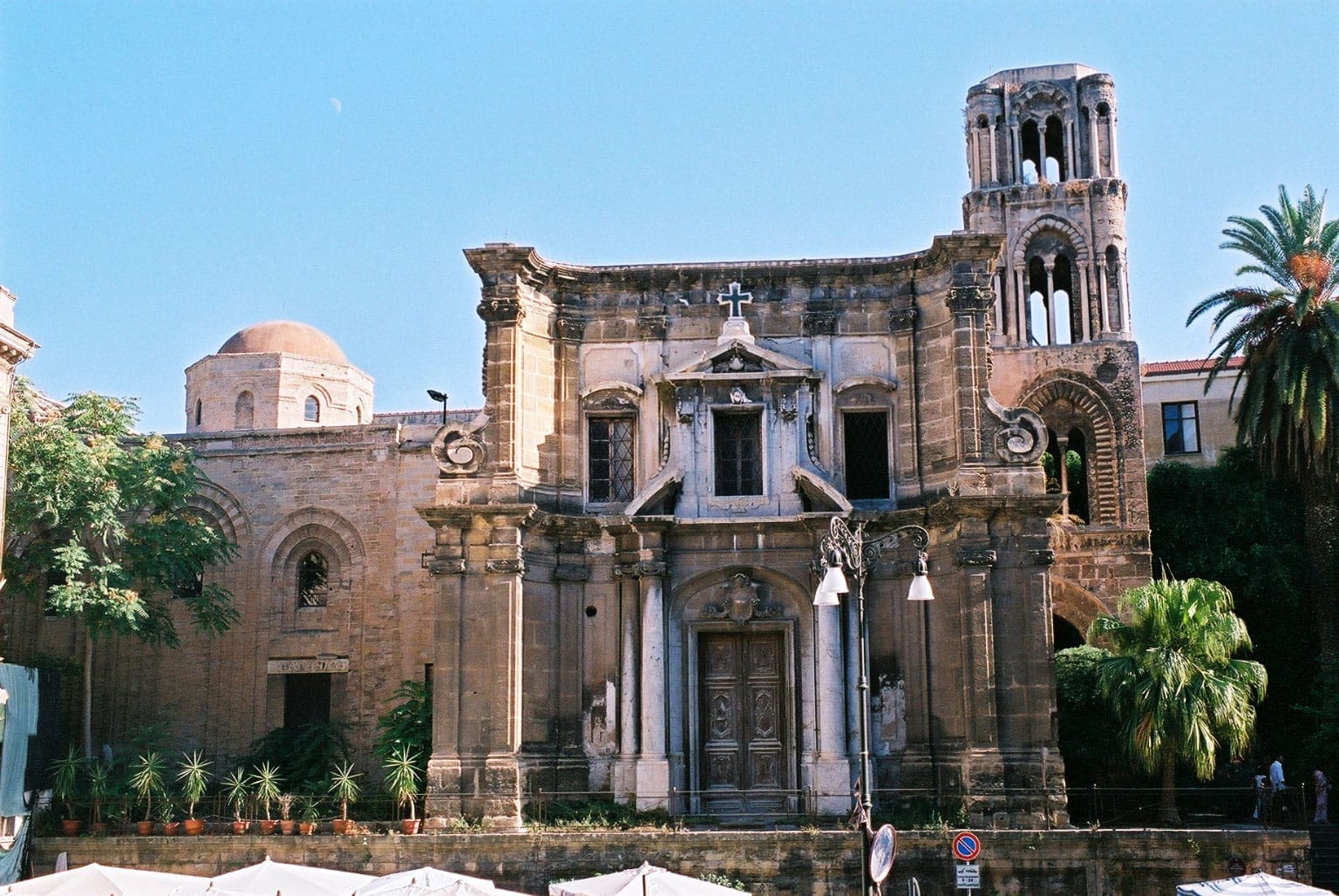
What Is the Church of the Martorana?
The Church of the Martorana, officially known as Santa Maria dell'Ammiraglio (Saint Mary of the Admiral), is one of Palermo's most architecturally layered buildings. Commissioned in 1143 by George of Antioch, admiral to the Norman king Roger II, it was designed as a commemorative church in thanks to the Virgin and decorated with mosaics executed by Greek craftsmen in the Byzantine tradition, likely trained in Constantinople. The result is a Norman shell encasing a fully Byzantine interior, a combination that exists almost nowhere else in Europe. The church sits on Piazza Bellini, steps from Quattro Canti, in the dense historic center of Palermo.
The name 'Martorana' comes not from the admiral but from Eloisa Martorana, a noblewoman who founded an adjacent Benedictine convent in 1193. In 1436 the church was transferred to her convent's care, and that association stuck. Today both names are in active use: Santa Maria dell'Ammiraglio in official and religious contexts, La Martorana in everyday speech.
The church is a component of the Arab-Norman Palermo UNESCO World Heritage serial site, inscribed in 2015 alongside the Palatine Chapel, Palermo Cathedral, Monreale Cathedral, and Cefalù Cathedral. Visiting it is not just a tick on a cultural checklist — it genuinely changes how you understand the political and artistic ambitions of Norman Sicily.
The Mosaics: What You Are Actually Looking At
The interior of the Martorana is small, almost surprisingly so. But that compression works in your favor: the mosaics are never far away. Created between roughly 1143 and 1155 by Byzantine craftsmen from Constantinople, they cover the cupola, the arches, and portions of the walls in gold tessera that pick up and throw back every photon of available light. The Christ Pantocrator in the dome — a severe, full-frontal figure against a gold ground — is the dominant image, surrounded by archangels and evangelists arranged with a strict hierarchical logic borrowed directly from Byzantine church decoration.
Two mosaics stand apart from the sacred program and have genuine historical importance. One shows Roger II being crowned by Christ, a political statement in mosaic: the Norman king depicted not by a pope or a patriarch, but by Christ directly, legitimizing his rule in visual terms. The other shows George of Antioch himself prostrate at the feet of the Virgin — the patron and builder rendered in permanent humility within his own commission. Both panels survive from the original 12th-century scheme and are among the earliest surviving examples of this kind of political iconography in the western Mediterranean.
💡 Local tip
Bring a small flashlight or use your phone torch. Parts of the interior, particularly the lower walls and transitional zones between mosaic panels, are poorly lit at certain times of day. The gold mosaics in the dome are best appreciated when morning light enters through the western windows.
The later Baroque additions — an extended nave and painted decorations added mainly in the 16th and 17th centuries — are noticeably different in quality and atmosphere from the 12th-century core. Some visitors find this contrast jarring; others find it honest, a visible record of the building's shifting identities over centuries. The original Greek-cross plan of the Norman church is still readable if you look at the floor pattern and the positions of the columns.
Tickets & tours
Hand-picked options from our booking partner. Prices are indicative; availability and final rates are confirmed when you complete your booking.
Entrance ticket with audioguide to Catania's St. Benedict Church
From 6 €Instant confirmationFree cancellationEtna South Upper Craters Guided Excursion from Taormina
From 42 €Instant confirmationFree cancellationTaormina private tour with an expert guide
From 42 €Instant confirmationFree cancellationIsola Bella boat tour and snorkeling
From 55 €Instant confirmationFree cancellation
The Experience by Time of Day
The Martorana opens at roughly 09:00–09:30 on Monday through Saturday and closes around 13:00 for the morning session, with additional afternoon opening hours on many days. Given that, mornings between 09:30 and 10:30 tend to offer the most favorable conditions: fewer tour groups, cooler air inside the stone building, and the best natural light for the dome mosaics.
By 11:00 on busy days, especially in spring and early autumn, organized tour groups arrive in waves. The interior is small enough that ten people moving through it changes the acoustic and spatial experience significantly. If you want to stand under the dome without jostling, come early. The church is also quieter on days with overcast skies, when the mosaics lose some of their gold luminosity but the space feels more contemplative.
⚠️ What to skip
The Martorana is an active place of worship for the Greek-Catholic community (Eparchy of Piana degli Albanesi). It may be closed without notice for liturgical events or local feast days. Hours indicated here — roughly Mon–Sat 09:00–13:00 with additional afternoon openings on many days — are based on visitor reports and should be verified locally or via the Eparchy before your visit.
Piazza Bellini: Context You Cannot Ignore
The Martorana shares Piazza Bellini with the Church of San Cataldo, a Norman chapel built around 1154 with a severe exterior marked by three distinctive red domes. San Cataldo's interior is sparse — no mosaics, minimal ornament — which makes it a useful contrast piece. Visiting both churches together (a combined ticket is often available) gives you a far more complete picture of Norman sacred architecture in Palermo than either building provides alone.
The square itself is one of Palermo's more pleasant outdoor spaces, shaded by trees and removed enough from the main traffic arteries to feel calm. In the morning, before the tourist flow peaks, you can hear the sounds of the surrounding neighborhood: shutters opening, a distant market vendor, the bells of nearby churches. The contrast between the noise of the historic streets just two blocks away and the relative quiet of Piazza Bellini is one of the small pleasures of this part of the city.
From Piazza Bellini, it is a short walk to the Quattro Canti intersection, the formal centerpiece of Norman Palermo's street grid, and a few minutes beyond that to the Palermo Cathedral. A focused morning can take in all three without rushing.
History in Layers: How the Building Changed
When George of Antioch completed Santa Maria dell'Ammiraglio in 1143, it was built in a Greek-cross plan, following Byzantine spatial conventions, but set within a Norman political context. This was intentional. Roger II's court in Palermo was genuinely multicultural — Arab administrators, Byzantine craftsmen, Latin clergy, and Norman nobility all operated within the same royal apparatus — and the buildings he and his officers commissioned were deliberately syncretic. The Martorana was not an accident of mixed influences; it was a programmatic statement.
After the 1190s, when the Martorana convent took root next door, the church began absorbing Latin practices alongside its Greek-rite traditions. The physical expansion of the nave in the 15th and 16th centuries, and subsequent Baroque overlay, progressively obscured the original compact Byzantine interior. Some of the earliest mosaics were lost during these campaigns. What survives in the dome and the western bays represents only a portion of what George of Antioch commissioned.
Today the church belongs to the Eparchy of Piana degli Albanesi, the Greek-Catholic diocese that serves the Albanian-speaking communities of Sicily — Arbëreshë communities whose ancestors came to the island in the 15th century. The liturgy celebrated here follows the Byzantine rite in the Arbëreshë dialect of Albanian. This means the Martorana is not just a museum piece: it is a living place of worship with a specific and continuous cultural identity.
Practical Notes for Your Visit
Piazza Bellini 3 is the address. The church is within easy walking distance of virtually every other historic-center attraction in Palermo. From the Quattro Canti, it is about a three-minute walk south. From the Norman Palace and Palatine Chapel, the walk is longer — around 20 minutes — but entirely flat and through central streets.
Several AMAT bus lines serve the historic center; check current routes at the AMAT Palermo website or at the stop nearest your accommodation. The area around Piazza Bellini is a Limited Traffic Zone (ZTL) for private vehicles, so driving directly to the square is not practical. Taxis and tour vehicles have designated drop-off points nearby.
Admission has been reported at around €2, with a discount when combined with San Cataldo. These figures should be treated as indicative. Prices for Palermo's smaller churches are not always posted online and can change without notice; bring small cash. Photography is generally permitted inside without flash, but confirm this on arrival as rules can vary during liturgical periods.
ℹ️ Good to know
Modest dress is required, as in all Sicilian churches: shoulders and knees covered. If you arrive without appropriate clothing, a scarf or light layer works. The stone interior stays noticeably cooler than the street outside, especially in summer — a factor worth noting if you are doing a long morning of sightseeing.
Accessibility information for the Martorana is not officially published in detail. The historic center's uneven paving and older building thresholds can present challenges for visitors with mobility considerations. Contact the Eparchy of Piana degli Albanesi or a local tourist office for current access conditions before visiting.
Is the Martorana Worth Your Time?
For anyone with an interest in medieval art, Byzantine history, or the specific cultural fusion that defines Norman Sicily, the Martorana is among the most concentrated and rewarding thirty minutes you can spend in Palermo. The mosaics are not inferior versions of what you find at Monreale Cathedral or the Palatine Chapel — they are smaller in scale but equally precise in execution, and in some ways more intimate because the space is so compressed.
Visitors who find religious interiors unengaging, or who are not interested in the historical context, may find the Martorana underwhelming relative to the effort of arriving during its restricted morning hours. The exterior, though architecturally interesting, is hemmed in by surrounding buildings and difficult to photograph cleanly. The experience is fundamentally about the interior, and that interior rewards attention and some prior reading.
If you are already visiting San Cataldo next door — and you should be — the combined cost and time investment for both churches is minimal. Treat them as a single stop rather than two separate decisions.
Insider Tips
- The mosaic showing Roger II crowned by Christ is on the left (north) wall as you enter — it is easy to miss if you walk straight toward the dome without pausing. Stop at the entrance and scan both side walls first.
- Visit San Cataldo immediately after or before the Martorana. The contrast between San Cataldo's bare Norman interior and the Martorana's gilded Byzantine decoration is one of the most instructive architectural comparisons in all of Sicily.
- The Martorana is an active Greek-Catholic church, and its calendar follows Byzantine feast days alongside Catholic ones. Visiting around Easter or major feast days of the Arbëreshë community can mean the church is closed or partially inaccessible — but if it is open during a service, the chanting in the Byzantine rite is something travelers rarely encounter in Sicily.
- The marzipan fruits sold in nearby pasticcerie are historically associated with this church: the nuns of the Martorana convent are credited with creating frutta di Martorana, the almond-paste confections shaped like fruits and vegetables, by the later Middle Ages. Look for them at traditional pastry shops around Piazza Bellini.
- Arrive at 09:30 when the doors open and you will often have the dome almost to yourself for ten to fifteen minutes before the first tour groups arrive.
Who Is Church of the Martorana For?
- Travelers interested in Byzantine art and Norman medieval history
- Architecture enthusiasts studying the Arab-Norman synthesis unique to Sicily
- Photographers who can work in low, warm interior light
- Anyone combining the Martorana with the nearby Palatine Chapel and Palermo Cathedral in a single Arab-Norman morning
- Curious visitors who want to understand Palermo beyond its Baroque streetscapes
Nearby Attractions
Other things to see while in Palermo:
- Ballarò Market
Stretching through the Albergheria district from Piazza Ballarò to Corso Tukory, the Mercato di Ballarò is Palermo's oldest continuously operating street market, with roots tracing back over a thousand years to Arab rule. It is free to enter, open daily, and unlike anything else in Sicily for raw atmosphere, local produce, and street food.
- Catacombs of the Capuchins
Below a quiet convent on the western edge of Palermo's historic centre, the Catacombs of the Capuchins hold one of the most extraordinary collections of preserved human remains anywhere in the world. Around 2,000 mummified bodies and skeletons line stone corridors carved from tuff rock, dressed in period clothing and arranged by profession, gender, and social status. It is an intimate, unsettling, and genuinely thought-provoking encounter with how a Mediterranean culture once confronted death.
- La Kalsa
La Kalsa is Palermo's oldest neighborhood, founded by Arab rulers in the 9th century as the city's administrative heart. Today it is a layered district of crumbling palazzi, Baroque churches, art-filled piazzas, and some of Palermo's most atmospheric street life. Free to explore and walkable in half a day, it rewards those who slow down.
- Mondello Beach
Mondello Beach is a wide crescent of pale sand framed by Monte Pellegrino and Monte Gallo, around 10 km north of central Palermo. Free to access, rich in Belle Époque architecture, and popular with both locals and visitors, it offers a genuine window into Palermitan summer life alongside reliable swimming conditions.