Church of San Cataldo, Palermo: The Arab-Norman Church with the Red Domes
Built in the mid-12th century, the Chiesa di San Cataldo is a compact Norman church on Piazza Bellini whose three terracotta domes have become one of Palermo's most photographed skylines. Inside, an original Cosmatesque mosaic floor and bare stone walls tell a story of layered history spanning medieval chancellors, a post office, and a crusading order. It is small, honest, and genuinely beautiful.
Quick Facts
- Location
- Piazza Bellini, Palermo historic centre, Sicily, Italy
- Getting There
- Walk from Palermo Centrale station (approx. 15 min); AMAT buses serve Via Maqueda nearby
- Time Needed
- 20–40 minutes inside; allow extra time for the piazza and La Martorana next door
- Cost
- Indicatively €2.50 full / €1.50 reduced (verify on site; no official tariff currently published)
- Best for
- Architecture lovers, medieval history, Arab-Norman UNESCO trail, photography
First Impressions: Three Domes on Piazza Bellini
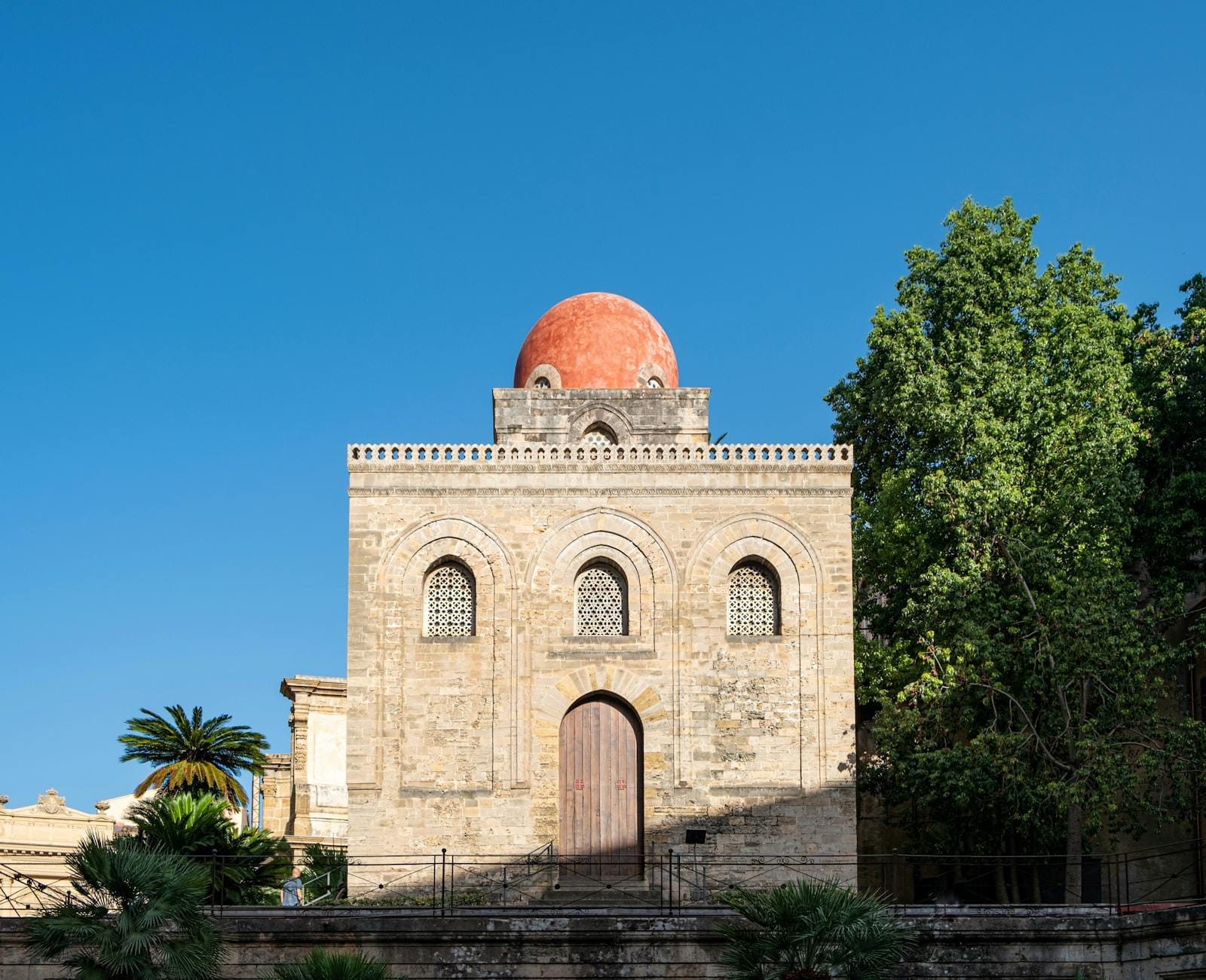
You see the Chiesa di San Cataldo before you fully understand what you are looking at. Arriving from Via Maqueda or cutting through the lanes south of the Quattro Canti, the three rounded terracotta domes appear above a low roofline without warning. They are small, perfectly proportioned, and deeply foreign-looking for a Christian church in an Italian city. That foreignness is the point: this is Norman architecture filtered through Arab and Byzantine traditions, built in the 12th century by people who treated those traditions as a common visual language.
Piazza Bellini, where San Cataldo stands, is a relatively quiet square by Palermo standards. A handful of cafe tables face the church. Pigeons settle on the crenellated parapet. The neighbouring church of Santa Maria dell'Ammiraglio, also known as La Martorana, is taller and more ornate, and it tends to draw the longer queues. San Cataldo, by contrast, receives a steadier, calmer trickle of visitors, which makes the experience inside considerably more reflective.
💡 Local tip
Opening hours are not published on the official custodian website and can change with little notice. Check locally on arrival, or contact the Equestrian Order of the Holy Sepulchre, which manages the church, before planning your visit around it.
History: A Chancellor's Church with Many Lives
San Cataldo was built in the mid-12th century and is associated with Maione da Bari, the powerful chancellor to Norman King William I of Sicily. Maione was one of the most influential men in the Norman court, and the church reflects his ambition: a private chapel of considerable architectural sophistication, positioned at the centre of a city that was then one of the wealthiest and most cosmopolitan in the Mediterranean world.
After Maione's death, also in 1160, the church passed through several hands, eventually coming under the diocese of Monreale. Its medieval function as a place of worship ended long before modernity arrived. By 1787 it had been converted into a post office, a reassignment that, while administratively convenient, stripped it of furnishings and left the interior in a state of considerable neglect. The 19th century brought restoration work aimed at recovering the church's medieval character, and that process revealed the extraordinary mosaic floor that visitors walk on today.
In 1937 the church was donated to the Equestrian Order of the Holy Sepulchre of Jerusalem, the Catholic institution that still holds and maintains it. The Order keeps it accessible to the public, and the resulting atmosphere is unusual: this is simultaneously an active property of a religious order and a recognized stop on one of Sicily's most significant heritage routes.
San Cataldo was inscribed as part of the "Arab-Norman Palermo and the Cathedral Churches of Cefalù and Monreale" UNESCO World Heritage serial site in 2015. That inscription formally recognised what architectural historians had argued for decades: that the Norman kingdom's fusion of Arab, Byzantine, and Latin building traditions produced something architecturally unique. For context on how this style plays out across Palermo, see the Arab-Norman Sicily guide.
Tickets & tours
Hand-picked options from our booking partner. Prices are indicative; availability and final rates are confirmed when you complete your booking.
Entrance ticket with audioguide to Catania's St. Benedict Church
From 6 €Instant confirmationFree cancellationEtna South Upper Craters Guided Excursion from Taormina
From 42 €Instant confirmationFree cancellationTaormina private tour with an expert guide
From 42 €Instant confirmationFree cancellationIsola Bella boat tour and snorkeling
From 55 €Instant confirmationFree cancellation
Architecture: What Makes This Building Remarkable
The exterior is immediately readable once you know what to look for. The three hemispherical domes sit on a flat, crenellated roofline, the battlements giving the church a fortress-like quality more associated with Islamic architecture than with Romanesque Europe. The walls are built in a warm golden stone, and the windows are small, round-arched, and framed with interlocking blind arcades. There is almost no sculptural decoration on the facade. The building communicates through geometry and proportion rather than imagery.
The interior is a rectangular hall divided by six columns into three naves. It is compact enough that you can take it in completely from a single standing position near the entrance. The columns are plain and relatively slender, topped with capitals that show varying degrees of ornament. The walls are bare stone: no frescoes, no gilded mosaics as you might find at the nearby Palatine Chapel. That plainness, which may disappoint visitors expecting Byzantine opulence, is actually part of the building's integrity. What was never added cannot be lost.
The floor is the interior's defining feature. It is a Cosmatesque mosaic, the term used for the style of inlaid geometric decoration in coloured marbles and stone developed in medieval Rome and southern Italy. The pattern at San Cataldo is intricate, with interlocking circles and geometric forms in terracotta, white, and grey. Much of it is original, which is genuinely rare. You will find yourself looking downward as much as upward, which almost never happens in major churches.
ℹ️ Good to know
Photography inside is generally permitted without flash. The floor photographs particularly well in diffuse morning light when the church first opens. Tripods may be restricted; check with the custodian on arrival.
Visiting in Practice: How the Experience Unfolds
Entry is through a door on the Piazza Bellini side. The interior is small enough that crowds of more than twenty people feel congested, so timing matters. Midday, particularly in summer, brings the highest foot traffic as coach groups work through Palermo's central sights. Morning visits, especially between opening time and about 10:30, offer noticeably more space and quieter light. In the summer months, the stone interior stays cool well into the morning even on very hot days.
There is no audio guide available inside, and signage is modest. Visitors who arrive without background knowledge may find the bare interior underwhelming. Reading about the Norman kingdom and its architectural legacy beforehand makes the visit substantially more rewarding. The church rewards close looking rather than passive wandering.
Dress modestly: shoulders and knees should be covered, as is standard for churches throughout Sicily. This applies to all visitors regardless of the season. The church is small and the custodians are present, so this is enforced in practice.
After visiting San Cataldo, the sensible next stop is Santa Maria dell'Ammiraglio, the Church of the Martorana, which shares the same piazza and offers a contrasting experience: its interior is richly covered in Byzantine mosaics that San Cataldo deliberately lacks. The two churches together give you the full range of Norman religious architecture in under an hour.
The Neighbourhood: Piazza Bellini and the Historic Centre
San Cataldo sits within walking distance of several of Palermo's most significant monuments. The Norman Palace and the Palatine Chapel are about fifteen minutes on foot to the southwest. The Ballarò market, one of Palermo's oldest street markets, is roughly the same distance to the south and offers a dramatically different experience: loud, fragrant, and crowded with traders selling produce, street food, and spices from North Africa and southern Italy.
Piazza Bellini itself connects to Via Maqueda, the city's main pedestrian spine, at the Quattro Canti intersection a few hundred metres north. If you are following the Arab-Norman heritage trail through Palermo, San Cataldo fits logically between the Palatine Chapel and the Monreale Cathedral, which lies a short bus or taxi ride southwest of the city centre.
Accessibility and Practical Limitations
The church's medieval structure means accessibility for visitors with reduced mobility is uncertain. The entrance may involve steps, and the historic fabric has not been adapted with modern accessibility infrastructure. If this is a concern, contact the Equestrian Order directly before visiting, as no formal accessibility information is published on the official custodian's site.
The building is small and has no internal seating for visitors, no cafe, and no gift shop. There are toilets at nearby cafes on Via Maqueda. Given the low admission cost and short visit time, San Cataldo works best as part of a wider morning in the historic centre rather than as a standalone destination.
⚠️ What to skip
Ticket prices (indicatively €2.50 full, €1.50 reduced) are not officially published and may change. No official tariff is listed on the custodian's site. Verify the current price on arrival.
Is San Cataldo Worth Your Time?
The honest answer is: yes, but with realistic expectations. This is not a large or lavish church. Visitors who enter hoping for gilded Byzantine mosaics or baroque ceiling paintings will be confused. The building's power is architectural and historical rather than decorative. It is a precise, austere, and genuinely unusual structure that looks unlike almost anything else in Italy, and understanding why it looks that way is half the experience.
For travellers with even a passing interest in medieval architecture, the Norman kingdom of Sicily, or the meeting of Arab, Byzantine, and Latin cultures, San Cataldo is one of the most concentrated and accessible demonstrations of all three in Palermo. The visit takes under an hour including the piazza, it costs very little, and it sits at the centre of a neighbourhood with several other worthwhile sights. That combination is rare.
If you are planning a wider itinerary that takes in Palermo's major sights, the one-week Sicily itinerary places San Cataldo within a logical route through the capital.
Insider Tips
- Visit immediately after opening, before the Martorana queue forms next door. When La Martorana is busy, San Cataldo is still calm, and you will have the mosaic floor largely to yourself.
- The exterior domes read best from across the piazza, from the corner nearest Via Maqueda. The afternoon light on the terracotta domes is warm and photogenic, but the interior light is better in the morning.
- If the church is momentarily closed on arrival, it often reopens within thirty minutes. The custodians take short breaks and are usually back quickly. The piazza has cafe seating where you can wait without pressure.
- The Cosmatesque floor is the highlight most visitors do not expect. Spend time on it before looking up. The geometric interlocking circles in the central nave are the best-preserved section.
- San Cataldo is not on the standard coach itinerary to the same degree as the Palatine Chapel or Monreale, so independent visitors often find it significantly quieter than those sites even during peak season.
Who Is Church of San Cataldo For?
- Travellers interested in medieval and Arab-Norman architecture who want a less crowded alternative to the Palatine Chapel
- Photographers looking for Palermo's most graphic exterior skyline shot: the three red domes against blue sky
- History-focused visitors following the UNESCO Arab-Norman heritage trail through Palermo
- Visitors with limited time who want to cover two contrasting Norman churches in one short stop, combining San Cataldo with La Martorana next door
- Travellers who appreciate architectural restraint and find stripped-back medieval interiors more moving than heavily decorated ones
Nearby Attractions
Other things to see while in Palermo:
- Ballarò Market
Stretching through the Albergheria district from Piazza Ballarò to Corso Tukory, the Mercato di Ballarò is Palermo's oldest continuously operating street market, with roots tracing back over a thousand years to Arab rule. It is free to enter, open daily, and unlike anything else in Sicily for raw atmosphere, local produce, and street food.
- Catacombs of the Capuchins
Below a quiet convent on the western edge of Palermo's historic centre, the Catacombs of the Capuchins hold one of the most extraordinary collections of preserved human remains anywhere in the world. Around 2,000 mummified bodies and skeletons line stone corridors carved from tuff rock, dressed in period clothing and arranged by profession, gender, and social status. It is an intimate, unsettling, and genuinely thought-provoking encounter with how a Mediterranean culture once confronted death.
- Church of the Martorana
Built in 1143 by a Norman admiral and decorated by craftsmen from Constantinople, the Church of the Martorana contains some of the most important Byzantine mosaics in the western Mediterranean. It sits on Piazza Bellini in Palermo's historic center, part of a UNESCO World Heritage site, and rewards visitors who arrive early and look up.
- La Kalsa
La Kalsa is Palermo's oldest neighborhood, founded by Arab rulers in the 9th century as the city's administrative heart. Today it is a layered district of crumbling palazzi, Baroque churches, art-filled piazzas, and some of Palermo's most atmospheric street life. Free to explore and walkable in half a day, it rewards those who slow down.