La Kalsa: Palermo's Ancient Arab Quarter Brought Back to Life
La Kalsa is Palermo's oldest neighborhood, founded by Arab rulers in the 9th century as the city's administrative heart. Today it is a layered district of crumbling palazzi, Baroque churches, art-filled piazzas, and some of Palermo's most atmospheric street life. Free to explore and walkable in half a day, it rewards those who slow down.
Quick Facts
- Location
- Southern edge of Palermo's historic center, steps from the waterfront, Palermo, Sicily, Italy
- Getting There
- Walkable from Palermo Centrale station (about 20 min on foot); AMAT city buses serve nearby Via Lincoln and the port area
- Time Needed
- 2–4 hours for a relaxed walk; half a day if visiting interior attractions
- Cost
- Free to walk and explore; individual museums and churches charge separate entry fees
- Best for
- History lovers, architecture enthusiasts, slow travelers, street photography
What La Kalsa Actually Is
La Kalsa is not a monument you visit and leave. It is a neighborhood, one of the oldest continuously inhabited quarters in Palermo, and understanding that distinction changes how you approach it. The name comes from the Arabic al-Khalisa, meaning roughly 'the chosen' or 'the pure one,' and the quarter was built in the 9th century as the fortified administrative heart of Palermo under Arab rule. Emirs, not tourists, once walked these streets.
What followed over the next twelve centuries was a palimpsest of rulers: Normans, Hohenstaufens, Aragonese, Spanish viceroys, and finally Italian unification. Each left marks. The Baroque churches came mostly in the 17th century. The bombed-out shells of palazzi, several of which still stand partially derelict, are a legacy of Allied air raids in 1943. The regeneration of piazzas and cultural spaces began in the 1990s and continues today. Walking La Kalsa is walking through all of that at once.
ℹ️ Good to know
La Kalsa is a public neighborhood with no gates, no entry fee, and no set opening hours. You can enter from multiple directions at any time of day or night. The experience changes dramatically depending on when you arrive.
The Texture of the Place: What You Actually See and Feel
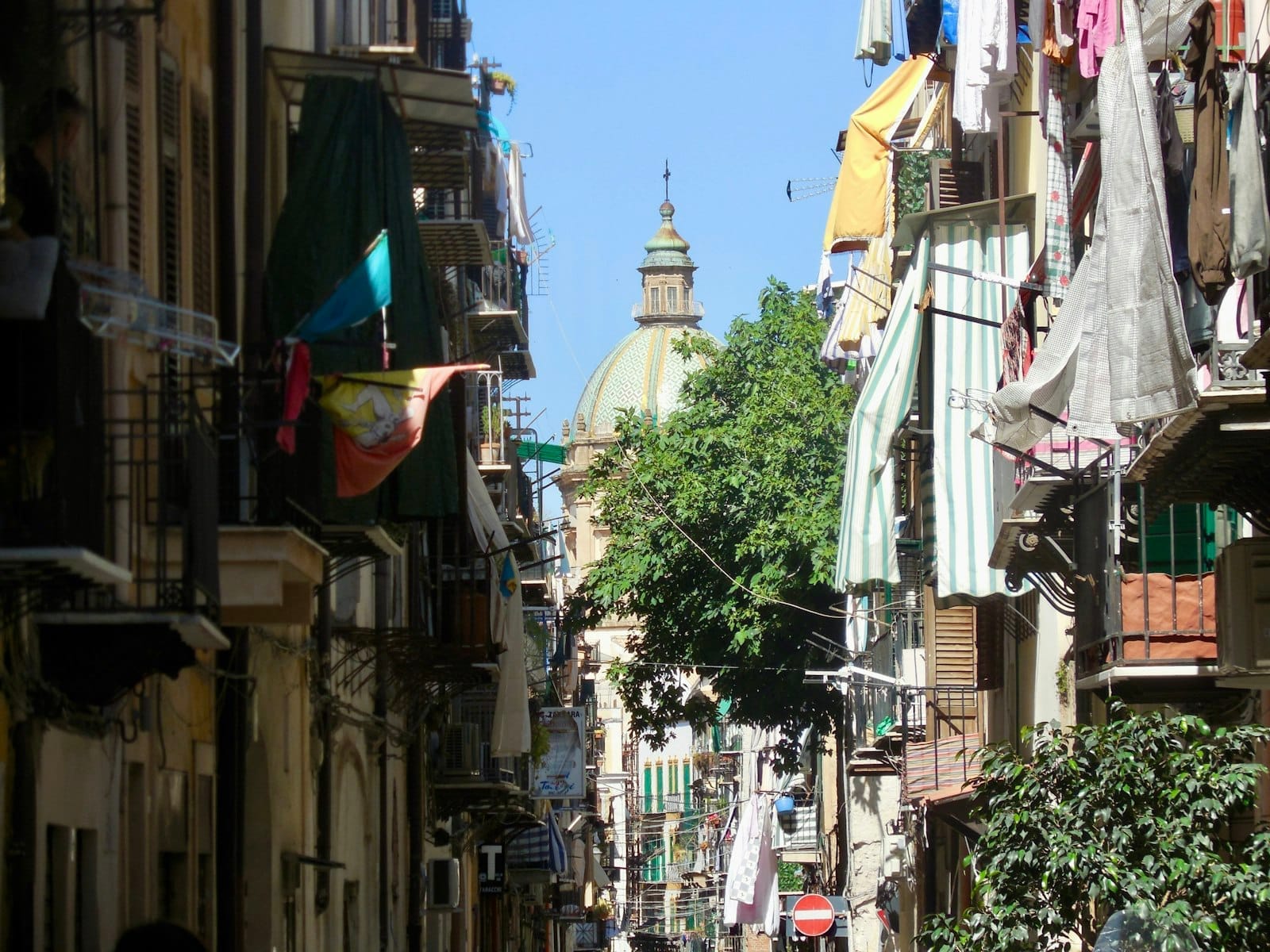
The streets of La Kalsa are narrow, often paved with worn basalt or patchy asphalt, flanked by facades that range from lovingly restored to dramatically ruined. This unevenness is not neglect in the simple sense. Some buildings were never rebuilt after the war, and their exposed interiors, with vines threading through broken rooflines and fig trees growing from collapsed floors, have become an accidental aesthetic. La Kalsa looks raw in a way that more polished historic centers do not.
The smell of the district shifts by block. Near the markets and the street food stalls around the Ballarò Market area, there is the sharp, citrusy scent of fresh produce mixing with frying oil. Deeper into the residential lanes, it becomes quieter and drier, with the faint mustiness of old stone. On warm evenings, when residents open ground-floor shutters, you catch fragments of television, cooking smells, and conversation in a blend of Italian and Sicilian dialect.
The soundscape is similarly layered. Scooters cut through the wider streets with the abruptness typical of southern Italian cities. The smaller vicoli go almost silent in the afternoon. Church bells from Santa Teresa alla Kalsa or the Church of the Gancia mark the hours with a slightly out-of-sync overlap that becomes its own rhythm after a while.
Tickets & tours
Hand-picked options from our booking partner. Prices are indicative; availability and final rates are confirmed when you complete your booking.
Etna South Upper Craters Guided Excursion from Taormina
From 42 €Instant confirmationFree cancellationTaormina private tour with an expert guide
From 42 €Instant confirmationFree cancellationIsola Bella boat tour and snorkeling
From 55 €Instant confirmationFree cancellationSyracuse and Ortygia Island guided tour from Taormina
From 65 €Instant confirmationFree cancellation
How the District Changes Through the Day
Morning is the most practical time to visit if you want to combine walking with entering specific buildings. Most churches and museums open between 9:00 and 10:00. The light in the narrow streets is soft until around 10:30, making it the best window for photography of facades, doorways, and the crumbling palazzo interiors visible from the street. Locals are going about their day with minimal tourist interference, and the bars are serving proper espresso and fresh cornetti.
Midday in July and August can be genuinely difficult. Temperatures on stone streets in direct sun regularly exceed 35°C, many small businesses close between 13:00 and 16:00, and the district empties. This is a good time to retreat to the gardens of Villa Giulia, one of Palermo's oldest public gardens, which sits at La Kalsa's southern edge along Via Lincoln and provides shade and a bench.
The most atmospheric time is late afternoon into evening, from about 17:00 onward. Piazza della Kalsa and the surrounding streets fill with residents, young people gather around Piazza Magione, and the golden hour light hits the ochre and terracotta facades at an angle that makes even derelict walls look deliberate. This is also when street food becomes more available and the neighborhood feels most alive. Come back after dinner and some of the quieter piazzas feel almost private.
💡 Local tip
If you visit in summer, plan your walking for before 11:00 or after 17:00. The midday heat on stone streets with limited shade is not pleasant, and most of the atmosphere disappears anyway during the siesta hours.
Key Landmarks Within La Kalsa
Piazza della Kalsa is the neighborhood's historic center point and a good place to orient yourself. The 17th-century church of Santa Teresa alla Kalsa faces the square with a facade that mixes Baroque confidence with the slightly faded dignity that characterizes much of the area. The piazza itself is a functioning public space rather than a set piece: benches are used by residents, and the edges have a few bar tables.
Piazza della Magione, slightly further inland, is perhaps the most relaxed open space in the district. The Norman-era church of La Magione faces a wide, tree-lined square where students and families gather in the evenings. The church dates from 1191, built by the chancellor of the Norman king William II and later given to the Teutonic Knights. Its simple, unadorned Norman interior is a striking contrast to the Baroque excess visible almost everywhere else in Palermo. Entry is typically free.
Palazzo Abatellis, on Via Alloro, houses the Galleria Regionale della Sicilia, one of the finest collections of medieval and Renaissance art in southern Italy. The building itself is a 15th-century late-Gothic Catalan palace, and the collection includes Antonello da Messina's Annunciation and the extraordinary fresco of the Triumph of Death. It is worth planning time for. Nearby, the Palazzo Abatellis is the kind of place many visitors underestimate until they are inside it.
The Church of Santa Maria dello Spasimo, known simply as Lo Spasimo, is one of La Kalsa's most unusual spaces. The church was never completed: construction began in 1506 but was interrupted, the building was used variously as a theatre, a hospital, and a plague refuge, and it was never given a roof. Today the roofless nave is an open-air venue for concerts and exhibitions, with the sky visible through the Gothic arches. Even when no event is scheduled, the internal courtyard is often open to walk through.
Historical Depth: From Arab Administrative Center to Wartime Ruin
The founding of La Kalsa in the 9th century reflects Palermo's position as one of the most important cities in the Arab Mediterranean. Under the Emirate of Sicily, Palermo was a city of hundreds of mosques, sophisticated irrigation systems, and a court culture that Arab geographers described as comparable to Córdoba. The Khalisa quarter was the walled enclosure reserved for the emir's palace, administrative buildings, and the garrison. None of those structures survive in their Arab form, but the irregular street grid and the compressed scale of the lanes follow the original Arab urban logic. For more on this layered cultural history, the Arab-Norman Sicily guide provides essential context.
The Norman conquest in 1072 changed the city's religious character but, crucially, did not erase its Arab urban structure. Many mosques were converted into churches rather than demolished, and Arab craftsmen continued to work under Norman patronage, which is why so much Norman architecture in Palermo carries geometric decorative programs that are distinctly Arab in origin. La Kalsa was absorbed into the Norman city rather than replaced.
The Allied bombing campaign of 1943 targeted the port area and surrounding neighborhoods. La Kalsa, sitting close to the waterfront, took significant damage. Unlike wealthier parts of the city that were eventually restored, sections of La Kalsa remained in partial ruin for decades. The demolition of bomb-damaged buildings that followed left empty lots in the urban fabric, some of which became informal parks or simply ground-level rubble. The process of reclaiming and restoring these spaces has been ongoing since at least the 1990s, with Piazza della Magione and Lo Spasimo among the more visible success stories.
Practical Walkthrough: How to Approach the Neighborhood
A logical entry point from the historic center is Via Vittorio Emanuele, which forms La Kalsa's northern edge and connects to the Quattro Canti intersection and, beyond it, the Norman Palace area. From Piazza Marina, turn south into Via Alloro to reach Palazzo Abatellis. Alternatively, approach from the Ballarò Market area to the west, which puts you in the neighborhood's more working-class, residential western section before moving east toward the piazzas. For the full market experience in that direction, Ballarò Market is one of Palermo's most intense street-level experiences and sits within easy walking distance.
Wear shoes with grip and flat soles. The basalt paving stones become slick after rain or in the morning before they have dried. Some sections of pavement are uneven enough to be a genuine trip hazard, particularly in the less-trafficked side streets. Visitors with mobility limitations will find the narrow lanes and uneven surfaces challenging, and there are no ramps or consistent accessibility infrastructure.
There are no large supermarkets or tourist-facing convenience stores within the core of La Kalsa. Bring water, especially in warm months. Small alimentari and corner bars are scattered through the neighborhood but follow local hours, which means limited options between roughly 13:00 and 16:00.
⚠️ What to skip
La Kalsa has historically had a reputation for petty theft, particularly in poorly lit side streets after dark. The neighborhood has improved considerably, but standard urban precautions apply: keep bags on your front, avoid displaying expensive camera equipment unnecessarily in quiet lanes at night, and stick to the more populated piazzas after 22:00.
Photography, Context, and Honest Expectations
La Kalsa photographs extremely well. The combination of ruined Baroque facades, laundry strung between balconies, worn stone alleys, and unexpected patches of vegetation growing through bomb-damaged walls produces images that feel both timeless and specific. The best light is in the morning before 10:30 and in the last two hours before sunset. Midday light in summer is flat and harsh.
Be honest about what this place is and is not. It is not a glossy restoration project. It is not uniformly beautiful. Some streets are unremarkable, some spaces are clearly struggling economically, and some of the 'atmosphere' is simply poverty and deferred maintenance. Visitors who want a cleaned-up, curated historic district will find it jarring. Visitors who want to see how a medieval city actually evolves, with all its contradictions, will find La Kalsa consistently interesting.
It fits naturally into a broader walk through Palermo's historic center. From La Kalsa you can reach the Quattro Canti in under ten minutes on foot, and the Palatine Chapel in the Norman Palace is about 20 minutes' walk to the northwest. Plan La Kalsa as part of a full day in the historic center rather than an isolated stop.
Insider Tips
- Lo Spasimo (the roofless church on Via dello Spasimo) occasionally hosts free or low-cost evening concerts and film screenings in summer. Check the local listings posted on the gate or ask at your accommodation. Arriving at dusk for an outdoor event in a roofless Gothic nave is an experience that is difficult to replicate anywhere else in Palermo.
- The stretch of Via Alloro between Piazza Marina and Palazzo Abatellis has several small antique and vintage dealers that open irregularly, usually mid-morning. If you are interested in Sicilian ceramics, old prints, or curiosities, it is worth checking what is out on the pavement as you pass.
- Villa Giulia, the public garden at the southern end of La Kalsa along Via Lincoln, is often missed by visitors focused on the churches and palazzi. The garden opened in 1778 and is one of the oldest public green spaces in Palermo. On a hot afternoon it is one of the few genuinely shaded spots near the historic center.
- The Church of La Magione charges no entry fee and sees far fewer visitors than the more famous churches of central Palermo. Its Norman cloister, austere and undecorated, is one of the quietest places in the city during peak season.
- If you want to understand the neighborhood's regeneration from a local perspective, look for the murals and street art on the streets between Piazza della Magione and Lo Spasimo. Several large-scale works by Sicilian and international artists were commissioned as part of urban renewal programs and give the area a character distinct from the rest of the historic center.
Who Is La Kalsa For?
- History and architecture travelers who want depth beyond the major UNESCO sites
- Street photographers looking for texture, contrast, and unposed urban life
- Slow travelers willing to spend half a day in a single neighborhood rather than checking off highlights
- Art lovers: Palazzo Abatellis houses work of national importance in a building most visitors skip entirely
- Travelers interested in how a medieval city actually functions today, not just how it looked in its prime
Nearby Attractions
Other things to see while in Palermo:
- Ballarò Market
Stretching through the Albergheria district from Piazza Ballarò to Corso Tukory, the Mercato di Ballarò is Palermo's oldest continuously operating street market, with roots tracing back over a thousand years to Arab rule. It is free to enter, open daily, and unlike anything else in Sicily for raw atmosphere, local produce, and street food.
- Catacombs of the Capuchins
Below a quiet convent on the western edge of Palermo's historic centre, the Catacombs of the Capuchins hold one of the most extraordinary collections of preserved human remains anywhere in the world. Around 2,000 mummified bodies and skeletons line stone corridors carved from tuff rock, dressed in period clothing and arranged by profession, gender, and social status. It is an intimate, unsettling, and genuinely thought-provoking encounter with how a Mediterranean culture once confronted death.
- Church of the Martorana
Built in 1143 by a Norman admiral and decorated by craftsmen from Constantinople, the Church of the Martorana contains some of the most important Byzantine mosaics in the western Mediterranean. It sits on Piazza Bellini in Palermo's historic center, part of a UNESCO World Heritage site, and rewards visitors who arrive early and look up.
- Mondello Beach
Mondello Beach is a wide crescent of pale sand framed by Monte Pellegrino and Monte Gallo, around 10 km north of central Palermo. Free to access, rich in Belle Époque architecture, and popular with both locals and visitors, it offers a genuine window into Palermitan summer life alongside reliable swimming conditions.