Palazzo Abatellis: Palermo's Regional Gallery of Sicily
Built between 1490 and 1495 for Francesco Abatellis, this Gothic-Catalan palace in Palermo's Kalsa quarter now houses the Galleria Regionale della Sicilia, Sicily's most important collection of medieval and Renaissance art. From the chilling Triumph of Death fresco to Antonello da Messina's luminous Annunciation, the building and its contents reward serious attention.
Quick Facts
- Location
- Via Alloro 4, Kalsa quarter, Palermo, Sicily, Italy
- Getting There
- Central Palermo by AMAT city bus, then a short walk through the Kalsa to Via Alloro
- Time Needed
- 1.5 to 2.5 hours for a thorough visit
- Cost
- Full €8, reduced €4; free entry on the first Sunday of each month
- Best for
- Art history lovers, architecture enthusiasts, hot-afternoon shelter, quiet cultural immersion
What Is Palazzo Abatellis?
Palazzo Abatellis, formally known as the Galleria Regionale della Sicilia, is a regional art museum housed in one of Palermo's finest late-Gothic palaces. The building was commissioned by Francesco Abatellis, a port authority official, and constructed between 1490 and 1495 in the Catalan-Gothic style that was fashionable under Aragonese rule. It later served as a Dominican convent before suffering serious bomb damage in World War II. The mid-20th-century restoration by architect Carlo Scarpa transformed it into a museum, turning the interplay between medieval stone and clean modern interventions into an exhibit in itself.
The museum sits in Palermo's Kalsa quarter, a neighborhood whose crumbling grandeur and slow gentrification give the approach to the museum its character. Walking down Via Alloro on a warm morning, past peeling plaster facades and the smell of espresso from corner bars, you arrive at a courtyard entrance that seems to belong to a different century entirely. That contrast, medieval refinement surrounded by a lived-in Sicilian street, is part of what makes the visit memorable.
ℹ️ Good to know
Opening hours: Tuesday to Friday 9:00–18:30; Saturday 9:00–18:30; Sunday and public holidays 9:00–13:00; closed Mondays. Verify hours on the official website before visiting, as public holiday schedules may vary.
The Building Itself: Gothic-Catalan Architecture in Stone
Before you look at a single painting, take ten minutes to absorb the architecture. The exterior facade on Via Alloro presents a restrained Gothic-Catalan composition: a pointed-arch portal framed by delicate carved stonework, slender windows with trefoil tracery, and a corner tower that gives the whole mass a quietly fortress-like presence. The honey-toned local limestone picks up the Palermo light differently at each hour of the day.
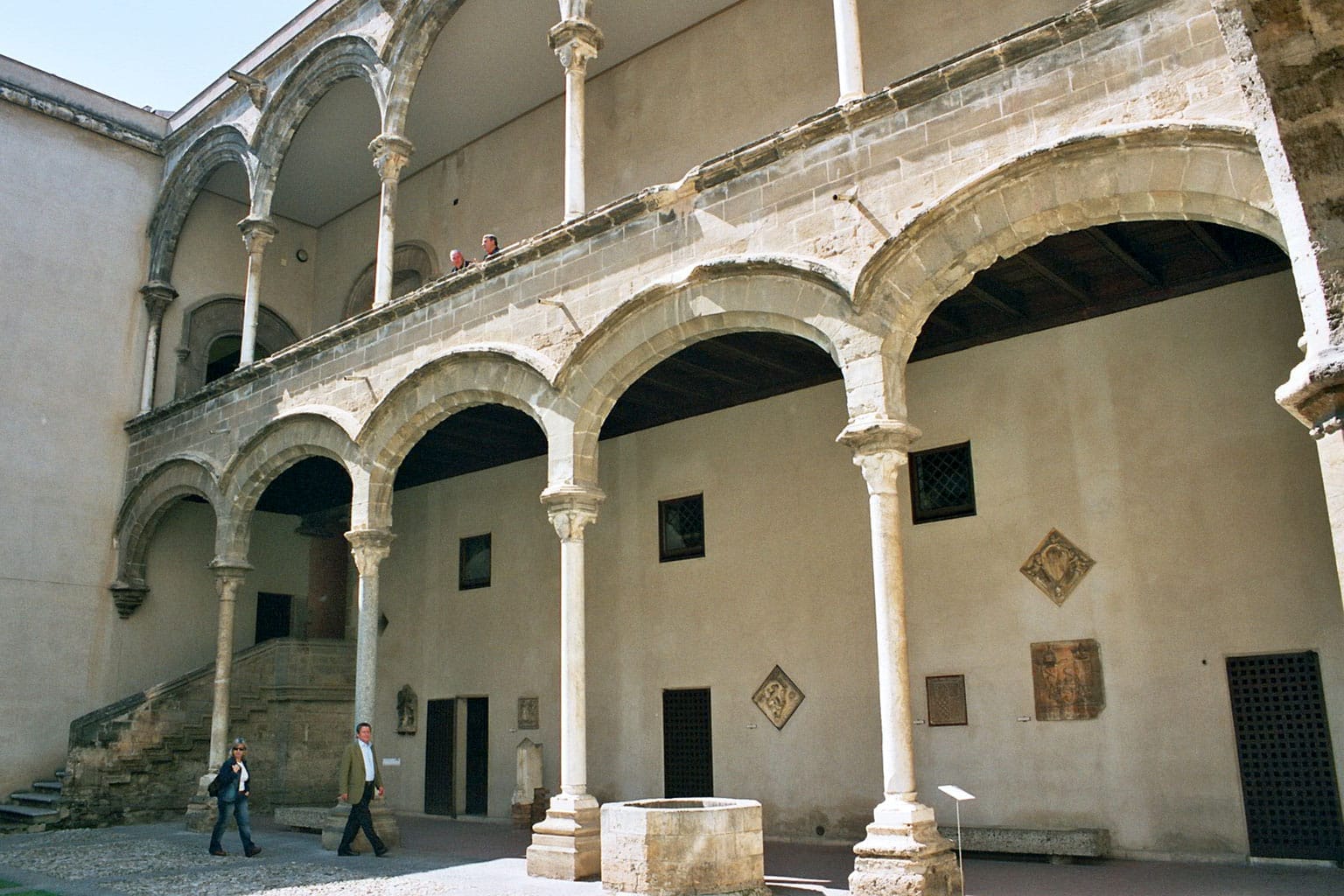
The central courtyard is the architectural heart of the palace. Loggia galleries on two levels are supported by slender columns whose capitals mix Gothic and late-medieval decorative motifs. In the morning, sunlight cuts at a low angle across the stone floor and the courtyard feels genuinely quiet, even in peak season, because most tourists visit the gallery rooms and move on without pausing here. It is worth the pause. Carlo Scarpa's restoration work is subtle but visible if you look: clean concrete thresholds, minimal steel fittings, and a studied neutrality in the added elements that refuses to compete with the original fabric.
Tickets & tours
Hand-picked options from our booking partner. Prices are indicative; availability and final rates are confirmed when you complete your booking.
Palazzo dei Normanni and Cappella Palatina guided tour
From 79 €Instant confirmationFree cancellationBuscemi and Palazzolo Private Tour with Typical Lunch of a Sicilian Family
From 1.000 €Instant confirmationFree cancellationEtna South Upper Craters Guided Excursion from Taormina
From 42 €Instant confirmationFree cancellationTaormina private tour with an expert guide
From 42 €Instant confirmationFree cancellation
The Collection: Medieval Painting, Sculpture, and the Triumph of Death
The museum's permanent collection spans roughly the 12th to the 16th century, with particular depth in Sicilian medieval sculpture and the painting of the Sicilian-Aragonese and early Renaissance periods. Ground-floor rooms contain Byzantine-influenced sculptural works, Islamic decorative fragments, and Romanesque stone pieces that reflect the island's layered history under successive rulers.
The undisputed highlight of the collection is the Triumph of Death, a large detached fresco of unknown authorship dating from around the mid-15th century. Originally from the courtyard of Palazzo Sclafani, it depicts Death as a skeletal horseman on a gaunt horse, trampling the rich and powerful while the poor look on as witnesses. The image is graphic, allegorical, and startlingly modern in its social commentary. It occupies an entire wall in a dedicated room, lit in a way that allows you to read the compositional layers slowly. Most visitors stand in silence for longer than they expect to. This fresco alone justifies the entrance fee.
The upper floors contain panel paintings and altarpieces, including works by Flemish-influenced Sicilian painters and, most significantly, Antonello da Messina's Annunciation, painted around 1474. Antonello, born in Messina and trained partly in Flanders, brought Northern European oil technique to Southern Italian painting. The Annunciation here shows the Virgin Mary at the moment of the angelic message, her eyes directed at the viewer rather than an angel, her expression one of composed interiority rather than theatrical surprise. It is a small panel but it holds attention in a way few works in the building do. The room is usually calm enough to sit with it properly.
💡 Local tip
Photography without flash is generally permitted in the museum rooms, but always check signage at the entrance to each gallery. For the Triumph of Death fresco, arrive early: the room is small and a single school group can make a reflective viewing impossible.
How the Experience Changes by Time of Day
Mornings from opening until around 11:00 are the quietest. The light in the courtyard is at its most atmospheric and the gallery rooms are sparsely attended, which makes a real difference in a building where the spaces are intimate rather than grand. This is the time to spend with the Antonello panel and the sculptural works without competing for sight lines.
By late morning, tour groups begin to arrive, particularly on weekdays. The Triumph of Death room fills quickly once a guide starts talking. If you arrive at 11:30 or later, consider starting your visit with the upper-floor paintings and working backward to the fresco once the group has moved on. On Sunday mornings, the museum closes at 13:00, which means the practical window is compressed. Arriving by 9:30 on a Saturday gives you roughly three hours, enough for a thorough visit, but the shortened hours catch some visitors by surprise.
Summer afternoons in Palermo are genuinely hot, often exceeding 30 degrees Celsius on the street. The museum's thick stone walls keep the interior noticeably cooler, which makes a mid-afternoon visit during July or August more pleasant than it might be at most outdoor sites. Bring water regardless.
Practical Walkthrough: Getting There and Navigating the Museum
Palazzo Abatellis is in the Kalsa, Palermo's southeastern historic quarter. From the city center, it is a 15 to 20-minute walk along Via Roma and then through the Kalsa's narrow streets. AMAT city buses serve central Palermo; alight near Piazza della Kalsa and follow Via Alloro south to number 4. Taxis from the central station take around 10 minutes. If you are combining the visit with other Palermo monuments, the Kalsa neighborhood contains several other points of interest within easy walking distance, including Santa Maria dello Spasimo and the oratory of San Lorenzo.
Tickets are purchased at the entrance. The full adult price is €8 and the reduced rate is €4. Entry is free on the first Sunday of each month, which makes those Sundays noticeably busier than usual. There is no advance booking system for general admission; you pay on arrival.
The layout is spread across two main floors connected by a staircase, with the courtyard accessible from the ground floor. Room labeling and description panels are available in Italian; English-language material is available but coverage varies. An audio guide or a printed guide purchased at the ticket desk adds considerably to the experience for visitors without a background in medieval Sicilian art.
⚠️ What to skip
The museum is closed on Mondays. Sunday hours are reduced to 9:00–13:00. A visit attempted on a Monday or after midday on a Saturday will result in a closed door. Check the official website before traveling to the Kalsa specifically for this museum.
Palazzo Abatellis is a historic palace with stairs and uneven stone flooring. Formal accessibility information is not provided in official public sources; visitors with mobility requirements should contact the museum directly before their visit to clarify current arrangements.
Cultural Context: Why This Building and Collection Matter
Sicily's art history is inseparable from the sequence of cultures that ruled the island: Greek, Roman, Byzantine, Arab, Norman, Hohenstaufen, Aragonese, and Spanish. Palazzo Abatellis was built at a pivotal moment, during the Aragonese period, when Catalan Gothic architecture was the prestige style imported from the Iberian Peninsula. The palace stands as one of the clearest surviving examples of that influence in Palermo, alongside buildings like the Zisa Castle and the Arab-Norman monuments farther north.
The collection reflects Sicily's position as a crossroads. Flemish technique arrived here through trade and the political connections of the Aragonese court, which is why Antonello da Messina's work looks unlike anything produced in mainland Italy at the same period. Byzantine formal conventions appear in sculpture carved decades or even centuries after they had been abandoned in Constantinople. For anyone exploring Sicily's Arab-Norman heritage across Palermo, Palazzo Abatellis offers an important counterpoint: a building and collection from the later Aragonese period that shows what came after the Norman synthesis.
Honest Assessment: Is It Worth Your Time?
This is not a large or encyclopedic museum. The collection is selective, and some rooms contain works of specialist interest with limited appeal to casual visitors. If you are primarily interested in ancient Greek or Roman archaeology, this is not the right destination; Palermo's Museo Archeologico Salinas covers that ground more extensively.
For anyone with genuine interest in medieval art, Italian Renaissance painting, or Gothic architecture, Palazzo Abatellis is one of the most rewarding museum visits in southern Italy. The Triumph of Death fresco and the Antonello Annunciation are works of genuine importance, not regional curiosities. The building itself is worth seeing for architectural reasons alone. Budget travelers will appreciate that the first Sunday of each month offers free entry without the overcrowding that similar schemes generate at more famous institutions. If you are putting together a one-week Sicily itinerary, half a morning here fits naturally before or after exploring the rest of the Kalsa.
Who should skip it: visitors on a very tight schedule with no particular interest in medieval or early Renaissance art, families with restless young children who are not museum-ready, and anyone visiting Palermo for a single afternoon who needs to prioritize outdoor monuments. The museum is deliberately calm and contemplative; it rewards patience rather than a quick pass-through.
Insider Tips
- The first Sunday of each month is free, but it brings more visitors than usual. If you want free entry without crowds, arrive at 9:00 sharp on that Sunday rather than mid-morning.
- The courtyard is often overlooked by visitors who move straight into the gallery rooms. Spend time in it before and after touring the collection; the light changes noticeably over the course of a morning.
- The Triumph of Death fresco is in a small room that fills quickly when a guided tour is present. Check where the tour group is when you enter and sequence your visit to arrive at that room between groups.
- Palermo's AMAT bus routes change periodically. Rather than relying on a specific line number, ask your accommodation for the current best bus to 'Piazza della Kalsa' or simply walk from the historic center, which is faster than waiting for infrequent buses in the Kalsa.
- If you are visiting in summer, the museum's stone interior stays noticeably cooler than the street. Scheduling your visit for 12:00 to 14:00 in July or August turns a practical necessity into an advantage, as this is when attendance is typically lower.
Who Is Palazzo Abatellis For?
- Art history enthusiasts interested in medieval and early Renaissance Sicilian painting
- Architecture visitors focused on Gothic-Catalan palace design
- Travelers seeking a quiet, contemplative museum experience away from major tourist crowds
- Anyone exploring Palermo's Kalsa quarter who wants to understand the neighborhood's layered history
- Budget travelers visiting on the first Sunday of the month for free entry
Nearby Attractions
Other things to see while in Palermo:
- Ballarò Market
Stretching through the Albergheria district from Piazza Ballarò to Corso Tukory, the Mercato di Ballarò is Palermo's oldest continuously operating street market, with roots tracing back over a thousand years to Arab rule. It is free to enter, open daily, and unlike anything else in Sicily for raw atmosphere, local produce, and street food.
- Catacombs of the Capuchins
Below a quiet convent on the western edge of Palermo's historic centre, the Catacombs of the Capuchins hold one of the most extraordinary collections of preserved human remains anywhere in the world. Around 2,000 mummified bodies and skeletons line stone corridors carved from tuff rock, dressed in period clothing and arranged by profession, gender, and social status. It is an intimate, unsettling, and genuinely thought-provoking encounter with how a Mediterranean culture once confronted death.
- Church of the Martorana
Built in 1143 by a Norman admiral and decorated by craftsmen from Constantinople, the Church of the Martorana contains some of the most important Byzantine mosaics in the western Mediterranean. It sits on Piazza Bellini in Palermo's historic center, part of a UNESCO World Heritage site, and rewards visitors who arrive early and look up.
- La Kalsa
La Kalsa is Palermo's oldest neighborhood, founded by Arab rulers in the 9th century as the city's administrative heart. Today it is a layered district of crumbling palazzi, Baroque churches, art-filled piazzas, and some of Palermo's most atmospheric street life. Free to explore and walkable in half a day, it rewards those who slow down.