Capuchin Catacombs of Palermo: What You'll Actually See Inside
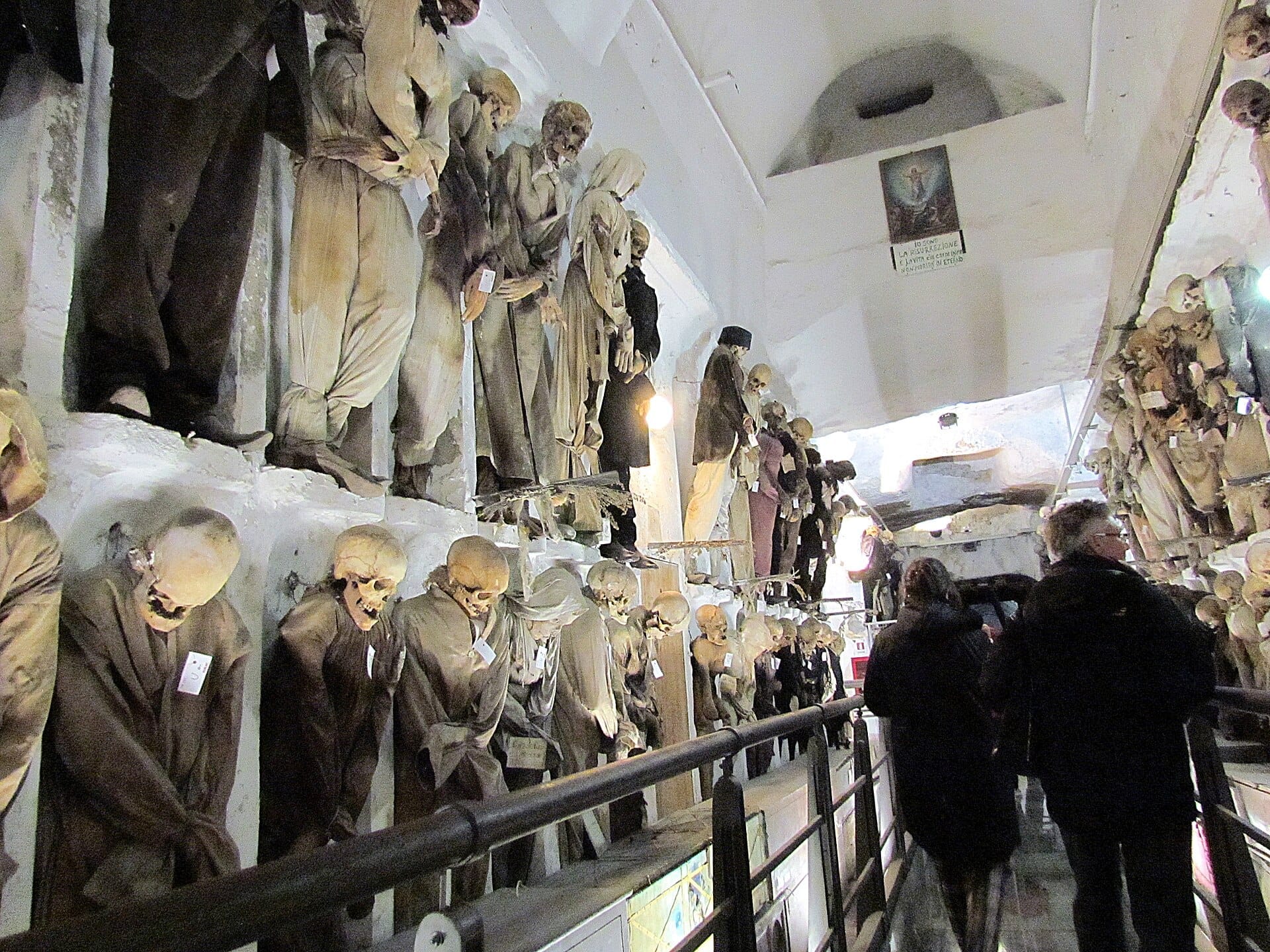
Below a quiet convent on the western edge of Palermo's historic centre, the Catacombs of the Capuchins hold one of the most extraordinary collections of preserved human remains anywhere in the world. Around 2,000 mummified bodies and skeletons line stone corridors carved from tuff rock, dressed in period clothing and arranged by profession, gender, and social status. It is an intimate, unsettling, and genuinely thought-provoking encounter with how a Mediterranean culture once confronted death.
Quick Facts
- Location
- Piazza Cappuccini 1, 90129 Palermo, Sicily, Italy (entrance on Via Pindemonte, near the church of Santa Maria della Pace)
- Getting There
- Metro: Palazzo Reale–Orleans (approx. 10–15 min walk); several AMAT bus lines pass nearby
- Time Needed
- 45–75 minutes for most visitors
- Cost
- Approx. €5 per person (verify current price at the entrance or official site)
- Best for
- History lovers, those interested in anthropology, visitors seeking something genuinely different from Sicily's usual baroque and beach circuit
- Official website
- www.catacombefraticappuccini.com/en
What Are the Capuchin Catacombs?
The Catacombs of the Capuchins, known in Italian as the Catacombe dei Cappuccini, occupy a network of underground galleries carved from tuff rock beneath the Capuchin church and convent in the Capo district of Palermo. The complex extends over several hundred metres of corridor space and holds an estimated 2,000 mummified bodies and skeletal remains, making it one of the largest collections of preserved human bodies in the world.
The site originated in 1599 when the Capuchin friars of Palermo needed a new burial space. The first body interred was Fra Silvestro da Gubbio, a friar whose remarkably well-preserved remains were placed in the newly excavated corridors beneath the convent. Word spread quickly that the tuff environment, combined with specific desiccation and preparation techniques used by the friars, was producing unusually intact corpses. Within decades, the catacombs became a prestigious burial destination for Palermo's secular elite: priests, professionals, noblewomen, and children were added alongside the friars, each arranged and dressed according to the customs of their era.
Burials continued until 1880, when the cemetery was definitively closed, except for a few exceptional interments in the early 20th century. The last person officially buried here was Rosalia Lombardo, a two-year-old girl who died in 1920 and whose remarkably preserved body, placed in a sealed glass case, has become the most-photographed and most-discussed single exhibit in the entire complex.
ℹ️ Good to know
Opening hours vary by season. Recent schedules have typically been 09:00–13:00 and 15:00–18:00 with a daily midday closure, but days of operation can change. Always verify current hours on the official site or by contacting the convent directly before visiting.
Walking the Corridors: What You Will Encounter
The entrance leads down a stone ramp into a world that smells of old stone and cool, dry air. The temperature in the galleries stays noticeably lower than street level even in the height of summer, partly because of the tuff geology and partly because of the midday closure that prevents heat from building up inside. If you arrive shortly after the afternoon reopening, the corridors are at their quietest.
The remains are arranged along the corridor walls and in alcoves, organized into distinct sections: men, women, virgins, children, priests, monks, and professionals. The categorization itself is a document of 17th and 18th-century Sicilian society. Men in the professional section are accompanied by placards identifying them as doctors, lawyers, or military officers. Women from noble families are dressed in silk that has dried and darkened over centuries. The monks wear their habits, some reduced to skeleton with cloth draped over bone, others with facial features still partially intact.
Protective grills run along the corridors to prevent physical contact with the remains, and photography is officially not permitted anywhere in the complex. This is worth noting before you arrive: visitors who come primarily for social media content will find the ban enforced. The prohibition is also part of what makes the visit feel serious rather than theatrical.
Tickets & tours
Hand-picked options from our booking partner. Prices are indicative; availability and final rates are confirmed when you complete your booking.
Etna South Upper Craters Guided Excursion from Taormina
From 42 €Instant confirmationFree cancellationTaormina private tour with an expert guide
From 42 €Instant confirmationFree cancellationIsola Bella boat tour and snorkeling
From 55 €Instant confirmationFree cancellationSyracuse and Ortygia Island guided tour from Taormina
From 65 €Instant confirmationFree cancellation
Rosalia Lombardo and the Science of Preservation
The most visited spot in the entire catacomb is a small side chapel where Rosalia Lombardo lies in a sealed glass case. She died in December 1920 at the age of two, and her father, devastated by grief, commissioned the embalmer Alfredo Salafia to preserve her. Salafia's formula, which included formalin, zinc salts, glycerin, salicylic acid, and alcohol, produced results so effective that Rosalia still appears to be sleeping rather than dead, more than a century later.
Her preservation is so complete that researchers studying her case have noted what appears to be a slight opening and closing of her eyelids at certain times of day, an optical effect caused by light angles and the position of the case. Scientists from Palermo's Institute for Mummies and the Iceman have conducted non-invasive scans of her body to document the internal state of preservation, finding her organs largely intact.
Visitors often spend more time at this one case than anywhere else in the complex. There is something about a child preserved with such perfection that short-circuits the detachment most adults manage to maintain elsewhere in the tunnels. It is the most affecting moment in the visit, and it is quiet, genuinely quiet, in a way that makes it easy to stand and look without feeling crowded.
Historical and Cultural Context
To understand why Palermo's wealthiest families wanted their relatives displayed here rather than buried in ground, you need to understand the early modern Sicilian relationship with death and commemoration. Being interred in the catacombs, dressed and visible, was a statement of social status. Families would visit their dead relatives, sometimes repairing or adjusting their clothing, as a way of maintaining a continued relationship with the deceased. The dead were not absent; they were present, observable, and part of the community of the living.
This practice was not unique to Sicily, but few places in the world executed it on this scale or preserved it so completely. For context, the broader Capuchin tradition of memento mori decorations can be seen in Rome's famous Capuchin Crypt, but the Palermo catacombs are significantly larger and include secular burials that make them a more complex social document. If you are visiting Palermo with a serious interest in the island's layered history, the catacombs complement other major sites: the Palatine Chapel and the Norman Palace show how rulers expressed power through sacred space above ground; the catacombs show how ordinary wealth expressed itself below it.
The mummification techniques varied over time. Early burials relied on the natural desiccating properties of the tuff environment. Later, friars developed more active methods, including washing bodies in vinegar and placing them in drying rooms called colatoi before moving them to their permanent positions. The results are uneven, which is part of what makes a walk through the corridors so visually varied: some figures are nearly skeletal, others retain skin, hair, and features.
Time of Day and Crowd Patterns
The catacombs see a steady flow of visitors year-round, but crowding is rarely severe given the site's slightly off-centre location and the midday closure that naturally breaks visitor flow. Morning sessions, from opening until around 11:30, tend to be quieter, with visitors who have planned ahead arriving before the tourist buses. The late afternoon session, roughly 15:30 to closing, is the most reliably peaceful window, especially on weekdays outside of July and August.
In summer, the contrast between the 30-plus degree heat of Palermo's streets and the cool, dim corridors underground is immediately striking. Bring a light layer: the temperature drop is enough to feel uncomfortable if you are dressed purely for outdoor summer heat. In winter, the galleries feel less dramatically cool, but the morning light filtering through the entrance area creates a different atmosphere, slightly more austere.
💡 Local tip
If you are visiting Palermo in summer, the afternoon catacomb session makes an excellent midday refuge from peak heat. The site reopens around 15:00 and the streets around Piazza Cappuccini are usually calmer than the historic centre at that hour.
Getting There and Practical Logistics
The catacombs are located at Piazza Cappuccini 1, with the physical entrance on Via Pindemonte, near the church of Santa Maria della Pace. The nearest metro stop is Palazzo Reale–Orleans, about 10 to 15 minutes on foot heading southwest. Several AMAT Palermo bus lines also serve streets nearby; checking the AMAT route planner before departure will save time, as the Capo district's street layout is not straightforward for first-time visitors.
On foot from the historic centre, the walk from the Quattro Canti takes around 20 minutes through the Capo neighbourhood, passing the Capo market along the way. This route is worth considering as part of a broader morning walk through Palermo's older residential quarters, which feel noticeably different from the more tourist-oriented streets around Via Vittorio Emanuele.
The site is generally not wheelchair accessible, as confirmed by the physical layout of the underground galleries, which involve ramps and uneven stone floors. Visitors with mobility limitations should be aware of this before planning the trip. Children can visit, but parents should use judgement: the experience is more appropriate for older children who can process what they are seeing calmly. Some younger children find it distressing.
Who Should Think Twice
This is not an attraction that works for everyone, and that is worth stating plainly. Visitors who are uncomfortable with human remains, even those presented in a respectful and historical context, will not enjoy it. The remains are displayed at close range along open corridors: there is no gradual build-up or preparation, you are simply inside a space lined with bodies. People with strong death anxiety, or those who find such displays voyeuristic rather than educational, are better served by Palermo's extraordinary above-ground cultural sites.
Similarly, visitors who are pressed for time and looking for a quick photogenic stop will find the photography ban frustrating and the experience less suited to their goals. The catacombs reward slow, attentive visitors. Those with only a single day in Palermo might weigh this against other priorities, such as the Palermo Cathedral or the Ballarò market, which offer more variety in a shorter time.
Insider Tips
- The midday closure is strictly observed. Arriving at 12:45 expecting to get in will not work. Plan your morning visit to arrive by 11:00 at the latest, or arrive promptly at 15:00 for the afternoon session.
- The Rosalia Lombardo chapel is at the far end of the complex, not near the entrance. Do not rush through the earlier corridors assuming you can circle back: the layout is largely linear and most visitors follow a single direction through the galleries.
- Photography is prohibited throughout, and the ban is enforced. Leave camera bags and conspicuous equipment at your accommodation if you want to avoid friction at the entrance.
- The admission fee is paid at the entrance and is cash-based at many religious sites in southern Italy. Bring coins and small notes rather than relying on card payment being available, and verify the current price, which has been reported at around €5 but may have changed.
- The convent is a functioning religious community. Modest dress is expected: shoulders covered and knees covered. This is standard for religious sites across Sicily, so if you are following a day-trip itinerary that includes multiple churches or monuments, dressing appropriately from the start makes logistics easier.
Who Is Catacombs of the Capuchins For?
- Visitors with a serious interest in history, anthropology, or the cultural history of death and commemoration
- Travellers who have already seen Palermo's main baroque and Norman monuments and want something genuinely different
- People interested in the science of preservation and historical embalming techniques
- Solo travellers or couples looking for a contemplative, non-rushed experience away from large group crowds
- History-focused families with older children who can engage with the subject thoughtfully
Nearby Attractions
Other things to see while in Palermo:
- Ballarò Market
Stretching through the Albergheria district from Piazza Ballarò to Corso Tukory, the Mercato di Ballarò is Palermo's oldest continuously operating street market, with roots tracing back over a thousand years to Arab rule. It is free to enter, open daily, and unlike anything else in Sicily for raw atmosphere, local produce, and street food.
- Church of the Martorana
Built in 1143 by a Norman admiral and decorated by craftsmen from Constantinople, the Church of the Martorana contains some of the most important Byzantine mosaics in the western Mediterranean. It sits on Piazza Bellini in Palermo's historic center, part of a UNESCO World Heritage site, and rewards visitors who arrive early and look up.
- La Kalsa
La Kalsa is Palermo's oldest neighborhood, founded by Arab rulers in the 9th century as the city's administrative heart. Today it is a layered district of crumbling palazzi, Baroque churches, art-filled piazzas, and some of Palermo's most atmospheric street life. Free to explore and walkable in half a day, it rewards those who slow down.
- Mondello Beach
Mondello Beach is a wide crescent of pale sand framed by Monte Pellegrino and Monte Gallo, around 10 km north of central Palermo. Free to access, rich in Belle Époque architecture, and popular with both locals and visitors, it offers a genuine window into Palermitan summer life alongside reliable swimming conditions.