Mondello Beach: Palermo's Favourite Sandy Escape
Mondello Beach is a wide crescent of pale sand framed by Monte Pellegrino and Monte Gallo, around 10 km north of central Palermo. Free to access, rich in Belle Époque architecture, and popular with both locals and visitors, it offers a genuine window into Palermitan summer life alongside reliable swimming conditions.
Quick Facts
- Location
- Mondello, Palermo — around 10 km north of the city centre, between Monte Pellegrino and Monte Gallo
- Getting There
- Bus 806 from central Palermo (approx. 30 min; services are more frequent in summer and reduced in winter rather than strictly April–October seasonal); taxi or car 10–20 min depending on traffic
- Time Needed
- Half a day minimum; a full day in summer
- Cost
- Free public beach access; private lido sunbed and umbrella hire around €30 for two chairs and an umbrella (prices vary by operator and season)
- Best for
- Families, sun seekers, architecture lovers, anyone wanting a genuine Palermitan beach day
What Is Mondello Beach?
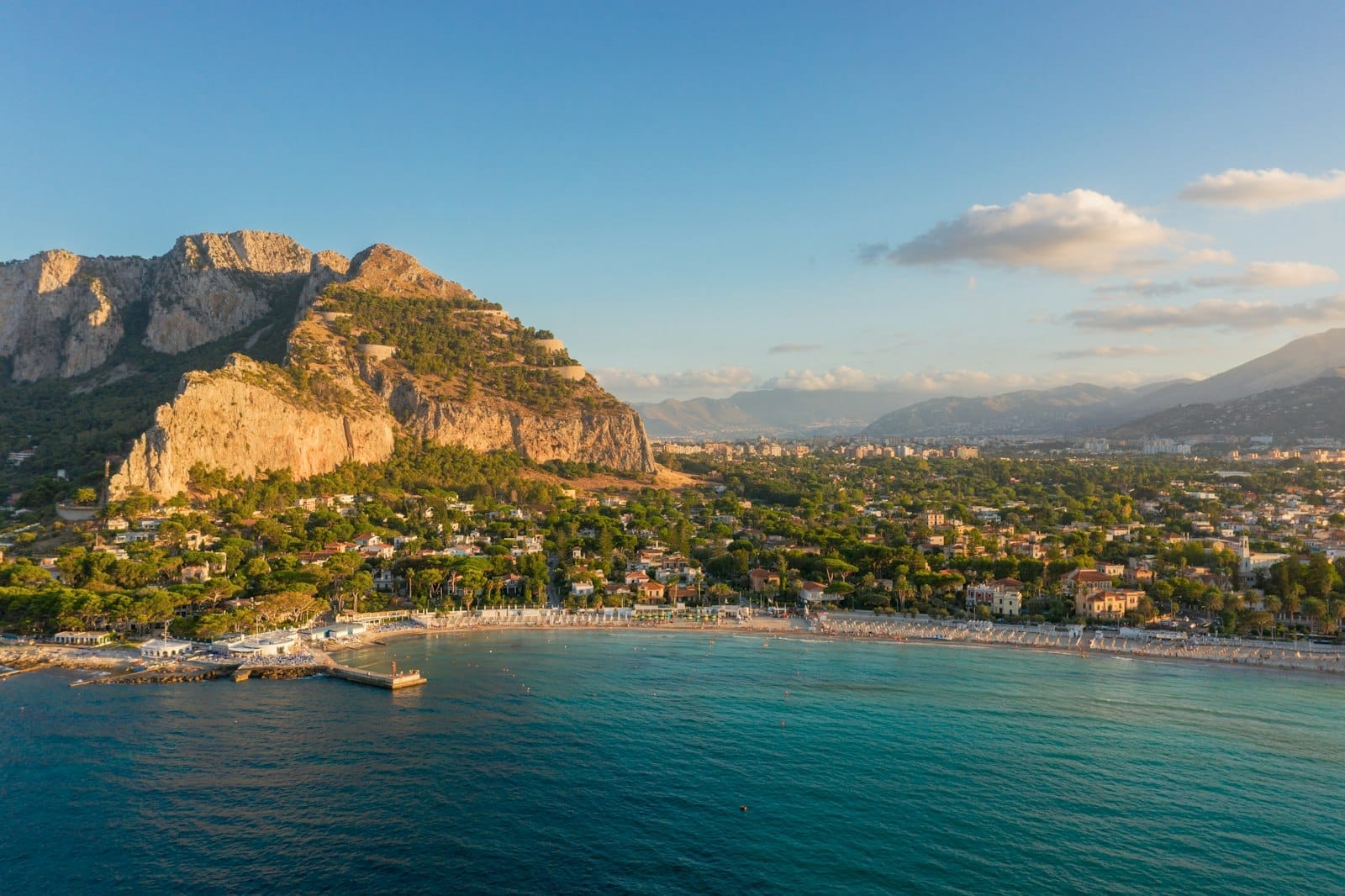
Mondello Beach, known locally as Spiaggia di Mondello or Lungomare di Mondello, is a long, flat arc of pale sand that sits in a sheltered bay on the northwestern tip of Palermo. It is the city's primary seaside district, not a remote retreat, and that distinction matters for setting expectations. On a July afternoon, the beach is packed with Palermitan families, teenagers on hired pedal boats, and the smell of fried food drifting from seafront kiosks. That social intensity is, for most visitors, precisely the point.
The bay is enclosed on both sides by headlands: Monte Pellegrino to the south and Monte Gallo to the north, giving the water a calm, almost lagoon-like quality in good weather. The sea colour shifts across the day from milky turquoise in early morning to a deeper cobalt blue under the midday sun. Sand is fine and light-coloured, with a texture closer to the Tyrrhenian standard than anything volcanic.
ℹ️ Good to know
The public sections of Mondello Beach are free and open at all hours. Private lidos occupy a significant portion of the central beach and charge for sunbeds and umbrellas. If free access is your priority, head to the northern and southern ends of the bay.
A Brief History: From Malarial Swamp to Liberty Jewel
What is now a popular beach was, until the late nineteenth century, a malaria-ridden swamp with a small fishing settlement. The transformation began in 1898 under the initiative of Prince Francesco Lanza di Scalea, who led a land reclamation project that drained the marshes and opened the bay to development. An Italian-Belgian company moved in quickly, constructing a lido, a hotel, and around 300 villas in the then-fashionable Art Nouveau style.
The most visible legacy of that era is the Antico Stabilimento Balneare, the historic bathing establishment built in 1912 on a pier extending into the bay. Its ornate Liberty-style facade, with wrought-iron details and pale stucco walls, looks almost surreal against the flat expanse of sand and water. The building still functions as a restaurant and events venue. Even if you never go inside, it shapes the aesthetic of the entire waterfront and is worth examining up close.
The Belle Époque villas that line the streets behind the beach are less visited but equally worth a slow walk. This architectural layer connects Mondello to the broader Norman and Arab-Norman heritage visible throughout Palermo — a city that has absorbed and reinterpreted outside influences for over a millennium. For context on how architecture tells Palermo's story more broadly, the Arab-Norman Sicily guide is a useful companion.
Tickets & tours
Hand-picked options from our booking partner. Prices are indicative; availability and final rates are confirmed when you complete your booking.
Mondello and Sanctuary in Monte Pellegrino Tour
From 25 €Instant confirmationFree cancellationEtna South Upper Craters Guided Excursion from Taormina
From 42 €Instant confirmationFree cancellationTaormina private tour with an expert guide
From 42 €Instant confirmationFree cancellationIsola Bella boat tour and snorkeling
From 55 €Instant confirmationFree cancellation
How the Beach Changes Through the Day
Arrive before 9 am and Mondello is almost meditative. The sand is raked clean in front of the lidos, the water is still and clear, and the only sounds are from the fishing boats bobbing in the northern corner of the bay. This is the best window for photography: the Antico Stabilimento Balneare glows in the early light without a crowd in front of it, and the reflections in the shallow water near the pier are sharp.
By 10 am in July or August, families begin staking out umbrellas and the lidos open their bars. By noon, the central stretch is dense and loud in the best possible way: children in inflatable rings, grandmothers under wide hats, teenagers playing paddle ball at the water's edge. The smell of sunscreen mixes with the salt air. The fritto misto vendors near the main piazza start their oil, and the aroma of fried calamari carries surprisingly far.
Late afternoon, roughly 5 to 7 pm, brings a second energy shift. The heat becomes more bearable, the light goes golden, and the beach transitions from swimming to socialising. The waterfront promenade fills with people walking, eating granita or gelato, and watching the sun drop behind Monte Gallo. This is arguably the most pleasant time to be here in high summer, and it is when Palermitans show up for the passeggiata as much as for the sea.
💡 Local tip
In July and August, aim to arrive before 9 am or after 5 pm to avoid the worst of both the heat and the crowds. Midday on a weekend in peak summer is genuinely overwhelming for anyone who prefers a quieter experience.
Getting There and Getting Around
From central Palermo, AMAT bus 806 is the most straightforward public option, running between the city centre and Mondello in roughly 30 minutes in light traffic. Note that this service runs year-round but with schedules and frequency that vary by season, with more departures in summer and fewer in winter. Outside those months, or if the bus schedule does not suit, a taxi or a short car journey is the practical alternative. The drive typically takes 10 to 20 minutes depending on traffic, which can be slow on summer weekend mornings as the whole city seems to have the same idea.
If you are arriving from Palermo's Falcone Borsellino Airport, Mondello is actually closer than the city centre: roughly 20–25 minutes by car, which makes it a plausible first stop on a summer arrival before heading into town. There is street parking in Mondello, but spaces fill early on summer mornings and the narrow roads around the bay can become gridlocked by mid-morning.
For those combining Mondello with a broader Palermo itinerary, it pairs logically with a morning at Monte Pellegrino, the dramatic headland that forms the southern boundary of the bay. The sanctuary at the summit is one of Palermo's most important religious sites, and the views from the top give you a clear aerial perspective of the very crescent of sand below you.
The Water, the Lidos, and the Free Beach
The water at Mondello is generally calm and clean, suitable for families with young children. The shallow gradient near the shore means you can wade out a considerable distance before losing your footing, which makes it one of the more forgiving Mediterranean beaches for non-swimmers. Jellyfish appear occasionally in late summer, particularly after storms, but this is not a persistent problem specific to Mondello.
Private lidos occupy the central and most organised sections of the beach. For roughly €30, you get two sunbeds and an umbrella for the day, plus access to changing facilities, showers, and a bar. Prices vary between operators and tend to rise on weekends and in August. The lidos are more reliable in terms of cleanliness and facilities, but they do occupy the best-positioned stretch of sand.
Free public access is available, particularly toward the northern and southern ends of the bay. The free sections are less manicured but perfectly usable. Bring your own towel, sunscreen, and water if you intend to stay there, as facilities thin out considerably. Shade is nonexistent unless you rent an umbrella, and the Sicilian midsummer sun between noon and 4 pm is genuinely intense.
⚠️ What to skip
Do not underestimate the midday sun. UV levels in southern Sicily in July and August are among the highest in Europe. High-SPF sunscreen, a hat, and regular water are not optional.
Eating and Drinking Near the Beach
Mondello's waterfront has a solid range of food options, from sit-down seafood restaurants to fast kiosks selling arancini, panelle, and the Palermitan staple of pane ca meusa (spleen sandwiches, if you are adventurous). Granita con brioche is the correct breakfast here: almond or coffee granita served with a brioche bun is what every Palermitan has on a beach morning, and the versions sold from the seafront bars are generally good.
For a deeper understanding of what you should be eating and why, the Sicily street food guide covers the full spectrum of Palermitan street food culture, much of which originated in the same port and market traditions that shaped the city's neighbourhood life.
Restaurant quality along the main promenade varies. The places with the most prominent signs and the most aggressive outdoor hosts are not always the best. Walk one or two streets back from the waterfront and you tend to find more straightforwardly good, locally-priced seafood. Ricci di mare (sea urchin) is a Mondello speciality when in season; pasta with fresh clams is reliable year-round.
When to Visit and What to Expect by Season
Mondello is at its most alive in June, July, and August. The sea temperature by late June is warm enough for comfortable swimming, the beach clubs are fully operational, and the social atmosphere is at its peak. However, August specifically is the month when much of Palermo relocates to the beach for Ferragosto, the national summer holiday period, and the crowd density can feel extreme. If you want the beach experience without the peak intensity, late June or early September offer the best balance.
Outside summer, Mondello changes character entirely. From October through April, the lidos close, the seafront empties, and the village reveals itself as a quiet residential neighbourhood with a long promenade and good off-season restaurants. The water is too cold for most swimmers, but the light on the bay in winter is exceptional. For planning purposes, the best time to visit Sicily guide gives a thorough breakdown of seasonal trade-offs across the island.
Weather can occasionally disrupt the experience even in summer. The Scirocco, the hot southerly wind from North Africa, periodically brings haze and a sticky heat that dulls the sea colour and coats everything in fine dust. These episodes rarely last more than a day or two, but it is worth checking forecasts before making the trip in June or September, when the Scirocco is most common.
Photography and Accessibility
The best photographic subject at Mondello is the Antico Stabilimento Balneare on the pier, ideally shot from the northern end of the bay in early morning light or at golden hour. The contrast between the ornate 1912 facade and the flat, reflective sea makes for an image that sums up Mondello's unusual character. The mountain backdrop of Monte Pellegrino and Monte Gallo is most visible in the cooler months when the air is cleaner.
The beach itself is flat and sandy, making it physically easier to navigate than many Sicilian coastal spots. Private lidos offer shower facilities and services that are generally more accessible than the open beach, but detailed accessibility information, including beach wheelchair availability, is not uniformly documented across operators. Visitors with specific mobility requirements should contact individual lidos directly before visiting.
Insider Tips
- The northern corner of the bay, near the old fishing boat moorings, has cleaner water and more space than the central beach, even in August. Most visitors stop at the main lido strip without continuing to the far end.
- Bus 806 is seasonal (roughly April–October). If you are visiting outside those months, confirm the service is running before relying on it, or budget for a taxi.
- The Antico Stabilimento Balneare on the pier is open as a restaurant and event venue. Booking a table for an early dinner gives you legitimate access to its interior and terrace without the beach day overhead.
- Granita with brioche is the non-negotiable breakfast. Order almond granita if you want the most distinctively Sicilian version. The bars one block back from the main promenade tend to charge less than those right on the waterfront.
- Mondello village itself, the streets behind the beach, repays a 20-minute walk. The Liberty-style villas from the early twentieth century are concentrated here and are almost entirely uncommented upon by standard tour groups.
Who Is Mondello Beach For?
- Families with young children who need shallow, calm water and organised facilities
- Palermo city visitors who want a half-day beach break without travelling far
- Architecture and history enthusiasts interested in early twentieth-century Italian coastal development
- Food lovers who want to combine a beach day with genuine Palermitan street food and seafood
- Photographers looking for the combination of Art Nouveau architecture, mountain backdrops, and Mediterranean light
Nearby Attractions
Other things to see while in Palermo:
- Ballarò Market
Stretching through the Albergheria district from Piazza Ballarò to Corso Tukory, the Mercato di Ballarò is Palermo's oldest continuously operating street market, with roots tracing back over a thousand years to Arab rule. It is free to enter, open daily, and unlike anything else in Sicily for raw atmosphere, local produce, and street food.
- Catacombs of the Capuchins
Below a quiet convent on the western edge of Palermo's historic centre, the Catacombs of the Capuchins hold one of the most extraordinary collections of preserved human remains anywhere in the world. Around 2,000 mummified bodies and skeletons line stone corridors carved from tuff rock, dressed in period clothing and arranged by profession, gender, and social status. It is an intimate, unsettling, and genuinely thought-provoking encounter with how a Mediterranean culture once confronted death.
- Church of the Martorana
Built in 1143 by a Norman admiral and decorated by craftsmen from Constantinople, the Church of the Martorana contains some of the most important Byzantine mosaics in the western Mediterranean. It sits on Piazza Bellini in Palermo's historic center, part of a UNESCO World Heritage site, and rewards visitors who arrive early and look up.
- La Kalsa
La Kalsa is Palermo's oldest neighborhood, founded by Arab rulers in the 9th century as the city's administrative heart. Today it is a layered district of crumbling palazzi, Baroque churches, art-filled piazzas, and some of Palermo's most atmospheric street life. Free to explore and walkable in half a day, it rewards those who slow down.