Ballarò Market: Palermo's Oldest and Most Intense Street Market
Stretching through the Albergheria district from Piazza Ballarò to Corso Tukory, the Mercato di Ballarò is Palermo's oldest continuously operating street market, with roots tracing back over a thousand years to Arab rule. It is free to enter, open daily, and unlike anything else in Sicily for raw atmosphere, local produce, and street food.
Quick Facts
- Location
- Via Ballarò, Albergheria district, Palermo (between Piazza Ballarò and Corso Tukory)
- Getting There
- Short walk from Palermo Centrale railway station; easily reached on foot from the historic centre
- Time Needed
- 1 to 2 hours for a relaxed walk; longer if you browse stalls or eat street food
- Cost
- Free entry; individual stalls priced in euros
- Best for
- Food lovers, photographers, cultural travellers, early risers
- Official website
- www.italia.it/en/sicily/palermo/ballaro
What Is the Mercato di Ballarò?
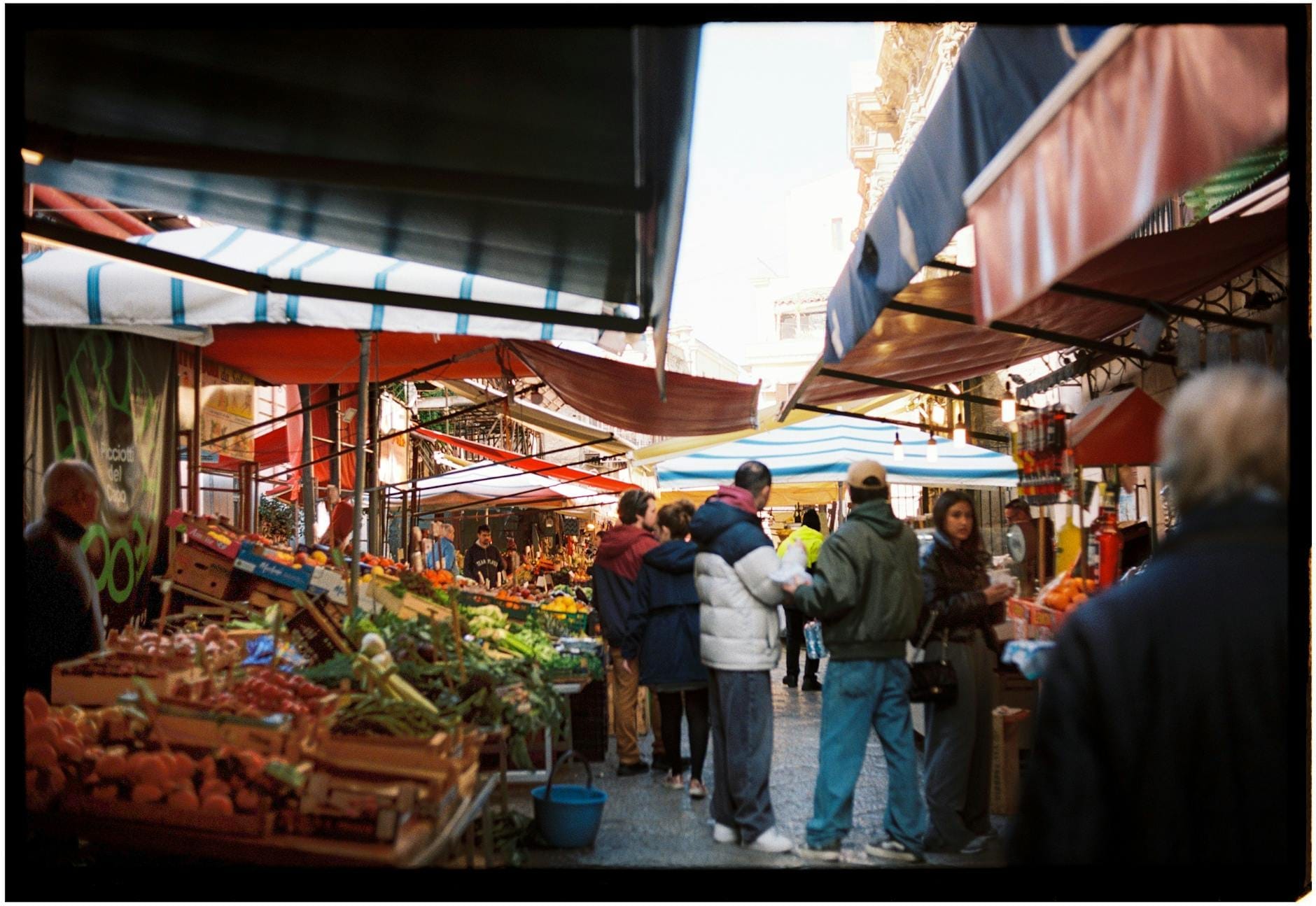
The Mercato di Ballarò is Palermo's oldest street market and, by most measures, its most alive. It runs through the Albergheria quarter, one of the city's historic quarters within the Arab-Norman UNESCO area, along a chain of narrow streets and small piazzas that begins near Piazza Ballarò and pushes south toward Corso Tukory. The market covers several hundred metres of open-air street trading, with stalls packed tightly on both sides and vendors spilling into every available gap.
Unlike a sanitised food hall or a curated artisan market, Ballarò is a working neighbourhood market used daily by local residents. Fish is laid out on ice directly on trestle tables. Vegetable sellers stack crates of produce from the floor up. Butchers hang cuts in the open air. The commercial logic is unchanged from the medieval market that preceded it, even if the goods, the faces, and the occasional mobile phone tell a different story.
Palermo has three major historic markets, Ballarò, the Vucciria, and the Capo, and each has its own character. The Vucciria Market has become more of a nightlife zone in recent decades, while Ballarò has retained its function as a daily food and household goods market. For visitors who want to see how Palermitani actually shop, Ballarò is the most representative of the three.
A Thousand Years of History in a Working Street
Ballarò has been operating since the medieval period, with documented trading activity stretching back over a thousand years. Its name is generally traced to Arab origins: one tradition links it to an Arab settlement called Bahlara, near the area of present-day Monreale, reflecting the profound influence of Arab rule on Palermo between the 9th and 11th centuries.
That Arab-Norman layer is visible in the architecture surrounding the market, not just in the street pattern. The Albergheria district contains some of Palermo's most significant medieval buildings. Walking through Ballarò, it is easy to pass under the façade of a Norman-era church or notice a carved arch incorporated into what is now a car repair shop or a block of apartments. The market and its surroundings form one of the most authentic remnants of medieval urban fabric in Sicily.
Two of Palermo's most important Arab-Norman monuments sit within easy walking distance of the market. The Palatine Chapel inside the Norman Palace is roughly ten minutes on foot, and the Church of the Martorana is nearby in Piazza Bellini. Combining the market with a morning visit to either site makes for a coherent and rewarding half-day in the western historic centre.
Tickets & tours
Hand-picked options from our booking partner. Prices are indicative; availability and final rates are confirmed when you complete your booking.
Etna South Upper Craters Guided Excursion from Taormina
From 42 €Instant confirmationFree cancellationTaormina private tour with an expert guide
From 42 €Instant confirmationFree cancellationIsola Bella boat tour and snorkeling
From 55 €Instant confirmationFree cancellationSyracuse and Ortygia Island guided tour from Taormina
From 65 €Instant confirmationFree cancellation
The Experience: What You Will Actually See, Hear, and Smell
Arriving at Ballarò in the morning, the first thing that registers is the sound. Vendors call out prices in a rhythmic, half-sung patter rooted in the suq tradition that has characterised Palermitan markets for centuries. The calls overlap, echo off the narrow street walls, and create a continuous soundscape that is both theatrical and entirely functional. Vendors are not performing for tourists. They are selling fish.
The smells arrive in sequence as you move through the market. Near the fish section, the scent of salt and sea ice is sharp and immediate. Towards the vegetable stalls, it shifts to cut citrus and herbs, particularly if vendors are trimming produce. Closer to the street food stations, you catch woodsmoke and frying oil from the arancina stands and the frittola carts, where offal and scraps are cooked in fat and served wrapped in paper.
The textures of the place are rough and uneven. Cobbles give way to worn concrete and back again. Fish water runs along improvised channels in the pavement. The walls of the surrounding buildings are faded plaster, patched over decades, occasionally decorated with informal murals. This is not a photogenic market in the polished sense. The beauty is in the density and the honesty of it.
💡 Local tip
Arrive between 08:00 and 10:00 on a weekday morning to see the market at full operation. This is when the fish is freshest, the vendors are most active, and the stall density is highest. By early afternoon, many sellers begin packing up and the atmosphere changes noticeably.
How the Market Changes Through the Day
The market opens early, with most stalls active by around 07:30 on weekdays. The first hour or so is the most concentrated: professional buyers, restaurant purchasers, and local families who shop daily come at this time. Prices are firm, transactions are quick, and the crowd is almost entirely local.
Mid-morning, roughly from 09:00 to 12:00, is when tourist visitors tend to arrive. The market is still fully operational and the atmosphere is no less authentic, but the mix of people broadens. This is the practical sweet spot for most travellers: late enough to avoid the very first rush, early enough to see everything in full swing.
By early afternoon, the character of the market shifts. Food stalls for prepared items often remain active for lunch trade, but fresh produce vendors begin closing, leaving gaps and cleared trestle tables. Sunday mornings follow a similar pattern to weekday mornings but the afternoon wind-down happens earlier, with many stalls done by midday. General opening hours are often listed as approximately 07:00 to 14:00 daily, with some sources noting activity extending later on certain days, but most fresh food vendors close by early afternoon. On Sundays the market is primarily a morning operation, with many stalls closing by around 14:00.
⚠️ What to skip
Individual stall hours vary significantly and are not fixed. Do not plan specifically around afternoon or Sunday shopping for fresh produce. If you want the full market experience, treat anything after 14:00 as a bonus, not a guarantee.
Street Food: What to Eat at Ballarò
Ballarò is one of the best places in Palermo to eat traditional street food at low cost and without ceremony. The market has its own street food ecosystem, separate from the sit-down restaurants that border its edges.
The most distinctively Palermitan items to try here are frittola, chopped offal cooked in its own fat and served hot; stigghiola, skewered and grilled intestine, usually goat or lamb, seasoned with parsley and onion; and panelle, chickpea fritters served in a soft roll. Arancine (fried rice balls, stuffed with ragù or butter and cheese) are available at several stalls and function as a reliable mid-morning snack. Sfincione, a thick Sicilian pizza base topped with tomato, onion, and breadcrumbs, appears at dedicated stalls and is filling and cheap.
These dishes are part of a broader Palermitan street food tradition that goes well beyond Ballarò. For context on what you are eating and where to find comparable food elsewhere in the city, the Sicily street food guide provides useful background on the history and regional variation of Sicilian street food culture.
Practical Walkthrough: Navigating the Market
Ballarò is not a single street but a connected network of lanes, and it can feel confusing on a first visit. The clearest orientation point is Piazza Ballarò, a small square near the northern end where several streets converge and where some of the most active stalls cluster. From there, the market extends south along Via Ballarò and its connecting streets toward Piazza del Carmine and eventually Corso Tukory.
From Palermo Centrale railway station, the market is a short walk: head northwest on foot through the historic centre and you will reach the southern edge near Corso Tukory in under ten minutes. The market is entirely open-air and runs along public streets, so there is no entrance point or ticketing. You simply walk in.
On the accessibility side, the route is technically flat with no steps, which makes it manageable in theory for wheelchair users. In practice, the combination of heavy crowds during peak hours, vendors extending their tables into the walking space, and uneven cobblestone and pavement surfaces can make navigation genuinely difficult. Early morning on a weekday tends to offer slightly more space than mid-morning.
💡 Local tip
Bring small denomination euro coins and notes. Many stallholders prefer cash and may not carry change for larger bills. Keep your bag in front of you in crowded sections. The market is generally safe, but pickpocketing in dense crowds is a common risk in any major Italian city market.
Photography at Ballarò
Ballarò is one of the most photogenic working markets in Italy, but photographing vendors directly requires awareness. Most traders are accustomed to being photographed and will not object, particularly if you have just made a purchase or are clearly engaging with the market rather than treating it as a spectacle. A simple gesture of asking permission, even without shared language, is usually well received and often leads to more open, expressive portraits.
The best light for photography is in the first two hours after opening, when the sun is low and the market is densely active. The narrow streets produce strong contrast between shadowed walls and lit stall fronts, which suits higher-contrast shooting. Later in the morning, as sunlight hits the overhead awnings and reflects off wet fish surfaces, the scene becomes more complex to expose correctly.
Honest Assessment: Limitations and Who Might Not Enjoy It
Ballarò is not a comfortable or sanitised experience, and some visitors find it overwhelming rather than charming. The smells, particularly around the fish and offal sections, are strong and not always pleasant. The noise is continuous. The streets are narrow and can feel claustrophobic at peak times. If you are visiting Sicily primarily for beach time, baroque architecture, or archaeological sites, Ballarò is probably not a priority.
It is also worth noting that, while the market has genuine historical depth and cultural significance, the tourist footprint is increasing. Some stalls near the main entry points now sell cheap imported goods rather than local produce, and a few vendors have adjusted their pitch toward visitors rather than neighbourhood shoppers. This is more visible at certain edges of the market than in the interior sections, but it is worth being aware of.
Visitors with a strong interest in Palermo's wider food culture might also consider pairing a Ballarò visit with a look at the city's broader culinary context. The Sicily food guide covers the island's cuisine with enough depth to help you make sense of what you are seeing and tasting at the market.
Insider Tips
- The frittola vendors often have no fixed signage. Look for a crowd of locals gathered around a large pot on a cart, usually near the Piazza del Carmine end of the market. This is the most local of all the street food options and the least visible to passing tourists.
- If you want to observe the fish auction dynamic, the early morning (before 09:00) is when professional buyers are actively negotiating with wholesalers. This is different from the retail trading that happens later and gives a clearer picture of how the market actually functions economically.
- The streets immediately surrounding Ballarò contain several significant Norman-era churches that are easy to miss because their facades are partly obscured or absorbed into later buildings. Look up and around as you walk, particularly near Piazza del Carmine, where the 17th-century Carmine Maggiore church has a distinctive tiled dome.
- Sunday morning visits offer a slightly different atmosphere: the market is quieter and the pace is slower, which can make for a more relaxed exploration if you are not specifically after the full weekday intensity.
- If you are combining Ballarò with the Norman Palace or the Palatine Chapel, visit the market first in the morning, then walk the ten minutes to the palace for the chapel's opening. The two experiences are complementary and cover the Arab-Norman history of Palermo from different angles.
Who Is Ballarò Market For?
- Food lovers who want to eat stigghiola, panelle, and frittola at source rather than in a restaurant setting
- Photographers and documentary travellers looking for authentic urban street life
- Cultural travellers with an interest in Palermo's Arab-Norman history and the layering of civilisations in the Albergheria district
- Early risers who want to see Palermo functioning before the tourist day begins
- Budget travellers who can eat a full breakfast or lunch at the market for a few euros
Nearby Attractions
Other things to see while in Palermo:
- Catacombs of the Capuchins
Below a quiet convent on the western edge of Palermo's historic centre, the Catacombs of the Capuchins hold one of the most extraordinary collections of preserved human remains anywhere in the world. Around 2,000 mummified bodies and skeletons line stone corridors carved from tuff rock, dressed in period clothing and arranged by profession, gender, and social status. It is an intimate, unsettling, and genuinely thought-provoking encounter with how a Mediterranean culture once confronted death.
- Church of the Martorana
Built in 1143 by a Norman admiral and decorated by craftsmen from Constantinople, the Church of the Martorana contains some of the most important Byzantine mosaics in the western Mediterranean. It sits on Piazza Bellini in Palermo's historic center, part of a UNESCO World Heritage site, and rewards visitors who arrive early and look up.
- La Kalsa
La Kalsa is Palermo's oldest neighborhood, founded by Arab rulers in the 9th century as the city's administrative heart. Today it is a layered district of crumbling palazzi, Baroque churches, art-filled piazzas, and some of Palermo's most atmospheric street life. Free to explore and walkable in half a day, it rewards those who slow down.
- Mondello Beach
Mondello Beach is a wide crescent of pale sand framed by Monte Pellegrino and Monte Gallo, around 10 km north of central Palermo. Free to access, rich in Belle Époque architecture, and popular with both locals and visitors, it offers a genuine window into Palermitan summer life alongside reliable swimming conditions.