Vucciria Market: Palermo's Most Dramatic After-Dark Transformation
The Mercato della Vucciria has anchored one of Palermo's oldest commercial quarters for many centuries. Today it operates on two completely different registers: a quiet, photogenic square by day, and one of the city's loudest street-food and nightlife scenes after dark.
Quick Facts
- Location
- Piazza Caracciolo, 90133 Palermo, Sicily, Italy
- Getting There
- 15-min walk from Palermo Centrale station via Via Roma; descend steps at Piazza Caracciolo
- Time Needed
- 1–3 hours depending on whether you eat, drink, or just browse
- Cost
- Free entry; street food €5–10, beer €3–5, cocktails €5–8 (verify locally)
- Best for
- Street food lovers, nightlife seekers, photographers, history enthusiasts
- Official website
- www.italia.it/en/sicily/palermo/vucciria-market
What Vucciria Actually Is (And What It Isn't)
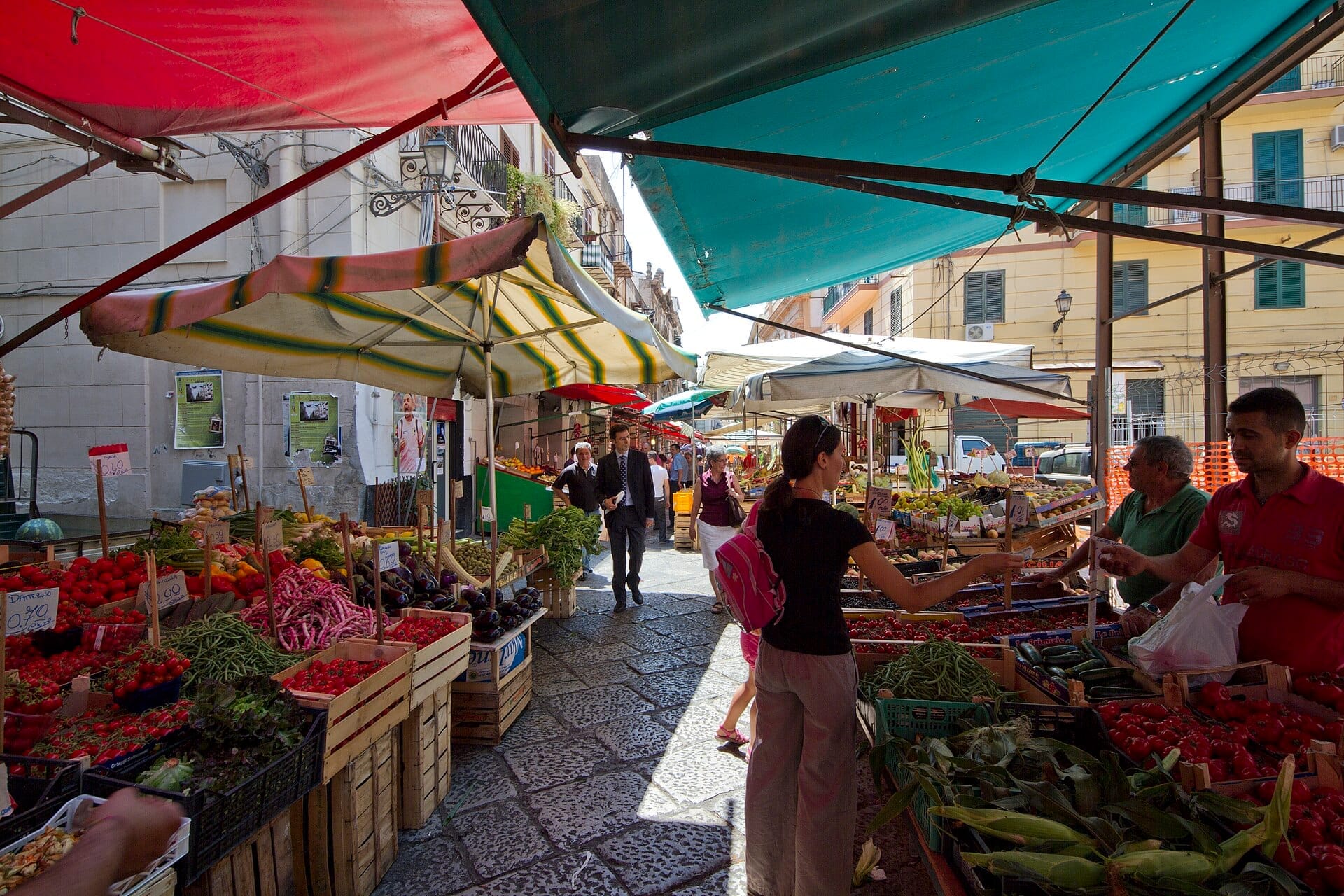
The Mercato della Vucciria is often described in shorthand as Palermo's most famous market. That description is both accurate and misleading. As a traditional daytime food market, Vucciria has been in steady decline since the late 20th century. Where vendors once spread fish, offal, vegetables, and spices across the entire quarter, today only a handful of stalls remain active in the mornings. The square itself, Piazza Caracciolo, can feel almost empty on a weekday afternoon.
Come back after 8 p.m., however, and the place barely resembles itself. Fold-out tables appear from nowhere, sound systems emerge from narrow doorways, and hundreds of locals converge on the same stone square to eat, drink, and talk loudly. This is the version of Vucciria that matters most to evening visitors: not a market in the conventional sense, but a permanent outdoor social space that happens to occupy one of Palermo's oldest commercial sites.
ℹ️ Good to know
Access to the market streets is free. There is no ticket, no gate, and no official closing time. Individual food stalls and bars set their own hours — expect most activity from around 8 p.m. onward, with the square at full capacity on Thursday through Saturday nights.
Eight Centuries of Commerce in a Single Square
Vucciria has operated near Palermo's old port quarter in some form for many centuries, making it broadly contemporary with the Arab-Norman architecture that still defines central Palermo. The name almost certainly derives from the French word 'boucherie,' meaning butcher's shop, a linguistic trace of the Norman and Angevin rule that shaped medieval Sicily. Over time, the word absorbed a second meaning in local usage: 'noise' or 'confusion,' a fitting description of the vendor calls and crowd chatter that historically filled the square.
The square took on its later form in the late 18th century, when Viceroy Domenico Caracciolo reorganized the space, adding arcaded stalls around the perimeter and a central fountain. That renovation gave the square its official name, Piazza Caracciolo, though almost nobody in Palermo calls it that. The quarter sits adjacent to the broader Kalsa district, one of the city's oldest neighborhoods and worth exploring before or after your Vucciria visit. Read more in our overview of La Kalsa, the surrounding historic quarter.
The market's cultural peak came in the mid-20th century, when it served as the working food supply for thousands of Palermitani. Its slow decline and reinvention as a nightlife hub mirrors a wider pattern across Sicily's historic city centers. Understanding that arc makes the current scene feel less like a tourist gimmick and more like a genuine evolution of an urban space.
Tickets & tours
Hand-picked options from our booking partner. Prices are indicative; availability and final rates are confirmed when you complete your booking.
Etna South Upper Craters Guided Excursion from Taormina
From 42 €Instant confirmationFree cancellationTaormina private tour with an expert guide
From 42 €Instant confirmationFree cancellationIsola Bella boat tour and snorkeling
From 55 €Instant confirmationFree cancellationSyracuse and Ortygia Island guided tour from Taormina
From 65 €Instant confirmationFree cancellation
The Market by Day: Quiet, Photogenic, and Historically Rich
Arrive between 7 a.m. and 1 p.m. and you encounter the remnants of the original market. A small number of vendors still operate here in the mornings, selling fish, seasonal vegetables, and occasionally cuts of meat. The fish stalls carry the strongest sensory imprint: the smell of fresh catch and brine on the flat stone paving, known as balate, and the sound of vendors announcing prices in a rapid Palermitan dialect that bears little resemblance to standard Italian.
The light in the morning is also significantly better for photography. The square is partially shaded by surrounding buildings until mid-morning, creating sharp contrasts between sunlit produce and shadowed arcades. By noon, direct sun bleaches out much of the detail. If you plan to photograph the market in its daytime mode, aim for 8 to 10 a.m.
The paving throughout the Vucciria quarter is uneven historic stonework. Comfortable, closed-toe shoes are a practical necessity regardless of what time you visit. The steps descending from Via Roma into Piazza Caracciolo have no ramp alternative at the main access point, which is a real limitation for visitors with mobility impairments.
💡 Local tip
The most atmospheric daytime approach is to walk south from Palermo's Quattro Canti along Corso Vittorio Emanuele, turn toward the port, then descend through the narrow alleys rather than arriving directly from Via Roma. This route takes you through several covered passages where remaining market traders set up.
After Dark: How Vucciria Transforms
The transition begins around sunset. Plastic chairs appear on the balate, temporary bar counters are wheeled into position, and the handful of permanent bars that ring the square open their hatches. By 9 p.m. on a Friday or Saturday, Piazza Caracciolo is packed to its edges with people eating street food, drinking Moretti or local wine, and conducting the kind of continuous loud conversation that requires no particular reason to continue.
The food on offer at night skews heavily toward Palermitan street classics. You will find panelle (chickpea fritters), sfincione (thick-crusted Palermitan pizza with tomato, anchovies, and caciocavallo cheese), arancine (fried rice balls), and the divisive but locally beloved pani ca meusa, a spleen sandwich served with or without ricotta. Prices are low by any standard. A full street-food meal with a beer can easily come in under €12 per person.
This nighttime food culture is one thread in a much larger story about Palermitan street eating. For a broader picture of what and where to eat across the city's markets, the Sicily street food guide covers the island's full range, including comparisons with the Ballarò Market, Vucciria's larger and more traditionally active rival a short walk to the west.
Navigating the Quarter: A Practical Walkthrough
Vucciria is not a single street or courtyard. It is a cluster of interconnected alleys, small piazzas, and covered passages spreading outward from Piazza Caracciolo. The main square is the social center, but some of the best food stalls are tucked into the side streets that lead toward the waterfront.
From Palermo Centrale station, the walk takes roughly 15 minutes. Head north along Via Roma, cross Corso Vittorio Emanuele, and continue for about 100 meters until you see steps descending on the right. Those steps drop you directly into Piazza Caracciolo. Alternatively, you can approach from the port side if you have been visiting the nearby Palazzo Abatellis or the Kalsa waterfront, which adds some pleasant street-level context to the arrival.
If you are spending a full day in central Palermo, Vucciria pairs naturally with the nearby Quattro Canti and Palermo Cathedral during the day, then returning to the market area for the evening meal.
⚠️ What to skip
The square gets genuinely crowded on weekend nights, and the surrounding alleys can be poorly lit. Keep your bag in front of you and stay aware of your surroundings, particularly late at night. This is not an unusually dangerous area, but it is a busy urban space with all that implies.
Is Vucciria Worth Your Time? An Honest Assessment
For travelers who expect a fully functioning, sprawling produce market in the style of Barcelona's Boqueria or Istanbul's Grand Bazaar, Vucciria will feel underwhelming by day. The daytime market is a shadow of what it was even 40 years ago. The Ballarò Market nearby is a significantly better option if a traditional, active street market is your primary goal.
But for travelers interested in how a city actually uses its public space after dark, Vucciria at night is genuinely compelling. It is not curated for tourists. The crowd is overwhelmingly local, the food is the same food Palermitani have been eating for generations, and the atmosphere is loud and unself-conscious in a way that increasingly rare European city centers rarely manage. It is also free.
Travelers with children should be aware that the nighttime scene is primarily adult-oriented, particularly late on weekends. Families are better served visiting in the late morning or early evening. For broader trip planning, the guide to Sicily with kids has practical advice on timing and neighborhood choice across the island.
Anyone who prefers quiet, uncrowded spaces or who is sensitive to noise will find the peak-hour nighttime scene overwhelming rather than enjoyable. Arriving between 6 and 7:30 p.m., before the full evening crowd builds, offers a reasonable compromise: the food stalls are open, the atmosphere is sociable, and you can still hear yourself think.
Insider Tips
- The best street-food stalls at Vucciria often have no signage. Follow the queues, not the loudest music. A stall with a line of locals is nearly always preferable to one that is empty or advertising in English.
- If you want a drink without standing in a crowd, arrive on a weekday evening rather than Thursday through Saturday. Monday and Tuesday nights have a very different, more relaxed atmosphere with a more local-to-tourist ratio.
- The steps down from Via Roma are the obvious entry point but also the most congested. Try the approach through the small alleys off Corso Vittorio Emanuele for a slower, more interesting arrival that passes several covered arcade sections of the original market.
- Pani ca meusa (spleen sandwich) is the most characteristically Palermitan food you can order here. Ask for it 'maritata' if you want it with ricotta and caciocavallo cheese, or 'schietta' for the plainer version. Many vendors offer both.
- Vucciria is painted in one of Sicily's most famous artworks: Renato Guttuso's large-format painting 'La Vucciria' (1974), which hangs in the Palazzo Steri nearby. Visiting the painting before the market adds a useful layer of historical context to what you are seeing.
Who Is Vucciria Market For?
- Travelers who want to eat Palermitan street food in an authentically local setting rather than a tourist-facing restaurant
- Night owls and those interested in how southern Italian cities use public space after dark
- Photographers looking for atmospheric evening light and candid street scenes
- History-minded visitors who want to understand the layers of Arab-Norman, French, and Spanish influence embedded in Palermo's commercial geography
- Budget travelers: a full evening of food and drinks here is possible for well under €15 per person
Nearby Attractions
Other things to see while in Palermo:
- Ballarò Market
Stretching through the Albergheria district from Piazza Ballarò to Corso Tukory, the Mercato di Ballarò is Palermo's oldest continuously operating street market, with roots tracing back over a thousand years to Arab rule. It is free to enter, open daily, and unlike anything else in Sicily for raw atmosphere, local produce, and street food.
- Catacombs of the Capuchins
Below a quiet convent on the western edge of Palermo's historic centre, the Catacombs of the Capuchins hold one of the most extraordinary collections of preserved human remains anywhere in the world. Around 2,000 mummified bodies and skeletons line stone corridors carved from tuff rock, dressed in period clothing and arranged by profession, gender, and social status. It is an intimate, unsettling, and genuinely thought-provoking encounter with how a Mediterranean culture once confronted death.
- Church of the Martorana
Built in 1143 by a Norman admiral and decorated by craftsmen from Constantinople, the Church of the Martorana contains some of the most important Byzantine mosaics in the western Mediterranean. It sits on Piazza Bellini in Palermo's historic center, part of a UNESCO World Heritage site, and rewards visitors who arrive early and look up.
- La Kalsa
La Kalsa is Palermo's oldest neighborhood, founded by Arab rulers in the 9th century as the city's administrative heart. Today it is a layered district of crumbling palazzi, Baroque churches, art-filled piazzas, and some of Palermo's most atmospheric street life. Free to explore and walkable in half a day, it rewards those who slow down.