Quattro Canti: Palermo's Baroque Crossroads Explained
Quattro Canti (officially Piazza Vigliena) is widely considered the center of Palermo's historic quarters, where four identical Baroque facades curve symmetrically at the crossing of Corso Vittorio Emanuele and Via Maqueda. Developed in the early 17th century, it is free to visit at any hour and remains one of the most emblematic Baroque public spaces in southern Italy.
Quick Facts
- Location
- Intersection of Corso Vittorio Emanuele and Via Maqueda, historic centre, Palermo, Sicily, Italy
- Getting There
- AMAT city buses stop within a short walk; the intersection is roughly 15 minutes on foot from Palermo Centrale railway station
- Time Needed
- 15–30 minutes to study the facades; allow extra time if exploring the surrounding quarter
- Cost
- Free; no ticket or admission required
- Best for
- Architecture enthusiasts, photographers, first-time visitors orienting themselves in Palermo's historic centre
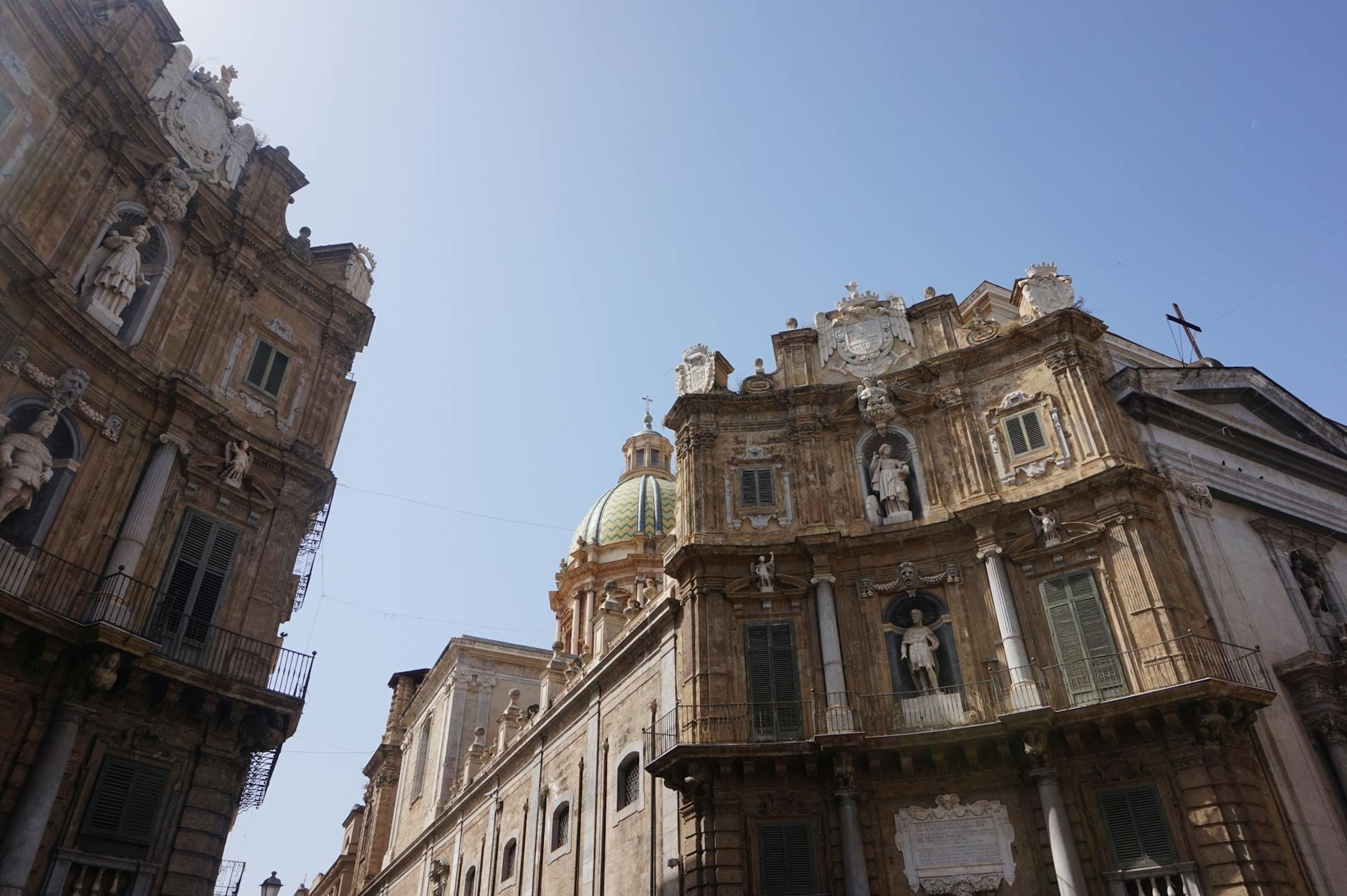
What Quattro Canti Actually Is
Quattro Canti, whose official name is Piazza Vigliena, is not a square in the conventional sense. It is the intersection of two major streets: Corso Vittorio Emanuele, the east-west spine of Palermo's old city, and Via Maqueda, which runs roughly north–south across the historic center. Where these two axes meet, four concave Baroque facades curve inward at 45-degree angles, creating a near-circular space at what was conceived, in the early 17th century, as the symbolic center of the city’s historic quarters.
The facades were constructed between 1609 and 1620, during a period of intensive urban planning under Spanish rule. Each of the four corners belongs to a different historic quarter of the city: Kalsa, Seralcadi, Albergaria, and Castellammare. Each facade follows a similar tripartite vertical structure: a fountain at street level, a statue of a Spanish ruler in the middle tier, and a figure of a patron saint at the top. The repetition is deliberate. The symmetry was intended to project administrative order and Catholic authority over the city's famously complex urban fabric.
ℹ️ Good to know
The full official name is Piazza Vigliena. You will rarely hear Palermitans use that name in conversation; to locals and visitors alike, it is simply the Quattro Canti, the Four Corners.
The Architecture Up Close
Standing at the center of the intersection and turning slowly, the effect of the four identical facades is disorienting in an interesting way. The curved stone catches light differently depending on the time of day, and the layered ornamentation becomes readable only when you stop moving and look methodically from base to crown.
At the lowest level, four fountains represent the four seasons. The water does not always run, and the stone basins show the weathering you would expect from four centuries of urban exposure: darkened at the edges, lime-scaled, occasionally hosting a pigeon or two. Above the fountains, the middle tier displays statues of four Spanish rulers over Sicily: Charles V, Philip II, Philip III, and Philip IV. These were not decorative afterthoughts; their placement at the physical center of the city was an explicit statement of Habsburg power over Sicily.
The upper tier features the four patron saints associated with Palermo's quarters: Cristina, Ninfa, Oliva, and Agata (Agatha). Above them, the facades are capped with stone balustrades and heraldic detailing. The material throughout is the pale golden limestone typical of Palermo's historic center, which reads very differently under the white midday glare of a Sicilian summer than under the amber light of late afternoon.
💡 Local tip
Photography tip: the facades facing north and west receive direct sunlight in the morning; the south and east faces are better lit in the afternoon. The most even light across all four facades occurs around the golden hour before sunset, especially in spring and autumn.
Tickets & tours
Hand-picked options from our booking partner. Prices are indicative; availability and final rates are confirmed when you complete your booking.
Mount Etna and Alcantara Gorges guided tour from Taormina
From 100 €Instant confirmationFree cancellationEtna and Alcantara tour from Taormina
From 120 €Instant confirmationFree cancellationAlcantara Valley tour with wine tasting from Taormina
From 50 €Instant confirmationFree cancellationEtna 2,900 metres and Alcantara tour from Taormina
From 120 €Instant confirmationFree cancellation
How the Space Changes Through the Day
Early morning, before 8:00, is the quietest window. Delivery vehicles occasionally pass through (the intersection remains a functioning road crossing), but foot traffic is thin. The light is soft and cool, and the carved stone takes on a pale grey tone that emphasizes texture over color. This is the hour for unhurried looking.
By mid-morning, the Quattro Canti becomes one of the more trafficked points in the historic centre. Tourists orient themselves here before heading toward the nearby Piazza Pretoria or up Via Maqueda toward the cathedral. Locals cross purposefully, largely indifferent to the architecture above them. The intersection is loud: a steady mix of scooters, conversations, and distant market noise from the Ballarò direction to the southwest.
Midday in summer is the least comfortable time to linger. The stone radiates heat, shade is limited to narrow strips along the facade bases, and the surrounding streets empty of serious pedestrian traffic as the city moves toward its afternoon pause. If you are visiting in July or August and want to spend time here, arrive before 9:00 or return after 17:00.
The late afternoon and early evening shift the atmosphere noticeably. As the light drops, Corso Vittorio Emanuele fills with people walking toward the harbor or heading into the market quarters. The facades catch the warm light from the west. This is also when the Quattro Canti functions best as a navigational hub, a place to pause, check your orientation, and decide which direction to continue.
Historical Context: Why This Intersection Was Built This Way
Palermo in the early 17th century was a capital city under Spanish Habsburg governance, and Via Maqueda had been laid out in the 1590s as a deliberate north-south axis to complement the older east-west Cassaro (now Corso Vittorio Emanuele). The creation of this grid division required leveling and rebuilding portions of the existing medieval city, a process that was as much about political control as urban improvement.
The design of the four curved corners, attributed to the architect Giulio Lasso (or Lasso/Giulio Lasso), resolved an urban planning problem while simultaneously creating a set piece of civic theater. The repeated motif across all four facades unified what would otherwise have been four separate building fronts into a single composition. It was an early and sophisticated example of Baroque urbanism in Italy and establishing Palermo as a city with genuine European ambitions in urban design.
Understanding this context changes how the space reads. The Quattro Canti is not merely decorative. It was a governing apparatus made in stone, designed to be legible to anyone standing at the crossing: this is the center of the city, these are your kings, these are your saints, and this city is ordered. That message has been visible at this intersection for over four centuries.
The Baroque ambitions visible at the Quattro Canti extend across Palermo's historic centre. The nearby Palermo Cathedral and the Norman Palace sit within the same dense historic fabric, all reachable on foot from this intersection.
Practical Walkthrough: Getting There and Getting the Most From It
Quattro Canti sits at the physical center of Palermo's historic district and is walkable from virtually every point in the old city. From Palermo Centrale station, the walk along Corso Vittorio Emanuele takes roughly 15 minutes at a moderate pace. City buses operated by AMAT Palermo serve multiple stops along both Via Maqueda and Corso Vittorio Emanuele; check the AMAT network map for the most current routes and stops before your visit, as urban bus routes are updated periodically.
There is no entry point, no ticket booth, and no queue. You simply walk to the intersection. The roads are active, so take care crossing; the junction has pedestrian crossings but traffic flow can be assertive. The surrounding sidewalk space is narrow in places, particularly along the facade bases, so stepping back to photograph the upper tiers sometimes requires standing in the roadway briefly during gaps in traffic, which is worth doing carefully.
Accessibility at the intersection itself is at street level with no steps. The surrounding streets in the historic centre, however, are uneven, with cobblestones and occasional raised kerbs that make wheelchair navigation and pushchair use variable. The intersection and the two main roads are more manageable than many of the narrower side streets in the adjacent quarters.
The Quattro Canti makes a natural starting point for exploring Palermo's historic markets. Ballarò market is a short walk to the southwest, while the Vucciria market lies to the northeast. Both are worth visiting, but they operate on different schedules and have distinct characters.
Who Will Get the Most Out of This Visit, and Who Might Not
The Quattro Canti rewards people who slow down and read architecture rather than simply photograph it. Visitors with an interest in the Arab-Norman and Baroque layers of Palermo's history will find genuine depth here. First-time visitors to the city benefit from pausing at this intersection simply to understand how the old city is structured: once you grasp the four-quarter logic, navigating the surrounding streets becomes considerably more intuitive.
Travelers following Sicily's Baroque trail will want to connect this visit with the broader context covered in the Arab-Norman Sicily guide, which explains how successive ruling powers shaped Palermo's layered architectural identity.
Travelers who are primarily interested in beaches, hiking, or food markets may find a brief glance from the pavement sufficient. The Quattro Canti does not have an interior to explore, a café to sit in, or a garden to rest in. It is a working intersection with an extraordinary facade. If architectural detail is not your particular interest, ten minutes here before moving on is perfectly reasonable, and the surrounding neighborhood will likely hold more of your attention than the facades themselves.
⚠️ What to skip
Summer heat warning: the stone of the intersection acts as a heat sink in July and August. There is essentially no shade at the crossing point itself. If you are visiting in peak summer, plan your stop for early morning or late afternoon and carry water.
Insider Tips
- Look straight up from the center of the intersection. The open sky framed by the four curved facades creates a circular composition that is far more striking than the eye-level view, and almost no one does it.
- Each of the four fountain basins at street level is dedicated to one of the four seasons. The carving quality and weathering varies corner to corner; compare them closely and you will notice differences that centuries of uneven exposure have introduced.
- Via Maqueda immediately north of the Quattro Canti is one of Palermo's main pedestrian shopping streets. If you want to photograph the facades with minimal traffic in frame, early Sunday mornings are significantly quieter than weekday mornings.
- The Quattro Canti is directly adjacent to Piazza Pretoria, home to the elaborate 16th-century Fontana Pretoria. It is less than 50 meters away and takes under a minute to reach; the two sites work well as a single stop.
- The facade stonework is best observed with binoculars or a zoom lens to pick out the fine heraldic carving near the upper balustrades. The detail at the top tier is largely invisible to the naked eye from street level.
Who Is Quattro Canti For?
- Architecture and Baroque art enthusiasts who want to understand Palermo's urban history in situ
- Photographers working in the golden hour, particularly in spring and autumn when the light is lower and warmer
- First-time visitors using it as an orientation point before navigating the old city's four quarters
- Travelers building a walking itinerary through the historic centre who want a central anchor point
- History-focused visitors interested in the period of Spanish governance in Sicily and its visible legacy
Nearby Attractions
Other things to see while in Palermo:
- Ballarò Market
Stretching through the Albergheria district from Piazza Ballarò to Corso Tukory, the Mercato di Ballarò is Palermo's oldest continuously operating street market, with roots tracing back over a thousand years to Arab rule. It is free to enter, open daily, and unlike anything else in Sicily for raw atmosphere, local produce, and street food.
- Catacombs of the Capuchins
Below a quiet convent on the western edge of Palermo's historic centre, the Catacombs of the Capuchins hold one of the most extraordinary collections of preserved human remains anywhere in the world. Around 2,000 mummified bodies and skeletons line stone corridors carved from tuff rock, dressed in period clothing and arranged by profession, gender, and social status. It is an intimate, unsettling, and genuinely thought-provoking encounter with how a Mediterranean culture once confronted death.
- Church of the Martorana
Built in 1143 by a Norman admiral and decorated by craftsmen from Constantinople, the Church of the Martorana contains some of the most important Byzantine mosaics in the western Mediterranean. It sits on Piazza Bellini in Palermo's historic center, part of a UNESCO World Heritage site, and rewards visitors who arrive early and look up.
- La Kalsa
La Kalsa is Palermo's oldest neighborhood, founded by Arab rulers in the 9th century as the city's administrative heart. Today it is a layered district of crumbling palazzi, Baroque churches, art-filled piazzas, and some of Palermo's most atmospheric street life. Free to explore and walkable in half a day, it rewards those who slow down.