Monreale Cloister: The Arab-Norman Courtyard That Rewrites What a Cloister Can Be
The Benedictine Cloister of Monreale is a 12th-century Norman courtyard of extraordinary intricacy, where 228 paired columns carry carved capitals depicting biblical scenes, hunting scenes, and geometric patterns that fuse Arab, Byzantine, and Norman craft into a single continuous walkway. Part of a UNESCO World Heritage serial site, it sits directly behind Monreale Cathedral on a hilltop above Palermo and takes about an hour to experience properly.
Quick Facts
- Location
- Piazza Guglielmo II, 90046 Monreale (PA), Sicily, Italy — hilltop above Palermo, directly behind Monreale Cathedral
- Getting There
- Bus 389 from Piazza Indipendenza, Palermo (approx. 30 min). Alight at 'Fontana del Drago', then a 5-min walk to the cathedral square.
- Time Needed
- 45–90 minutes for the cloister; allow extra time for the adjacent cathedral
- Cost
- Admission fee applies; prices vary and should be confirmed on-site or via the official cathedral website before visiting
- Best for
- Architecture, medieval history, Arab-Norman art, UNESCO heritage, photography
- Official website
- http://www.monrealeduomo.it
What the Benedictine Cloister of Monreale Actually Is
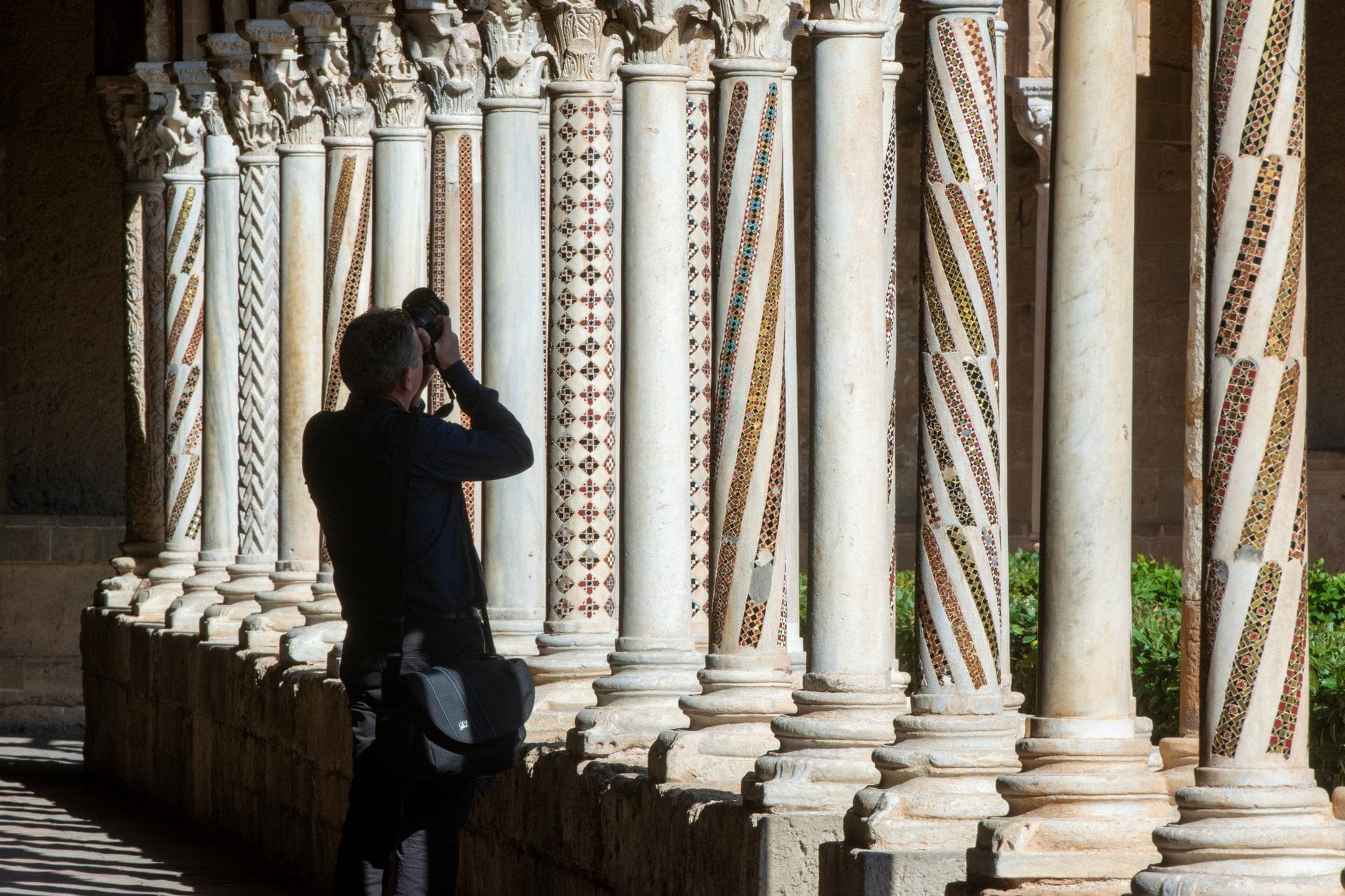
The Benedictine Cloister of Monreale (Chiostro Benedettino di Monreale) is a late 12th-century monastic courtyard commissioned by King William II of Sicily, known as William the Good, as part of a grand Benedictine abbey complex built alongside the cathedral he founded from 1172. The cloister is roughly square, measuring about 47 metres per side, and is enclosed on all four sides by an arcade of paired, slender columns. There are 228 of these columns in total, and virtually no two capitals are carved the same way.
The sheer density of carved stone here is unlike anything else in Sicily. Each capital is a separate composition: some show scenes from the Old and New Testaments, others depict Norman knights hunting, others still carry intricate geometric interlace, foliage, mythological animals, and human figures locked in narrative. It is not a building you walk past. It is a building that holds you in place, pulling attention from one capital to the next before you have finished reading the last.
💡 Local tip
Buy your ticket for the cloister separately from the cathedral — they are managed together but may have different entry queues. Arrive when it opens (09:00 Monday to Saturday) to have the space to yourself. By late morning in summer, tour groups arrive in numbers and the narrow arcade becomes crowded.
The Arab-Norman-Byzantine Fusion: What You Are Looking At
The cloister is one of the defining monuments of the Arab-Norman artistic tradition that flourished in 12th-century Sicily under Norman rule. The Norman kings — who had taken the island from the Arabs in the 11th century and maintained a cosmopolitan court — patronised buildings that deliberately fused Islamic, Byzantine, and Western Romanesque visual languages. The result is an architecture with no clean category.
Look at the columns themselves: the shafts are covered in geometric mosaic inlay of glass and stone, a technique with clear Islamic roots, while the capitals above them carry Romanesque figurative carving more at home in France or southern Italy. In one corner of the cloister, a separate fountain pavilion (fontana) sits on its own cluster of columns with particularly fine mosaic detailing — this small sub-structure is often the most photographed element in the courtyard. The same layered cultural logic governs the cathedral itself, which is covered in Byzantine gold mosaics. For more on how this tradition connects across Palermo, see our guide to Arab-Norman Sicily.
In 2015, the cloister became part of a UNESCO World Heritage Site inscribed as 'Arab-Norman Palermo and the Cathedral Churches of Cefalù and Monreale.' The inscription recognises the entire complex as an exceptional testimony to the cultural exchanges of the medieval Mediterranean. That status is well-earned. There are grander cloisters in Europe, and more famous ones, but few that make the argument for medieval multiculturalism with this much specificity and craft.
Tickets & tours
Hand-picked options from our booking partner. Prices are indicative; availability and final rates are confirmed when you complete your booking.
Monreale day trip from Palermo
From 20 €Instant confirmationFree cancellationCefalu and Monreale tour from Palermo with optional boat trip
From 99 €Instant confirmationFree cancellationPalermo and Monreale Tour from Cefalu
From 60 €Instant confirmationFree cancellationFull-day private tour of Monreale, Palermo and its street food
From 1.220 €Instant confirmationFree cancellation
Walking the Cloister: What the Experience Feels Like
The cloister is entered from inside the cathedral complex, typically through a door off the main nave or via a separate access from the piazza side. Once inside, you step into a rectangular garden space with a central lawn. The arcade runs around all four sides, shaded and cool even in July, while the open centre is exposed to the sky. In the morning, the eastern walkway is in shadow and the garden is lit from the west; by midday, light floods straight down and the mosaics on the column shafts catch it sharply.
The walkway floor is stone, worn smooth in places, uneven in others. The cloister is part of a medieval monastic complex and has not been flattened for tourist comfort: there are steps at certain transitions, and the paving is not level throughout. Visitors with reduced mobility should contact the cathedral directly before visiting, as official accessibility information is not published on the site's main pages.
Most people do one full circuit of the arcade. That takes about 20 minutes if you move without stopping. Most visitors do not move without stopping. The capitals reward sustained attention. Several have been identified as representing the life of William II himself, others as depictions of the months of the year, others as purely ornamental inventions. Bring whatever optical aid you use for small print: some of the most detailed carving is above eye level.
ℹ️ Good to know
Opening hours: Monday to Saturday 09:00–19:00. Sunday and public holidays 09:00–13:30 (last admission 13:00). These hours apply to the cloister specifically; verify before visiting as they may change seasonally or for religious observances.
The Cathedral Next Door: Should You Visit Both?
Yes, without hesitation. The Monreale Cathedral and its cloister are functionally one site even though they may be ticketed separately. The cathedral interior is one of the largest and most complete cycles of Byzantine-style gold mosaic in the world, covering approximately 6,340 square metres of surface area. The famous bust of Christ Pantocrator in the apse is enormous and technically extraordinary, but the mosaics continue across every wall, arch, and vault, telling the entirety of the Old and New Testaments in gold and coloured tesserae.
If you are visiting as part of a broader day in the Palermo area, it is worth noting that several of the Arab-Norman monuments within the city itself — including the Palatine Chapel inside the Norman Palace — display the same fusion aesthetic in an even more concentrated form. Seeing Monreale first gives context for what you encounter back in the city, or vice versa.
Getting Here from Palermo: What to Expect
Monreale is about 8 kilometres southwest of central Palermo, on a hillside above the Conca d'Oro plain. The most practical public transport option is bus 389, which departs from Piazza Indipendenza in Palermo (where the Norman Palace is located) and takes roughly 30 minutes to reach Monreale. Alight at the 'Fontana del Drago' stop, then walk uphill for about 5 minutes to reach Piazza Guglielmo II and the cathedral facade.
The bus runs frequently during the day but check current schedules with AMAT Palermo before travelling, as frequencies reduce in the early morning and evening. Taxis and hire cars are also straightforward options, with parking available near the piazza. If you are exploring the wider Palermo area, the cloister pairs naturally with the Norman Palace and Palatine Chapel into a half-day Arab-Norman circuit — both are on the same bus route back into the city.
⚠️ What to skip
Modest dress is required for entry to both the cloister and the cathedral. Shoulders and knees must be covered. Shawls and wraps are sometimes available at the entrance, but it is more reliable to dress appropriately from the start to avoid delays or refusal of entry.
Photography, Timing, and Honest Caveats
The cloister is one of the most photogenic spaces in Sicily — the repetition of the column arcade, the interplay of light and shadow across the mosaic shafts, and the detail of the capitals all make for strong images. The best light is in the morning before 10:00, when the angle is lower and the garden is not yet in harsh midday contrast. The fountain pavilion in the southwest corner photographs well at almost any time.
A practical caveat: in high summer (July and August), Monreale is on the route of large coach tour groups that move through the site in waves. The arcade is narrow, and once a group enters, passing or finding a clear angle becomes difficult. This is not a reason to avoid visiting, but it is a reason to arrive exactly when the doors open. In shoulder seasons (April to early June, October), the volume is noticeably lower and the experience is calmer.
If the cloister forms part of a broader Sicily itinerary focused on medieval architecture, the Cefalù Cathedral — about 70 kilometres east of Palermo — is part of the same UNESCO inscription and shows a closely related mosaic tradition. The two sites read together as chapters of the same story.
Who Should Consider Skipping This
Visitors who find stone architecture and medieval iconography inaccessible without a guide may feel that the cloister requires more context than they are equipped to bring. It is not a site that explains itself through signage — the labels are minimal and the interpretive content is sparse compared to a well-curated museum. An audio guide, guidebook, or prior reading on Norman Sicily makes a substantial difference to how much the carved capitals communicate.
Travellers with limited mobility should investigate accessibility conditions carefully before making the trip up to Monreale specifically for this site, as the uneven stone surfaces and steps within the complex may present genuine difficulty. The journey from Palermo adds time and a bus ride to what is, in physical terms, a single courtyard. For those with one day in the Palermo area and limited time, the Palatine Chapel in the city centre delivers a similar Arab-Norman experience with less travel.
Insider Tips
- The fountain pavilion (fontana) in the southwest corner of the cloister is structurally separate from the main arcade and is easy to overlook if you are moving quickly. Stop here and look at the column cluster beneath it — the mosaic inlay is among the finest in the entire complex.
- If you want to photograph the capitals in detail without a flash (which is often prohibited), bring a lens with image stabilisation or a small monopod. The covered arcade is noticeably darker than the open garden, and handheld shots of the carving above eye level often come out blurred.
- Visit the cathedral rooftop terrace if it is open during your visit. The view from above gives a different sense of the scale of the complex and looks out over the Conca d'Oro valley toward Palermo — a strong orientation point for understanding why the Normans built here.
- Sunday opening is shorter (closing at 13:30, last entry 13:00). If you plan a Sunday visit, take the earliest possible bus from Palermo and go straight to the cloister before the cathedral to avoid being cut off by closing time.
- The town of Monreale itself has a few cafes and a market street below the cathedral piazza. Allow 20 minutes after the visit to walk down the main street, where local ceramic and food shops sell quality Sicilian products without the markup of central Palermo tourist shops.
Who Is Monreale Cloister For?
- Travellers with a specific interest in medieval architecture and the Arab-Norman tradition of 12th-century Sicily
- Photographers looking for architectural detail and controlled light conditions in a courtyard setting
- History-focused visitors building an itinerary around Sicily's UNESCO World Heritage sites
- Palermo day-trippers who want one excursion outside the city that is direct and high-reward
- Couples and small groups who prefer quiet, contemplative spaces over high-energy attractions
Nearby Attractions
Other things to see while in Palermo:
- Ballarò Market
Stretching through the Albergheria district from Piazza Ballarò to Corso Tukory, the Mercato di Ballarò is Palermo's oldest continuously operating street market, with roots tracing back over a thousand years to Arab rule. It is free to enter, open daily, and unlike anything else in Sicily for raw atmosphere, local produce, and street food.
- Catacombs of the Capuchins
Below a quiet convent on the western edge of Palermo's historic centre, the Catacombs of the Capuchins hold one of the most extraordinary collections of preserved human remains anywhere in the world. Around 2,000 mummified bodies and skeletons line stone corridors carved from tuff rock, dressed in period clothing and arranged by profession, gender, and social status. It is an intimate, unsettling, and genuinely thought-provoking encounter with how a Mediterranean culture once confronted death.
- Church of the Martorana
Built in 1143 by a Norman admiral and decorated by craftsmen from Constantinople, the Church of the Martorana contains some of the most important Byzantine mosaics in the western Mediterranean. It sits on Piazza Bellini in Palermo's historic center, part of a UNESCO World Heritage site, and rewards visitors who arrive early and look up.
- La Kalsa
La Kalsa is Palermo's oldest neighborhood, founded by Arab rulers in the 9th century as the city's administrative heart. Today it is a layered district of crumbling palazzi, Baroque churches, art-filled piazzas, and some of Palermo's most atmospheric street life. Free to explore and walkable in half a day, it rewards those who slow down.