Piazza Pretoria: Palermo's Fountain of Shame and the Square That Defines the Old City
Piazza Pretoria sits at the crossroads of Palermo's historic centre, anchored by a monumental Renaissance fountain ringed with nude mythological figures. Free to view at any hour from the surrounding square, it rewards visitors who linger long enough to read the layers of history built into every stone.
Quick Facts
- Location
- Piazza Pretoria, 90133 Palermo, Sicily, Italy — seconds from the Quattro Canti crossroads
- Getting There
- Walking distance (under 2 minutes) from Quattro Canti; most AMAT city buses serving Corso Vittorio Emanuele or Via Maqueda stop nearby
- Time Needed
- 20–40 minutes to absorb the square; combine with Quattro Canti and the Martorana church for a 2-hour circuit
- Cost
- Free — public square, accessible at all hours
- Best for
- Architecture lovers, history seekers, photographers, first-time Palermo visitors
What Is Piazza Pretoria?
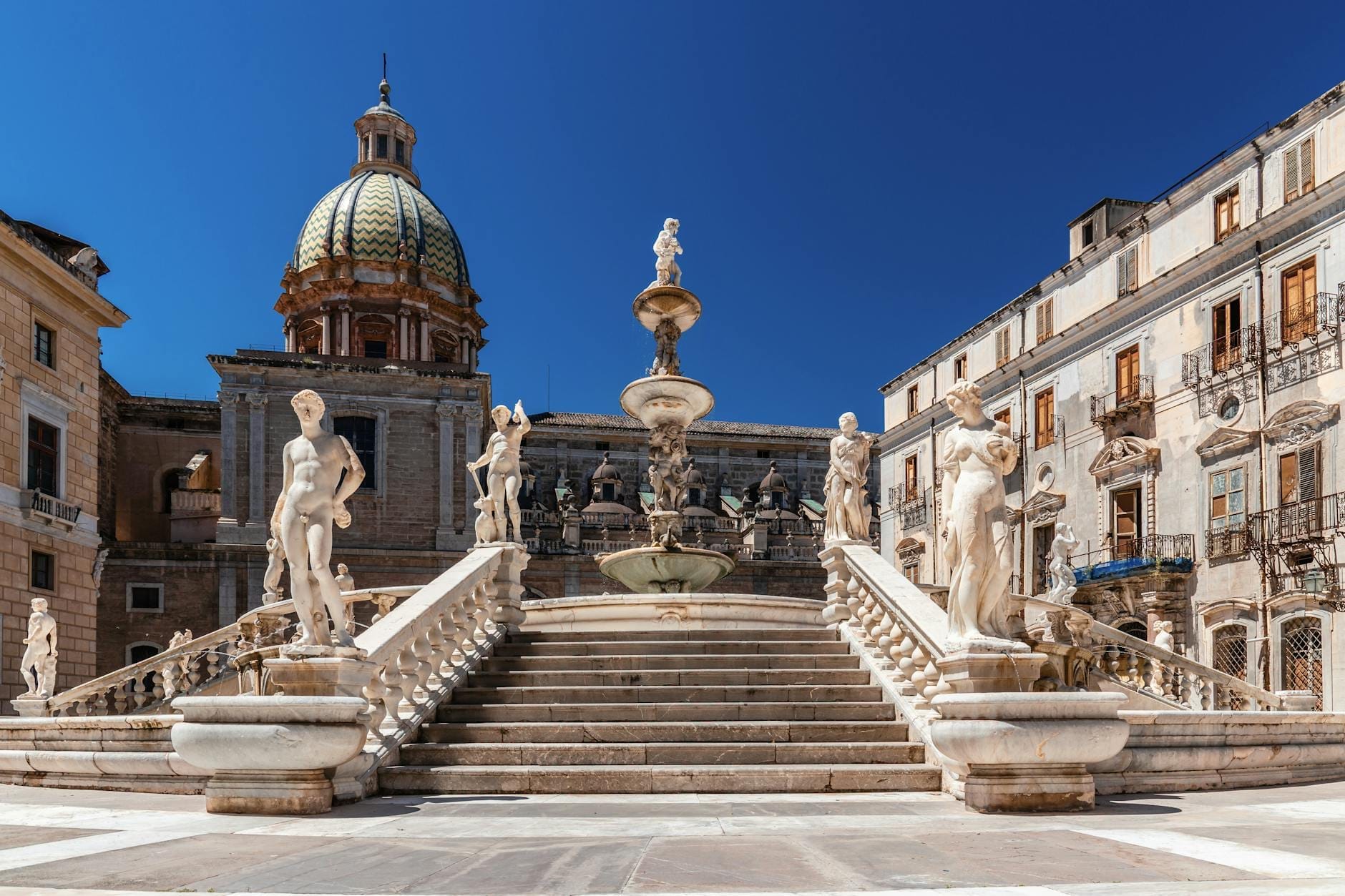
Piazza Pretoria is one of Palermo's most recognisable civic spaces, set at the intersection of the Cassaro (Corso Vittorio Emanuele) and Via Maqueda, just metres from the Quattro Canti baroque crossroads. It is a working piazza in the truest sense: Palazzo Pretorio, the city's functioning town hall known locally as Palazzo delle Aquile, faces directly onto it, giving the square an institutional weight that most tourist squares lack.
At the centre of everything stands the Fontana Pretoria, a late Renaissance fountain approximately 133 metres in circumference and 12 metres high, encircled by tiers of marble basins, water-spouting animals, and dozens of nude mythological figures. It is theatrical, slightly overwhelming, and impossible to walk past without stopping. When it was installed here in 1574, Palermo's conservative citizens were so shocked by the unclothed statuary that they nicknamed it the Fontana della Vergogna — the Fountain of Shame. The name stuck, and it still gets used today.
💡 Local tip
The square is free and accessible around the clock, so you can come by at any hour — but early morning and late evening offer the clearest views of the fountain without tour groups crowding the terraced walkways.
The Fountain's Unlikely Origin Story
The Fontana Pretoria was not built for Palermo. Francesco Camilliani designed and constructed it in Florence in the mid-16th century for the private garden of Don Pedro of Toledo, the Spanish Viceroy of Naples. When the Toledo estate was broken up, the fountain was sold — in its entirety — to the city of Palermo in the 1570s. It arrived in pieces, was transported across the sea, and was reassembled in stages in its current location by 1574. Some elements were lost or adapted in transit, which accounts for a few compositional quirks that art historians still debate.
The fountain's iconographic programme draws on classical mythology: river gods, nymphs, tritons, and allegorical figures representing the seasons and virtues populate its concentric marble terraces. For a mid-16th-century Florentine garden, this was entirely normal. For a public square in a city still shaped by Arab-Norman architectural sensibilities and Spanish Catholic governance, a crowd of nude marble bodies felt like a provocation. The clash between the fountain's Florentine Renaissance origins and its Sicilian context is, in many ways, the most interesting thing about it.
Tickets & tours
Hand-picked options from our booking partner. Prices are indicative; availability and final rates are confirmed when you complete your booking.
Agrigento and Piazza Armerina guided tour from Taormina
From 70 €Instant confirmationFree cancellationDay-trip to Agrigento and Piazza Armerina from Palermo
From 122 €Instant confirmationFree cancellationWine and arancini tasting experience in Piazza Armerina
From 50 €Instant confirmationFree cancellationWine tasting and lunch at a restaurant in Piazza Armerina
From 70 €Instant confirmationFree cancellation
How the Square Changes Throughout the Day
Piazza Pretoria wakes up gradually. By 7:30 in the morning, the square belongs almost entirely to residents: people cutting through on their way to work, the odd delivery vehicle pulling up to a side street, and pigeons reclaiming the basin edges. The marble reads differently in early light — cooler, greyer, with the water catching low-angled sun to throw ripples across the stone. This is when the fountain's scale becomes most apparent, because there is nothing competing for your attention.
By mid-morning, tour groups arrive in rotation. The raised circular walkways around the fountain become congested, and the ambient sound shifts to a mix of guided commentary in multiple languages and the steady splash of water. If you visit between 10am and 1pm in summer or during peak season, expect company. The surrounding cafes and bars along Via Maqueda are usually doing brisk business by this point.
Evening transforms the square entirely. The fountain is lit from below after dark, and the effect on the white Carrara marble is genuinely striking — the figures seem to acquire more volume in artificial light than they do in flat afternoon sun. Palermitans come out to sit on the steps of Palazzo delle Aquile or the nearby church of Santa Caterina, and the piazza takes on the relaxed energy of a neighbourhood gathering place rather than a tourist attraction. If you can time just one visit, late evening is the one to choose.
ℹ️ Good to know
The surrounding streets are part of Palermo's largely pedestrianised historic centre. Noise levels are low in the early morning and after 9pm, making those hours ideal if you want to photograph the fountain without people or distractions in frame.
The Architecture Around the Square
The fountain is the centrepiece, but the buildings framing the piazza are equally worth your attention. Palazzo Pretorio, also called Palazzo delle Aquile after the stone eagles (aquile) mounted on its facade, is a Gothic-Renaissance hybrid that has long served as Palermo's seat of municipal government. Its current facade dates largely from the 15th and 16th centuries. The building is not generally open for public touring, but its exterior and the piazza steps in front of it are a legitimate civic space where you can sit without being moved on.
On the south side of the piazza, the facade of Santa Caterina d'Alessandria, a 16th-century church attached to a Dominican convent, adds another architectural layer. The interior of Santa Caterina is celebrated for its baroque ornamentation and is worth a separate visit. A short walk along Via Maqueda leads to the Church of the Martorana, one of Palermo's finest Norman-era buildings, with Byzantine mosaics that predate the fountain by four centuries.
The proximity of all these layers — Norman, Gothic, Renaissance, baroque — within a few minutes' walk reflects the broader story of Arab-Norman Palermo and its successive waves of rulers and artistic influence. Piazza Pretoria sits at the centre of this compressed architectural history.
What to Bring and Practical Notes
Because the square is open and largely paved, there is very little shelter from the sun during the middle of the day. In summer, temperatures in Palermo regularly reach 30°C and above, and the white marble of the fountain reflects heat back at you. Sunscreen, water, and a hat are more useful here than they might seem for a 20-minute stop. The surrounding bars are good for a quick espresso or granita, which you can take out and drink in the square without any pressure.
The paving around the fountain is flat and continuous, which makes the square relatively manageable for visitors with mobility considerations. The terraced walkways that ring the fountain involve a small step up, but the outer perimeter of the square is level throughout. No ticket, booking, or timed entry is required at any hour.
Photography is straightforward, but wide-angle lenses or a phone in standard mode will struggle to capture the full fountain from close range — it is genuinely large, and the surrounding square does not give you unlimited distance to step back. The best angle for a full composition is from the steps of Palazzo Pretorio, looking across the fountain toward Via Maqueda. At night, the uplighting creates strong shadows on the figures, so a phone camera with a decent night mode will produce more interesting results than a standard daylight shot.
⚠️ What to skip
In summer, the square between 11am and 3pm can be uncomfortably hot with minimal shade. Visit early morning or after 6pm if heat is a concern.
How Piazza Pretoria Fits Into a Palermo Walk
Piazza Pretoria sits at the junction of two historic axes that have defined Palermo's street plan since the Norman period. The Cassaro runs east-west through the old city; Via Maqueda, added in the late 16th century, crosses it at the Quattro Canti a few metres away. Walking south along Via Maqueda from here takes you toward the Ballarò market and the older Albergheria quarter. Walking west along the Cassaro brings you toward the Norman Palace and the Palatine Chapel.
For a focused historic centre walk, combining Piazza Pretoria with Quattro Canti, the Martorana, and San Cataldo takes under two hours at a comfortable pace. If you want to extend that into a half-day, the Norman Palace and its Palatine Chapel are a 15-minute walk west and represent one of the most significant Norman-era sites in Europe.
Piazza Pretoria is also a natural anchor point when exploring Palermo's historic centre for the first time. Nearly everything worth seeing in the old city is within walking distance, and the fountain is distinctive enough that it serves as a reliable landmark to orient yourself.
Is Piazza Pretoria Worth Your Time?
For most visitors, yes — but with a caveat. If you arrive at peak midday in high season expecting a quiet, contemplative encounter with Renaissance sculpture, you will find it crowded and hot. The fountain is impressive, but it is not the Trevi Fountain in terms of spectacle, and some visitors leave feeling it was a brief tick on a list rather than a genuine experience.
The visitors who get the most from it are those who spend time on the details: the individual figures on the fountain's tiers, the relationship between the different buildings around the square, the way Palermo's civic and religious life has always been compressed into small spaces. If you are interested in how cities accumulate history rather than just in ticking famous landmarks, Piazza Pretoria will repay attention that a quick 10-minute stop will not.
Visitors looking primarily for beaches, outdoor activities, or the natural drama of eastern Sicily may find the historic centre circuit less compelling overall. In that case, a brief pass through the piazza on the way between bus stops is perfectly sufficient.
Insider Tips
- Arrive before 8:30am to have the fountain almost entirely to yourself — the early morning light on the marble is softer and more flattering than the harsh midday sun, and you can walk the outer terrace without navigating around other visitors.
- Look at the individual figures on the fountain's upper tiers, not just the overall composition. Many have distinct expressions and postures that get lost when you view the fountain from a distance.
- The steps of Palazzo delle Aquile (the town hall) are a legitimate public space where you can sit for as long as you like. Locals use them as a meeting point in the evenings.
- Santa Caterina d'Alessandria, on the south side of the piazza, is frequently overlooked in favour of the fountain. Its baroque interior is among the most richly decorated in Palermo and is worth the separate admission cost.
- If you are visiting in the late afternoon, position yourself on the Via Maqueda side of the fountain as the sun moves west — the light catches the water jets and the marble figures from a much more interesting angle than it does at midday.
Who Is Piazza Pretoria For?
- First-time visitors to Palermo wanting to orient themselves in the historic centre
- Architecture and art history enthusiasts interested in Renaissance sculpture and its cultural collision with Sicilian history
- Photographers seeking the fountain lit from below after dark
- Travellers building a half-day walking route through Palermo's Norman and baroque quarters
- Anyone who wants a central, free landmark that works as a starting point for the entire old city
Nearby Attractions
Other things to see while in Palermo:
- Ballarò Market
Stretching through the Albergheria district from Piazza Ballarò to Corso Tukory, the Mercato di Ballarò is Palermo's oldest continuously operating street market, with roots tracing back over a thousand years to Arab rule. It is free to enter, open daily, and unlike anything else in Sicily for raw atmosphere, local produce, and street food.
- Catacombs of the Capuchins
Below a quiet convent on the western edge of Palermo's historic centre, the Catacombs of the Capuchins hold one of the most extraordinary collections of preserved human remains anywhere in the world. Around 2,000 mummified bodies and skeletons line stone corridors carved from tuff rock, dressed in period clothing and arranged by profession, gender, and social status. It is an intimate, unsettling, and genuinely thought-provoking encounter with how a Mediterranean culture once confronted death.
- Church of the Martorana
Built in 1143 by a Norman admiral and decorated by craftsmen from Constantinople, the Church of the Martorana contains some of the most important Byzantine mosaics in the western Mediterranean. It sits on Piazza Bellini in Palermo's historic center, part of a UNESCO World Heritage site, and rewards visitors who arrive early and look up.
- La Kalsa
La Kalsa is Palermo's oldest neighborhood, founded by Arab rulers in the 9th century as the city's administrative heart. Today it is a layered district of crumbling palazzi, Baroque churches, art-filled piazzas, and some of Palermo's most atmospheric street life. Free to explore and walkable in half a day, it rewards those who slow down.