Old Summer Palace (Yuanmingyuan Ruins Park): Beijing's Most Haunting Imperial Site
Once the grandest imperial garden complex in the world, the Old Summer Palace was destroyed in 1860 and left as a deliberate ruin. Today its 350 hectares of fractured stonework, lotus-covered lakes, and wooded paths offer a completely different kind of Beijing experience: reflective, spacious, and quietly sobering.
Quick Facts
- Location
- No. 28, West Tsinghua Road, Haidian District, Beijing
- Getting There
- Beijing Subway Line 4, Yuanmingyuan Station, Exit B
- Time Needed
- 2 to 4 hours; full-day for thorough exploration
- Cost
- CNY 10 general admission; CNY 5 half-price; annual pass CNY 120
- Best for
- History lovers, photographers, solo wanderers, Beijing regulars seeking solitude
- Official website
- www.yuanmingyuanpark.cn
What Is the Old Summer Palace?
The Old Summer Palace, known in Chinese as Yuanmingyuan (圆明园遗址公园), is a 350-hectare park in Haidian District preserving the ruins of one of the largest and most architecturally complex imperial garden complexes ever built. Construction began in 1707 during the Kangxi era of the Qing dynasty. Over the following century and a half, three interconnected gardens took shape: the Yuanming, Changchun, and Qichun gardens, together containing nearly 160,000 square metres of palace halls, pavilions, artificial hills, canals, and lakes.
In October 1860, during the Second Opium War, British and French forces looted and then burned the complex over three days. What survived the fire was further stripped across subsequent decades. The ruins were left standing by the Chinese government as a deliberate memorial to that destruction, which is why a visit here feels categorically different from a tour of the intact Summer Palace a short distance away. You are not looking at restored grandeur. You are walking through what remains after catastrophic loss.
ℹ️ Good to know
Opening hours are seasonal. April 1 to October 31: park opens at 06:00, ticket sales from 07:00, last entry at 19:00, closes at 21:00. November 1 to March 31: park opens at 06:30, ticket sales from 07:00, last entry at 17:30, closes at 19:30. Verify before visiting as hours can be adjusted for public holidays.
The Ruins Themselves: What You Actually See
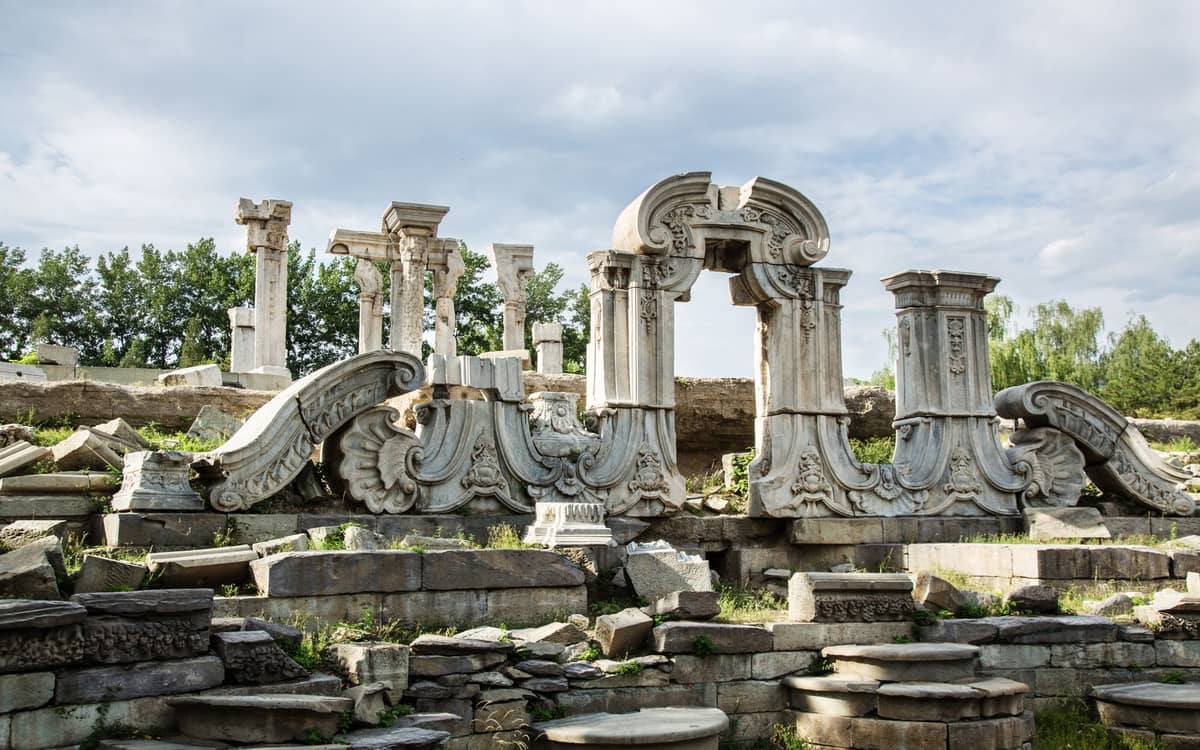
Most international visitors come specifically for the European Palatial Ruins in the northeastern section of the park, known in Chinese as Xiyanglou. These are the skeletal remains of baroque-style stone buildings designed by Jesuit missionaries in the 18th century under the commission of the Qianlong Emperor. White marble column fragments, crumbling archways, and tiered fountain bases stand in open ground, their European architectural vocabulary in stark contrast to the willows and reeds surrounding them. The combination is genuinely arresting.
The ruins are smaller than most first-time visitors expect. The photogenic fragments you have likely seen in photographs occupy a compact area, and after 20 minutes of close inspection, many visitors feel they have seen the highlights. That is not the whole story, though. The park surrounding these ruins is vast, and the experience of walking its quieter western and southern sections, where almost no other visitors venture, is what most people miss.
The larger garden area is dominated by Fuhai Lake, a broad artificial lake with small islands connected by stone bridges. In summer the water is dense with lotus flowers, and the smell on still mornings is rich and green. In winter the lake freezes and the bare branches of willows trace sharp lines against grey sky. In autumn the colors around the causeways shift through amber and copper. This is a park that genuinely changes character across seasons, which is worth factoring into your timing. Check our best time to visit Beijing guide for broader seasonal advice.
Tickets & tours
Hand-picked options from our booking partner. Prices are indicative; availability and final rates are confirmed when you complete your booking.
Beijing Summer Palace Entrance Ticket
From 7 €Instant confirmationFree cancellationMutianyu Great Wall and Summer Palace small-group tour from Beijing
From 171 €Instant confirmationFree cancellationPrivate Guided Tour to Temple of Heaven, Panda House and Summer Palace
From 67 €Instant confirmationFree cancellationForbidden City, Temple of Heaven and Summer Palace guided tour
From 294 €Instant confirmationFree cancellation
How the Park Changes Through the Day
Early morning is when the park is at its most atmospheric and least crowded. Between 07:00 and 09:00 on weekdays you will share the grounds primarily with local residents doing their morning exercises: older adults doing tai chi near the lakeside, walkers with small radios, a few people practicing calligraphy with water brushes on stone pavement. The sound of birds over the lake carries clearly. The European Ruins themselves, backlit in morning light with low mist over the surrounding water, are at their most photogenic at this hour.
Midday on weekends, particularly in good weather from April through October, draws school groups, families with young children, and tour groups. The area around the main ruins becomes congested, and the scale of selfie-taking at the marble archways can reduce the meditative quality of the space considerably. If you cannot avoid a weekend visit, plan to arrive when the park opens and move through the ruins section before 10:00.
Late afternoon, from around 16:00 onward, sees crowds thin again. Summer afternoons in particular offer golden light across Fuhai Lake in the final hours before the park closes. Note that the entrance gates for ticket purchase close well before the park itself: last entry is at 19:00 in summer and 17:30 in winter, so plan accordingly if you want late-afternoon light.
Historical and Cultural Context
Understanding what you are looking at requires some historical grounding. The Yuanmingyuan complex was the primary residence of the Qing emperors from the Yongzheng reign onward, and they spent more time here than in the Forbidden City for much of the 18th and early 19th centuries. The complex integrated Chinese classical garden design with Western baroque architecture in a way that had no precedent. It contained thousands of artworks, rare books, gold and jade objects, and silk textiles accumulated over generations.
When the Anglo-French forces arrived in October 1860, they systematically looted what they could carry and then set fires to destroy what remained. The burning lasted three days. The memory of this event carries significant weight in Chinese national consciousness, and the government's decision to leave the ruins unrestored rather than reconstruct them is a deliberate political and historical statement. Many Chinese visitors come here with that awareness fully present. If you are visiting as a foreign national, some sensitivity to this context is worthwhile. For more on Beijing's imperial history and its layers of meaning, the Beijing imperial history guide provides useful context.
The debate about Chinese cultural relics looted during this period remains active. Twelve bronze animal heads that formed part of a fountain at the Xiyang Lou complex have become particular symbols of this history. Several have been returned to China through various channels; others remain in overseas collections. Information panels in the park address this directly.
Practical Walkthrough: Navigating 350 Hectares
The park is genuinely large and the path network is extensive. A focused visit to the European Ruins area plus a circuit of Fuhai Lake takes about two hours at a comfortable pace. Allowing three to four hours lets you explore the quieter Changchun Garden section to the east, where the ruins are more sparse but the atmosphere is more solitary.
Pick up a paper map at the main gate. Digital maps do not always reflect the actual path network accurately, and some paths between sections are not immediately obvious. The park is flat throughout, which makes walking manageable, but the distances between major features are real: the European Ruins are in the northeast of the Yuanming Garden section, and reaching Fuhai Lake from there involves a 15 to 20 minute walk.
Boat rentals are available on Fuhai Lake seasonally, typically from late spring through early autumn. Pedal boats and rowboats let you access the small central island and get a completely different perspective on the scale of the park. Fees and availability vary by season; confirm at the lakeside rental points.
💡 Local tip
Wear shoes suited for uneven ground. Some paths near the ruins section are cobbled or compressed earth, and the stone fragments themselves have irregular surfaces. Sandals or thin-soled shoes make the experience significantly less comfortable.
Photography at Yuanmingyuan
The European Ruins are the most-photographed feature, and for good reason: the contrast of broken baroque stonework with the surrounding trees and water is visually striking. Morning light from the east hits the marble columns directly; afternoon light falls from the west and produces longer shadows across the tiered stonework. Both produce worthwhile images. For a broader look at shooting in Beijing, see our Beijing photography guide.
The lotus season on Fuhai Lake, typically July through August, offers a completely different photographic subject. The lake surface can be nearly covered, and the contrast of pink flowers against the stone bridges and distant willows is one of the more underrated photography opportunities in Beijing. Come early in the morning when the light is soft and the flowers are fully open.
Photography is permitted throughout the park for personal use. There are no significant photography restrictions visible to general visitors in the main accessible areas, though the usual common sense applies around other visitors.
Getting There and Practical Information
The most straightforward route is Beijing Subway Line 4 to Yuanmingyuan Station, Exit B. From the exit it is a short walk to the South Gate of the park. Line 4 connects to major interchange stations including Zhongguancun, Haidian Huangzhuang, and Xidan, making it accessible from most parts of central Beijing without transfers.
Multiple bus routes serve the Yuanmingyuan South Gate stop, including routes 319, 320, 331, 432, 438, 498, 601, 626, 628, 664, and 690. If you are combining this visit with the nearby Summer Palace, note that the two parks are approximately 2 kilometres apart and connected by the same subway line (Beigongmen Station on Line 4 serves the Summer Palace North Gate). Many visitors pair the two, spending the morning at Yuanmingyuan and the afternoon at the Summer Palace, though this makes for a long and physically demanding day.
General admission is CNY 10, which is among the lowest entry prices for major Beijing sites. The half-price ticket at CNY 5 applies to eligible visitors including students and seniors; bring relevant documentation. An annual pass at CNY 120 is worthwhile for anyone living in or making extended visits to Beijing, as it includes unlimited entries across the full year. Note that the European Palaces scenic area and some exhibitions require separate tickets.
⚠️ What to skip
Accessibility information is not comprehensively published on official park sources. The grounds are generally flat but include some uneven and cobbled surfaces. Visitors with mobility requirements should contact the park directly at +86 10 62543673 before visiting to confirm current arrangements for step-free access, accessible toilets, and any available assistance.
Honest Assessment: Who This Is For and Who Should Skip It
The Old Summer Palace is one of the few major Beijing attractions that rewards a reflective, slower pace of travel. It is not a place where spectacular intact monuments are displayed for easy consumption. If you are visiting Beijing on a tight schedule and your primary interest is grand imperial spectacle, the intact Forbidden City or the Summer Palace will deliver more in less time.
Visitors who will get the most from Yuanmingyuan are those who appreciate the texture of historical sites that have not been sanitized or restored, who want to understand a complex and painful chapter of modern Chinese history, or who simply want a large, quiet park in which to walk for several hours away from the heavier tourist circuits. On a weekday morning in April or October, it can feel remarkably unrushed for a site this close to central Beijing.
Families with young children may find the experience less engaging than the Beijing Zoo or Olympic Park, both of which offer more structured activity. The ruins themselves, while striking to adults with context, are not self-explanatory to children, and the park's information panels are primarily in Chinese.
Insider Tips
- The northeastern corner of Fuhai Lake, near the smaller stone bridges connecting to the central island, sees very few visitors even on busy weekends. Walk past the main crowds at the European Ruins and continue south and west: the park opens up considerably within ten minutes.
- The park officially opens at 06:00 (06:30 in winter) but ticket sales only begin at 07:00. If you arrive before ticket sales begin, confirm at the gate whether early entry is permitted under the current admission arrangements.
- There are several food stalls and small restaurants inside the park near the main paths. Quality is basic and prices are tourist-site prices, so bringing your own snacks and water for a long visit is a reasonable approach, particularly for a full-day exploration.
- In winter, when the crowds thin dramatically and the lake freezes, the ruins take on a completely different character. The marble stonework against bare trees and grey sky, with almost no other visitors, is one of the starker and more memorable versions of the site. Dress for temperatures that frequently drop below zero.
- The Changchun Garden section in the eastern part of the complex receives far less foot traffic than the main Yuanming Garden area. Its paths along the water's edge, with fragments of stone balustrades still in place, give a better sense of the original garden's scale than the more crowded western section.
Who Is Old Summer Palace (Yuanmingyuan Ruins Park) For?
- History and modern Chinese history enthusiasts who want context behind the ruins
- Photographers seeking unusual compositional subjects and strong morning light
- Solo travelers looking for extended, reflective walking space away from tourist crowds
- Beijing regulars and expatriates who want a large green park that changes across seasons
- Travelers interested in Qing dynasty imperial culture who want to go beyond the Forbidden City
Nearby Attractions
Other things to see while in Haidian District:
- Beijing Aquarium
Beijing Aquarium is one of the largest indoor aquariums in Asia, located within the grounds of Beijing Zoo in Haidian District. This guide covers what you'll actually see, how to plan your visit efficiently, and whether it's worth the ticket price for your specific travel style.
- Big Bell Temple (Dazhongsi)
Tucked along the North 3rd Ring West Road in Haidian, the Big Bell Temple Ancient Bell Museum houses one of the largest surviving bronze bells in the world. It is a serious museum experience, combining a working Qing-dynasty temple complex with a specialist collection of historic bells that draws scholars, photographers, and curious travelers in equal measure.
- Five Pagoda Temple (Wuta Temple)
Officially the Beijing Stone Carving Art Museum, the Five Pagoda Temple sits on the grounds of the former Ming-dynasty Zhenjue Temple in Haidian. It combines one of China's most distinctive Buddhist structures with an outdoor museum of stone carvings that rewards visitors who take time to look closely.
- Military Museum of the Chinese People's Revolution
The Military Museum of the Chinese People's Revolution stands at No. 9 Fuxing Road in Haidian District, presenting extensive collections across more than 40,000 square meters of exhibition space. It is one of the largest military history museums in China, admission is free, and it makes for a genuinely substantial half-day visit for anyone curious about modern Chinese history.