Big Bell Temple (Dazhongsi): Beijing's Ancient Bell Museum Explained
Tucked along the North 3rd Ring West Road in Haidian, the Big Bell Temple Ancient Bell Museum houses one of the largest surviving bronze bells in the world. It is a serious museum experience, combining a working Qing-dynasty temple complex with a specialist collection of historic bells that draws scholars, photographers, and curious travelers in equal measure.
Quick Facts
- Location
- A31 North 3rd Ring West Road, Haidian District, Beijing
- Getting There
- Dazhongsi Station (Subway Line 12 or Line 13)
- Time Needed
- 1.5 to 2.5 hours
- Cost
- CNY 30 adults / CNY 15 concession; free for under-18s, 60+, military, and registered visitors with disabilities (valid ID required)
- Best for
- History enthusiasts, architecture lovers, quiet museum-goers, photographers
What Is the Big Bell Temple Ancient Bell Museum?
The Big Bell Temple Ancient Bell Museum, officially known in Chinese as 大钟寺古钟博物馆 (Dàzhōngsì Gǔzhōng Bówùguǎn), is one of Beijing's more specialized and underattended institutions. It occupies Dazhong Temple, a Qing-dynasty religious compound that survives largely intact, and dedicates its exhibition halls to a remarkable collection of antique Chinese bells spanning more than two thousand years of casting history.
The centerpiece of the entire site is the Yongle Bell, a massive bronze bell commissioned during the reign of the Yongle Emperor in the early Ming dynasty. It is covered inside and out with Buddhist sutras rendered in fine relief script, and its scale, when you stand beneath it, is genuinely arresting. This is not the kind of attraction where the reality falls short of expectation.
ℹ️ Good to know
The museum is closed on Mondays. It opens Tuesday through Sunday from 09:00 to 17:00, with the last admission at 16:30. Arrive before 16:00 if you want enough time to see the Yongle Bell hall without rushing.
The Setting: A Qing Temple Alongside a Modern Ring Road
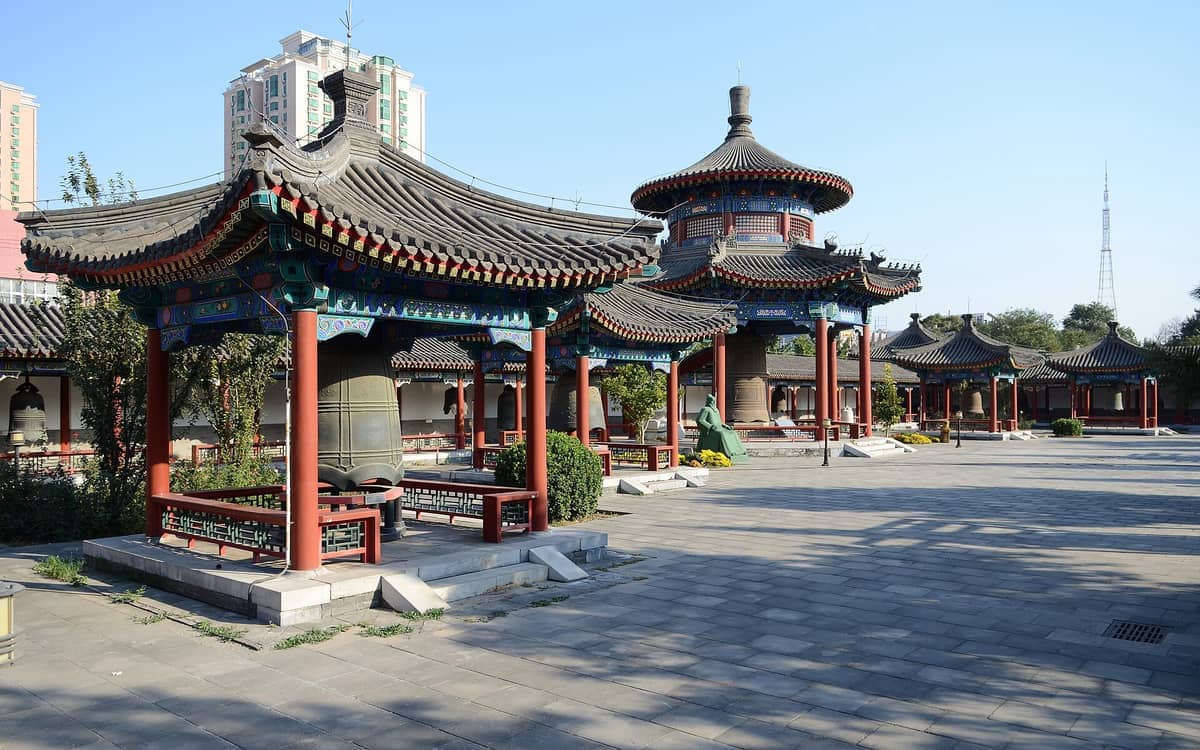
The temple sits on the southern edge of Haidian District, pressed between the North 3rd Ring West Road and a residential neighborhood. From street level, the red perimeter walls and traditional gate give little away about the scale of what is inside. Once through the entrance, the noise of the ring road drops away noticeably. The courtyard layout follows a classical Chinese temple axis: successive gateways, ceremonial halls, and courtyards arranged along a central north-south line.
Haidian is primarily known today as Beijing's university and technology corridor, home to Peking University and a dense cluster of research institutions. The temple sits slightly apart from that identity, a preserved religious site that survived the twentieth century without being dismantled. If you are combining this visit with other Haidian District sites, the Summer Palace is roughly 8 kilometers to the northwest, reachable by subway with one transfer.
The architecture itself rewards attention even before you reach the main bell hall. The painted timber detailing on the gate structures shows careful restoration work, and the proportions of the successive courtyards create a sense of graduated arrival toward the centerpiece. In winter, when the trees in the courtyard are bare, the geometry of the rooflines is particularly clear.
Tickets & tours
Hand-picked options from our booking partner. Prices are indicative; availability and final rates are confirmed when you complete your booking.
Small group tour of Tian'anmen Square and the Forbidden City
From 43 €Instant confirmationFree cancellationBeijing Summer Palace Entrance Ticket
From 7 €Instant confirmationFree cancellationMutianyu Great Wall and Summer Palace small-group tour from Beijing
From 171 €Instant confirmationFree cancellationPrivate Guided Tour to Temple of Heaven, Panda House and Summer Palace
From 67 €Instant confirmationFree cancellation
The Yongle Bell: What You Actually See
The Yongle Bell is housed in its own pavilion at the rear of the complex, suspended within a purpose-built wooden frame. The bell is enormous by any standard. It is covered on every outer and inner surface with inscriptions of Buddhist sutras in Chinese and Sanskrit, rendered with a precision that is difficult to comprehend given the technical limitations of early Ming casting. Visitors can view the interior of the bell through a small circular opening at the base, looking up into the inscribed interior dome.
A coin-tossing tradition has developed around this opening: if a coin lands inside, it is considered good luck. On weekday mornings, this results in a quiet, sporadic sound of coins ringing against bronze, which is oddly appropriate given the setting. On weekends, the area around the base is more crowded and the atmosphere shifts toward something more theme-park-adjacent.
💡 Local tip
For the best experience of the Yongle Bell, visit on a weekday morning. The pavilion is quieter, the light through the lattice windows is softer, and you can stand beneath the bell without crowds pressing around you.
The acoustics of the pavilion are worth noting. Even without ringing, there is a resonant quality to the enclosed space. Display panels around the hall explain the casting process and the historical significance of the bell, with English translations available, though the translation quality varies and some technical descriptions require patience to parse.
The Bell Collection: More Than One Object
Beyond the Yongle Bell, the museum holds a collection of bells across multiple exhibition halls, representing different dynasties, casting techniques, and ceremonial functions. The variety is genuine. Some bells are small enough to hold in one hand; others required teams of craftsmen and months of preparation. Labels identify the dynasty, region of origin, and purpose, with information on whether bells were used for Buddhist ritual, Confucian ceremony, or military signaling.
This makes the museum a credible complement to a visit to the Confucius Temple and Guozijian, where ritual bell music played a central role in Confucian ceremony. Seeing the physical objects here adds context to the ceremonial spaces elsewhere in Beijing.
The collection also includes bells from Korea, Japan, and Southeast Asia, providing a regional perspective on bronze bell casting traditions that is unusual to find in a single Beijing institution. This section is less visited and worth slowing down for, particularly if you have any interest in comparative metallurgical history or East Asian religious material culture.
How the Experience Changes by Time of Day and Season
Mornings between 09:00 and 11:00 on weekdays represent the most comfortable window to visit. School groups sometimes arrive mid-morning, particularly on Tuesdays and Wednesdays, so arriving at opening gives you the first hour with almost no other visitors. The light in the courtyards is low and angled in autumn and winter, which makes for more interesting photography of the architectural details.
Summer visits are entirely possible but the heat inside some of the older exhibition halls can be significant. The Yongle Bell pavilion itself is not air-conditioned, though its high roof and thick walls provide some relief. Carry water and plan your visit for the cooler morning hours if you are traveling between June and August. Autumn, particularly October, offers the best combination of manageable temperatures, lower humidity, and clear air.
Winter visits have a particular quality. The bare trees, quieter crowds, and low winter light create an atmosphere that is harder to find at more popular Beijing sites. If you are visiting Beijing in the colder months, this pairs well with a broader temple circuit across the city, where the off-season quiet rewards visitors who can tolerate the cold.
Getting There and Practical Logistics
The easiest approach is by subway. Line 13 stops at Dazhongsi Station, which places you within a short walk of the temple entrance. From the station, follow signage toward the North 3rd Ring West Road; the red perimeter walls of the complex are visible from the street. Several bus routes also stop here, including routes 87, 94, 361, 425, 606, 658, 695, 921, and the dedicated route 专168, making it accessible from multiple parts of the city without needing to transfer.
If you are coming from central Dongcheng, the subway journey takes approximately 30 to 40 minutes depending on your starting point. The museum pairs logically with a visit to the Beijing Zoo, which is a short distance east and accessible via the same general corridor, or with the Five Pagoda Temple, another specialist museum site in Haidian that receives far fewer visitors than it deserves.
Tickets cost CNY 30 for adults and CNY 15 for concession. Visitors under 18, those aged 60 and above, active military personnel, and registered visitors with disabilities receive free admission on presentation of valid identification. The ticket office closes at 16:30, so account for this if arriving in the afternoon.
⚠️ What to skip
The official listing does not provide detailed information about step-free access routes, lifts, or accessible toilet facilities within the complex. Visitors with mobility requirements should contact the museum directly or check with Beijing's municipal cultural heritage bureau before visiting.
Honest Assessment: Who Will Appreciate This, and Who Won't
The Big Bell Temple Ancient Bell Museum is a specialist site. It rewards visitors who approach it with some curiosity about Chinese material culture, religious history, or bronze casting, and it offers genuine depth for those who do. The setting is attractive, the centerpiece is impressive, and the overall experience is calm in a way that few Beijing attractions manage.
Visitors who prefer a faster pace, who are primarily interested in Beijing's imperial history, or who have limited time in the city may find that the museum's narrow thematic focus does not justify the journey from central districts. It is not a broad survey museum in the way that the National Museum of China is, and it should not be treated as one. For travelers with more than three days in Beijing and an interest in going beyond the obvious circuit, however, it is a genuinely rewarding stop.
If your Beijing schedule is tight, prioritize the Forbidden City and Temple of Heaven first. Come here when you are ready to go deeper into the city's cultural fabric rather than covering its headline sites.
Photography at Dazhongsi
The temple complex offers strong compositional opportunities. The successive gate arches create natural layered frames, and the contrast between the red-painted timber and grey courtyard paving is consistent throughout. The Yongle Bell pavilion itself presents a challenge: the interior is dimly lit and the bell is large, making it difficult to capture the inscriptions in detail without a camera capable of handling low light well. If photography is a priority, consult the Beijing photography guide for advice on managing interior temple light conditions.
External courtyard shots are best in the morning when the sun is to the east, illuminating the front facades of the main halls. By early afternoon, much of the central courtyard falls into shade. The coin-toss opening at the base of the Yongle Bell is a popular subject, but capturing it sharply requires patience and a steady hand given the low ambient light inside the pavilion.
Insider Tips
- Arrive within the first 30 minutes of opening on a weekday. The first hour is consistently the quietest, and the Yongle Bell pavilion is at its most atmospheric before tour groups arrive.
- Look at the inscriptions on the bell's interior surface through the base opening rather than only viewing the exterior. The density of the Sanskrit and Chinese text inside the dome is one of the most unusual sights in the museum.
- The smaller exhibition halls on either side of the main axis are often skipped by visitors moving directly toward the Yongle Bell. Slow down here; the dynastic survey of smaller bells includes some formally beautiful objects that are easy to miss.
- If you are traveling in autumn, the ginkgo trees in the courtyard turn yellow in late October and early November, adding warmth to the grey courtyard stone. Timing your visit for this window improves the photographic possibilities considerably.
- Carry cash or ensure your mobile payment app (Alipay or WeChat Pay) is set up before arriving. While payment methods at Beijing museums have expanded, having options ready avoids friction at the ticket counter.
Who Is Big Bell Temple (Dazhongsi) For?
- Travelers with a serious interest in Chinese history, religion, or material culture
- Photographers looking for a less-crowded temple complex with strong architectural lines
- Visitors on a second or third trip to Beijing who have already covered the major imperial sites
- Those combining Haidian sightseeing with the Summer Palace or university campus areas
- Budget-conscious travelers who qualify for free admission and want a substantive museum experience
Nearby Attractions
Other things to see while in Haidian District:
- Beijing Aquarium
Beijing Aquarium is one of the largest indoor aquariums in Asia, located within the grounds of Beijing Zoo in Haidian District. This guide covers what you'll actually see, how to plan your visit efficiently, and whether it's worth the ticket price for your specific travel style.
- Five Pagoda Temple (Wuta Temple)
Officially the Beijing Stone Carving Art Museum, the Five Pagoda Temple sits on the grounds of the former Ming-dynasty Zhenjue Temple in Haidian. It combines one of China's most distinctive Buddhist structures with an outdoor museum of stone carvings that rewards visitors who take time to look closely.
- Military Museum of the Chinese People's Revolution
The Military Museum of the Chinese People's Revolution stands at No. 9 Fuxing Road in Haidian District, presenting extensive collections across more than 40,000 square meters of exhibition space. It is one of the largest military history museums in China, admission is free, and it makes for a genuinely substantial half-day visit for anyone curious about modern Chinese history.
- Old Summer Palace (Yuanmingyuan Ruins Park)
Once the grandest imperial garden complex in the world, the Old Summer Palace was destroyed in 1860 and left as a deliberate ruin. Today its 350 hectares of fractured stonework, lotus-covered lakes, and wooded paths offer a completely different kind of Beijing experience: reflective, spacious, and quietly sobering.