Five Pagoda Temple (Wuta Temple): Beijing's Most Underrated Architectural Treasure
Officially the Beijing Stone Carving Art Museum, the Five Pagoda Temple sits on the grounds of the former Ming-dynasty Zhenjue Temple in Haidian. It combines one of China's most distinctive Buddhist structures with an outdoor museum of stone carvings that rewards visitors who take time to look closely.
Quick Facts
- Location
- No. 24 Wutasi Village, Haidian District, Beijing
- Getting There
- Line 4 or Line 9 to National Library Station, Exit C — approx. 500 m east along Wutasi Road
- Time Needed
- 1 to 1.5 hours
- Cost
- ¥20 adults; free for the first 200 visitors on Wednesdays; check current concessions before visiting
- Best for
- Architecture enthusiasts, history lovers, photography, quiet afternoon escapes
- Official website
- http://www.bjstoneartmuseum.org.cn/EN
What Is the Five Pagoda Temple?
The Five Pagoda Temple, known in Chinese as Wuta Temple (五塔寺), is the colloquial name for the former Zhenjue Temple (真觉寺), a Ming-dynasty royal Buddhist complex in Haidian District. Today the site operates as the Beijing Stone Carving Art Museum (北京石刻艺术博物馆), a specialized institution that uses the temple grounds to display hundreds of stone carvings spanning several centuries of Chinese history.
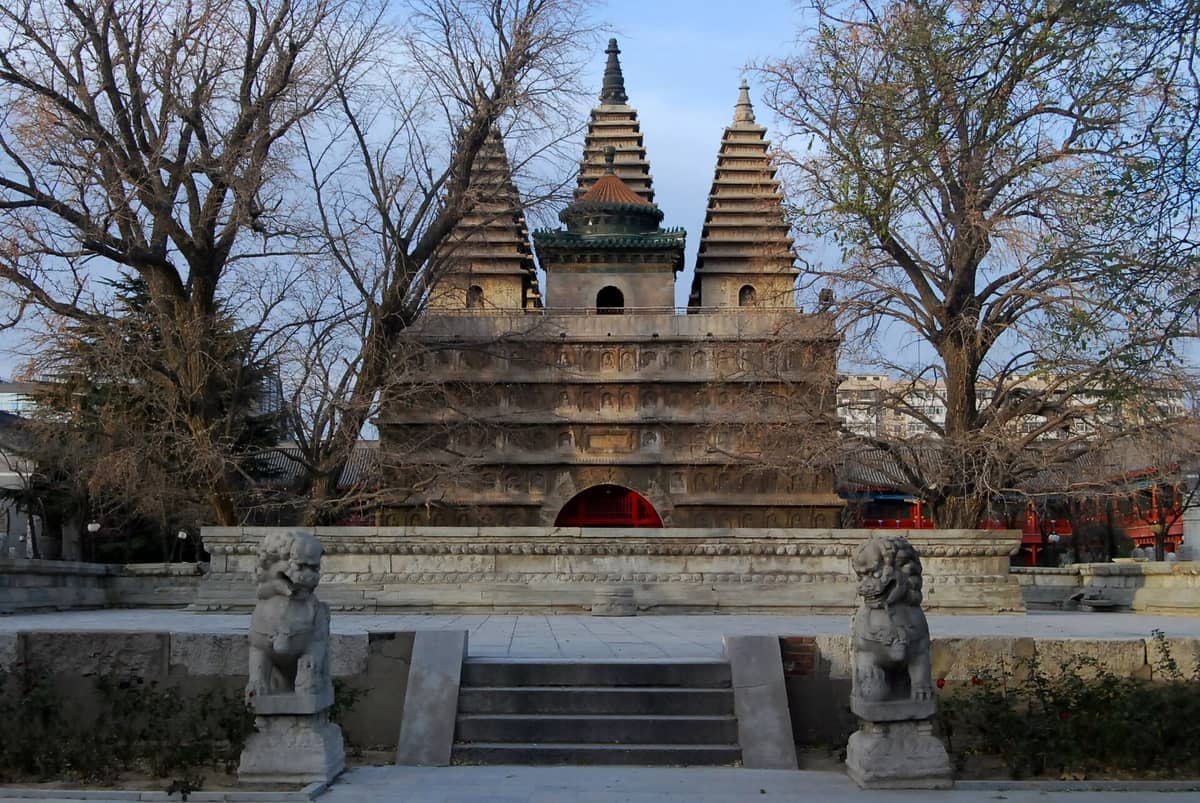
The centrepiece is the Diamond Throne Pagoda, a stone structure built in 1473 during the reign of the Chenghua Emperor. Five smaller pagodas rise from a wide stone platform, giving the complex its popular name. The style is directly modeled on Indian Buddhist stupas, and it remains one of the few surviving examples of this pagoda form in China. That architectural pedigree alone separates this site from the more commonly visited temples in the city.
ℹ️ Good to know
Opening hours: 9:00–16:30, last entry 16:00. Closed Mondays. Verify hours around public holidays before visiting, as schedules can shift without wide advance notice.
The Architecture: What You Are Actually Looking At
The Diamond Throne Pagoda is not immediately legible to visitors unfamiliar with Buddhist architectural traditions, and that first moment of confusion is worth sitting with. The structure works from the ground up: a tall, solid stone platform serves as the throne, its exterior covered in carved niches containing Buddha figures, lotus borders, Sanskrit inscriptions, and decorative animals. The density of carving across every surface is remarkable. Counting the carved niches is almost futile — there are over a thousand.
Above the platform, five separate pagodas in a North Indian style stand at the cardinal points and centre. Each pagoda tapers upward through multiple tiers of carved decorative detail. Stone staircases inside the platform lead visitors to the upper terrace, where the pagodas can be viewed at close range. The views from the top down into the surrounding garden and across to the Chang River canal are modest but satisfying, especially in the morning when light comes from the east.
For context on how this fits into Beijing's broader Buddhist heritage, the Lama Temple in Dongcheng represents the Tibetan tradition in a more ceremonially active form, while the Five Pagoda Temple offers a more purely architectural and historical encounter with Buddhist building traditions.
Tickets & tours
Hand-picked options from our booking partner. Prices are indicative; availability and final rates are confirmed when you complete your booking.
Small group tour of Tian'anmen Square and the Forbidden City
From 43 €Instant confirmationFree cancellationBeijing Summer Palace Entrance Ticket
From 7 €Instant confirmationFree cancellationMutianyu Great Wall and Summer Palace small-group tour from Beijing
From 171 €Instant confirmationFree cancellationPrivate Guided Tour to Temple of Heaven, Panda House and Summer Palace
From 67 €Instant confirmationFree cancellation
The Stone Carving Museum: More Than a Backdrop
Most visitors come for the pagoda and walk past the stone carving collection without realising how substantial it is. That is a mistake. The outdoor displays arranged across the temple grounds include funerary sculpture, decorative column bases, imperial stele fragments, carved animal figures, and architectural elements spanning from the Han dynasty through the Qing. Many pieces were relocated here from demolition sites across Beijing during 20th-century urban redevelopment.
The collection has an elegiac quality. These are objects that were not designed to be displayed in a museum setting, and their displacement from original contexts gives the grounds an atmosphere different from a conventional museum gallery. Stone animals that once guarded tomb avenues stand on grass. Stele fragments lean against walls. For visitors with an interest in Chinese funerary customs or imperial ritual culture, this is one of the more concentrated open-air collections in Beijing.
If this kind of stone and architectural heritage interests you, Ming City Wall Relics Park in Dongcheng offers a complementary perspective on preserved Ming-era stonework in an outdoor setting.
How the Experience Changes Through the Day
Morning visits, particularly on weekdays, produce the closest thing to solitude this city offers near a historical site. Arriving close to the 9:00 opening means you may walk the grounds with very few other visitors. The stone surfaces are cool to the touch, pigeons settle on the platform ledges, and the garden smells of damp earth and stone. Early morning light from the east catches the carved detail on the pagoda's eastern faces particularly well, which matters if photography is a priority.
By midday the tempo shifts. School groups appear during term time, and the narrow corridors inside the stone platform can feel crowded when a group passes through simultaneously. Weekend afternoons bring the largest crowds, though even then the site is quiet compared to the major imperial attractions. Late afternoon light falls across the western face of the pagoda and produces warm tones on the carved stone, making the hour before the 16:00 last entry another reasonable photography window.
💡 Local tip
Wednesday morning is the most rewarding time to visit: the first 200 visitors enter free, crowds are typically light, and the garden is at its quietest. Arrive shortly after 9:00 to secure a free ticket.
Getting There and What to Bring
The most practical route is Beijing Subway Line 4 or Line 9 to National Library Station. Take Exit C and walk to the museum. Several bus routes also stop at National Library or Baishi Bridge, but the subway is more predictable in timing.
The site is located in Haidian District, which also contains the Summer Palace and the Old Summer Palace. Combining the Five Pagoda Temple with one of those larger sites makes for a full day in western Beijing without heavy transit.
Wear comfortable flat shoes. The stone staircase inside the pagoda platform has steps that are steep and uneven in places; handrails are present but grip conditions vary when wet. Bring water during summer months, as there is limited shade in parts of the garden. Photography inside the platform staircase requires care due to low light and tight space.
⚠️ What to skip
Detailed accessibility information for step-free routes, lifts, or wheelchair assistance was not confirmed in available sources. Visitors with mobility requirements should contact the museum directly before visiting.
Honest Assessment: Is It Worth Your Time?
The Five Pagoda Temple is not a site that rewards passive tourism. Visitors who arrive expecting the scale or grandeur of the Forbidden City or the Temple of Heaven will find it underwhelming. The grounds are compact. The exhibits lack extensive English labelling. The pagoda itself is a structure you walk around and up into, not a space with a dramatic interior.
What the site does offer is concentrated, specific, and genuinely unusual: a well-preserved Indian-influenced pagoda structure surviving from the 15th century, combined with a stone carving collection that documents Chinese memorial and ritual culture across two millennia. For visitors interested in that specific intersection of architectural history and material culture, this is more rewarding than many higher-profile sites. It also pairs well with a broader interest in Beijing's museum landscape, which offers significant depth beyond the famous imperial palaces.
Visitors who prefer a fuller narrative experience with context panels, audio guides, and curated flow will find the experience less satisfying. Those who travel with children under ten may find the site too quiet and object-focused to hold attention for long. For everyone else with a genuine interest in Beijing's layered architectural history, the low ticket price and short visiting time make it a low-risk addition to a Haidian itinerary.
Photography Notes
The pagoda photographs best from the garden path that runs along its southern face, where the full height of the structure is visible without obstruction. A standard 24-70mm lens covers most angles comfortably. The carved Buddha niches reward close-up detail work: a macro lens or telephoto zoom will pick up individual figures and Sanskrit inscriptions that are invisible at normal viewing distance.
The canal bank just outside the temple gate also offers a frame of the pagoda tops above the garden wall, which makes for a less obvious composition. For a structured approach to photographing Beijing's historical architecture, the Beijing photography guide covers timing and technique across the city's major sites.
Insider Tips
- Arrive on a Wednesday morning to access the first-200-visitors free admission policy. The grounds are typically very quiet at that time, and you will have the pagoda largely to yourself for the first hour.
- The stone staircase inside the platform is steep and narrow. If you are visiting with someone who has difficulty with stairs, they can wait in the garden below while others ascend — the view of the surrounding carvings at ground level is equally worthwhile.
- The canal path running beside Wutasi Road between the subway exit and the temple entrance is pleasant in spring and autumn. Allow an extra ten minutes to walk it slowly rather than rushing straight to the gate.
- English labelling across the stone carving displays is limited. If context matters to you, spend ten minutes reading the English introduction panels at the main entrance before dispersing into the grounds — they provide the historical framework that makes the individual pieces coherent.
- The site closes at 16:30, and staff begin moving visitors toward the exit from around 16:15. Plan your visit so you have fully explored the grounds before 16:00, even if you intend to use the full last-entry window.
Who Is Five Pagoda Temple (Wuta Temple) For?
- Architecture and design travellers with an interest in Buddhist building traditions beyond the mainstream
- History-focused visitors who want to engage with Chinese funerary and ritual culture through material objects
- Photographers looking for carved stone detail and unusual structural geometry outside the main tourist circuit
- Travellers on a tight budget who want a genuinely historical site at a fraction of the cost of the major imperial attractions
- Anyone combining the visit with a half-day at the Summer Palace or Old Summer Palace and looking for a quieter morning or afternoon complement
Nearby Attractions
Other things to see while in Haidian District:
- Beijing Aquarium
Beijing Aquarium is one of the largest indoor aquariums in Asia, located within the grounds of Beijing Zoo in Haidian District. This guide covers what you'll actually see, how to plan your visit efficiently, and whether it's worth the ticket price for your specific travel style.
- Big Bell Temple (Dazhongsi)
Tucked along the North 3rd Ring West Road in Haidian, the Big Bell Temple Ancient Bell Museum houses one of the largest surviving bronze bells in the world. It is a serious museum experience, combining a working Qing-dynasty temple complex with a specialist collection of historic bells that draws scholars, photographers, and curious travelers in equal measure.
- Military Museum of the Chinese People's Revolution
The Military Museum of the Chinese People's Revolution stands at No. 9 Fuxing Road in Haidian District, presenting extensive collections across more than 40,000 square meters of exhibition space. It is one of the largest military history museums in China, admission is free, and it makes for a genuinely substantial half-day visit for anyone curious about modern Chinese history.
- Old Summer Palace (Yuanmingyuan Ruins Park)
Once the grandest imperial garden complex in the world, the Old Summer Palace was destroyed in 1860 and left as a deliberate ruin. Today its 350 hectares of fractured stonework, lotus-covered lakes, and wooded paths offer a completely different kind of Beijing experience: reflective, spacious, and quietly sobering.