Ming City Wall Relics Park: Beijing's Forgotten Imperial Boundary
Ming City Wall Relics Park preserves a surviving 1.5-kilometer stretch of Beijing’s original Ming-dynasty city wall, anchored by the restored Southeast Corner Tower. Entry to the park is free, the crowds are thin, and the scale of the remaining wall is quietly impressive for anyone curious about what enclosed the imperial capital for over five centuries.
Quick Facts
- Location
- No. 9 Chongwenmen East Main Street, Dongcheng District, Beijing
- Getting There
- Chongwenmen Station, Lines 2 or 5; also bus routes 52, 60, 108, 111, or Dongbianmen-area stops
- Time Needed
- 45 minutes to 1.5 hours
- Cost
- Park: free. Southeast Corner Tower: ¥10 per person. Ticket sales close at 16:30.
- Best for
- History enthusiasts, architecture photography, a slow morning walk away from tourist crowds
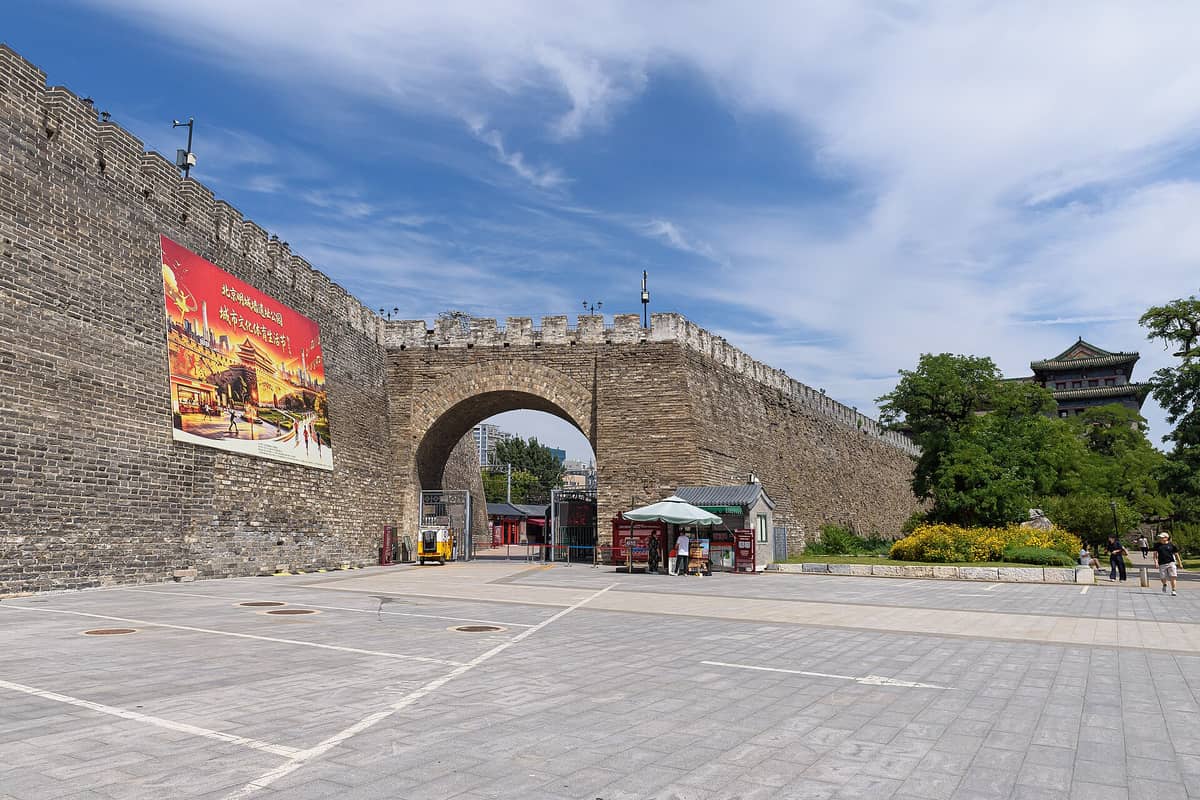
What Ming City Wall Relics Park Actually Is
Most of Beijing's Ming-dynasty city wall was demolished in the 1950s and 1960s to make way for roads, and later for Line 2 of the Beijing Subway. What remains at Ming City Wall Relics Park (明城墙遗址公园) is a preserved section of that wall running roughly east along Chongwenmen East Main Street in Dongcheng District, terminating at the Southeast Corner Tower (东南角楼). The park was developed around this remnant rather than reconstructed from scratch, which matters: the brickwork you see is original, weathered, and carries the texture of genuine antiquity rather than the smooth precision of a restoration project.
The wall here dates to the early Ming dynasty. It formed part of the southern boundary of the inner city that enclosed the imperial capital for more than five hundred years. At its height, Beijing's Ming city wall stretched roughly 40 kilometers in total circumference. The section preserved here is a fraction of that, but standing beside it, you get an immediate sense of the wall's engineering ambition: the base is massively thick, the gray bricks are large and densely laid, and the entire structure rises well above head height.
ℹ️ Good to know
The park and wall walkway are free to enter. The Southeast Corner Tower at the eastern end carries a separate admission of ¥10. The park is open Tuesday through Sunday, 08:30 to 17:00, with ticket sales closing at 16:30. It is closed on Mondays except statutory public holidays.
The Walk Along the Wall
The park is long and narrow. A path runs along the southern side of the wall, with the wall itself rising to your left as you walk east toward the Corner Tower. On the right, a strip of maintained greenery separates the path from the street. This is not a dramatic landscape in the way that a mountain park might be, but it offers something different: a corridor of unusual calm inside a city of 21 million people. Morning light falls across the face of the wall at an angle that reveals every crack, repair, and moss-covered brick face in detail. Come before 10:00 and you are likely to share the path with almost no one except local residents doing morning exercises.
The texture of the wall itself rewards close attention. Many of the bricks are stamped with production marks from the Ming period, identifiers that trace individual kilns and craftsmen responsible for specific sections of the wall. These marks are small, often faded, and easy to miss at walking pace. Slow down and look at brick level. Some sections show distinct repair lines where later Qing-dynasty or Republican-era patching used slightly different brick proportions, creating readable layers of time in the masonry.
By mid-morning on weekdays, the path remains quiet. On weekends, particularly in spring and autumn, small groups of visitors and photographers arrive, but the park never reaches the density you encounter at the major imperial sites. This is partly because Ming City Wall Relics Park does not appear in most short-stay itineraries, and partly because it requires a certain disposition toward the quiet satisfaction of seeing something genuinely old rather than visually dramatic.
Tickets & tours
Hand-picked options from our booking partner. Prices are indicative; availability and final rates are confirmed when you complete your booking.
Mutianyu Great Wall and Ming Tombs Private Guided Tour
From 306 €Instant confirmationFree cancellationJuyongguan Great Wall and in-depth tour of Ming Tombs
From 331 €Instant confirmationFree cancellationShilinxia glass platform and 798 Art District or Ming City Wall tour
From 331 €Instant confirmationFree cancellationJuyongguan Great Wall, Sacred Way and Ming Tombs Day Tour from Beijing
From 289 €Instant confirmationFree cancellation
The Southeast Corner Tower
The Southeast Corner Tower (东南角楼) stands at the eastern end of the preserved wall section and is the most architecturally prominent feature of the park. The tower is a two-story wooden structure built on a massive brick platform, with upswept eaves in the style characteristic of Ming military architecture. It was used as an arrow tower: the walls of the structure are lined with openings through which archers and crossbowmen could cover approaches to the corner of the city wall from multiple directions simultaneously.
The ¥10 admission to the tower is worth paying. Inside, the upper level offers views along the remaining wall to the west and across the surrounding Dongcheng streetscape. The interior also houses display panels covering the history of the wall and the tower's own restoration. The restoration work was substantial, and the building you enter today reflects considerable reconstruction, though the brick platform base is original. The wooden upper structure was rebuilt using traditional carpentry methods. For context on how this fits into the broader history of the dynasty, the
For context on how Beijing's imperial structures relate to one another, the Beijing imperial history guide covers the sequence of dynasties and what they built across the city.
Photography at the Park
The park offers several distinct photographic situations that differ from most Beijing attraction photography. The wall itself, particularly in the hour after sunrise, catches low raking light that emphasizes the relief of the brickwork and the depth of the erosion channels. The combination of the ancient wall face with the modern urban skyline visible above it creates images that communicate Beijing's compressed layering of historical periods without requiring caption explanations.
The Southeast Corner Tower photographs well from the southwestern approach within the park, where the full form of the structure is visible against sky. On clear blue-sky days in autumn, the gray-green glazed roof tiles contrast sharply with the sky. Air quality in Beijing varies considerably by season and weather system; hazy days flatten the light and reduce contrast, which affects both the wall's texture and the tower's visibility. Autumn, particularly October, tends to offer the clearest air and is generally considered the best season for photography in the city.
💡 Local tip
For photography: arrive within the first hour of opening on a weekday. The path will be near-empty, the light is optimal from the east, and the wall's brick texture is most legible. A polarizing filter helps saturate the roof tiles on the tower against a blue sky.
For broader photography strategy across Beijing's historic sites, the Beijing photography guide covers timing, equipment, and locations in detail.
Practical Details for Your Visit
Bus routes serving the Dongbianmen area provide access to the park, and Chongwenmen and Beijing Railway Station are nearby subway access points. Check the current Beijing transit map for the best route from your starting point.
The path through the park is mostly flat and paved, making it manageable for most visitors. However, the official sources for this park do not specify details about wheelchair access, step-free routes to the tower platform, accessible toilets, or lifts. If you have specific accessibility requirements, contact the park directly at 010-65270574 before visiting to confirm what is available.
Wear comfortable walking shoes. The path is smooth, but the tower platform has uneven brick surfaces. There is no food service inside the park, and shade is limited to the area immediately adjacent to the wall itself. In summer, when Beijing temperatures regularly exceed 30°C and humidity rises with the monsoon period from June through August, bring water and plan to visit in the morning. Winter visits between December and February are quiet and the wall looks striking against cold clear skies, but temperatures regularly fall below zero, so dress accordingly.
⚠️ What to skip
The park is closed on Mondays, except when a Monday falls on a statutory public holiday. Ticket sales for the Southeast Corner Tower stop at 16:30, thirty minutes before the park closes at 17:00. Arrive with time to spare if you want to enter the tower.
How It Fits Into a Dongcheng Itinerary
Ming City Wall Relics Park sits in the southern part of Dongcheng District, which places it at a useful geographic midpoint between several major attractions. The
Temple of Heaven is located to the southwest in what is now Tiantan Park, close enough to combine into a half-day. To the north, the southern approaches of Tiananmen Square and the Forbidden City are accessible by metro in under fifteen minutes.
Combining the wall park with a walk through the Qianmen area makes particular sense historically: both sites represent different layers of the same Ming city plan. From the wall, the historic defensive perimeter is easier to understand as part of the broader Ming city plan, even though most of the original wall no longer survives above ground. That context makes the individual sites more meaningful, not less.
If you are building a multi-day itinerary that covers Beijing's historic core, the 3-day Beijing itinerary provides a logical sequence that includes Dongcheng's major sites without overcrowding any single day.
Who Should Skip This Park
Ming City Wall Relics Park is not the right choice for every visitor. If you have only one or two days in Beijing and are working through the headline sites, the wall park will likely feel underwhelming relative to the Forbidden City, the Temple of Heaven, or a full day at the Great Wall. The experience depends heavily on an interest in urban archaeology and architectural texture rather than spectacle or interactivity. There is no interpretive tour, the signage is not comprehensive in English, and Although the preserved section is relatively short compared with Beijing's former city wall, allow additional time if you want to examine the wall and tower rather than simply pass through.
Visitors traveling with young children who need active engagement will find little here to hold attention for long. The tower interior offers some interest through its display panels, but it is a contained space without the open-air scale that makes some historic sites work well for families. For a more family-oriented alternative in the same part of the city, the parks and open spaces around the Qianmen area offer more variety.
Insider Tips
- Look at individual bricks at close range along the lower courses of the wall. Many bear stamped production marks from Ming-dynasty kilns, identifying the craftsmen responsible for that section. These marks are one of the most tangible connections to the people who built the wall, and most visitors walk straight past them.
- The best single photography position for the Southeast Corner Tower is from the path inside the park, angled from the southwest, roughly 50 to 70 meters from the base of the platform. This captures the full vertical form of the tower without the surrounding street infrastructure intruding into the frame.
- If you are visiting on a weekend and want near-solitude, arrive at opening time on a Saturday rather than a Sunday. Sunday late mornings tend to see the highest visitor numbers, particularly in spring and autumn.
- The park connects thematically to Beijing's former city wall, and the surrounding streets and transit corridors can help place this surviving section in the context of the historic perimeter.
- For the ¥10 tower admission, ask at the ticket window whether the upper observation level is open on the day you visit. Conditions inside the tower can vary, and it is worth confirming before paying.
Who Is Ming City Wall Relics Park For?
- Architecture and urban history enthusiasts who want to engage with original Ming-dynasty fabric rather than reconstruction
- Photographers seeking low-crowd conditions and layered historical-modern compositions
- Repeat visitors to Beijing who have covered the headline sites and want to go deeper into the city's physical history
- Slow-travel itineraries that prioritize texture and atmosphere over a checklist of major attractions
- Early morning walkers looking for a quiet, historically significant route in central Dongcheng
Nearby Attractions
Other things to see while in Dongcheng District:
- Ancient Observatory (Guguanxiangtai)
Built in 1442 during the Ming dynasty, it holds a remarkable collection of Qing-era bronze instruments and offers a rare window into imperial Chinese astronomy in central Beijing.
- Bell Tower and Drum Tower
Standing at the northern end of Beijing's ancient central axis, the Bell Tower and Drum Tower have marked time for the city since the Ming dynasty. This guide covers what to see, when to go, how to get there, and whether the climb is worth your while.
- Confucius Temple and Guozijian
The Confucius Temple and Guozijian Museum preserves two of Beijing's most historically significant sites: a Yuan dynasty Confucian temple and the Imperial College that trained China's governing elite for six centuries. Quieter than most major attractions, it rewards visitors who want genuine historical depth alongside calm, tree-shaded courtyards.
- Forbidden City (Palace Museum)
The Forbidden City, officially the Palace Museum, is the world's largest surviving imperial palace complex and Beijing's most significant cultural landmark. Built between 1406 and 1420 under Ming emperor Zhu Di, it served as the ceremonial and political heart of China for nearly five centuries. This guide covers everything you need to visit confidently.