National Centre for the Performing Arts: Beijing's Titanium Dome on the Water
Rising from an artificial lake just west of Tiananmen Square, the National Centre for the Performing Arts is one of the most architecturally striking buildings in Beijing. Part concert hall, part art space, part architectural spectacle, it rewards visitors who go beyond the lobby.
Quick Facts
- Location
- No. 2 West Chang'an Avenue, Xicheng District, Beijing
- Getting There
- Tian'anmen West Station (Lines 1 & 2) – short walk east; or walk west from Tian'anmen East
- Time Needed
- 1.5 to 3 hours for a daytime visit; longer if attending a performance
- Cost
- CNY 40 standard daytime visit ticket; performance tickets priced separately
- Best for
- Architecture lovers, classical music fans, photography enthusiasts, curious first-timers
- Official website
- en.chncpa.org
What Is the National Centre for the Performing Arts?
The National Centre for the Performing Arts (国家大剧院, Guójiā Dàjùyuàn) sits on West Chang'an Avenue in Xicheng District, directly beside the Great Hall of the People and a short walk west of Tiananmen Square. It opened in 2007 after a six-year construction process that began in 2001, and its presence on this street still manages to surprise. The building looks nothing like its neighbours.
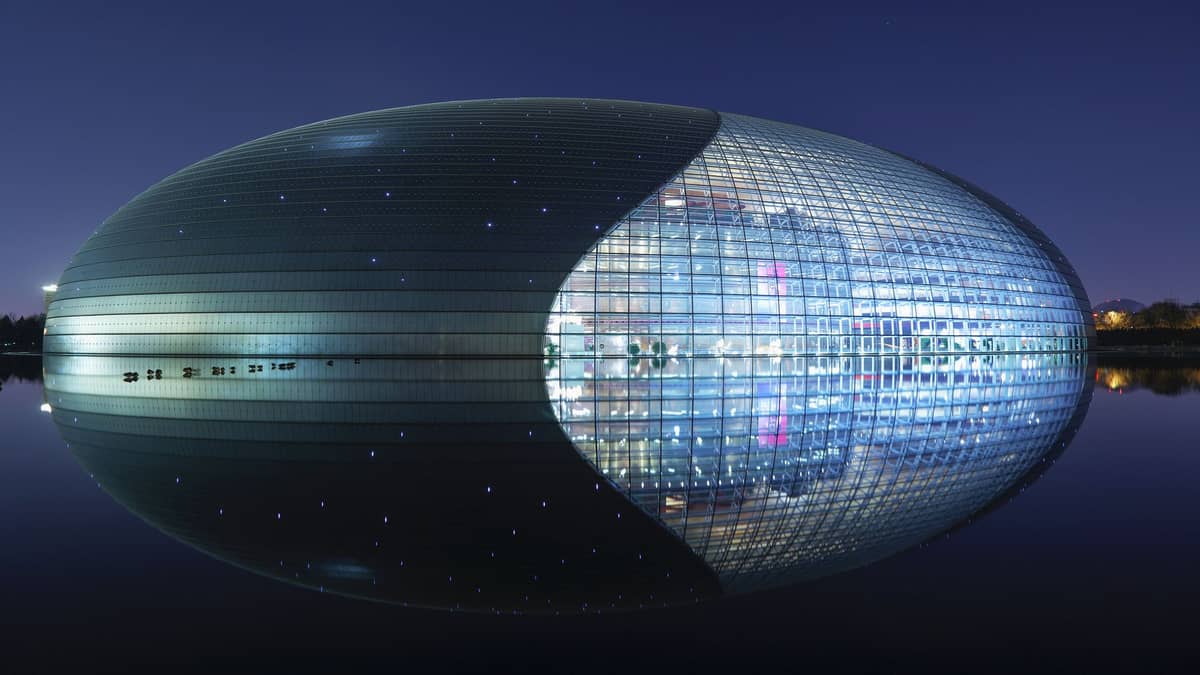
Designed by French architect Paul Andreu, the structure is a half-ellipsoid shell clad in titanium and glass. The entire dome appears to float on an artificial lake, and the complex contains three performance halls: an opera house, a concert hall, and a theatre.
The CNY 40 daytime visit ticket covers access to the public spaces inside the dome, rotating art exhibitions, and views into the performance halls when they are not in use. It does not include a performance. If you want to attend opera, classical music, or theatre, book separately through the official website. For a broader look at Beijing's cultural landscape, the Beijing contemporary art guide puts the NCPA into useful context alongside the city's other major venues.
💡 Local tip
Real-name ticket booking applies. Bring your passport or the ID used during booking. The ticket counter accepts walk-ins but availability of specific halls can vary, especially on weekends.
The Architecture: A Building That Divides Opinion
When construction was announced in the late 1990s, the project generated significant debate among Chinese architects, urban planners, and cultural commentators. Andreu's design was criticized by some for clashing with the monumental, axial character of the surrounding government district. The argument has not entirely faded. Standing on West Chang'an Avenue, you do notice the tension: the dome's organic curve sits beside the flat, horizontal mass of the Great Hall of the People in a way that is genuinely dissonant.
Up close, that dissonance becomes more interesting than it sounds in photographs. The titanium cladding shifts colour through the day, appearing silver-grey under overcast winter light and warmly bronze when the late-afternoon sun catches it from the southwest. The glass bands around the shell allow you to see the interior framework from outside, and at night the dome glows from within, reflecting across the lake surface. Evening, when performances are underway, is when the building looks its most dramatic.
The underground entrance tunnel is one of the more memorable architectural details. Approximately 80 metres long and flanked by curved glass walls, it passes beneath the lake before rising into the central foyer. Walking through it on a summer afternoon, with light filtering through the water above, is a genuinely atmospheric experience. The foyer itself is enormous: a soaring atrium with polished stone floors, timber-panelled walls, and the curved undersides of the three performance halls visible overhead.
Tickets & tours
Hand-picked options from our booking partner. Prices are indicative; availability and final rates are confirmed when you complete your booking.
Small group tour of Tian'anmen Square and the Forbidden City
From 43 €Instant confirmationFree cancellationBeijing Summer Palace Entrance Ticket
From 7 €Instant confirmationFree cancellationMutianyu Great Wall and Summer Palace small-group tour from Beijing
From 171 €Instant confirmationFree cancellationPrivate Guided Tour to Temple of Heaven, Panda House and Summer Palace
From 67 €Instant confirmationFree cancellation
Opening Hours, Tickets, and Getting There
The NCPA's daytime opening hours and last admission time vary by the current visitor schedule. It is closed on some Mondays unless announced otherwise for holidays or special events. Verify hours on the official website before visiting, as special performances or rehearsals can affect public access to certain areas.
The North Gate of the NCPA serves as the box-office location for ticket collection. Check the official site for current daytime admission prices, booking arrangements, and entrance instructions before visiting.
For transit, Tian'anmen West Station on Line 1 puts you within a few minutes' walk to the east. The building is also easily reached on foot from Tiananmen Square itself, making it a natural pairing with Tiananmen Square or the Forbidden City in a single morning or afternoon. The avenue is wide and well-lit, but there is no direct road crossing directly to the north entrance from the main boulevard; follow the signed pedestrian routes.
ℹ️ Good to know
Accessibility assistance is available through the NCPA; contact the venue in advance for the current accessible route and assistance arrangements.
What to Actually Do Inside
Most daytime visitors spend their time moving between the public foyer, the exhibition galleries, and the viewing corridors that overlook the performance halls. The exhibitions rotate and have previously covered subjects ranging from the history of Beijing's performing arts to international opera and orchestral design. The quality varies, but they are generally well-presented and informative, with bilingual signage in Chinese and English.
The viewing windows into the opera house, concert hall, and theatre are one of the more rewarding aspects of the daytime ticket. Each hall has its own acoustic and visual character. The opera house seats over 2,000 people and uses a deep-red colour palette with a horseshoe-shaped balcony arrangement. The concert hall is warmer in tone, with timber surfaces and a suspended reflector above the stage. If you can look into all three, the design differences are worth noting.
There is a rooftop terrace that offers views across the surrounding area, including a perspective onto the dome itself from the outside edge, and sightlines toward the Forbidden City and the Great Hall of the People. This is one of the less-advertised aspects of the visit and is quieter than the main foyer at most times of day.
If photography is a priority, the NCPA is one of the more rewarding subjects in the city. The Beijing photography guide covers the best angles and lighting windows in detail, but the short version is: arrive in the first hour after opening for empty interior shots, and return at dusk for exterior reflections on the lake.
Attending a Performance
The NCPA's programming covers opera, orchestral concerts, chamber music, ballet, traditional Chinese music, drama, and international touring productions. The standard is high: the centre hosts the National Ballet of China, the China National Symphony Orchestra, and the China National Opera House, along with international companies and soloists throughout the year.
Performance tickets range widely in price depending on seat location and programme. Booking early through the official English-language site is the most reliable route. If you are planning an evening performance, combine it with dinner at one of the restaurants around Qianmen Street to the south, or explore the lake edge and avenue before the show. The NCPA is also relevant to anyone following the Beijing opera guide, which covers both traditional Peking opera venues and the modern large-scale productions staged here.
Dress code is smart casual for most performances. The foyer opens well before curtain time, which is worth using to explore the space without the midday crowd. Evening lighting transforms the interior from the daytime's neutral cream and timber tones into something considerably more theatrical.
Honest Assessment: Is the Daytime Visit Worth It?
For most visitors, the daytime ticket is worth CNY 40 if you have an interest in architecture, design, or the performing arts. The building is genuinely extraordinary from an engineering standpoint, and the interior spaces are well-maintained and calm relative to the major tourist sites nearby. Expect to spend around 90 minutes comfortably, or up to three hours if you read the exhibitions carefully.
However, the daytime visit is clearly a secondary experience to attending a performance. If your schedule allows for an evening show, that is the context the building was designed for. Visitors who come primarily to look at the exterior and take photographs from the lakeside edge may find the ticket price hard to justify, since the lake and the dome are visible without entering.
Travelers who prefer historical depth over contemporary design will likely get more satisfaction from the Temple of Heaven or the Capital Museum in Xicheng. The NCPA is an unmistakable landmark, but it is a building of 2007, not of imperial Beijing, and visitors who come expecting something ancient will be surprised.
⚠️ What to skip
Security checks are thorough on entry, similar to other major sites along Chang'an Avenue. Allow extra time if arriving close to the 16:30 last admission cutoff. Large bags may be subject to inspection.
Practical Notes for Your Visit
The NCPA has a cafe and restaurant inside, though pricing is predictably higher than the surrounding neighbourhood. There are no locker facilities explicitly advertised for daytime visitors, so travel light. The gift shop on the ground level stocks performance programmes, books on Chinese performing arts, and a modest selection of design objects related to the building.
Winter visits are comfortable indoors, and the lake adds visual interest with occasional ice formation in January and February. Summer visits mean air-conditioned relief from the heat, though the underground tunnel can feel humid on particularly warm days. Autumn, particularly October, combines mild temperatures with clear skies that make exterior photography more rewarding.
The NCPA fits naturally into a broader Xicheng itinerary. After your visit, the Houhai and Shichahai lakes are accessible by metro or on foot to the north, offering a very different kind of water-and-architecture experience in one of Beijing's most atmospheric lakeside neighborhoods.
Insider Tips
- The rooftop terrace is underused by visitors and offers one of the better elevated views of the western Chang'an Avenue axis. Ask staff at the information desk on the main floor for the current access route, as signage can be easy to miss.
- If you want to photograph the dome's reflection on the lake without people in the frame, arrive at or shortly after 09:00 on a Tuesday through Friday. Weekend mornings bring tour groups within the first hour.
- The viewing windows into the performance halls are sometimes closed if rehearsals are underway. This is not refundable, but you can ask at the ticket counter before purchasing whether all three halls have viewing access that day.
- Evening exterior photography is best taken from the small path along the south side of the lake, where the reflection is most complete and the building is lit from within. The south side also has less foot traffic than the north approach.
- The NCPA publishes its performance schedule several months in advance on the English-language site. If you are planning a Beijing trip around a specific programme, booking performance tickets before your flights is realistic and recommended for popular productions.
Who Is National Centre for the Performing Arts For?
- Architecture and design enthusiasts who want to see one of contemporary China's most debated public buildings up close
- Classical music, opera, or ballet audiences looking for a world-class performance venue
- Photographers seeking dramatic reflective and interior architectural subjects
- First-time visitors to Beijing who are combining a morning at Tiananmen Square with an afternoon cultural stop
- Travelers on a rainy or very hot day who want a high-quality indoor cultural experience near the city centre
Nearby Attractions
Other things to see while in Xicheng District:
- Beihai Park
Beihai Park is one of Beijing's oldest and best-preserved imperial gardens, covering roughly 69 hectares with more than half the area given over to a large lake. Dating back over a thousand years, it offers a rare mix of imperial architecture, Buddhist monuments, and open green space within walking distance of the Forbidden City.
- Beijing Planetarium
Beijing Planetarium (北京天文馆) is located in Xicheng District near Beijing Zoo. It runs dome theater shows, 3D and 4D screenings, and permanent science exhibitions across two buildings. Here's what a visit actually looks like.
- Beijing Zoo
Beijing Zoo is one of China's oldest and largest zoological parks, covering over 80 hectares in Xicheng District. Home to the city's most accessible giant panda viewing experience, it draws millions of visitors each year. This guide covers what to expect, when to go, and how to make the most of your time there.
- Capital Museum
The Capital Museum (首都博物馆) in Xicheng District is Beijing's premier civic museum, tracing the city's history across three millennia. Admission is free, the permanent galleries are genuinely impressive, and it rarely gets as crowded as the Forbidden City — making it one of the smartest stops in central Beijing.