Ho Chi Minh City Museum of Fine Arts: Colonial Architecture Meets Vietnamese Art
Housed in three French colonial villas built between 1929 and 1934, the Ho Chi Minh City Museum of Fine Arts holds one of Vietnam's most significant collections of traditional and contemporary Vietnamese art. For under a dollar admission, it offers a rare combination of architectural beauty and cultural depth in the heart of District 1.
Quick Facts
- Location
- 97 Pho Duc Chinh Street, Nguyen Thai Binh Ward, District 1, Ho Chi Minh City
- Getting There
- 10-minute walk from Ben Thanh Market; Grab or taxi from anywhere in District 1
- Time Needed
- 1.5 to 2.5 hours
- Cost
- 30,000 VND adults (~$1.20 USD); 15,000 VND students, seniors, and visitors with disabilities; free for children under 6
- Best for
- Art lovers, architecture enthusiasts, travelers seeking a quiet midday retreat
What the Museum Actually Is
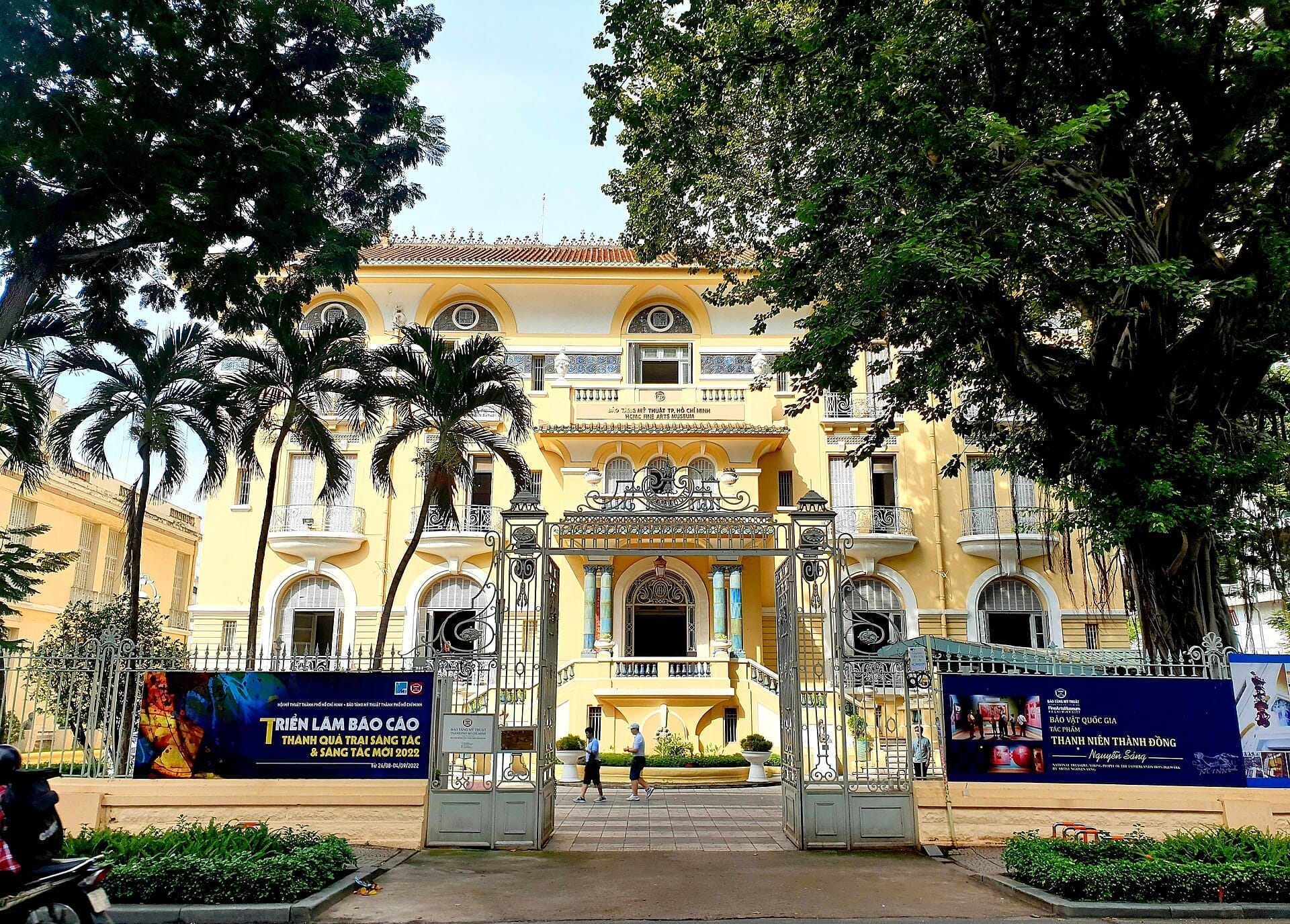
The Ho Chi Minh City Museum of Fine Arts, known in Vietnamese as Bảo tàng Mỹ thuật Thành phố Hồ Chí Minh, occupies three interconnected French colonial villas on Pho Duc Chinh Street in District 1. The building alone is reason enough to visit. Constructed between 1929 and 1934 as the private residence of Hua Bon Hoa (also known as Hui-Bon-Hua), a prominent Chinese-Vietnamese businessman and one of the wealthiest figures in colonial-era Saigon, the complex was designed by French architect Auguste Delaval in an eclectic style that blends French colonial structure with Chinese decorative motifs. The result is a facade of pale yellow stucco, ornate tile work, and broad verandas that looks genuinely different from the more purely European buildings found nearby on Dong Khoi Street.
The property was seized in 1975, repurposed for cultural use in 1987, and officially opened as a public museum in 1992. Today it houses thousands of works across traditional lacquerware, silk painting, wood sculpture, ceramics, and modern Vietnamese oil painting, organized across multiple floors and galleries. The collection spans the pre-Angkor period through contemporary Vietnamese art, with particular depth in 20th-century work produced during and after the wartime period.
ℹ️ Good to know
Opening hours are 8:00 AM to 5:00 PM daily. Admission is 30,000 VND for adults and 15,000 VND for students, seniors, and visitors with disabilities. Children under 6 enter free. Prices are subject to change — confirm on arrival.
The Building: What You Will See Before You Walk Through the Door
From Pho Duc Chinh Street, the museum announces itself through an ornate gateway into a shaded courtyard. The main villa is three stories of carefully maintained colonial architecture: iron balustrades, latticed window screens with green-painted shutters, and decorative ceramic tiles on the staircase risers that show clear Chinese influence despite the overall European framework. This is not a generic colonial building. The architectural layering reflects the actual social history of Saigon's merchant elite, who moved freely between French administrative culture and Chinese commercial tradition.
In the morning, the light falls across the courtyard at an angle that brings out the texture of the stucco and the color of the tiles. By midday the courtyard is in full sun, which makes the shaded interior galleries feel particularly cool and calm. Late afternoon, when tour groups have largely cleared out, the building takes on a more quiet atmosphere and the upper-floor galleries are often nearly empty. If you care about photographing the architecture, morning arrival gives the best exterior light.
💡 Local tip
Photography is permitted throughout most of the museum. Use the staircases as your primary subject, not just the art on the walls: the tile work and ironwork are among the most photographically rewarding elements in the building.
Tickets & tours
Live prices and dates from our booking partner. If you book, we may earn a commission at no extra cost to you.
Private full-day trip from Ho Chi Minh City to Mekong Delta
From 52 €Instant confirmationFree cancellationLandmarks of Ho Chi Minh City half-day tour
From 33 €Instant confirmationFree cancellationCu Chi tunnels guided experience from Ho Chi Minh City
From 33 €Instant confirmationFree cancellationHalf-day Cu Chi Tunnels guided tour from Ho Chi Minh City
From 21 €Instant confirmationFree cancellation
The Collection: What Deserves Your Attention
The permanent collection is spread across the ground floor and upper levels of the main building, with additional galleries in the connecting villas. Ground floor rooms typically feature lacquerware and sculpture, including pre-Angkor artifacts and Cham-period pieces. These rooms are relatively compact but the objects are often striking: carved wood panels, bronze figurines, and large lacquer screens with the kind of depth that makes lacquerware difficult to photograph but easy to study in person.
The upper floors hold the museum's stronger collection of 20th-century Vietnamese painting. Wartime propaganda art appears in this section, which some visitors find unexpectedly moving and others find uncomfortable. Either reaction is legitimate. These are not sanitized representations: some works are bluntly political, and the curatorial approach does not shy away from the period. Alongside these are quieter works in the socialist realist tradition depicting rural life, domestic scenes, and landscapes that reward slow looking.
The contemporary galleries, housed partly in the secondary villas, tend to rotate more frequently and feature living Vietnamese artists. Quality and interest varies more here than in the permanent collection, but the better pieces show a conversation between traditional Vietnamese techniques, especially lacquer, and contemporary concerns. Check what is currently on show when you arrive, as the temporary exhibition space can make a real difference to the overall visit.
Practical Walkthrough: How to Move Through the Museum
The museum complex is larger than it appears from the street. Allow at minimum 90 minutes if you want to see all three buildings; 2 to 2.5 hours is more comfortable for thorough looking. Start in the main building, work your way up floor by floor, then cross to the secondary villas. Signage is in Vietnamese and English, though translations are occasionally incomplete. If context matters to you, doing some reading about Vietnamese art history before you visit will repay itself. The HCMC Museum of History provides useful background on the broader historical arc that the fine arts collection builds on.
The building is multi-level with staircases that are steep in places. There is no confirmed elevator access, and visitors with significant mobility limitations may find the upper floors inaccessible. The ground floor galleries are more easily navigated. Reduced admission (15,000 VND) is offered for visitors with disabilities.
The museum is located on Pho Duc Chinh Street, a short walk from Ben Thanh Market to the north and Nguyen Hue Walking Street to the east. A Grab ride from anywhere in central District 1 will cost under 50,000 VND. There is no dedicated parking difficulty for those arriving by motorbike, as the surrounding streets have standard roadside parking.
⚠️ What to skip
The museum can feel warm and humid on the upper floors during midday in the dry season. Wear light, breathable clothing. A small bottle of water is useful, though food and drink are not permitted inside the galleries.
Time of Day and Crowd Behavior
Weekday mornings between 9:00 AM and 11:00 AM are the quietest period. You will often have individual galleries entirely to yourself, which is unusual for a major urban museum in Southeast Asia. School groups visit periodically, typically mid-morning, and can make the ground floor crowded and noisy for 20 to 30 minutes before dispersing.
Weekend afternoons bring more visitors, particularly to the courtyard and the main staircase, both of which are popular for photographs. The galleries themselves rarely reach the density that would make them uncomfortable. This is not a museum that draws large tourist crowds in the way that the War Remnants Museum does. The visitors tend to be a mix of art-interested travelers, local university students, and Vietnamese families. The overall atmosphere is calm and unhurried throughout most opening hours.
If you are planning a broader day of cultural sightseeing in District 1, the fine arts museum pairs well with the Ho Chi Minh City Museum a few minutes away, and you can combine both with a walk along Dong Khoi Street for a half-day itinerary that covers architecture, art, and history without feeling rushed.
An Honest Assessment: Who Gets the Most From This Museum
If you are interested in Vietnamese art and have any patience for slower, more contemplative museum experiences, this is genuinely one of the better cultural institutions in Ho Chi Minh City. The combination of the building itself and the depth of the collection, particularly in lacquerware and 20th-century painting, makes it worth the time and the modest entrance fee.
If you are primarily a first-time visitor working through a short highlight itinerary, the War Remnants Museum or Reunification Palace may be higher priorities for the historical and political context they provide. The fine arts museum rewards visitors who come specifically for art, not those who are looking to understand the city's recent history. The collection is also not comprehensively labeled in English throughout, which can reduce the experience for visitors who rely heavily on written interpretation.
Travelers on a tight schedule should note that the museum fits naturally into a Ho Chi Minh City itinerary as a morning start before the heat intensifies, with the rest of the day free for the outdoor attractions nearby.
Insider Tips
- The staircases inside the main villa are among the most photographically compelling elements in any museum in Ho Chi Minh City: ceramic tile risers, wrought-iron balustrades, and light from high windows combine in a way that rewards wide-angle shooting.
- The secondary villas often contain temporary exhibitions that are not well advertised at the entrance. Walk through all three buildings rather than stopping after the main one.
- Arrive within the first 30 minutes of opening (8:00 AM) on a weekday if you want the courtyard and staircase completely clear for photographs. The light is also cooler and more flattering at that hour.
- The ground floor gift shop sells quality lacquerware reproductions and silk paintings by local artists at prices below what you will find in the galleries on Dong Khoi Street. It is worth looking even if you do not intend to buy.
- If you want written context for the collection, consider downloading or reading about Vietnamese art history in advance. The English-language labeling improves considerably on the upper floors but is sparse in parts of the ground floor.
Who Is Ho Chi Minh City Museum of Fine Arts For?
- Travelers with a genuine interest in Vietnamese painting, lacquerware, or sculpture
- Architecture enthusiasts interested in French colonial and Sino-French hybrid design
- Visitors wanting a quiet, unhurried museum experience away from the city's most crowded sites
- Photographers looking for interiors with strong natural light and decorative detail
- Travelers pairing cultural sightseeing with a half-day District 1 walking loop
Nearby Attractions
Other things to see while in District 1 (Colonial Quarter):
- Bến Nghé Canal & Riverside Walk
The Bến Nghé Canal cuts through the heart of District 1 as one of Ho Chi Minh City's oldest urban waterways, linking the Saigon River to the city's colonial core. Free to walk any hour of the day, the riverside path offers a grounded, unhurried perspective on a city that rarely slows down.
- Bến Thành Market
Bến Thành Market has anchored the heart of Saigon since 1912 and remains one of Ho Chi Minh City's most recognizable landmarks. With nearly 1,500 booths spread across 13,000 square meters, it sells everything from fresh produce and dried seafood to ao dai fabric, lacquerware, and street food. This guide covers the realities of visiting, including when it is worth your time and when it is not.
- Bitexco Financial Tower & Saigon Skydeck
The Bitexco Financial Tower is District 1's most recognizable skyscraper, its lotus-inspired silhouette rising 262 meters above the Saigon River. The Saigon Skydeck on the 49th floor offers a glass-enclosed, 360-degree panorama that takes in the whole city at once, from colonial rooftops to the river bends to the sprawling suburbs beyond.
- Saigon Central Post Office
Built between 1886 and 1891 and attributed to Gustave Eiffel's engineering office, the Saigon Central Post Office is one of the finest French colonial buildings in Southeast Asia. It functions as a working post office to this day, meaning you can mail a postcard home from inside a genuine architectural landmark. Free to enter and centrally located in District 1, it earns its place on most itineraries.
Planning a trip? Discover personalized activities with the Nomado app.