Ho Chi Minh City Museum of History: Saigon's Oldest Museum in a Stunning Colonial Building
Housed in a 1929 Sino-French colonial building that blends pagoda curves with Parisian symmetry, the Ho Chi Minh City Museum of History spans Vietnamese civilization from prehistoric times to 1945. With 40,000 artifacts and an entrance fee of 40,000 VND, it rewards curious visitors who want context behind the city's layered past.
Quick Facts
- Location
- 2 Nguyễn Bỉnh Khiêm St, Ben Nghe Ward, District 1, Ho Chi Minh City
- Getting There
- Taxi or ride-hail to Nguyen Binh Khiem St; roughly 2.3 km northeast of the People's Committee Building
- Time Needed
- 1.5 to 2.5 hours
- Cost
- 40,000 VND (approx. USD 1.60)
- Best for
- History enthusiasts, architecture lovers, families seeking an air-conditioned break
Why This Museum Deserves More Than a Passing Glance
Most visitors to District 1 move quickly between landmarks: the cathedral, the post office, the palace. The Ho Chi Minh City Museum of History tends to get skipped, tucked behind the gates of the Saigon Zoo and Botanical Garden. That is a mistake. At 40,000 VND, it is one of the cheapest and most substantive hours you can spend in Saigon, with a building that is itself worth the entrance fee.
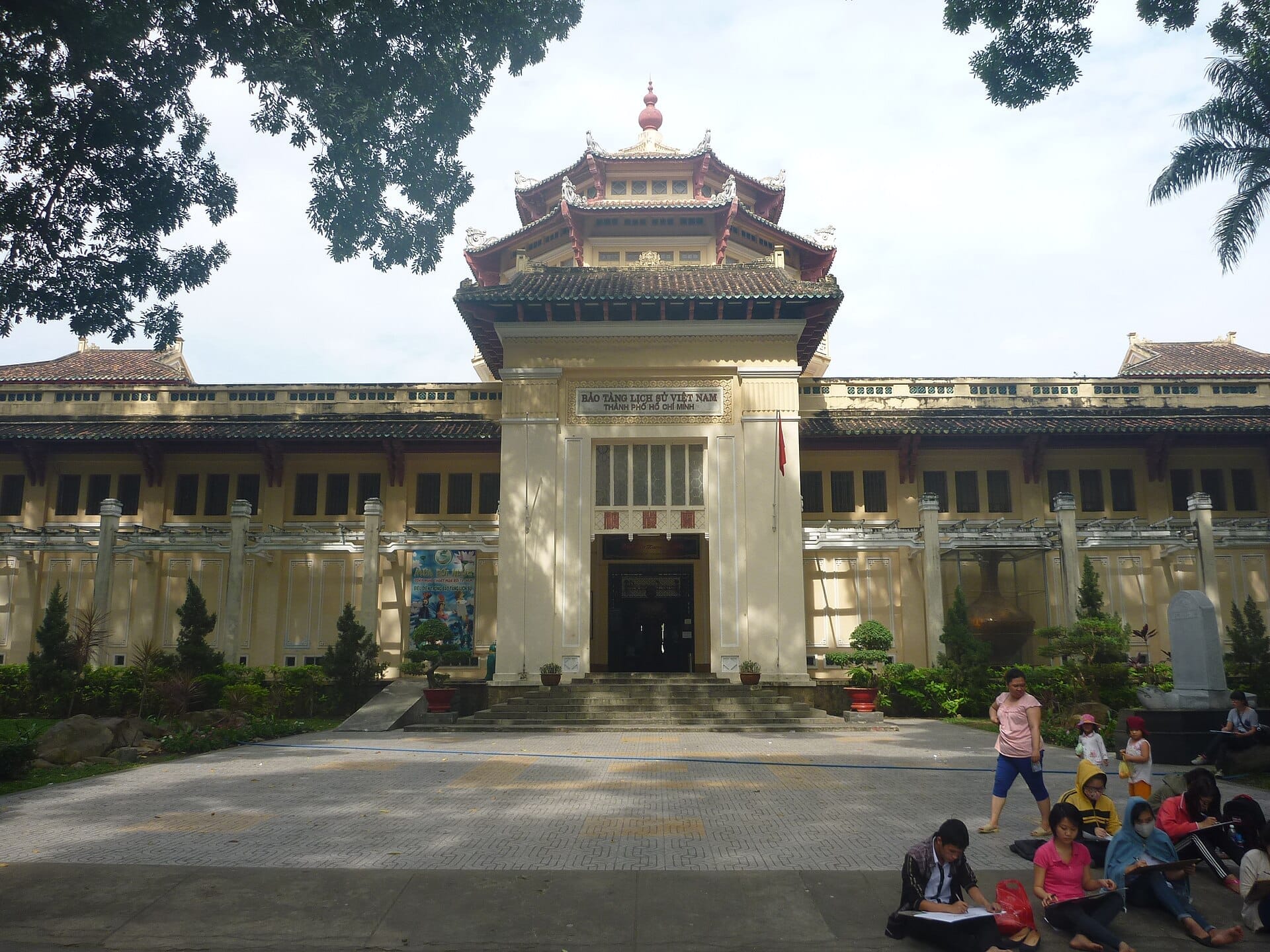
The museum sits at 2 Nguyễn Bỉnh Khiêm Street, just inside the botanical garden precinct. You can enter from the street on the western side or from the garden side to the east. If you are combining a visit with the Saigon Zoo and Botanical Garden, the eastern entrance makes the most logistical sense. Either way, the building announces itself clearly: a two-storey Sino-French hybrid with tiered roof corners that curl upward like a pagoda, set against a sky that, on clear mornings, looks almost theatrical.
💡 Local tip
The museum is closed on Mondays and splits its hours into two sessions: 8:00 AM–12:00 PM and 1:30–5:00 PM. Arrive by 10:00 AM on weekdays for the smallest crowds and the best light through the upper gallery windows.
The Building Itself: A 1929 Colonial Landmark
The structure was completed in 1929 and was originally called the Blanchard de la Brosse Museum, making it the first museum established in southern Vietnam under French colonial administration. The architect blended the rational symmetry of French institutional design with decorative elements drawn from Vietnamese and Chinese temple architecture. The result is a building that feels neither purely colonial nor purely Asian — it sits in an interesting middle ground that reflects the layered cultural reality of Saigon in that era.
In 2012, the building was formally recognized as a National Architectural and Artistic Monument by the Vietnamese government. That designation is not ceremonial. The tiled floors, the proportioned archways, the wide verandas on the upper level, and the carved detailing on the roof cornices all hold together with unusual coherence for a building nearly a century old. Walk around the exterior before you go in. The morning light on the south-facing facade, when the shadows are still long, is worth a few minutes of slow looking.
The museum was renamed the Vietnam National Museum in 1956, then officially became the Ho Chi Minh City History Museum on August 23, 1979. Each renaming reflects a shift in the political and cultural framing of the collection, and that history is itself part of what you are reading when you move through the galleries.
Tickets & tours
Live prices and dates from our booking partner. If you book, we may earn a commission at no extra cost to you.
Premium Cu Chi Tunnels Tour Exploring Vietnam's History From HCM
From 15 €Instant confirmationFree cancellationCu Chi Tunnels historical tour
From 44 €Instant confirmationFree cancellationHo Chi Minh City historical landmarks half-day guided tour
From 21 €Instant confirmationSaigon historical highlights half-day guided tour
From 21 €Instant confirmation
What the Collection Covers: 40,000 Artifacts Across Deep Time
The permanent collection holds approximately 40,000 artifacts, though only a fraction are displayed at any time. The chronological sweep is serious: exhibits move from prehistoric settlements in southern Vietnam, through the Sa Huynh and Óc Eo cultures, the Khmer period, the Cham kingdom, and the successive Vietnamese dynasties, up to 1945. This is not a war museum. The War Remnants Museum handles that period with greater depth and intensity. What the History Museum offers is everything that came before.
The Óc Eo section deserves particular attention. Óc Eo was an ancient trading port in the Mekong Delta region, flourishing roughly between the 1st and 7th centuries CE, and its artifacts reveal a civilization with trading connections stretching from Rome to India to China. The museum holds gold ornaments, religious figurines, and ceramic pieces from this period that rarely appear in international exhibitions. If you have plans to visit the Mekong Delta, seeing this collection first gives the landscape an additional layer of meaning.
The Cham gallery displays sandstone sculptures from the ancient Champa kingdom, whose territory once covered much of central and southern Vietnam. These are not replicas. The level of preservation on several pieces, particularly the deity figures and decorative panels, is remarkable. Photography is generally permitted, but diffuse natural light from the gallery windows tends to flatten detail, so morning visits before the overhead sun flattens shadows will produce better results if documentation matters to you.
ℹ️ Good to know
Labels throughout the museum are in both Vietnamese and English. The English translations are functional rather than scholarly, so some nuance is lost. A basic knowledge of Vietnamese dynastic history beforehand helps you get more from the experience.
Moving Through the Galleries: A Practical Walkthrough
The layout is roughly chronological across two floors. Ground floor galleries handle prehistoric and early historic periods. Upper galleries move through the more recent dynastic and colonial material. There is no rigidly enforced route, and the signage is clear enough to navigate independently. Allow at least ninety minutes if you intend to read labels. Two hours is more comfortable.
In the afternoon, particularly between 2:00 and 4:00 PM, the upper galleries can feel warm despite fans and partial air conditioning. The ground floor stays cooler and is more pleasant for slow looking during the heat of the day. By mid-afternoon on weekends, school and tour groups sometimes move through in numbers that briefly congest the smaller rooms. If you have flexibility, Tuesday through Thursday mornings are reliably quiet.
The museum also houses a traditional water puppet theatre, which operates on certain days and times. Check schedules at the ticket desk when you arrive, as performances add a memorable dimension to the visit, particularly for families with children.
⚠️ What to skip
The water puppet show schedule varies and is not always available on every open day. Confirm at the ticket window when you purchase admission.
Honest Assessment: Strengths and Limitations
The museum's strengths are the building, the depth of the prehistoric and early historic collections, and the price. At 40,000 VND, it asks almost nothing of you financially and delivers more historical substance than most free attractions in the city.
Its limitations are real. Certain galleries feel under-curated, with artifacts arranged in cases without the interpretive depth they deserve. The English translations, while present, sometimes lack the context needed to understand an object's significance without prior knowledge. Lighting in some display cases is inconsistent, and a few rooms feel maintenance-deferred. This is not the Musée du Quai Branly. But it is genuine, and the collection is not sanitized for easy consumption.
Visitors who come primarily for dramatic, immersive experiences may find the format slow. The War Remnants Museum delivers visceral impact in a way that the History Museum does not aim to. These are two very different institutions serving very different purposes, and both are worth your time if history interests you at all.
The museum is not well suited to visitors in a hurry, those with very young children who cannot navigate quiet, fragile-objects environments, or travelers who have no prior interest in pre-modern Southeast Asian history. For everyone else, it is a serious and undervisited institution.
Combining This Visit With the Surrounding Area
The museum sits within or adjacent to the Saigon Zoo and Botanical Garden precinct, one of the oldest botanical gardens in Asia. A combined visit works well for a half-day. From here, Notre Dame Cathedral and the Central Post Office are accessible by a short ride or a long walk through the tree-lined streets of District 1.
The museum is also close to Nguyen Binh Khiem Street, which runs parallel to the Ben Nghe Canal. That canal, part of the city's historic waterway network, connects this northeastern pocket of District 1 to the commercial core. After the museum, a short ride south takes you toward Dong Khoi Street and the riverside promenade, where the contrast between nineteenth-century colonial architecture and the glass towers now crowding the skyline is most visibly compressed.
If you are building a broader itinerary around HCMC's cultural institutions, the Reunification Palace and the Museum of Fine Arts make logical companions across different days. Trying to fit all three in one afternoon will blunt everything.
Insider Tips
- Enter from the Nguyễn Bỉnh Khiêm Street (western) gate if you want to see the museum facade clearly before entering. The eastern botanical garden entrance is more shaded but less dramatic as an arrival.
- Ask at the ticket desk about the water puppet theatre schedule immediately on arrival. If a show is running during your visit, time your gallery walk to end near the performance space.
- The upper floor veranda offers a view over the treetops of the botanical garden that most visitors miss entirely. Step outside the gallery doors on the second level and take a few minutes there, especially in the early morning before the heat builds.
- The Óc Eo and Cham sculpture galleries are the most internationally significant parts of the collection and tend to receive the least visitor attention. Allocate more time here than the room size suggests.
- Bring a small water bottle. There is no café inside the museum, and on warm afternoons the upper galleries can be genuinely tiring. The botanical garden outside has vendors and seating if you need a break.
Who Is Ho Chi Minh City Museum of History For?
- History and archaeology enthusiasts who want pre-modern Vietnamese context
- Architecture travelers drawn to Sino-French colonial buildings
- Travelers combining a visit with the Saigon Zoo and Botanical Garden
- Families looking for a structured, shaded indoor experience
- Anyone visiting multiple HCMC museums and building a chronological understanding of the region
Nearby Attractions
Other things to see while in District 1 (Colonial Quarter):
- Bến Nghé Canal & Riverside Walk
The Bến Nghé Canal cuts through the heart of District 1 as one of Ho Chi Minh City's oldest urban waterways, linking the Saigon River to the city's colonial core. Free to walk any hour of the day, the riverside path offers a grounded, unhurried perspective on a city that rarely slows down.
- Bến Thành Market
Bến Thành Market has anchored the heart of Saigon since 1912 and remains one of Ho Chi Minh City's most recognizable landmarks. With nearly 1,500 booths spread across 13,000 square meters, it sells everything from fresh produce and dried seafood to ao dai fabric, lacquerware, and street food. This guide covers the realities of visiting, including when it is worth your time and when it is not.
- Bitexco Financial Tower & Saigon Skydeck
The Bitexco Financial Tower is District 1's most recognizable skyscraper, its lotus-inspired silhouette rising 262 meters above the Saigon River. The Saigon Skydeck on the 49th floor offers a glass-enclosed, 360-degree panorama that takes in the whole city at once, from colonial rooftops to the river bends to the sprawling suburbs beyond.
- Saigon Central Post Office
Built between 1886 and 1891 and attributed to Gustave Eiffel's engineering office, the Saigon Central Post Office is one of the finest French colonial buildings in Southeast Asia. It functions as a working post office to this day, meaning you can mail a postcard home from inside a genuine architectural landmark. Free to enter and centrally located in District 1, it earns its place on most itineraries.
Planning a trip? Discover personalized activities with the Nomado app.