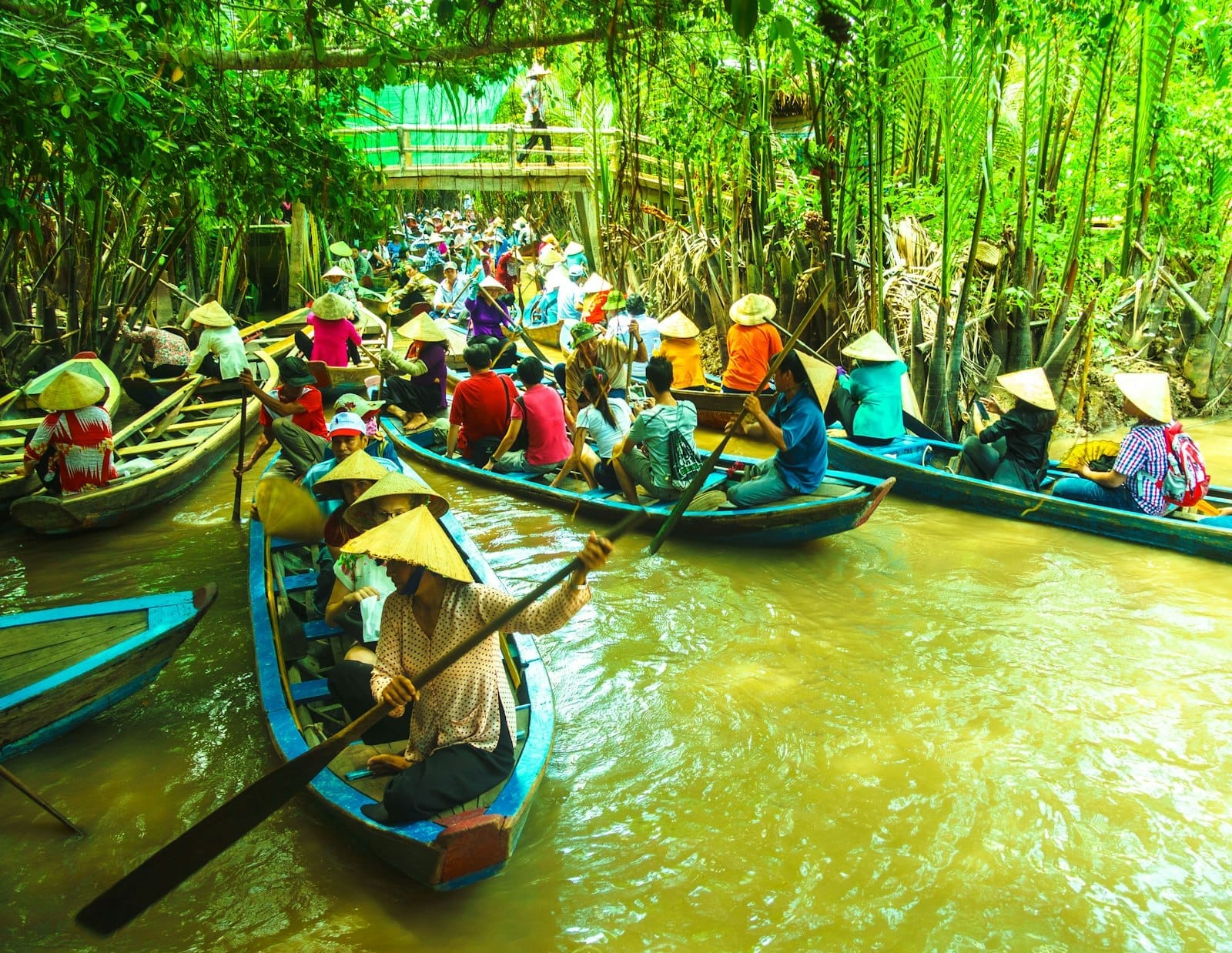
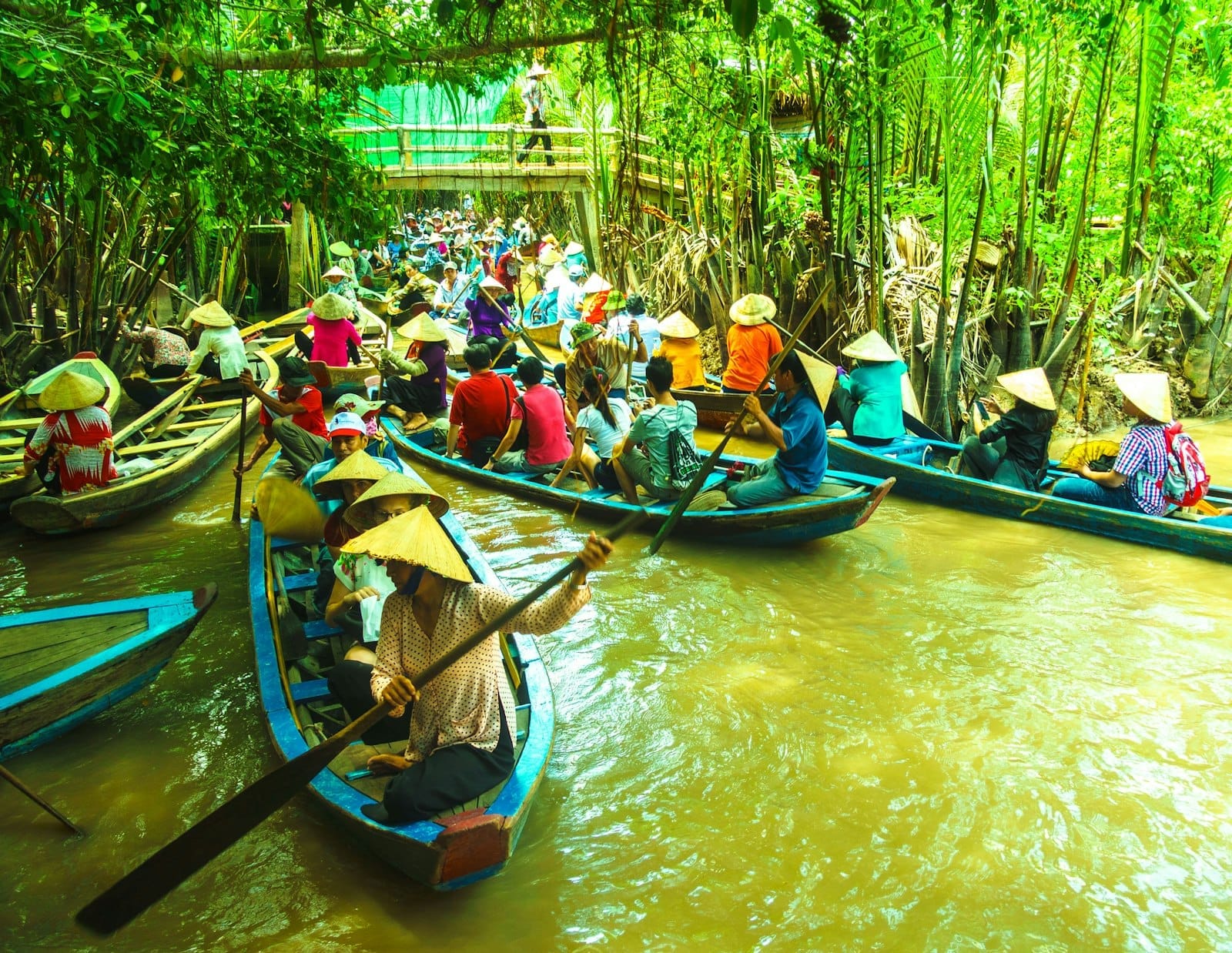
The Mekong Delta stretches across more than 40,500 square kilometers southwest of Ho Chi Minh City, a flat, canal-laced world of rice paddies, floating markets, and river life that feels completely removed from the city's noise. Known locally as Mien Tay or the 'Nine Dragon River Delta,' it is one of Vietnam's most distinctive landscapes and one of the most rewarding day trips or overnight escapes from Saigon.
The Mekong Delta is not a neighborhood you sleep in after a night out. It is a separate world entirely: a vast, low-lying river system just a few hours west of Ho Chi Minh City where daily life still moves by boat, the air smells of river mud and tropical fruit, and the pace has nothing in common with the city you left behind. For travelers based in Saigon, it is the most compelling reason to look beyond the city limits.
Orientation: Where the Delta Fits
The Mekong Delta begins almost immediately west of Ho Chi Minh City, separated from the urban sprawl by the Vam Co Dong River and the transitional flatlands of Long An province. It covers roughly 40,500 square kilometers and encompasses 12 provinces and one centrally-governed city: Long An, Tien Giang, Ben Tre, Vinh Long, Tra Vinh, Soc Trang, Dong Thap, An Giang, Hau Giang, Kien Giang, Bac Lieu, Ca Mau, and the municipality of Cần Thơ. To the north, the Vietnamese-Cambodian border marks the upper boundary; to the west, the Gulf of Thailand; to the east, the South China Sea.
The region is commonly called 'Mien Tay' by Vietnamese speakers, meaning 'the West,' and that geographic shorthand captures how locals think about it: a direction, a way of life, a contrast to the urban east. For travelers based in District 1 or Pham Ngu Lao, the nearest Delta entry point is Long An province, reachable in under two hours by road. Can Tho, the region's largest city and cultural heart, sits roughly 170 kilometers southwest of Saigon and takes between three and four hours depending on traffic and route.
Understanding the Delta's geography requires reorienting your mental map of Vietnam. The Mekong River, which originates in Tibet and flows through China, Myanmar, Laos, Thailand, and Cambodia, splits into nine distributaries as it crosses into Vietnam. These nine branches, locally called 'Cuu Long' (Nine Dragons), give the region its poetic Vietnamese name. The result is a landscape of extraordinary flatness threaded with hundreds of rivers, canals, and tidal channels. For context on planning your time across the broader city and region, the Ho Chi Minh City itinerary guide covers how to structure days in Saigon alongside Delta excursions.
Character & Atmosphere
The Delta changes character by the hour in a way that has nothing to do with traffic or tourist foot traffic. Before sunrise, the floating markets on rivers near Can Tho and Cai Rang are already in full operation: wooden boats loaded with watermelons, pineapples, and dragonfruit drift alongside each other, vendors hanging their goods on tall poles so buyers can identify them from a distance. The air at this hour is cool and damp, carrying the smell of river water, diesel from small boat engines, and the occasional scent of pho being cooked on a floating kitchen.
By mid-morning, the markets begin to thin and the waterways quieten. This is when the Delta reveals its second character: mile after mile of rice paddies in every direction, broken by lines of coconut palms, wooden farmhouses on stilts, and narrow concrete bridges crossing irrigation channels. The light is flat and bright, reflecting off the water in the fields. Walking or cycling the narrow paths between paddies in Tien Giang or Ben Tre, you might go thirty minutes without seeing another tourist.
Afternoons bring heat and the distinctive sounds of Delta village life: roosters, the distant hum of a motorbike, the creak of a wooden boat against a dock. Tropical fruit orchards in Ben Tre and Vinh Long are open for visits, and many guesthouses in riverside villages organize boat trips through narrow canal networks where the vegetation closes overhead. By evening, the light turns golden across the water, and the temperature drops enough to make sitting on a riverside terrace genuinely pleasant.
ℹ️ Good to know
The Mekong Delta is home to significant ethnic diversity beyond the Vietnamese majority, including Khmer, Chinese-Vietnamese, and Cham communities, particularly in An Giang and Soc Trang provinces. This is reflected in the local temples, food, and festivals you will encounter if you travel beyond the standard tourist route.
What to See & Do
The floating markets are the Delta's signature experience and the one most visitors prioritize. Cai Rang floating market, about six kilometers from Can Tho's city center and accessible by a short boat ride, is the largest in the region and most active between 5am and 8am. Phong Dien, slightly further out, is smaller and sees fewer organized tour groups. Both are working wholesale markets first and tourist attractions second, which means arriving early matters not just for atmosphere but for authenticity.
Beyond the markets, the Delta offers a range of experiences that vary significantly by province. An Giang, near the Cambodian border, combines floating villages on the Mekong's main channel with mountain scenery around Sam Mountain (Nui Sam) and a diverse religious landscape including Cham mosques, Khmer Buddhist temples, and Vietnamese pagodas. Dong Thap province is known for its lotus fields, which are at their most photogenic between July and November. Ca Mau, at Vietnam's southernmost tip, has mangrove forests and a national park accessible by boat.
For travelers coming from Ho Chi Minh City on a single day, the most practical destinations are Tien Giang, Ben Tre, and the outer districts of Can Tho. Organized Mekong Delta day trips from Saigon typically combine a boat ride through narrow canals, a visit to a coconut candy workshop, fruit tasting at an orchard, and a short cycling segment through a village. These work well as introductions but compress the experience considerably.
Cai Rang floating market, Can Tho: best before 7am, accessed by motorboat from Ninh Kieu pier
Coconut candy workshops, Ben Tre: small family operations along the canal roads where you can watch the entire production process
Fruit orchards, Tien Giang and Vinh Long: seasonal fruit tasting with guided walks through the groves
Sam Mountain (Nui Sam), An Giang: the Delta's only significant hill, with temple complexes and views across the floodplains
U Minh Cajuput forest, Ca Mau: tea-colored waterways through cajuput trees, accessible by narrow boat
Tra Su bird sanctuary, An Giang: flooded cajuput forest full of herons and cormorants, best visited at dawn
💡 Local tip
The floating markets are genuinely best at dawn. If you are doing a day trip from Ho Chi Minh City and want to see Cai Rang properly, consider an overnight in Can Tho rather than rushing from Saigon at 3am. One night in Can Tho allows you to visit the market in full swing, explore the riverfront at a reasonable hour, and return to HCMC by early afternoon the next day.
Eating & Drinking
The Mekong Delta has a food culture that is distinct from Saigon's and worth treating seriously. The region's proximity to water means freshwater fish, shrimp, and crab dominate the menu. Elephant ear fish (ca tai tuong), served whole and deep-fried to a crisp, is a Delta specialty typically eaten by wrapping pieces of the fish in rice paper with fresh herbs and dipping in tamarind sauce. This dish is common in riverside restaurants throughout Tien Giang and Can Tho.
Banh mi and pho exist here, but the local breakfast staples lean toward hu tieu (a clear noodle soup with pork and shrimp), bun nuoc leo (a Khmer-influenced noodle soup made with fermented fish paste, common in Soc Trang), and banh xeo (sizzling crepes filled with shrimp and bean sprouts, eaten with lettuce and herbs). Street food culture is strong throughout the Delta and significantly cheaper than in Saigon. For an overview of Vietnamese street eating conventions before you travel, the Ho Chi Minh City street food guide covers the basics.
Can Tho has the most developed restaurant scene in the region, with riverside establishments along Hai Ba Trung street offering both local Delta cuisine and more tourist-oriented menus at moderate prices. Ninh Kieu night market, adjacent to the city's main pier, is worth walking through in the evening for grilled seafood and local snacks. In smaller towns and villages, food options are simpler: com binh dan (rice plate) restaurants with a selection of braised fish, vegetables, and soup for a few dollars.
Coconut-based products are a genuine Delta specialty worth buying rather than just tasting. Ben Tre province produces most of Vietnam's coconuts, and the local coconut candy (keo dua) is made in small factories you can visit along the canal roads. Fresh coconut water, coconut rice, and coconut-based desserts appear on menus throughout the region. Wash it down with ca phe sua da (Vietnamese iced coffee) or a glass of fresh-pressed sugarcane juice from the roadside stalls found every few hundred meters on provincial roads.
Getting There & Around
The primary departure point for buses heading to the Mekong Delta is Mien Tay Bus Station (Ben xe Mien Tay), located in Binh Chanh district in western Ho Chi Minh City. This is the largest bus terminal in the south of Vietnam and serves all major Delta destinations. From central District 1, reaching Mien Tay by taxi or ride-hailing app takes roughly 30 to 45 minutes depending on traffic. Buses from Mien Tay to Can Tho run frequently throughout the day and take between 3 and 4 hours. Services to Tien Giang take approximately 1.5 to 2 hours.
Ride-hailing apps including Grab operate widely in Ho Chi Minh City and are the most practical way to get from central districts to Mien Tay Bus Station. Note that HCMC Metro Line 1 is now operational but serves the northeast corridor toward Thu Duc, not the western direction toward the Delta. The guide to getting around Ho Chi Minh City covers transit options across the city in detail.
Within the Delta itself, transport options depend heavily on where you are going. In Can Tho and other provincial capitals, Grab operates and xe om (motorbike taxi) drivers are available near bus stations and markets. For reaching smaller villages, canals, and orchards, you will typically rely on hired boats arranged through your accommodation or a local tour operator. Renting a bicycle or motorbike is a practical option in flatter areas like Tien Giang and Ben Tre, where the roads between canal-side villages are easy to navigate.
Organized day trips from Saigon depart from District 1 hotels and include minibus transport, a boat trip, guide, and lunch. These cost between 15 and 35 USD per person depending on itinerary length and group size. While convenient, they follow fixed routes and compress the experience into a few hours. Travelers with two or more days available will get significantly more out of an independent trip, which allows for overnight stays in Can Tho and visits to less-frequented areas.
⚠️ What to skip
The Mekong Delta faces serious land subsidence issues, particularly in low-lying southern areas closer to the coast. Some canal roads and riverbanks can be unstable or flooded during the wet season (May to November). If traveling by motorbike through rural areas during this period, check local conditions before heading out on minor roads near tidal zones.
Day Trip vs. Overnight: Choosing Your Approach
A single day is enough to get a meaningful impression of the Delta if you target a specific area and commit to an early start. The Mekong Delta day trip from Saigon works best for travelers who want river scenery, orchard visits, and a boat ride without extended travel time. Tien Giang and the outskirts of Ben Tre are the most accessible destinations in this format.
For anyone with two to three days, Can Tho as a base opens up significantly more. The city has a good range of accommodation from budget guesthouses near Ninh Kieu pier to mid-range hotels along the riverfront. From Can Tho, the Cai Rang floating market is a short morning boat ride, and day trips deeper into Vinh Long, Dong Thap, or An Giang are straightforward. Spending at least one evening on the Can Tho riverfront, watching the boats cross the wide Hau River as the sky changes color, is one of the more quietly memorable experiences southern Vietnam offers.
For travelers planning a longer stay in the region, the broader day trips from Ho Chi Minh City guide provides context on how the Delta compares to other excursion options including Cu Chi and the coast. Travelers building a full southern Vietnam itinerary should also note that Can Tho has its own small domestic airport with flights connecting to Hanoi and Da Nang, making it possible to arrive overland from Saigon and depart by air.
Practical Considerations
The wet season runs roughly from May through November, with the heaviest rainfall between July and September. This is not necessarily a reason to avoid the Delta: the rice fields are at their greenest, the bird sanctuaries are most productive, and the floating markets remain active. However, some minor roads flood, boats cannot access certain shallow canals, and humidity is intense. The dry season from December through April offers more comfortable travel conditions and clearer skies, making photography easier.
Dress codes for temple visits throughout the Delta require covered shoulders and knees. This applies particularly to the Khmer Buddhist pagodas in Soc Trang and Tra Vinh and the Cham mosques in An Giang, which are worth visiting not just for their architecture but for the communities that maintain them. Lightweight, breathable clothing that can be layered covers most situations: the boat rides create a breeze that makes the heat manageable, but stepping off the boat and walking through a village in direct midday sun is another matter.
Vietnamese Dong (VND) is the only currency that works at rural markets, canal-side restaurants, and small guesthouses throughout the Delta. While larger hotels in Can Tho may accept cards, cash is essential everywhere else. Withdraw VND in Ho Chi Minh City before departing, as ATM availability in smaller towns varies. For a broader picture of when to time your visit to southern Vietnam, the best time to visit Ho Chi Minh City guide includes seasonal context relevant to Delta excursions.
TL;DR
The Mekong Delta is a half-day to multi-day excursion from Ho Chi Minh City, not a city neighborhood: it sits 2 to 4 hours west of Saigon and requires dedicated planning.
Best for: travelers who want to see rural Vietnam, river life, and floating markets beyond the city circuit. One day is worthwhile; two to three days in Can Tho is significantly better.
The floating markets at Cai Rang and Phong Dien are active before 8am and genuinely most atmospheric between 5am and 7am, which means an overnight in Can Tho is the practical choice for seeing them properly.
Transport from HCMC departs from Mien Tay Bus Station in western Ho Chi Minh City; buses to Can Tho run frequently and cost a fraction of organized tour prices.
Not ideal for: travelers with limited time (under one full day), those sensitive to heat and humidity in the wet season, or anyone expecting the comforts of central Saigon's hotel district.
Ho Chi Minh City's tropical climate divides sharply into a dry season and a wet season, and timing your visit makes a bigger difference than most travelers expect. This guide breaks down every month, from ideal dry-season windows to the pros of traveling in the rain.
Ho Chi Minh City rewards deep exploration, but some of the most memorable experiences in southern Vietnam sit just beyond the city limits. These are the best day trips from Ho Chi Minh City, from underground war history to slow-boat river journeys.
Ho Chi Minh City's transport network is more layered than most visitors expect. From the newly opened Metro Line 1 to app-based motorbike taxis that slice through gridlock, this guide breaks down every practical way to get around Saigon, with honest assessments of what actually works.
Whether you have a long weekend or nearly a week, this guide breaks down exactly how to spend 2, 3, or 5 days in Ho Chi Minh City. From the war history of District 1 to the Chinese temples of Cholon and the tunnel networks of Cu Chi, every day is mapped out with honest advice on timing, crowds, and what's genuinely worth your time.
From cheap beers on Bùi Viện to cocktails 40 floors above the Saigon River, Ho Chi Minh City's nightlife runs seven days a week and rarely stops before 3 AM. This guide breaks down every scene by neighborhood, budget, and vibe so you spend less time deciding and more time out.
From crispy bánh xèo in District 4 to late-night snails on Nguyễn Thượng Hiền Street, Ho Chi Minh City's street food scene is one of the most diverse and affordable in Southeast Asia. This guide breaks down the essential dishes, the best neighborhoods to find them, honest pricing, and the traps worth avoiding.
Ho Chi Minh City, still widely called Saigon, packs more experiences per square kilometer than almost any city in Southeast Asia. This guide covers the top attractions, day trips, nightlife, food, and practical planning tips so you can spend less time deciding and more time exploring.
Ho Chi Minh City's food scene runs from sidewalk plastic stools to contemporary kitchens earning Michelin recognition. This guide cuts through the noise with specific restaurants, real prices in Vietnamese Dong, neighborhood breakdowns, and honest assessments of what's worth your time.
Choosing where to stay in Ho Chi Minh City (Saigon) shapes your entire trip. This guide breaks down the best neighborhoods by travel style and budget, with honest assessments of what each area delivers — and what it doesn't.