Montelbaanstoren: Amsterdam's Leaning Tower on the Oudeschans Canal
Built in 1516 as a harbour defence tower and crowned with a decorative spire by Hendrick de Keyser in 1606, the Montelbaanstoren stands at the edge of the old Lastage district on the Oudeschans canal. It doesn't open to visitors, but that's beside the point: this is one of the most atmospheric and historically layered spots in the city, free to see at any hour.
Quick Facts
- Location
- Oudeschans 2, 1011 KX Amsterdam (De Wallen / Lastage district)
- Getting There
- Walk 10 min from Amsterdam Centraal; metro to Nieuwmarkt
- Time Needed
- 15–30 minutes for the exterior; longer if combined with a canal walk
- Cost
- Free — no admission, no ticket required
- Best for
- Architecture lovers, photographers, canal walkers, history enthusiasts
What Is the Montelbaanstoren?
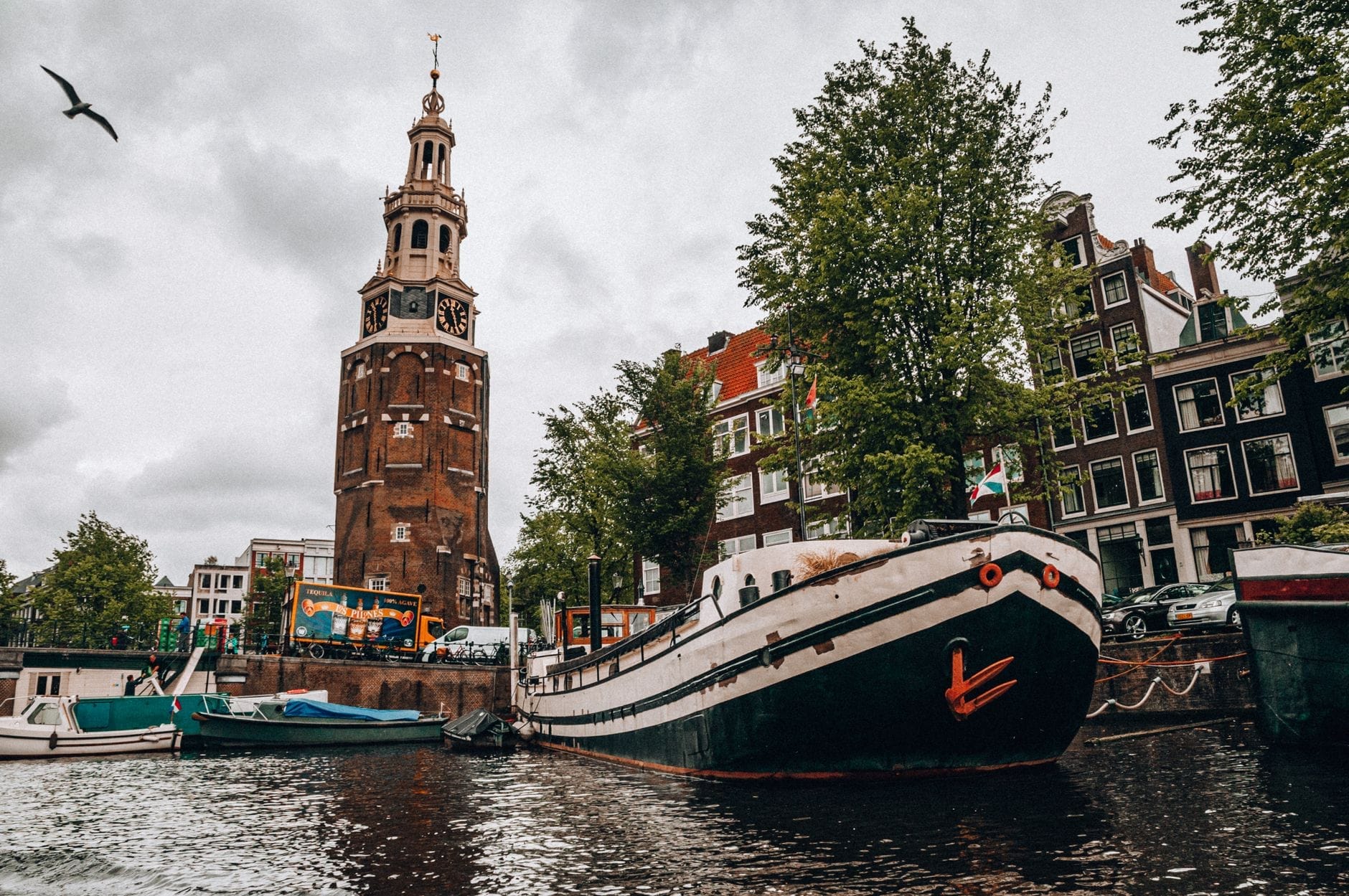
The Montelbaanstoren is a medieval watchtower rising above the Oudeschans canal in Amsterdam's historic eastern harbour district. It was constructed around 1516 and 1517 as part of the city's defensive fortifications, positioned to guard the Lastage shipbuilding and trading quarter against attack from the waterside. Today it is a rijksmonument, a nationally designated heritage monument, and one of the few surviving fragments of Amsterdam's original city wall system.
The tower is not open to the public in the usual sense. It functions as office space and there are no regular visiting hours or entrance tickets. What you come for is the exterior: a tall, slightly tilting structure that reads almost like a Renaissance illustration of a Dutch tower, sitting at the junction of the Oudeschans canal and the Oude Waal, framed by houseboats and leaning gables.
ℹ️ Good to know
No ticket needed. The Montelbaanstoren is free to view from the street and quayside 24 hours a day, every day of the year. There is no interior access for general visitors.
A Short History: From Cannon Platform to Clock Tower
When it was first built, the Montelbaanstoren was a squat, functional military structure with no upper tower. It formed part of Amsterdam's eastern fortifications, protecting the harbour and the adjacent Lastage area where ships were built and repaired. The name is believed to derive from 'Monte Albano,' a reference that appeared in early city records, though the exact etymology is debated.
The tower's character changed dramatically in 1606, when the city commissioned the architect Hendrick de Keyser to add a decorative upper section. De Keyser, who also designed the Westerkerk and several other Amsterdam landmarks, gave the Montelbaanstoren an octagonal base, a lantern stage, and a wooden spire clad in lead. The result transformed a utilitarian gun platform into one of the most recognisable silhouettes on the Amsterdam waterfront.
The clock and carillon bells added to the tower quickly earned a local nickname: 'Malle Jaap,' meaning roughly 'Crazy Jaap.' The bells rang at irregular intervals, and residents in the surrounding Lastage district complained that the chimes bore little relation to the actual time. The nickname stuck and is still used today.
The tower leans noticeably, a tilt that has been documented since the early 17th century and is caused by Amsterdam's famously soft, marshy subsoil. If you stand on the quayside and look carefully at the spire, the lean is visible to the naked eye. The city designated the Montelbaanstoren a rijksmonument in 1970. For more on Amsterdam's architectural character and how layers of building from different centuries sit side by side, see the Amsterdam architecture guide.
Tickets & tours
Live prices and dates from our booking partner. If you book, we may earn a commission at no extra cost to you.
Gray Line Canal Cruise with snackbox & Heineken Experience
From 48 €Instant confirmationFree cancellationAmsterdam evening canal cruise
From 18 €Instant confirmationFree cancellationJewish Museum and Portuguese Synagogue entrance ticket
From 20 €Instant confirmationFree cancellationAdmission ticket for Artis Royal Zoo and Micropia
From 39 €Instant confirmationFree cancellation
Visiting in Practice: What You'll Actually See
The tower stands at Oudeschans 2, at the point where the Oudeschans canal meets the Waalseilandsgracht. The best vantage point is from the bridge or quayside on the western bank of the Oudeschans, which puts the full tower in frame with the canal water and the houseboats moored below. From here the lean of the spire is obvious, and the contrast between the plain 16th-century base and De Keyser's elaborate upper section is clear.
The immediate area is quiet by Amsterdam standards. The Lastage district sits just east of the more visited parts of De Wallen, and the streets around the Oudeschans have a slower pace, with fewer tourist shops and more ordinary street life. The canal here is narrow enough that sounds carry across the water: the creak of moored houseboats, passing cycling bells, occasional boat engines.
The surrounding streets and quays are level, paved city footpaths, accessible to wheelchair users and anyone with limited mobility. Viewing the exterior requires no stairs or physical effort.
💡 Local tip
For the best photograph, stand on bridge 280 over the Waalseilandsgracht and face north. You get the tower, the canal, and a line of canal houses in a single frame with minimal distraction.
Morning, Afternoon, and Evening: How the Tower Changes
In the early morning, before 9am, the Oudeschans is genuinely calm. The low northern light catches the brickwork of the base tower and the lead-clad spire, and the canal surface reflects the whole structure without the movement that later boat traffic creates. Cyclists pass on the bridges but the quayside is mostly empty. This is the best time for photography if you want clean lines and no crowds.
By midday the area sees more foot traffic from people walking between Nieuwmarkt and the eastern docks or following canal cruise routes. The tower draws attention but rarely a crowd, as most visitors are passing through rather than stopping deliberately. In summer, the longer daylight and higher sun flatten some of the texture in photographs, though the evening light recovers this.
At dusk and into the evening the tower is lit from below, and the spire appears to glow against the darkening sky. The reflection in the canal is particularly good in still weather. In winter, when sunset comes early, this effect is easy to catch even on a short visit. Rain is not necessarily a problem: the glazed surface of the lead spire picks up overcast light in an interesting way, and the empty quayside makes for uncluttered images.
Getting There
The Montelbaanstoren is around a 10–15-minute walk from Amsterdam Centraal station. Head south from the station, cross the Prins Hendrikkade, continue through the narrow streets toward Nieuwmarkt, and then follow the Oudeschans canal southeast. The tower appears at the end of the canal, visible from some distance.
You can also reach it from Nieuwmarkt itself, which is served by metro lines 51, 52, 53, and 54. From Nieuwmarkt square, walk east along Sint Antoniesbreestraat and then turn toward the Oudeschans. The whole area forms part of a natural route through De Wallen and the old city centre, and the tower fits easily into a longer walking morning.
Many canal cruise routes pass the Montelbaanstoren on their way through the eastern harbour area. If you are considering a boat trip, it is one of the landmarks that appears on routes covering the IJ and the older canals. See the Amsterdam canal cruise guide for route options.
The Neighbourhood Around the Tower
The Lastage district that surrounds the Montelbaanstoren was historically one of Amsterdam's working harbour quarters, outside the city walls and home to shipbuilders, rope-makers, and sailors. It sits between the more famous canal ring to the west and the Jewish Historical Quarter to the south and east, and it has a character distinct from both.
A short walk south of the tower brings you to the Waterlooplein area and the Waterlooplein Market, Amsterdam's large outdoor flea market. North along the Oudeschans you can connect toward Nieuwmarkt and the Nieuwmarkt square, which has its own historic gatehouse and a Saturday organic market. The combination of the tower, the canal walk, and one of these stops makes for a satisfying half-morning without entering a single building or spending anything beyond coffee.
The streets directly around the tower are not heavily commercial. There are some local cafes along the Oudeschans, and the quaysides have benches facing the water. If you want a spot to sit and look at the tower without committing to anything, the benches just north of bridge 280 are the obvious choice.
⚠️ What to skip
The Montelbaanstoren is often included in lists of 'things to do in Amsterdam' in a way that sets expectations it cannot meet. It is an exterior landmark, not a visitor attraction with interior access. If you are expecting to climb it, buy a ticket, or see an exhibition, you will be disappointed. Come to look at it and walk along the canal.
Photography and Practical Notes
The Montelbaanstoren is one of the more photogenic structures in Amsterdam, precisely because it sits at a canal junction with open sky around it. A 24mm to 35mm lens equivalent on any camera system captures the full tower with canal context. A longer focal length from further down the Oudeschans compresses the canal and tower nicely, with houseboats layered in the foreground.
In winter the bare trees along the quayside open the sight lines further. In summer, the foliage frames the tower but can obscure the lower half. Drone flight in this part of the city is subject to restrictions and generally requires permits; check current regulations before attempting aerial photography.
If you are covering multiple sites in the area in a single day, consider using the Amsterdam City Card for transport and museum access, though the tower itself will not require it. Combining the Montelbaanstoren with nearby paid attractions like the Jewish Historical Museum makes practical sense given the proximity.
Insider Tips
- The lean of the tower is more visible from the southern end of the Oudeschans, looking north, than from directly beside the structure. Step back at least 100 metres for the best sense of the tilt.
- The nickname 'Malle Jaap' (Crazy Jaap) for the bells is a genuine local reference, not a tourist invention. Using it when asking locals for directions can help, especially with older residents familiar with the nickname.
- Early morning on weekdays, before 8am, the quayside is almost entirely empty. This is the only time the canal surface is consistently still enough for a clean mirror reflection.
- The tower appears on several Amsterdam canal cruise routes but is usually a passing view from the water. If you want to photograph it from the boat, position yourself on the right side of the vessel heading east.
- The benches on the western quay of the Oudeschans, just north of bridge 280, face the tower directly and are almost always available. They make a good stop for ten minutes on a longer walk through the old city.
Who Is Montelbaanstoren For?
- Architecture enthusiasts interested in Amsterdam's defensive history and the work of Hendrick de Keyser
- Photographers looking for a canal-and-tower composition that is less crowded than the central canal ring
- Walkers combining a route through De Wallen, the Lastage district, and the Jewish Historical Quarter
- Travellers on tight budgets who want historically significant sights without admission fees
- Canal cruise passengers who want to understand what they are looking at when the boat passes this landmark
Nearby Attractions
Other things to see while in De Wallen (Red Light District):
- The Amsterdam Dungeon
The Amsterdam Dungeon puts 500 years of the Netherlands' darkest history on stage inside a historic former church on Rokin. With live actors, special effects, and ride elements, it is one of the few attractions in Amsterdam that genuinely aims to unsettle you. Here is what the experience is actually like, and whether it belongs in your itinerary.
- Amsterdam Museum
Historically housed in the former Burgerweeshuis, a centuries-old civilian orphanage on Kalverstraat, the Amsterdam Museum explores how this canal city grew from a modest fishing settlement into one of Europe's most recognizable capitals. The building itself is as much the exhibit as the collection inside.
- Begijnhof
Tucked behind an unmarked gate in the heart of Amsterdam, the Begijnhof is a walled courtyard of historic houses, two chapels, and a garden that has existed for more than 600 years. Entry is free, the setting is genuinely quiet, and few places in the city offer this much history in such a compact space.
- Beurs van Berlage
Completed in 1903 and designed by Hendrik Petrus Berlage, the Beurs van Berlage is a national monument that helped define Dutch modern architecture. Today it operates as a conference and events venue, but the building itself remains one of the most rewarding architectural stops in Amsterdam's historic centre.
Planning a trip? Discover personalized activities with the Nomado app.