Jewish Museum Amsterdam: Four Synagogues, One Remarkable Story
The Jewish Museum Amsterdam (officially Jewish Museum + junior, Dutch: Joods Museum) occupies four interconnected historic Ashkenazi synagogues in the Plantage district. Through art, artifacts, and personal testimonies, it traces centuries of Jewish life in Amsterdam and the Netherlands, from prosperity to persecution and renewal.
Quick Facts
- Location
- Nieuwe Amstelstraat 1, 1011 PL Amsterdam (Plantage district)
- Getting There
- Metro 51, 53, 54 or tram 14 to Waterlooplein
- Time Needed
- 1.5 to 2.5 hours
- Cost
- Combiticket (all four locations) €30.00 | Duoticket (Jewish Museum + junior & Portuguese Synagogue) €20.00 | National Holocaust Museum €20.00 (verify before visiting)
- Best for
- History enthusiasts, families, cultural travelers
- Official website
- jck.nl/en
What the Jewish Museum Actually Is
The Jewish Museum Amsterdam, officially named Jewish Museum + junior and known in Dutch as the Joods Museum, is one of the most architecturally distinctive museums in the Netherlands. It occupies four historic Ashkenazi synagogues in the heart of Amsterdam's former Jewish quarter, buildings that date back to the late 17th and early 18th centuries. These aren't reconstructed or transplanted structures; the synagogues still stand where they were built, connected by internal passages to form a single museum complex on Nieuwe Amstelstraat.
The museum is part of the broader Jewish Cultural Quarter (Joods Cultureel Kwartier), which also includes the Portuguese Synagogue directly across the street, the National Holocaust Museum, and the Hollandsche Schouwburg nearby. Each institution can be visited separately, but together they form one of Europe's most concentrated circuits of Jewish history and memory. If you plan to visit more than one, combination tickets are worth checking on the official website.
ℹ️ Good to know
Opening hours: almost every day, 10:00–17:00 for the Jewish Cultural Quarter, with the Jewish Museum itself open 11:00–17:00. Confirm closures around Jewish holidays and public holidays on jck.nl before your visit, as hours can vary.
The Buildings: Architecture as History
Walking into the complex, the first thing most visitors notice is the scale of the Great Synagogue, the largest of the four. Completed in 1671, it was among the earliest major public synagogues in Amsterdam and one of the most significant in Western Europe at the time. The interior features high arched windows that flood the main hall with natural light, original wooden galleries, and the raised bimah platform at the center. It is substantial without being ornate, a building that communicates permanence and community rather than decoration.
The three other synagogues, the Obbene Shul (1685), the Dritt Shul (1778), and the Neie Shul (1752), are smaller and were historically used by different sections of the Ashkenazi community, sometimes divided by social class or wealth. Today they hold various permanent and rotating collection spaces. The internal connections between the buildings feel slightly labyrinthine on a first visit, which is actually useful: it slows you down and prevents the kind of rushed, check-box touring that large single-hall museums encourage.
The buildings survived the Second World War structurally, but Amsterdam's Jewish community did not. Before 1940, approximately 80,000 Jews lived in Amsterdam and its surroundings. By 1945, the vast majority had been deported and murdered. The synagogues were looted and left empty. That the buildings stand today, carefully restored and transformed into a place of memory and education, carries its own weight.
Tickets & tours
Live prices and dates from our booking partner. If you book, we may earn a commission at no extra cost to you.
Jewish Museum and Portuguese Synagogue entrance ticket
From 20 €Instant confirmationFree cancellationJewish Cultural Quarter and House of Gassan tour
From 23 €Instant confirmationFree cancellationDe Wallen, historical audio tour beyond the Red Light District
From 8 €Instant confirmationFree cancellationHistorical Amsterdam bike tour with audio guide by mobile app
From 15 €Instant confirmation
What the Collection Covers
The permanent collection is organized around two broad themes: Jewish identity and Jewish history in the Netherlands. The identity section is more conceptual, exploring how Jewish communities have maintained distinct cultural, religious, and social practices across centuries of diaspora. Ritual objects, textiles, ceremonial silver, and religious manuscripts are displayed alongside explanatory panels aimed at visitors with no prior knowledge of Jewish tradition. The explanations are clear without being patronizing.
The history section moves more chronologically, covering the arrival of Sephardic Jews in Amsterdam from the Iberian Peninsula in the late 16th century, the growth of the Ashkenazi community from Central and Eastern Europe, the relative tolerance Amsterdam offered compared to much of Europe, and the cultural and economic contributions Jewish residents made to Dutch life. The 17th-century Golden Age sections are particularly strong, with objects and documents that tie Amsterdam's Jewish community into the broader story of Dutch trade, printing, and intellectual life.
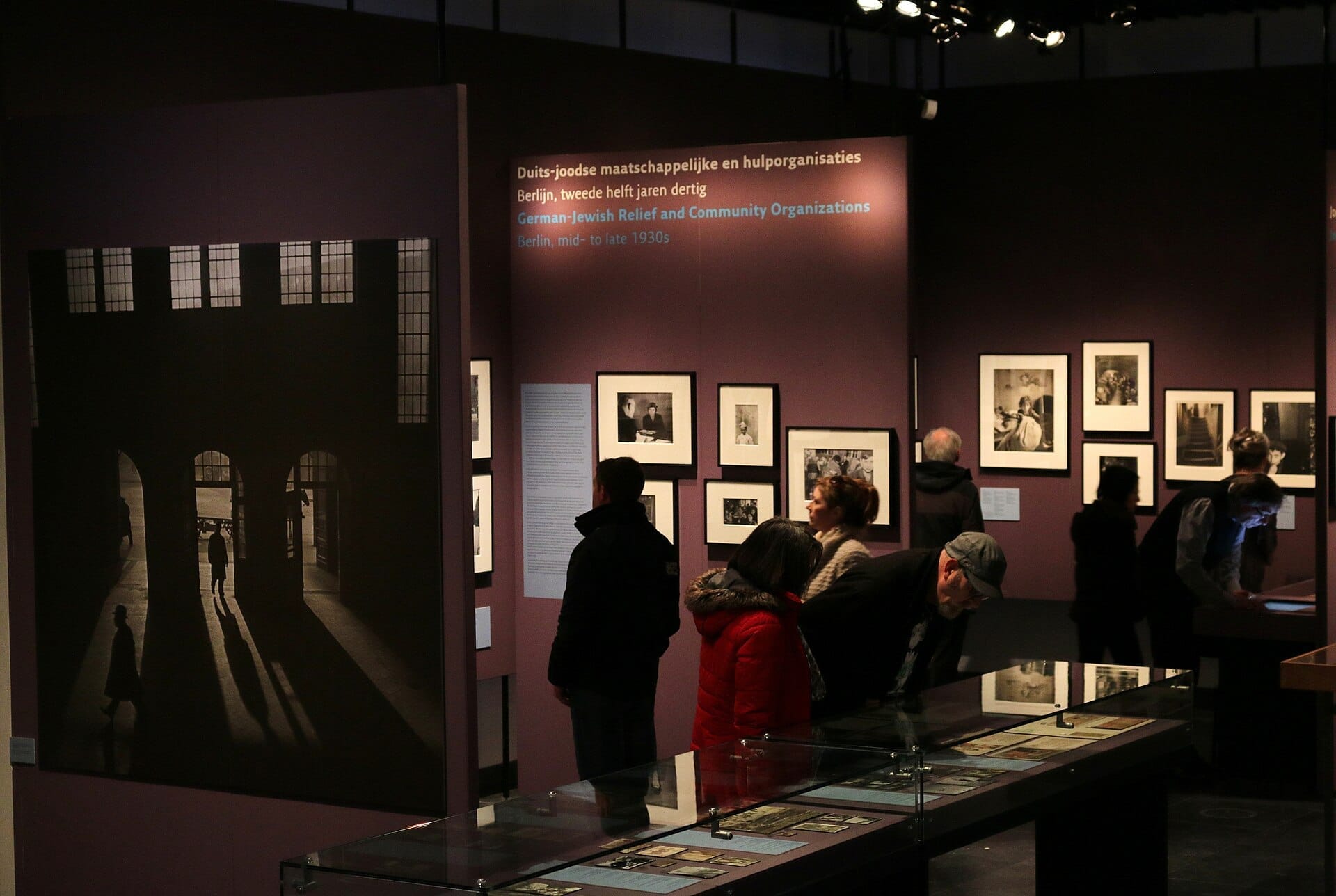
The 20th century is handled with care but without evasion. The Holocaust section does not rely on shock tactics; instead it uses personal documents, photographs, and objects belonging to specific individuals and families. This approach is more affecting than large-scale statistics. You leave with faces in your mind rather than numbers.
The museum also has a dedicated junior section, making it more accessible for families with children. If you are visiting Amsterdam with younger travelers, this is one of the Dutch Resistance Museum neighborhood's better options for combining genuine historical content with age-appropriate presentation. The junior space uses hands-on displays and storytelling formats that engage children without reducing the subject matter to trivia.
When to Visit and What to Expect
The museum opens at 11:00 and sees its heaviest foot traffic between 12:00 and 14:00, particularly on weekends and during the summer months. Arriving at opening time gives you the main hall of the Great Synagogue largely to yourself, which is worth experiencing: the morning light through the high windows at that hour is genuinely striking, and the space feels different when it's quiet.
Afternoons, especially from around 13:30 onward, tend to be busier as visitors arrive after lunch or combine the museum with the nearby Waterlooplein flea market. The 11:00 opening slot on weekdays is consistently the calmest time to visit. Allow between 90 minutes and two and a half hours, depending on how closely you engage with the text panels and whether you explore the temporary exhibition spaces.
💡 Local tip
Photography is generally permitted in the permanent collection without flash. Some temporary exhibitions restrict photography; look for signage at the entrance to each gallery.
The museum is wheelchair accessible. Audio guides are available in multiple languages and add depth to a visit, particularly in the architectural sections where the history of the individual synagogue buildings is explained room by room.
Getting There and the Surrounding Area
The museum sits in the Plantage district, one of Amsterdam's quieter inner neighborhoods, a short walk from the main tourist corridor around the canal ring. Take metro lines 51, 53, or 54, or tram 14, to Waterlooplein. From the stop, the museum is a three-minute walk southeast along Nieuwe Amstelstraat. The area is flat and easy to navigate on foot.
The neighborhood itself rewards some time before or after the museum. The Portuguese Synagogue sits directly across the street and is one of the best-preserved 17th-century synagogues in the world. It is managed separately with its own admission fee, but many visitors combine both in a single afternoon. The Waterlooplein market is a five-minute walk and offers a practical and atmospheric place for lunch before or after your visit.
Further into the Plantage district, the Hortus Botanicus botanical garden offers a complete change of atmosphere if you need a break from indoor exhibitions, and the Artis Amsterdam Royal Zoo is particularly useful if you are visiting with children and want to extend the afternoon.
Is This Museum Worth Your Time?
The honest answer is: it depends on what you're looking for. If your interest in Amsterdam's Jewish history is primarily focused on the Holocaust, the National Holocaust Museum (which opened in the same neighborhood in 2024 as part of the Jewish Cultural Quarter) may be more directly relevant to that specific period. The Jewish Museum's scope is broader, tracing roughly 400 years of Jewish life in Amsterdam, which means the WWII period is one chapter among many rather than the central focus.
Visitors who engage most deeply with this museum tend to be those with an interest in religious history, material culture, or the longer arc of Jewish life in Europe. The combination of remarkable architecture and a carefully assembled collection gives it a quality that purely photogenic or purely educational museums often lack.
Travelers looking for a quick, visually spectacular experience may find the pace and text-heavy presentation challenging. The museum asks you to read, to slow down, and to consider context. That is not a criticism; it is a description. Those willing to give it genuine attention tend to leave having learned something they didn't expect to.
⚠️ What to skip
Ticket prices and opening hours are subject to change. Always check jck.nl before your visit, especially around Jewish holidays when some dates may have altered schedules or closures.
Insider Tips
- Arrive at 11:00 on a weekday to have the Great Synagogue's main hall nearly to yourself. The quality of light and the silence in that space at opening time are not replicated later in the day.
- The Jewish Cultural Quarter offers a combination ticket covering multiple sites including the Portuguese Synagogue. If you plan to visit both, buying the combo online in advance saves both money and queue time.
- The internal connections between the four synagogues are not always intuitive. Pick up the free floor plan at the entrance and take a moment to orient yourself before diving in; it prevents accidental backtracking.
- The museum café is small but functional. If you want a proper lunch, the Waterlooplein market stalls and nearby Nieuwe Amstelstraat cafés are a better option and only a short walk away.
- The junior section is specifically designed for children aged 6 to 13. If you are visiting with kids in that age range, factor in extra time: the interactive elements can hold attention for longer than a standard gallery visit.
Who Is Jewish Historical Museum For?
- History travelers who want context beyond the standard Amsterdam tourist circuit
- Families with children aged 6 and up, thanks to the dedicated junior section
- Architecture enthusiasts interested in historic religious buildings
- Travelers combining the Plantage district's cultural cluster in a single half-day
- Anyone interested in the long history of Jewish life in Europe, not just the Holocaust period
Nearby Attractions
Other things to see while in Plantage & Jewish Quarter:
- ARTIS Amsterdam Royal Zoo
Founded in 1838, ARTIS Amsterdam Royal Zoo is the oldest zoo in the Netherlands and the fifth oldest zoo in the world still in operation. Set across landscaped grounds in the Plantage neighborhood, it blends wildlife, botanical gardens, and 19th-century heritage architecture into a single half-day destination that works for families, history enthusiasts, and curious solo travelers alike.
- Brouwerij 't IJ
Brouwerij 't IJ is Amsterdam's most distinctive craft brewery, operating inside an early-20th-century bathhouse at the foot of the De Gooyer windmill. The tasting room is free to enter, pours a rotating lineup of house-brewed beers, and offers short brewery tours on weekends. It is one of the few places in the city where industrial heritage, local brewing culture, and canal-side atmosphere converge in a single address.
- De Gooyer Windmill
Standing 26.6 metres tall on the eastern edge of the city, De Gooyer is widely described as the tallest wooden windmill in the Netherlands and one of Amsterdam's most photogenic historic structures. The mill itself is private, but the exterior is free to visit, and the craft brewery in the former bathhouse beside it is reason enough to linger.
- Dutch Resistance Museum
The Dutch Resistance Museum (Verzetsmuseum Amsterdam) tells the story of the Nazi occupation of the Netherlands through the choices ordinary people made: those who resisted, those who complied, and those who stood between. Located in the Plantage district, it is one of the most thoughtfully curated war museums in Europe.
Planning a trip? Discover personalized activities with the Nomado app.