Portuguese Synagogue Amsterdam: Inside the Candlelit Esnoga
Built in 1675 and still an active house of worship, the Portuguese Synagogue in Amsterdam stands as one of Europe's most intact and awe-inspiring religious buildings. Its vast, candlelit interior has changed remarkably little in 350 years, making it a rare encounter with the Golden Age at its most profound.
Quick Facts
- Location
- Mr. Visserplein 3, Plantage, Amsterdam
- Getting There
- Waterlooplein metro station (M51/M53/M54) or tram stop; short walk from Nieuwmarkt
- Time Needed
- 45–90 minutes
- Cost
- Covered by Jewish Cultural Quarter ticket; check jck.nl for current pricing
- Best for
- History enthusiasts, architecture lovers, anyone tracing Jewish heritage in Amsterdam
- Official website
- www.esnoga.com/en
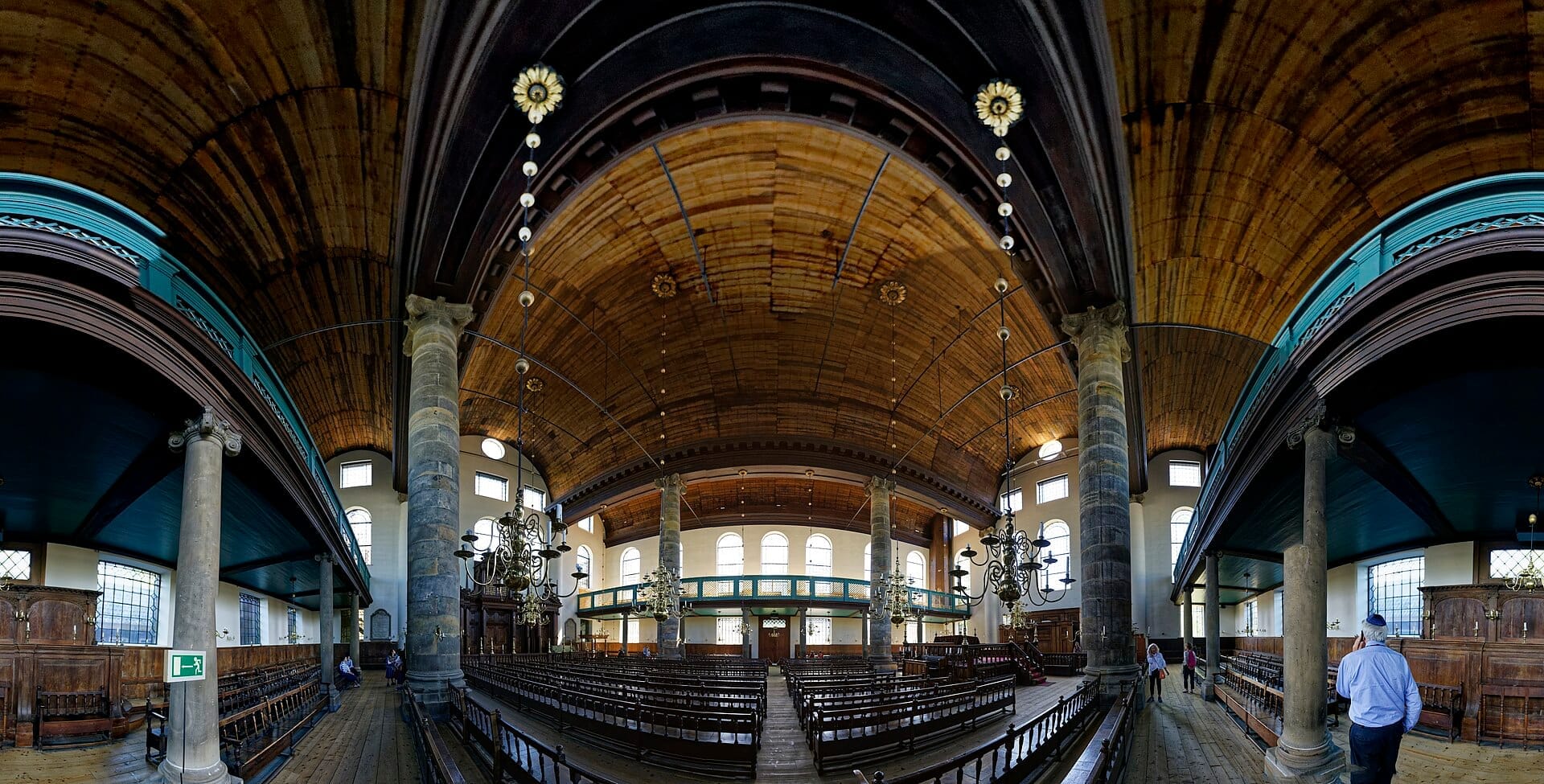
What You're Walking Into
The Portuguese Synagogue, known locally as the Esnoga or Snoa, occupies a quiet square just a few minutes' walk from Waterlooplein. From the outside, the building reads more like a Dutch Reformed church than a synagogue: plain brick, wide proportions, tall windows. That restraint is deliberate. When Sephardic Jews who had fled the Iberian Peninsula built this in 1675, they did so under a peculiar form of Dutch tolerance that permitted worship but discouraged ostentation. The street facade gives nothing away.
Step through the courtyard and into the interior, and the experience changes completely. The main sanctuary is one of the most extraordinary religious spaces in Northern Europe. Twelve massive Ionic columns support a barrel-vaulted timber ceiling. Several large brass chandeliers, each holding dozens of candles, hang above rows of plain wooden benches. There is no electric lighting in the main hall. During special occasions and services, this space can be illuminated by hundreds of candles. The smell of warm wax and aged timber is immediate.
💡 Local tip
Visit on a grey or overcast afternoon in the quieter months. Low natural light from the high windows intensifies the atmospheric quality of the interior and reduces the chance of heavy tour groups.
Historical Context: Why This Building Matters
The community that built this synagogue, Kahal Kados Talmud Tora, was founded in 1639 by Sephardic Jews who had fled the Spanish Inquisition and its Portuguese equivalent. Many arrived via Brazil and the Caribbean before settling in Amsterdam, which offered a comparatively stable environment for Jewish life in 17th-century Europe. Amsterdam's relative openness made it one of the most significant centres of Jewish culture in the Western world during the Golden Age.
When it was completed in 1675, the Portuguese Synagogue was among the largest synagogues of its time, and one of the largest religious buildings in Amsterdam. Its scale was a statement. The architect, Elias Bouman, modelled elements of the design on the Temple of Solomon as described in biblical and scholarly texts, though the Dutch Renaissance influence is unmistakable throughout. The building predates most of the city's famous canal houses and has outlasted wars, occupations, and urban transformation with its interior essentially intact.
The synagogue sits at the heart of Amsterdam's historic Jewish quarter, close to the Jewish Historical Museum and the National Holocaust Museum. Together these sites form what is now called the Jewish Cultural Quarter, and a combined ticket covers entry to all of them. If Amsterdam's Jewish history is your focus, budget most of a day for this cluster.
Tickets & tours
Live prices and dates from our booking partner. If you book, we may earn a commission at no extra cost to you.
Jewish Museum and Portuguese Synagogue entrance ticket
From 20 €Instant confirmationFree cancellationGray Line Canal Cruise with snackbox & Heineken Experience
From 48 €Instant confirmationFree cancellationAmsterdam evening canal cruise
From 18 €Instant confirmationFree cancellationAdmission ticket for Artis Royal Zoo and Micropia
From 39 €Instant confirmationFree cancellation
The Interior: What to Look For
The sanctuary layout follows Sephardic tradition: the bimah (raised reading platform) stands in the centre of the hall rather than at the front, surrounded by seating on all sides. Men sit on the main floor; the upper galleries were designated for women. The benches are original 17th-century furniture, worn smooth by three and a half centuries of use. The texture of the wood, the slight creak underfoot, and the faint unevenness of the floor are things photographs do not convey.
The Ark, which houses the Torah scrolls, is a monumental carved wooden structure positioned along the Jerusalem-facing wall. It is richly detailed compared to the otherwise plain interior, making it an immediate focal point. The collection of Torah scrolls kept here is among the more substantial historic Sephardic collections in Europe; many are displayed in the adjacent Ets Haim library and treasury, which are also included in the visit.
The Ets Haim library is, by some accounts, the more remarkable find. Founded in the 17th century, it holds manuscripts, rare books, and documents and is regarded as the oldest functioning Jewish library in the world. UNESCO recognised the collection in 2009 as part of the Memory of the World Programme. It is not a display case in a museum; it is a working library with materials that have been in continuous use for centuries. Access during general visits is limited, but what is shown is genuinely exceptional.
Visiting Hours and Practical Details
The Portuguese Synagogue is open to visitors Sunday through Friday, 10:00 to 17:00. It is closed on Saturdays, which is Shabbat, and hours are adjusted around Jewish festivals and high holidays. Before you go, check the Jewish Cultural Quarter website at jck.nl, especially if you are planning to visit around Rosh Hashanah, Yom Kippur, Passover, or other major dates on the Jewish calendar, as the synagogue remains an active house of worship and visiting access is sometimes restricted.
Entry is via the Jewish Cultural Quarter combined ticket. The ticket covers the Portuguese Synagogue, the Jewish Historical Museum, the Jewish Museum, the National Holocaust Museum and Hollandsche Schouwburg memorial. Pricing is set by the Jewish Cultural Quarter and changes periodically; confirm the current rate at jck.nl or at the ticket desk before you go. The Amsterdam City Card may offer discounts, so check that option if you are covering multiple attractions.
⚠️ What to skip
This is an active synagogue, not just a heritage site. Modest dress is expected: shoulders covered, and men are asked to wear a head covering inside the sanctuary. Kippot are available at the entrance if you do not have one. Photography rules may vary; ask staff before shooting inside.
The building is a 17th-century structure kept largely in its original state. There are steps at various points, and the internal spaces have not been retrofitted with lifts or ramps. If you have mobility requirements, contact the Jewish Cultural Quarter in advance to understand what is and is not accessible. The main sanctuary floor can generally be reached, but some sections of the complex may present challenges.
Time of Day and Crowd Patterns
Mornings after opening tend to be quietest. By midday, tour groups begin arriving, particularly between 12:00 and 14:00. The space is large enough to absorb some crowding, but the intimacy of the interior shifts noticeably when groups of 20 or more fill the benches. Arriving at opening, around 11:00, gives you the best chance of quiet reflection. Late afternoon visits before 16:30 can also be calm on weekdays outside of high summer.
In winter, the reduced daylight filtering through the high windows creates a particularly atmospheric quality in the main hall. The candles in the brass chandeliers are not always lit during daytime visiting hours, but the sheer scale of the chandeliers and the warmth of the aged wood make the space feel charged regardless. In summer, bright light floods through the tall windows and the atmosphere is lighter, more airy, though some of the drama is diluted.
How the Synagogue Fits Into the Surrounding Area
The synagogue sits in the Plantage neighbourhood, which transitions quickly from the historic Jewish quarter into the cultural and scientific institutions of the broader Plantage district. A short walk brings you to the Hortus Botanicus, one of the world's oldest botanical gardens, and to Artis Amsterdam Royal Zoo. The area is walkable and relatively calm compared to the Canal Ring.
If you are exploring the Jewish history of Amsterdam in depth, the Dutch Resistance Museum is also nearby and provides critical context for understanding how Amsterdam's Jewish community was decimated during World War Two. The Portuguese Synagogue's survival of the Nazi occupation, when it was reportedly not used or damaged thanks to a combination of circumstances, is itself a significant historical fact that guides will cover during your visit.
For a broader view of Amsterdam's Jewish heritage sites and how to sequence a day or a full trip around them, the best museums in Amsterdam guide covers all the major options with practical routing advice.
Who Should Skip This Attraction
If you are looking for interactive, multimedia museum experiences, this is not that. The Portuguese Synagogue is a preserved religious building with period furnishings and a library collection. Interpretive signage exists but the primary experience is architectural and atmospheric. Children who need constant engagement may find it difficult, though older teenagers with an interest in history generally respond well to the scale and quiet gravity of the space.
It is also worth being honest that the combined Jewish Cultural Quarter ticket assumes you will spend meaningful time at multiple sites. If you only have an hour in the neighbourhood and want a single strong impression, the Portuguese Synagogue's interior is arguably the most immediate. But the full ticket offers real depth, and rushing through it to tick a box would be a poor use of the price of admission.
Insider Tips
- The Ets Haim library collection is genuinely rare and often underappreciated by visitors focused on the main sanctuary. Ask at the desk what is currently on display from the collection and factor that into your time.
- If you are visiting in winter, check whether any candlelit events or Hanukkah observances are open to the public. The interior lit entirely by candles at dusk is a completely different experience from a daytime visit.
- Combine the visit with the National Holocaust Museum nearby for a deeply affecting half-day. The contrast between the synagogue's survival and the community's near-destruction during the war creates a powerful historical narrative.
- The courtyard of the synagogue complex, with its surrounding outbuildings and winter sheds, is often overlooked. Linger there before or after entering the main hall. The architecture at street level tells its own story about how this community occupied urban space.
- If you have questions about the Sephardic liturgical tradition or the history of the community, the guides on site tend to be knowledgeable and willing to go into detail when the crowds permit. Early morning visits make these conversations easier.
Who Is Portuguese Synagogue For?
- Travellers with a serious interest in Jewish history and culture in Europe
- Architecture enthusiasts drawn to 17th-century Dutch religious buildings
- Anyone visiting the Jewish Cultural Quarter who wants to understand the depth of Amsterdam's Sephardic heritage
- History-focused visitors who want to combine the synagogue with the Dutch Resistance Museum and National Holocaust Museum in a single day
- Photographers drawn to candlelit interiors and aged timber architecture
Nearby Attractions
Other things to see while in Plantage & Jewish Quarter:
- ARTIS Amsterdam Royal Zoo
Founded in 1838, ARTIS Amsterdam Royal Zoo is the oldest zoo in the Netherlands and the fifth oldest zoo in the world still in operation. Set across landscaped grounds in the Plantage neighborhood, it blends wildlife, botanical gardens, and 19th-century heritage architecture into a single half-day destination that works for families, history enthusiasts, and curious solo travelers alike.
- Brouwerij 't IJ
Brouwerij 't IJ is Amsterdam's most distinctive craft brewery, operating inside an early-20th-century bathhouse at the foot of the De Gooyer windmill. The tasting room is free to enter, pours a rotating lineup of house-brewed beers, and offers short brewery tours on weekends. It is one of the few places in the city where industrial heritage, local brewing culture, and canal-side atmosphere converge in a single address.
- De Gooyer Windmill
Standing 26.6 metres tall on the eastern edge of the city, De Gooyer is widely described as the tallest wooden windmill in the Netherlands and one of Amsterdam's most photogenic historic structures. The mill itself is private, but the exterior is free to visit, and the craft brewery in the former bathhouse beside it is reason enough to linger.
- Dutch Resistance Museum
The Dutch Resistance Museum (Verzetsmuseum Amsterdam) tells the story of the Nazi occupation of the Netherlands through the choices ordinary people made: those who resisted, those who complied, and those who stood between. Located in the Plantage district, it is one of the most thoughtfully curated war museums in Europe.
Planning a trip? Discover personalized activities with the Nomado app.