Nieuwmarkt: Amsterdam's Most Historic Square and the Story Behind De Waag
Nieuwmarkt is a large, open city square in Amsterdam's old centre, anchored by the medieval De Waag building dating to 1488. Free to visit at any hour, it hosts daily markets, an organic farmers' market on Saturdays, and a summer antiques and flea market on Sundays, all within walking distance of the canal ring and the Jordaan.
Quick Facts
- Location
- Nieuwmarkt, 1012 CR Amsterdam (De Wallen, city centre)
- Getting There
- Metro Nieuwmarkt (lines 51, 53, 54); 10-min walk from Amsterdam Centraal
- Time Needed
- 30–90 minutes for the square; longer if combining with nearby streets
- Cost
- Free — public square with free market access
- Best for
- History lovers, market browsers, café-sitters, photographers
What Nieuwmarkt Actually Is
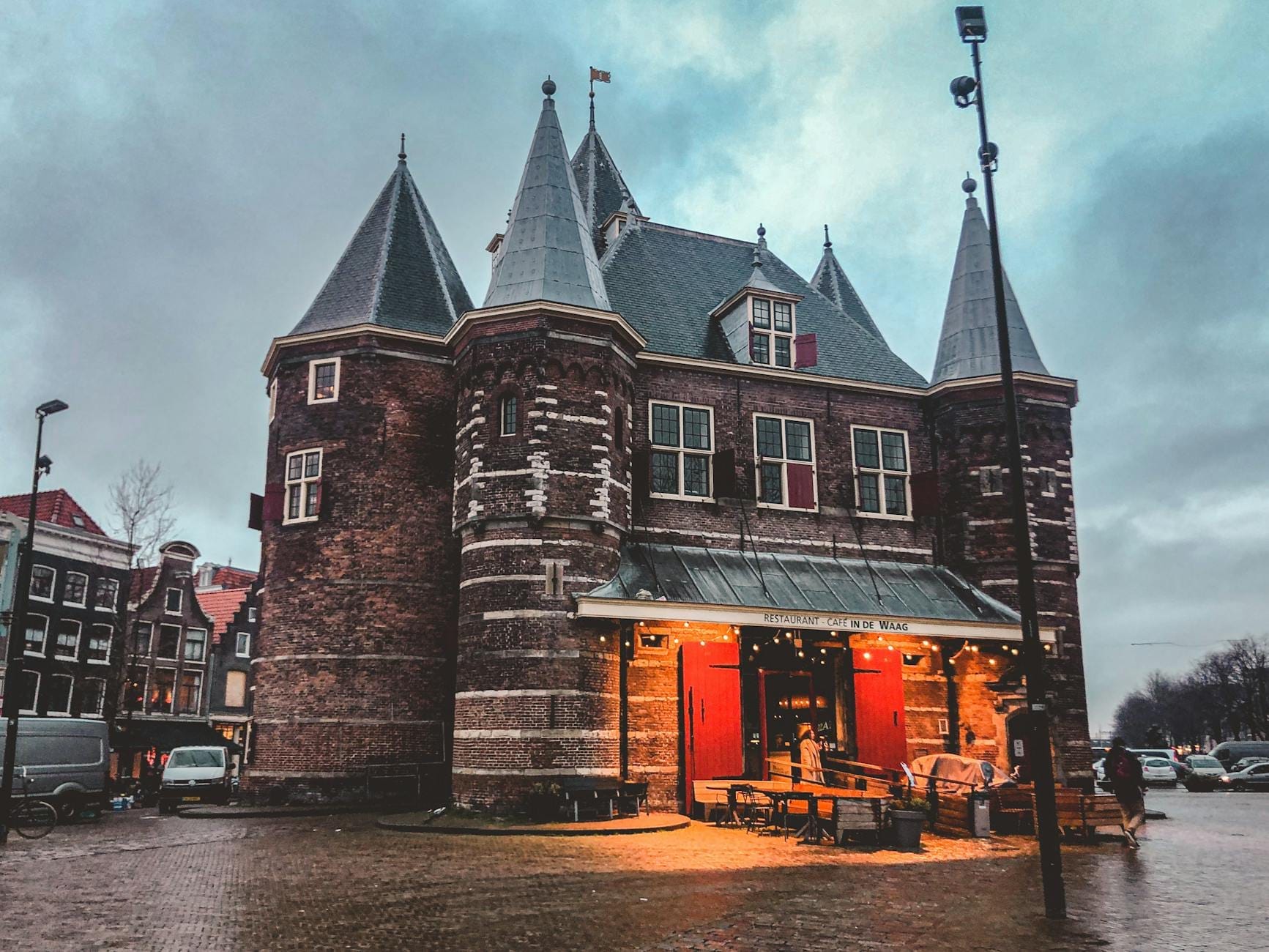
Nieuwmarkt is one of Amsterdam's largest open squares, sitting in the heart of the old city between the Red Light District and the former Jewish quarter. Its name means 'New Market', though there is nothing new about it: the square has functioned as a trading ground since 1614. At its centre stands De Waag, a turreted stone building originally constructed in 1488 as the Sint Antoniespoort, one of the city's main fortified gates. When the canal Kloveniersburgwal was partially filled in around 1614 to expand the city's market capacity, the old gate found itself stranded in the middle of a new plaza and repurposed as a weighing house, later serving as a guild hall for surgeons, painters, and masons.
The result is a square that carries genuine historical weight without feeling like a museum exhibit. Locals use it daily. Café terraces fill the perimeter in warmer months. The metro entrance is tucked to one side, and the market stalls form loose clusters around De Waag from Monday through Saturday. It is the kind of place that looks different every time you visit, depending on the hour, the season, and whether the organic market has set up along the edges.
ℹ️ Good to know
Nieuwmarkt square is a public space with no entry fee and no opening hours — it is accessible at all hours. De Waag itself is privately operated as a café-restaurant and has its own service hours. Market stalls operate roughly Monday–Friday during the day, with an organic farmers’ market on Saturdays and an antiques and flea market on summer Sundays (May–October, typically around 09:00–17:00).
De Waag: Five Centuries in One Building
De Waag is the oldest surviving non-religious building in Amsterdam, and understanding its history makes the square considerably more interesting. The building began as Sint Antoniespoort in 1488, a fortified city gate with towers. As Amsterdam expanded outward in the 17th century, the gate lost its defensive purpose. Rather than demolish it, city authorities converted it into a weighing house (waag) where goods like butter, cheese, and gunpowder were measured and taxed before sale — standard commercial practice in Dutch trading cities of the era.
The guild towers were added over the following century, each occupied by a different craft guild. The Surgeons' Guild is the most historically notable: Rembrandt van Rijn painted 'The Anatomy Lesson of Dr. Nicolaes Tulp' in 1632, depicting a dissection performed here. The original painting now hangs in the Mauritshuis in The Hague, but its connection to this building is a tangible link between a physical space and one of the most recognisable works in Dutch Golden Age art.
Today, De Waag operates as a café-restaurant with a terrace facing the square. The interior retains its medieval stonework, thick walls, and low vaulted ceilings. Even if you are not eating, it is worth noting the building's exterior carefully: the asymmetric towers, the Gothic windows, and the coats of arms carved into the facade each correspond to a different occupying guild. Architects and detail-oriented visitors will find a lot to study in a short time.
If De Waag captures your interest in Amsterdam's architectural history, a longer exploration is worthwhile. The Amsterdam architecture guide covers how the city's Golden Age expansion shaped everything from canal house proportions to public building placement.
Tickets & tours
Live prices and dates from our booking partner. If you book, we may earn a commission at no extra cost to you.
Historical Amsterdam bike tour with audio guide by mobile app
From 15 €Instant confirmationGray Line Canal Cruise with snackbox & Heineken Experience
From 48 €Instant confirmationFree cancellationAmsterdam evening canal cruise
From 18 €Instant confirmationFree cancellationJewish Museum and Portuguese Synagogue entrance ticket
From 20 €Instant confirmationFree cancellation
The Markets: What to Expect and When
Nieuwmarkt operates as a working market on most days of the week, though the character changes significantly depending on the day. A small weekday market (Monday through Friday) focuses on general goods, produce, and food stalls, with additional stalls on Saturday. Saturday is the busiest market day, when an organic farmers' market sets up around the square from 09:00, offering seasonal vegetables, artisan bread, cheeses, and prepared foods. This is genuinely popular with local residents rather than primarily tourist-facing, which gives it a different atmosphere from, say, the Bloemenmarkt on the Singel canal.
Between May and October, Sunday brings an antiques and flea market, generally running from around 09:00 to 17:00. The Sunday market leans more eclectic: old prints, secondhand books, ceramics, vintage clothing, and the occasional genuine antique sitting next to something considerably less valuable. Prices are negotiable on some stalls, and browsing is entirely free. The Sunday crowds are noticeably lighter than Saturday, which makes it one of the better times to photograph the square with De Waag as a backdrop.
For a broader picture of Amsterdam's market scene, including weekday options across different neighbourhoods, the Amsterdam markets guide gives a useful overview of what each market specialises in.
How the Square Changes Through the Day
Early morning on a weekday, Nieuwmarkt is quiet in a way that most Amsterdam central spaces are not. The metro station brings a steady trickle of commuters around 07:00–09:00, but the square itself is largely empty. De Waag sits grey and imposing in low light, and the cobblestones often hold standing water from overnight rain. This is genuinely the best time for unobstructed photography: no market tents, no café chairs, just the medieval gatehouse framed by narrow canal-era streets.
By mid-morning on a Saturday, the tone shifts completely. Stalls are set up in curved rows around De Waag, the terrace fills with people drinking coffee, and the smell of fresh bread from the organic stalls drifts across the square. This version of Nieuwmarkt is social and lively without being aggressively crowded, at least before noon. After 13:00, tourist foot traffic increases noticeably, as the square sits on the walking route between Amsterdam Centraal and the Waterlooplein area.
Evening brings a third character. The café terrace around De Waag glows against the dark stone, and the square attracts a younger, local crowd sitting on the steps of the building itself. In summer, this informal gathering continues well past 22:00. The square is lit but not floodlit, which keeps the atmosphere relaxed rather than performative. It is worth returning in the evening even if you visited earlier in the day.
💡 Local tip
For photography, arrive before 09:00 on a weekday or between 08:30 and 09:30 on a Sunday. The antiques market sets up gradually, giving you a window of clean, crowd-free angles before the square fills.
The Surrounding Streets and Neighbourhood Context
Nieuwmarkt sits at the intersection of several historically distinct Amsterdam neighbourhoods, which makes it a practical base for a longer walk. To the west, the narrow streets of De Wallen begin almost immediately; the atmosphere changes sharply within half a block, as this is the edge of Amsterdam's Red Light District. Most visitors pass through without incident, but it is worth knowing the transition is abrupt. The streets directly around Nieuwmarkt are residential and commercial in a mundane, everyday way, which contrasts clearly with the more explicitly tourist-oriented blocks to the west.
To the south and southeast, Nieuwmarkt connects to the Jodenbuurt, Amsterdam's historic Jewish quarter. The Portuguese Synagogue, the Jewish Historical Museum, and the National Holocaust Museum are all within a 10-minute walk. This part of Amsterdam has a quieter, more reflective quality, and the contrast with the lively square is significant if you walk both areas on the same visit.
The Portuguese Synagogue on Mr. Visserplein is one of the best-preserved 17th-century synagogues in Europe and is roughly a 7-minute walk from Nieuwmarkt. It pairs well as part of the same itinerary.
To the northwest, Nieuwmarkt connects through Kloveniersburgwal and Sint Antoniesbreestraat toward the Canal Ring and the Rembrandthuis on Jodenbreestraat, which is just a two-minute walk from the square.
Getting There and Practical Notes
The Metro Nieuwmarkt station (lines 51, 53, 54) deposits you directly at the square's edge. From Amsterdam Centraal, the metro takes under five minutes. On foot from the station, the walk through the old centre takes about ten minutes along Damstraat or through the Zeedijk, both of which are interesting routes in their own right. Cycling is straightforward: the square has bike parking around its edges, though it fills quickly on Saturday mornings.
The square itself is flat, paved, and step-free, making it accessible for wheelchairs and prams. The metro station has elevator access, though visitors with specific mobility requirements should check current GVB service status before travel, as lift availability at Amsterdam metro stations can vary. Restrooms are not available on the square itself; the nearest public options are in the metro station or in the surrounding cafés.
⚠️ What to skip
Nieuwmarkt is centrally located but on the edge of De Wallen. Pickpocketing is a documented issue in this part of Amsterdam, particularly during crowded Saturday markets. Keep bags closed and in front of you. The square itself is generally safe and well-used by locals, but standard city-centre awareness applies.
Weather affects the experience more than at enclosed attractions. The market stalls operate rain or shine, but the outdoor café terraces are at their best in dry weather. In winter, the square has a different appeal: quieter, often misty, and with a starkness that makes the De Waag's medieval stonework read more clearly. Bring a waterproof layer in any season except high summer.
If you are planning a wider visit to Amsterdam's old centre, the Amsterdam walking tours guide includes routes that pass through Nieuwmarkt as part of a longer circuit through the historic city.
Who Will and Won't Get the Most from Nieuwmarkt
Nieuwmarkt rewards visitors who are happy to spend time simply being in a place rather than working through a checklist. If your interest is in architecture, history, and the texture of daily Amsterdam life, the square gives you a lot to engage with for very little investment of time or money. The Saturday organic market in particular has a local character that is uncommon in the city centre.
Visitors expecting a formal attraction with clear signage, audio guides, or interior spaces to explore will be disappointed. There is no museum here. De Waag cannot be toured as a historical monument. The square is primarily experienced by being in it, not by consuming information about it. If you are travelling on a tight schedule focused on major museum collections, Nieuwmarkt is best treated as a 20-minute stop or a transit point rather than a destination in its own right. Families with young children will find it fine as a break point, with space to move and café options nearby, but there is nothing specifically designed for children.
Insider Tips
- The Sunday antiques market (May–October, generally around 09:00–17:00) is significantly less crowded than the Saturday organic market, and the browsing is unhurried. If your primary goal is photographing De Waag without market tents in the frame, arrive before 09:30 on a Sunday before stalls are fully set up.
- Kloveniersburgwal, the canal running south from Nieuwmarkt, is one of Amsterdam's wider and less-photographed canals. Walking south along it for ten minutes takes you past a series of well-preserved 17th-century merchant houses with minimal tourist foot traffic.
- The Zeedijk, running northwest from Nieuwmarkt toward Centraal Station, is Amsterdam's Chinatown and one of the oldest streets in the city. It is lined with Chinese restaurants, a Buddhist temple, and independent bars. Worth walking even if you don't stop.
- De Waag's café terrace faces roughly south and catches afternoon light from around 14:00 in summer. If you want a drink in the sun with a medieval building behind you, the southwest-facing corner of the terrace is the spot.
- Rembrandt's 'The Anatomy Lesson of Dr. Nicolaes Tulp' was painted in the Surgeons' Guild room inside De Waag in 1632. The painting is now in the Mauritshuis in The Hague, but standing outside the building knowing that connection gives the stonework a different weight.
Who Is Nieuwmarkt For?
- History and architecture enthusiasts interested in Amsterdam's pre-Golden Age urban fabric
- Food and market visitors who prefer locally-oriented organic produce over tourist markets
- Photographers looking for a medieval centrepiece building with changing light conditions
- Walkers using Nieuwmarkt as a junction point between the canal ring, the Jewish quarter, and the old city
- Travellers who want to experience a working Amsterdam square without paying admission for anything
Nearby Attractions
Other things to see while in De Wallen (Red Light District):
- The Amsterdam Dungeon
The Amsterdam Dungeon puts 500 years of the Netherlands' darkest history on stage inside a historic former church on Rokin. With live actors, special effects, and ride elements, it is one of the few attractions in Amsterdam that genuinely aims to unsettle you. Here is what the experience is actually like, and whether it belongs in your itinerary.
- Amsterdam Museum
Historically housed in the former Burgerweeshuis, a centuries-old civilian orphanage on Kalverstraat, the Amsterdam Museum explores how this canal city grew from a modest fishing settlement into one of Europe's most recognizable capitals. The building itself is as much the exhibit as the collection inside.
- Begijnhof
Tucked behind an unmarked gate in the heart of Amsterdam, the Begijnhof is a walled courtyard of historic houses, two chapels, and a garden that has existed for more than 600 years. Entry is free, the setting is genuinely quiet, and few places in the city offer this much history in such a compact space.
- Beurs van Berlage
Completed in 1903 and designed by Hendrik Petrus Berlage, the Beurs van Berlage is a national monument that helped define Dutch modern architecture. Today it operates as a conference and events venue, but the building itself remains one of the most rewarding architectural stops in Amsterdam's historic centre.
Planning a trip? Discover personalized activities with the Nomado app.