Begijnhof Amsterdam: The Medieval Courtyard That Stopped Time
Tucked behind an unmarked gate in the heart of Amsterdam, the Begijnhof is a walled courtyard of historic houses, two chapels, and a garden that has existed for more than 600 years. Entry is free, the setting is genuinely quiet, and few places in the city offer this much history in such a compact space.
Quick Facts
- Location
- Begijnhof 30, 1012 WT Amsterdam (enter via Begijnensteeg gate)
- Getting There
- Tram 2, 11, or 12 to Spui; a short tram ride then walk from Amsterdam Centraal
- Time Needed
- 30–60 minutes
- Cost
- Free entry
- Best for
- History, architecture, quiet respite, solo travelers, couples
- Official website
- hetbegijnhof.nl/?lang=en
What Is the Begijnhof?
The Begijnhof is one of the oldest inhabited inner courtyards in Amsterdam, with the site's first recorded mention dating to 1346, when a beguinage was established here. For over six centuries, this walled enclosure housed Beguines: devout lay Catholic women who lived in community, took informal religious vows, but were not bound to a formal convent. They worked, prayed, and maintained their independence in ways that formal nunneries did not allow. The last Beguine, Cornelia Arens, died in 1971, and the courtyard has since been maintained as both a residential community and a historic site open to respectful visitors.
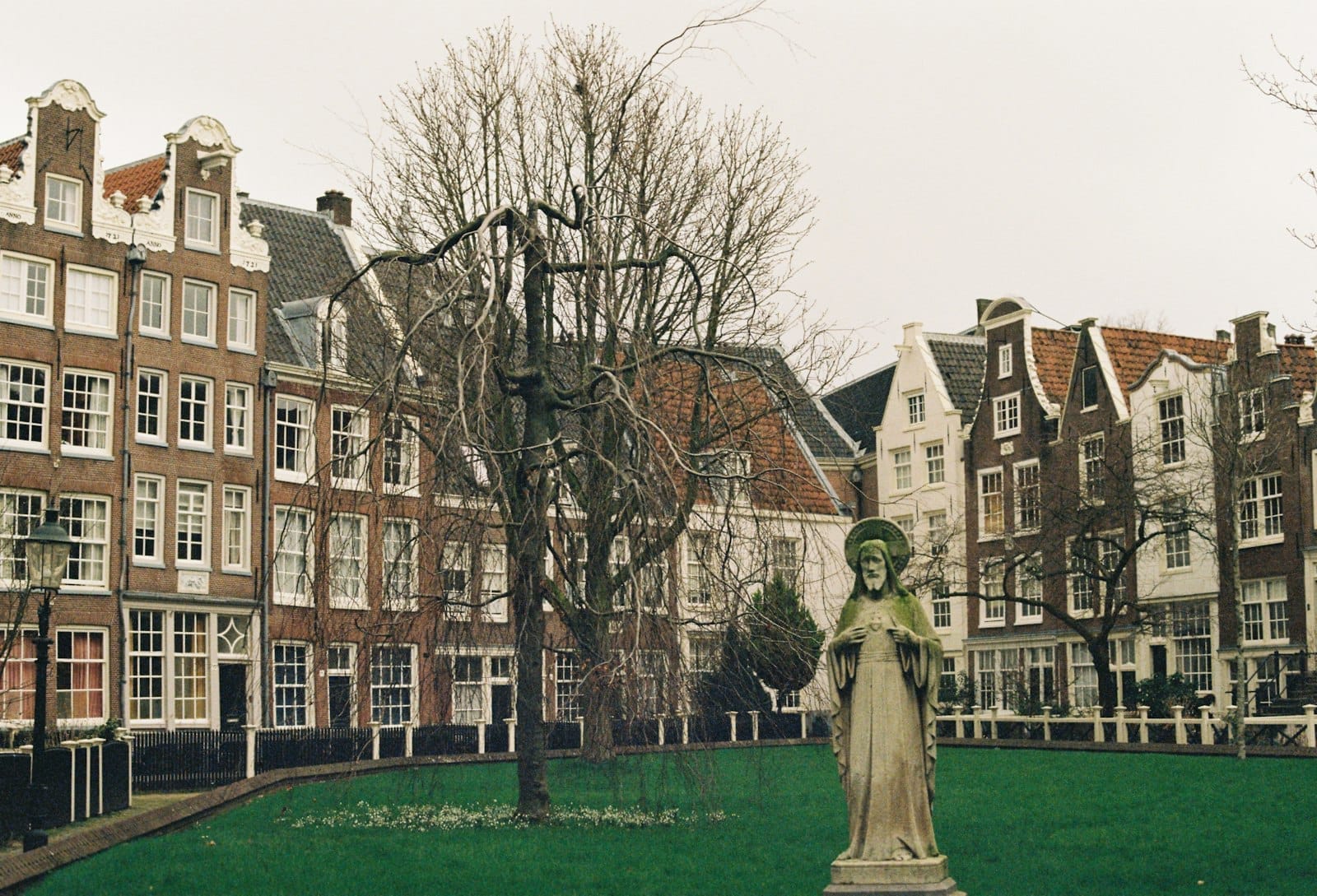
What you find when you step through the gate is a ring of gabled historic houses surrounding a neatly tended garden. Two chapels face each other across the courtyard. The whole complex exists in a kind of deliberate quietness: just steps from the Spui square and the dense retail of Kalverstraat, yet acoustically and atmospherically removed from all of it.
ℹ️ Good to know
The tourist entrance is the gate on Begijnensteeg, not the larger gate on the Spui side, which is for residents only. Look for the Begijnenpoort archway. The courtyard is still a residential address, so silence and restraint are expected once you are inside.
The Courtyard: What You Will Actually See
The garden at the center of the Begijnhof is small, well-maintained, and ringed by a path that takes under five minutes to walk around. The houses lining the courtyard are largely 17th and 18th century in character, though their facades and interiors have been altered many times. One exception stands out: the Houten Huys at Begijnhof 34, one of only two surviving medieval timber-framed houses in Amsterdam, often dated to around 1528. Its dark wooden facade is visually striking against its stone neighbors, and it is the detail most worth looking for.
The two chapels facing each other across the courtyard have a history that reflects Amsterdam's religious past. The Begijnhofkapel, on the west side, is the Roman Catholic chapel that the Beguines used after the Protestant Reformation. Because Catholicism was formally suppressed in the city after 1578, they disguised the chapel's exterior to look like ordinary houses, a configuration still visible today. The English Reformed Church (Engelse Kerk) on the east side is a Gothic structure dating from the mid‑15th century that was given to Amsterdam's English Protestant community in 1607. The Pilgrim Fathers, who briefly lived in Leiden before sailing to America, are connected to this congregation, and small plaques inside the church reference that history.
The Begijnhof sits at the southern edge of the Centrum district, within easy walking distance of the Royal Palace on Dam Square and the shops along Kalverstraat. It fits naturally into any walk through the old city center.
Tickets & tours
Live prices and dates from our booking partner. If you book, we may earn a commission at no extra cost to you.
Famous painters Amsterdam private walking tour
From 222 €Instant confirmationFree cancellationGray Line Canal Cruise with snackbox & Heineken Experience
From 48 €Instant confirmationFree cancellationAmsterdam evening canal cruise
From 18 €Instant confirmationFree cancellationJewish Museum and Portuguese Synagogue entrance ticket
From 20 €Instant confirmationFree cancellation
How the Experience Changes by Time of Day
Arrive at or shortly after 10:00, when the gates open, and the courtyard is at its most peaceful. The light in the morning falls across the garden from the east, catching the brick facades in a warm tone, and the only sounds tend to be birds and the occasional resident. This is the window for photographs without crowds in the frame.
By late morning and through the early afternoon, tour groups begin arriving. Guides gather their groups near the entrance gate, and the courtyard, which is genuinely small, can feel crowded during peak months from April through September. Movement slows to a shuffle near the Houten Huys and at the chapel entrances. If you visit between roughly 11:00 and 15:00 on a summer weekend, manage your expectations: you will still see everything, but the contemplative quality largely disappears.
Late afternoon, from around 16:00 until closing at 18:00, often sees fewer visitors. The light at this hour is lower and more directional, which works well for architectural photography. The garden is often empty enough that you can sit on one of the benches undisturbed. If your schedule allows, this is the most reliably quiet window outside of early morning.
💡 Local tip
Visiting on a weekday morning between late October and early March nearly guarantees a quiet courtyard. Winter light in Amsterdam is low and diffuse, which softens the brick tones of the houses. Bring a layer, because the enclosed courtyard retains damp and chill.
Historical and Cultural Context
The Beguine movement emerged across northwestern Europe during the 12th and 13th centuries, providing a path for women who wanted a religious life outside of formal monastic institutions. They were not nuns, could leave the community to marry, and often supported themselves through textile work, nursing, or teaching. Amsterdam's Begijnhof became one of the longest-surviving examples of this arrangement in the Low Countries.
The 1578 Alteratie, Amsterdam's shift from Catholic to Protestant civic control, transformed the city's religious landscape permanently. The Beguines lost their main church but adapted, converting what appeared to be a row of houses into the hidden Catholic chapel that still functions today. This kind of clandestine religious architecture, called a schuilkerk or hidden church, appears elsewhere in Amsterdam as well.
The most famous hidden church example in the city is Our Lord in the Attic, a fully preserved 17th-century Catholic church concealed within a canal house on the Oudezijds Voorburgwal. Visiting both sites on the same day gives a layered picture of how Amsterdam's Catholic community practiced their faith under legal restriction for more than two centuries.
For visitors coming from a broader interest in Amsterdam's religious heritage, the Portuguese Synagogue and the Jewish Historical Museum are also within the wider city center, offering a different but equally complex picture of minority religious communities in the same city.
Practical Walkthrough
The Begijnhof is open daily from 10:00 to 18:00 for visitors. It is closed on King's Day, 27 April, a date when the surrounding city turns into a street party and the courtyard's residents close the gates for privacy. Admission is free.
To reach it, take tram lines 2, 11, or 12 to the Spui stop. From there, walk south along the Spui square and turn into Begijnensteeg: a narrow alley that runs between the bookshops and the outer wall of the courtyard. The tourist gate is at the end of this alley. Do not attempt to enter through the larger wooden gate on the Spui side, which is a private residential entrance.
If you are walking from the Rijksmuseum or Vondelpark, the walk north through Oud-Zuid and across Leidseplein takes roughly 20–25 minutes on foot. The Begijnhof works well as a mid-route stop on a longer day in the center.
Photographs are allowed in the courtyard, but pointing a camera directly at the private house windows is considered intrusive and is discouraged by the management. Voices carry across the small space, so be aware of volume. The garden path and courtyard are on flat cobblestone, manageable for most mobility needs, though the uneven stone surface may present challenges for wheelchair users.
⚠️ What to skip
People do live in the houses around the courtyard. Peering into windows, touching facades, or sitting on private stoops will get you asked to leave. The tone of the visit is closer to entering a church than a public park.
Is the Begijnhof Worth Your Time?
For most visitors spending two or three days in Amsterdam, yes. The combination of free entry, a genuinely historic interior, and a location that requires almost no detour from the city center makes it an efficient addition to any itinerary. The site takes thirty to sixty minutes at a comfortable pace and rewards people who read the information panels and take time to notice the architectural differences between the buildings.
That said, the Begijnhof can be overhyped as a secret or undiscovered spot. It appears in nearly every major Amsterdam guidebook and sees significant tourist traffic during peak season. The word serene applies accurately in the early morning and late afternoon outside of summer, but not at noon on a Saturday in July. Visitors who arrive expecting an empty courtyard in summer will likely be disappointed.
Travelers looking for genuinely off-the-beaten-path Amsterdam would do better to combine this visit with less-trafficked sites like the Willet-Holthuysen Museum or to explore the quieter streets of the Jordaan neighborhood after leaving the courtyard.
Visitors who are purely interested in retail, nightlife, or outdoor activities will find little here. Children can visit, but the courtyard offers no interactive features or open space to run, so attention spans may be short for younger travelers.
Insider Tips
- The Begijnhofkapel still holds regular Catholic services. If you arrive during a service, the chapel will be closed to tourist visitors. Check the schedule on the chapel’s official website before planning your visit around entering the chapel interior.
- The Houten Huys at number 34 is the single most photographically interesting facade in the courtyard. Position yourself near the garden center for the best angle without crowds in the foreground.
- King's Day on 27 April is the one day the Begijnhof is fully closed. The surrounding streets around Spui and Kalverstraat will be packed with market stalls and street parties, so plan your visit for the 26th or 28th if you are traveling around that date.
- The English Reformed Church occasionally hosts lunchtime concerts and cultural events. These are open to the public and offer a reason to spend more time in the courtyard than a standard walk-through allows.
- The courtyard has benches along the garden path. On a quiet weekday afternoon, sitting for ten minutes is more rewarding than walking the loop twice. The silence itself is the attraction at that point.
Who Is Begijnhof For?
- History and architecture enthusiasts who want context beyond a photograph
- Solo travelers who appreciate quiet, historically layered spaces
- Couples looking for a calm pause between busier sights in the city center
- Travelers with limited mobility who need a low-effort, high-reward stop in the Centrum
- Anyone interested in the religious history of Amsterdam or the Beguine movement across Europe
Nearby Attractions
Other things to see while in De Wallen (Red Light District):
- The Amsterdam Dungeon
The Amsterdam Dungeon puts 500 years of the Netherlands' darkest history on stage inside a historic former church on Rokin. With live actors, special effects, and ride elements, it is one of the few attractions in Amsterdam that genuinely aims to unsettle you. Here is what the experience is actually like, and whether it belongs in your itinerary.
- Amsterdam Museum
Historically housed in the former Burgerweeshuis, a centuries-old civilian orphanage on Kalverstraat, the Amsterdam Museum explores how this canal city grew from a modest fishing settlement into one of Europe's most recognizable capitals. The building itself is as much the exhibit as the collection inside.
- Beurs van Berlage
Completed in 1903 and designed by Hendrik Petrus Berlage, the Beurs van Berlage is a national monument that helped define Dutch modern architecture. Today it operates as a conference and events venue, but the building itself remains one of the most rewarding architectural stops in Amsterdam's historic centre.
- Dam Square
Dam Square sits at the geographic and symbolic center of Amsterdam, tracing its origins to a 13th-century dam across the Amstel river. Free to enter and open around the clock, it anchors the city's oldest neighborhood and gives visitors an immediate sense of Amsterdam's scale, history, and daily rhythm.
Planning a trip? Discover personalized activities with the Nomado app.