Our Lord in the Attic: Amsterdam's Secret Church Above the Canal
Built in secret between 1661 and 1663 when Catholic worship was banned in the Dutch Republic, Our Lord in the Attic Museum preserves a fully intact hidden church inside three adjoining canal houses. It is one of the most intimate and historically charged spaces in all of Amsterdam.
Quick Facts
- Location
- Oudezijds Voorburgwal 38–40, 1012 GD Amsterdam (De Wallen)
- Getting There
- Amsterdam Centraal (4-min walk) or Nieuwmarkt metro (5-min walk)
- Time Needed
- 1 to 1.5 hours
- Cost
- Paid entry; check opsolder.nl for current EUR prices. Around $22 USD as an indicative guide.
- Best for
- History lovers, architecture enthusiasts, religious heritage, quiet contrast to the busy streets outside
- Official website
- opsolder.nl/en/museum-our-lord-in-the-attic
What Makes This Place Unusual
From the outside, Oudezijds Voorburgwal 38–40 looks exactly like every other 17th-century canal house on this stretch of water — narrow gable facade, worn brick, small windows. Nothing signals that climbing through its interior floors leads to a fully functioning church capable of seating a congregation. That contrast, between ordinary exterior and extraordinary interior, is the entire point.
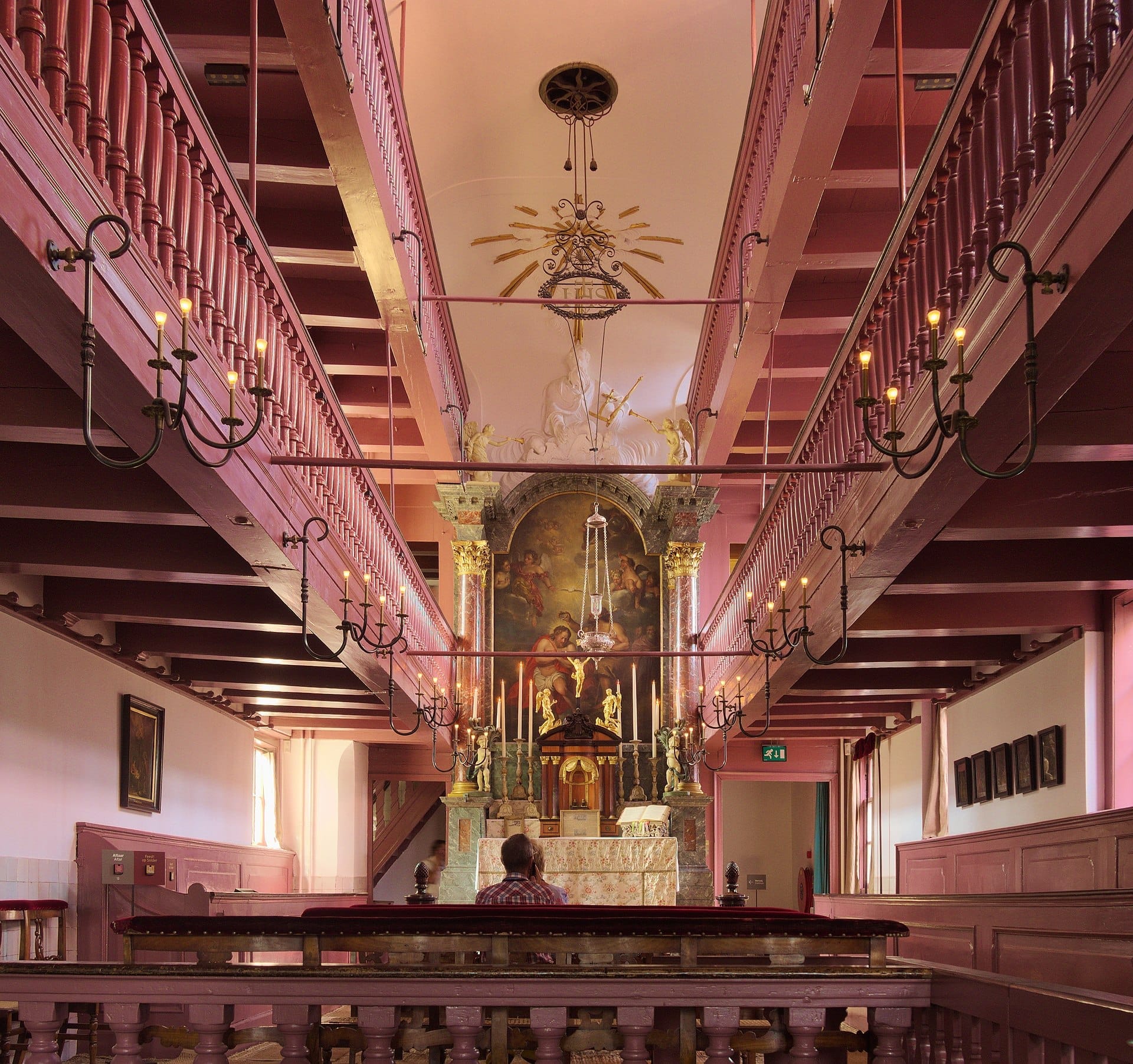
The museum formally known as Museum Ons' Lieve Heer op Solder (Our Lord in the Attic) is one of Amsterdam's genuinely rare things: a historic space that has not been stripped of its original purpose. The rooms you walk through are not recreations. The altar, the organ, the confessionals, and the painted ceiling are all in their original positions, preserved from the 1660s. The building entered museum use in 1888, but before that, it was a working place of worship used by Catholic Amsterdammers for over two centuries.
💡 Local tip
Book tickets in advance on the official website (opsolder.nl). The museum is small and visitor numbers are controlled, so walk-in access can be limited during peak morning hours, particularly in spring and summer.
The History: Worship in a City That Banned It
After the Dutch Revolt and the establishment of the Protestant Dutch Republic in the late 16th century, public Catholic worship was officially prohibited. Catholics could still practice their faith privately, and the city authorities often tolerated hidden churches provided they were discreet and caused no public disturbance. This arrangement produced a series of schuilkerken, or clandestine churches, spread across Amsterdam.
The most intact survivor of these is this one. Catholic merchant Jan Hartman commissioned the construction of the hidden church between 1661 and 1663, incorporating the upper floors of three adjoining houses. It was inaugurated in 1663 and served its congregation continuously through the period when public Catholic worship remained restricted. The sheer scale of what Hartman built — a church with a nave, galleries, an organ loft, and altar — hidden within what appeared to be a domestic terrace, speaks to both the ingenuity of its builders and the determination of Amsterdam's Catholic community.
Understanding this history properly before you visit is worthwhile. The Jewish Historical Museum and the Portuguese Synagogue nearby tell parallel stories of religious communities navigating the same city and the same era under different pressures — visiting them together adds considerably to the picture.
Tickets & tours
Live prices and dates from our booking partner. If you book, we may earn a commission at no extra cost to you.
Walking Through the Building: What You Actually See
Entry is through the ground floor of the canal house, and the visit takes you progressively upward through rooms that functioned as the merchant's domestic quarters. These floors are furnished with period objects — kitchen equipment, painted tiles, wooden furniture — that reconstruct the life of a wealthy 17th-century Amsterdam household. It is a museum within a museum: daily life on the lower floors, spiritual life on the upper ones.
The stairs are steep and narrow, as they are in virtually every Amsterdam canal house of this period. There are multiple flights, and the transition from domestic room to church interior happens gradually, which makes the final reveal more effective. When you step into the attic church itself — a proper three-story nave with a gallery, painted columns, and a working organ installed around 1794 — the sense of disorientation is genuine. The scale of the space does not match the building you thought you were in.
The altar is dedicated to Our Lord in the Attic, and the ceiling painting depicts the Baptism of Christ. Details are worth examining closely: the painted architectural trompe l'oeil on the walls, the quality of the woodwork on the confessionals, the arrangement of the pews. None of it is grandiose by the standards of a cathedral, but everything is carefully made, which is what makes it affecting.
⚠️ What to skip
This museum involves significant stair climbing through narrow, steep staircases typical of 17th-century Dutch canal houses. Lift access is limited and does not reach the historic attic church; most of the visit still involves many narrow staircases typical of 17th-century Dutch canal houses. Visitors with limited mobility, knee problems, or difficulty on steep stairs should consider this carefully before purchasing tickets.
When to Visit and How the Experience Changes
The museum is generally open from 10:00 to 18:00, but hours vary by day (for example, Sunday opening is later) and can change on public holidays, so the museum advises checking the official site before your visit. Mornings from opening until around 11:00 tend to be the quietest period, particularly on weekdays outside of peak summer months. The building's interior is naturally dim — the windows are small, as they needed to be to avoid drawing attention from the street — and the quality of light inside changes meaningfully depending on the weather and time of day.
On overcast winter days, the lower floors can feel genuinely dark, and the candlelit quality of the church upstairs is more pronounced. In summer, when afternoon light pushes through the small upper windows, the church has a warmer, more open feel. Neither condition is better than the other; they suit different moods. What the space never loses is its quietness. Even when the museum has a steady flow of visitors, the building absorbs sound in a way that feels appropriate to what it once was.
The museum sits in De Wallen, Amsterdam's oldest neighborhood, which also contains the Oude Kerk, the city's oldest building, just a few minutes away. The contrast between the two — one a grand public church converted to secular uses, the other a domestic building secretly converted to religious ones — is one of the more thought-provoking juxtapositions you can find in any European city.
Practical Details and Getting There
The museum is at Oudezijds Voorburgwal 38–40, about four minutes on foot from Amsterdam Centraal Station. Walk south along the canal — you will pass through the edge of De Wallen, Amsterdam's red-light district. The juxtaposition of the museum's location within this neighborhood is itself historically accurate: the clandestine church existed here while the same streets served their other purposes. The walk is short and the route is straightforward.
If you are arriving by metro, Nieuwmarkt is approximately five minutes away on foot. Combining this museum with a broader walk through De Wallen makes sense — the neighborhood has considerable architectural and historical depth beyond its most obvious reputation. For a structured overview of Amsterdam's historic sites, the Amsterdam architecture guide provides useful context.
Admission prices should be confirmed on the official website before your visit, as they are updated periodically. The museum accepts both online pre-booking and (subject to availability) walk-in ticket purchases. Guided audio tours are available inside. Photography is generally permitted in most areas of the museum, though this can vary — check current guidance at the entrance.
Who This Museum Is For — and Who Might Want to Skip It
This is not a large or loud attraction. There are no interactive exhibits, no theatrical lighting, and no dramatic set-pieces. What it offers is authenticity: the actual rooms, the actual objects, the actual church, in something close to their original arrangement. Visitors who respond to that — who can stand in a small, dim room and connect it to the people who used it three centuries ago — will find it quietly absorbing.
Visitors primarily interested in art collections will be better served by the Rijksmuseum or the Amsterdam Museum. Families with young children may find the steep stairs difficult and the exhibit content too text-heavy to hold attention. Anyone with significant mobility limitations should not attempt this visit without confirming accessibility options directly with the museum.
For those interested in religious history, Dutch Golden Age social history, or simply experiencing a space where the gap between what a building appears to be and what it actually is could not be wider, this museum delivers something that is genuinely hard to find elsewhere.
Insider Tips
- Take time on the lower domestic floors before ascending. Most visitors rush through the 17th-century kitchen and parlor rooms to get to the church, but the household objects provide important context for understanding how the building functioned as both a home and a place of worship simultaneously.
- The organ in the attic church, installed around 1794, is occasionally played for special events and services. Check the museum's event calendar — hearing the instrument in that space is a completely different experience from a standard visit.
- Arrive as close to opening time as possible if you want the church to yourself. By mid-morning in high season, the upper nave fills quickly and the intimate atmosphere shifts. The first 30 minutes after opening are often the most contemplative.
- The museum sits directly on the Oudezijds Voorburgwal canal. Before entering, walk a few meters south and look back at the facade — it helps you appreciate just how invisible the church would have been to anyone passing on the water.
- The Amsterdam City Card covers entry to this museum. If you are planning multiple museum visits in a day or two, it is worth calculating whether the card saves money overall before paying separately.
Who Is Our Lord in the Attic Museum For?
- History enthusiasts interested in the Dutch Golden Age and religious tolerance
- Architecture visitors who appreciate interiors over grand exteriors
- Solo travelers seeking a quiet, contemplative counterpoint to Amsterdam's louder attractions
- Visitors interested in Catholic heritage or clandestine religious history
- Anyone on a walking tour of De Wallen's historical layer, beyond its modern reputation
Nearby Attractions
Other things to see while in De Wallen (Red Light District):
- The Amsterdam Dungeon
The Amsterdam Dungeon puts 500 years of the Netherlands' darkest history on stage inside a historic former church on Rokin. With live actors, special effects, and ride elements, it is one of the few attractions in Amsterdam that genuinely aims to unsettle you. Here is what the experience is actually like, and whether it belongs in your itinerary.
- Amsterdam Museum
Historically housed in the former Burgerweeshuis, a centuries-old civilian orphanage on Kalverstraat, the Amsterdam Museum explores how this canal city grew from a modest fishing settlement into one of Europe's most recognizable capitals. The building itself is as much the exhibit as the collection inside.
- Begijnhof
Tucked behind an unmarked gate in the heart of Amsterdam, the Begijnhof is a walled courtyard of historic houses, two chapels, and a garden that has existed for more than 600 years. Entry is free, the setting is genuinely quiet, and few places in the city offer this much history in such a compact space.
- Beurs van Berlage
Completed in 1903 and designed by Hendrik Petrus Berlage, the Beurs van Berlage is a national monument that helped define Dutch modern architecture. Today it operates as a conference and events venue, but the building itself remains one of the most rewarding architectural stops in Amsterdam's historic centre.
Planning a trip? Discover personalized activities with the Nomado app.