Dam Square: Amsterdam's Historic Heart
Dam Square sits at the geographic and symbolic center of Amsterdam, tracing its origins to a 13th-century dam across the Amstel river. Free to enter and open around the clock, it anchors the city's oldest neighborhood and gives visitors an immediate sense of Amsterdam's scale, history, and daily rhythm.
Quick Facts
- Location
- Dam, 1012 Amsterdam, Netherlands (De Wallen / City Center)
- Getting There
- Tram stop 'Dam' (lines 4, 9, 16, 24, 25); 5–10 min walk south from Amsterdam Centraal Station via Damrak
- Time Needed
- 30–45 minutes to absorb the square itself; allow extra time if visiting the Royal Palace or Nieuwe Kerk
- Cost
- Free (public square). Separate admission required for Royal Palace Amsterdam and Nieuwe Kerk
- Best for
- First-time visitors, history enthusiasts, architecture lovers, orientation walks
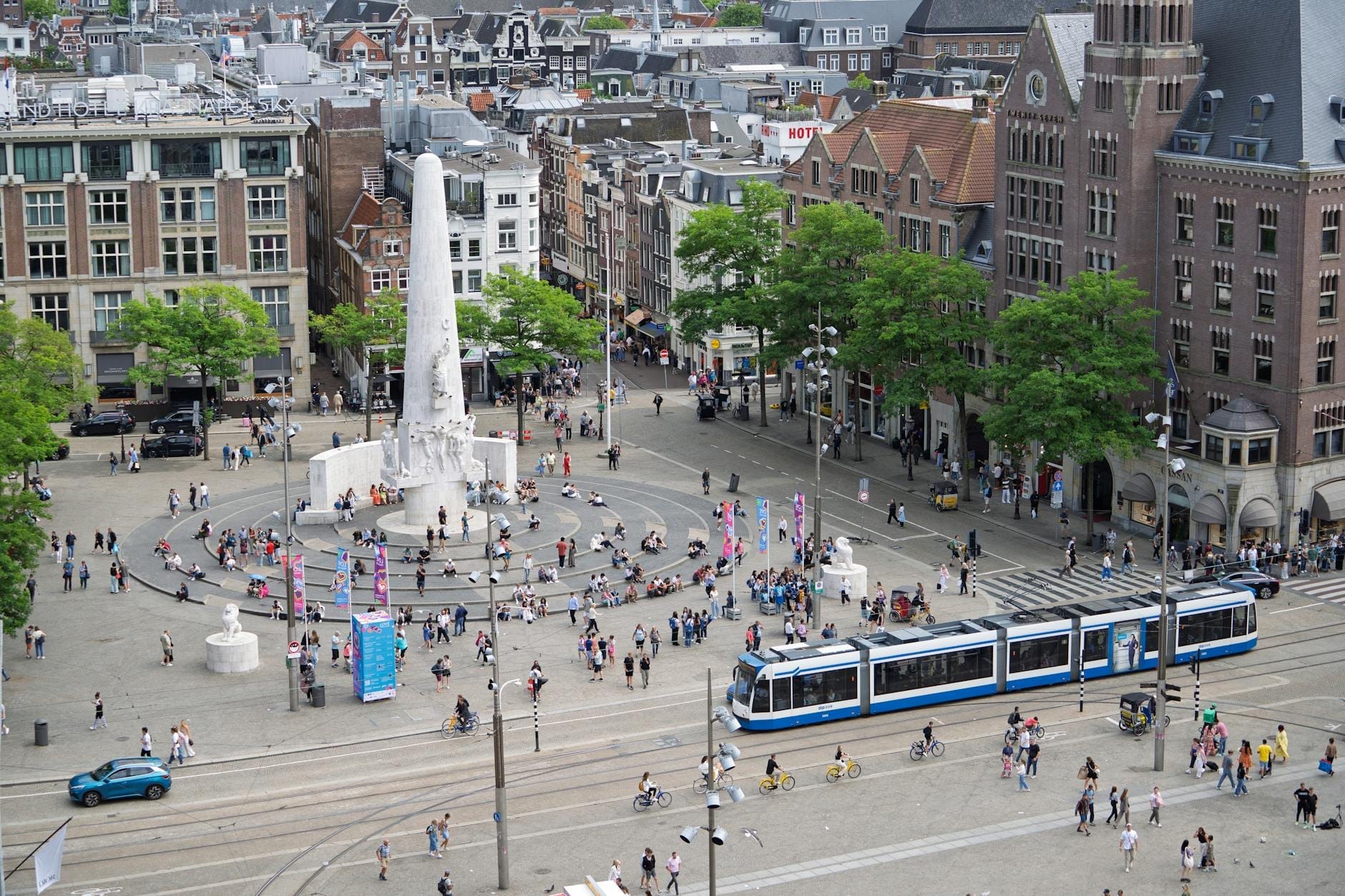
What Dam Square Actually Is
Dam Square is not a manicured park or a museum courtyard. It is a wide, open paved plaza in the middle of Amsterdam's oldest urban core, and it functions exactly as city squares should: as a place where everything converges. Trams cross it, tourists photograph it, locals cut through it, and political demonstrations occasionally fill it. Understanding that dual character, grand historic stage and everyday thoroughfare, is key to getting something genuine out of a visit.
The square takes its name from the original reason Amsterdam exists at all. In the 13th century, settlers built a dam across the Amstel river at this location to control flooding and create usable land. That dam became a crossing point, the crossing point became a market, and the market became a city. Dam Square today sits directly on that founding site, making it a key site in Amsterdam's origins.
ℹ️ Good to know
Dam Square is a public space with no admission fee and no opening hours. It is accessible 24 hours a day, every day of the year. The attractions around its edges, including the Royal Palace Amsterdam and the Nieuwe Kerk, have separate tickets and hours that should be checked before visiting.
The Architecture Around You
Standing at the center of the square, you face a concentrated display of the city's different eras. On the western edge sits the Royal Palace Amsterdam (Koninklijk Paleis), a 17th-century building that began life as Amsterdam's city hall and was converted to a royal palace under Louis Napoleon in 1808. Its classical facade, built from Bentheim sandstone, is imposing in a restrained Dutch way: no excessive ornament, but enormous in scale and solid in confidence.
Directly adjacent to the Royal Palace stands the Nieuwe Kerk (New Church), which is, despite its name, a Gothic church begun in the late 14th century. It no longer holds regular services but functions as an exhibition and ceremonial space. Dutch monarchs are inaugurated here rather than crowned, a distinction that matters in the Netherlands. Both buildings are worth examining from the outside even if you do not pay to go in.
Flanking the square's other edges are department stores, a branch of Madame Tussauds, and several tourist-facing retail blocks. They are not architecturally significant, but they frame the space and give you a sense of how commercial pressure and heritage coexist in the De Wallen neighborhood. The contrast between the 17th-century palace and the modern retail units around it is one of the more honest things about Dam Square: it does not pretend to be a preserved historic tableau.
At the center of the square stands the National Monument, a 22-meter white stone obelisk unveiled in 1956. It commemorates Dutch civilians and soldiers who died during the Second World War. The monument is flanked by two stone lions and backed by a curved wall with urns containing earth from each of the Dutch provinces, as well as from the former Dutch East Indies. It is understated and worth a closer look, particularly for anyone visiting Amsterdam's other sites of wartime memory.
The National Monument makes more sense in context if you have already visited the Anne Frank House or the Dutch Resistance Museum. Without that context, it reads as a civic obelisk; with it, the square feels like a much weightier place.
Tickets & tours
Live prices and dates from our booking partner. If you book, we may earn a commission at no extra cost to you.
Gray Line Canal Cruise with snackbox & Heineken Experience
From 48 €Instant confirmationFree cancellationAmsterdam evening canal cruise
From 18 €Instant confirmationFree cancellationRipley's Believe It or Not! Amsterdam ticket and one-hour canal cruise
From 35 €Instant confirmationFree cancellationAmsterdam City Canal Cruise and Moco Museum Entrance Ticket
From 38 €Instant confirmationFree cancellation
How the Square Changes Through the Day
Early morning, between roughly 7:00 and 9:00, Dam Square is genuinely calm. The trams run, a few commuters cross, and the light catches the palace facade in a way that photographs cleanly. This is the window when you can stand at the National Monument without navigating around tour groups, and when the scale of the square is easiest to appreciate. The pigeons are more numerous than the tourists at this hour.
By mid-morning the square begins to fill steadily, and by early afternoon it reaches its most crowded state. Groups form around the National Monument, street performers set up along the edges, and the tram stops become briefly chaotic when multiple lines arrive simultaneously. The noise level rises considerably: tour guide commentary, traffic, and the mechanical sounds of the city all layering together. For anyone sensitive to crowds, this is the period to avoid.
Late afternoon brings a slight thinning of the tourist crowd as day visitors return toward their hotels or board tour buses, while younger travelers and locals fill the square's periphery. By evening, Dam Square shifts again: the palace is lit, the monument takes on a different gravity in the quieter air, and the surrounding streets begin to animate. It is a different experience from the midday version and, for many people, a better one.
💡 Local tip
If you are visiting in spring or summer, arrive before 9:00 for photographs without crowds. The low morning light hits the Royal Palace facade at an angle that midday sun flattens completely.
Getting There and Getting Oriented
Dam Square sits approximately 750 meters south of Amsterdam Centraal Station. The most direct walking route follows Damrak, the broad street that connects the station to the square in roughly 5 to 10 minutes depending on foot traffic. Damrak is commercial and fairly hectic, but it gives a first impression of central Amsterdam's density and scale.
Multiple tram lines stop at the square directly, including lines 4, 9, 16, 24, and 25. For visitors arriving from Schiphol Airport, the train to Amsterdam Centraal followed by the short walk or tram ride to Dam Square is the standard and most efficient route.
The square works well as an orientation point for a first day in the city. From here you can walk west into the Canal Ring toward the Anne Frank House and the Jordaan neighborhood, or east toward Nieuwmarkt and the older streets of De Wallen. The walking tours of Amsterdam that depart from Centraal Station almost always pass through Dam Square within the first ten minutes.
The square is a flat, open paved surface with no steps or barriers. Trams stop directly adjacent, and the approach from Damrak is level throughout. Visitors with mobility considerations should note that the square's cobblestone sections, particularly near the monument, can be uneven underfoot.
What to Actually Do Here
The square itself takes 20 to 30 minutes to walk through properly. Start at the National Monument and read the inscriptions. Walk the perimeter of the Royal Palace and note the tympanum sculptures over the entrance. Step inside the Nieuwe Kerk if there is a current exhibition that interests you; the building's Gothic interior is worth seeing regardless of the show.
Dam Square is also a practical reference point for the two major attractions that sit a short walk away. The Royal Palace Amsterdam allows visitors inside to see the grand ceremonial rooms and is ticketed separately. If you are planning a day of cultural sightseeing, booking the palace entry in advance avoids queuing on the square, which can be significant in peak season.
For visitors interested in the city's street-level energy rather than indoor attractions, the square makes a natural starting point for exploring on foot or by bicycle. The cycling routes in Amsterdam that begin near Centraal Station pass through Dam Square and branch outward into the canal streets, which give a more textured picture of the city than the square itself provides.
⚠️ What to skip
Be aware of pickpockets on and around Dam Square, particularly in peak tourist hours. The combination of crowds, distraction from monuments and street performers, and proximity to major transit routes makes it a known area for opportunistic theft. Keep bags closed and in front of your body.
Honest Assessment: Is It Worth the Time?
Dam Square is not Amsterdam's most photogenic spot. The canal streets, the Jordaan, and the museum quarter all offer more striking visuals. What the square offers is context: a physical understanding of where the city came from and how it has layered centuries of use onto a single site. For a first visit to Amsterdam, that context is useful.
Visitors expecting a European piazza in the Italian mold, with cafe terraces and atmospheric quiet, will be disappointed. The square is large, open, and traffic-affected. It can feel impersonal at busy times. But it is the center of Amsterdam in a way that goes beyond geography, and passing through it properly, rather than simply using it as a landmark to navigate by, adds something to a visit.
Travelers who want a deeper understanding of Amsterdam's wartime history should note that Dam Square connects naturally to several nearby sites. The Portuguese Synagogue and the Jewish Historical Museum are within reasonable walking distance, and together they form a route through the city's most significant memorial spaces.
If you are putting together an itinerary, the Amsterdam 2-day itinerary places Dam Square on day one as a starting anchor, which reflects how most visitors naturally use it: as a beginning, not a destination in itself.
Insider Tips
- The Royal Palace Amsterdam is frequently overlooked by visitors who assume it is not accessible. It is open to the public most days and the interior, particularly the grand Citizens' Hall with its inlaid marble floor showing Amsterdam at the center of the world, justifies the admission price. Check the official Royal Palace website for current hours before visiting, as it closes for state functions.
- If you want a photograph of the National Monument without crowds in the frame, aim for weekday mornings before 8:30. Weekend mornings remain busy even in off-peak months due to overnight visitors.
- The Nieuwe Kerk's exhibition program changes throughout the year and sometimes features internationally significant shows that are worth the ticket even if you have no particular interest in the church building itself. Check their program before dismissing it as a tourist attraction.
- Damrak, the street connecting the square to Centraal Station, is lined with exchange offices offering poor rates. If you need euros in cash, use an ATM elsewhere. The exchange offices on Damrak are aimed at unprepared tourists.
- Dam Square occasionally hosts national commemorations, particularly on May 4th (Dodenherdenking, the national Remembrance of the Dead) when a major ceremony takes place at the National Monument. If your visit overlaps with this date, the square will be cordoned off in the evening and access restricted. It is, however, one of the most moving public events in the Dutch calendar.
Who Is Dam Square For?
- First-time visitors to Amsterdam who want to understand the city's geographic and historical center
- History and architecture enthusiasts interested in Dutch Golden Age civic buildings and postwar memorials
- Travelers using the square as a practical starting point for walking or cycling tours of the canal district
- Anyone visiting the Royal Palace Amsterdam or Nieuwe Kerk, which flank the square directly
- Photography of Dutch urban architecture, particularly in low morning light
Nearby Attractions
Other things to see while in De Wallen (Red Light District):
- The Amsterdam Dungeon
The Amsterdam Dungeon puts 500 years of the Netherlands' darkest history on stage inside a historic former church on Rokin. With live actors, special effects, and ride elements, it is one of the few attractions in Amsterdam that genuinely aims to unsettle you. Here is what the experience is actually like, and whether it belongs in your itinerary.
- Amsterdam Museum
Historically housed in the former Burgerweeshuis, a centuries-old civilian orphanage on Kalverstraat, the Amsterdam Museum explores how this canal city grew from a modest fishing settlement into one of Europe's most recognizable capitals. The building itself is as much the exhibit as the collection inside.
- Begijnhof
Tucked behind an unmarked gate in the heart of Amsterdam, the Begijnhof is a walled courtyard of historic houses, two chapels, and a garden that has existed for more than 600 years. Entry is free, the setting is genuinely quiet, and few places in the city offer this much history in such a compact space.
- Beurs van Berlage
Completed in 1903 and designed by Hendrik Petrus Berlage, the Beurs van Berlage is a national monument that helped define Dutch modern architecture. Today it operates as a conference and events venue, but the building itself remains one of the most rewarding architectural stops in Amsterdam's historic centre.
Planning a trip? Discover personalized activities with the Nomado app.