Anne Frank House: What to Know Before You Visit the Secret Annex
The Anne Frank House on Prinsengracht 263 preserves the hidden rooms where Anne Frank and seven others lived in concealment from 1942 to 1944. One of the most significant memorial sites in Europe, it requires advance planning but rewards visitors with an experience that stays with them long after they leave Amsterdam.
Quick Facts
- Location
- Westermarkt 20, Prinsengracht 263–267, Canal Ring, Amsterdam
- Getting There
- Tram 13 or 17 to Westermarkt; approx. 20-min walk from Amsterdam Centraal
- Time Needed
- 1.5 to 2.5 hours
- Cost
- Online tickets required; €1.00 with Museumkaart or ICOM card (booking fee only); standard adult price — check annefrank.org for current rates
- Best for
- History visitors, WWII memorial travel, older teenagers and adults
- Official website
- www.annefrank.org/en
What the Anne Frank House Actually Is
The Anne Frank House is not a traditional museum in any comfortable sense. It is a preserved building on the Prinsengracht canal where, from July 1942 to August 1944, eight Jewish people lived in complete concealment behind a movable bookcase, hiding from Nazi occupation forces. Among them was Anne Frank, whose diary, kept during those 25 months, became one of the most widely read books in the world after the war.
The official Dutch name is Anne Frank Huis. The entrance is not on the canal-facing side of the building but at Westermarkt 20, slightly set back from Prinsengracht. The complex incorporates the original warehouse and annex building, plus an adjoining modern wing that provides exhibition space, context, and the entry sequence.
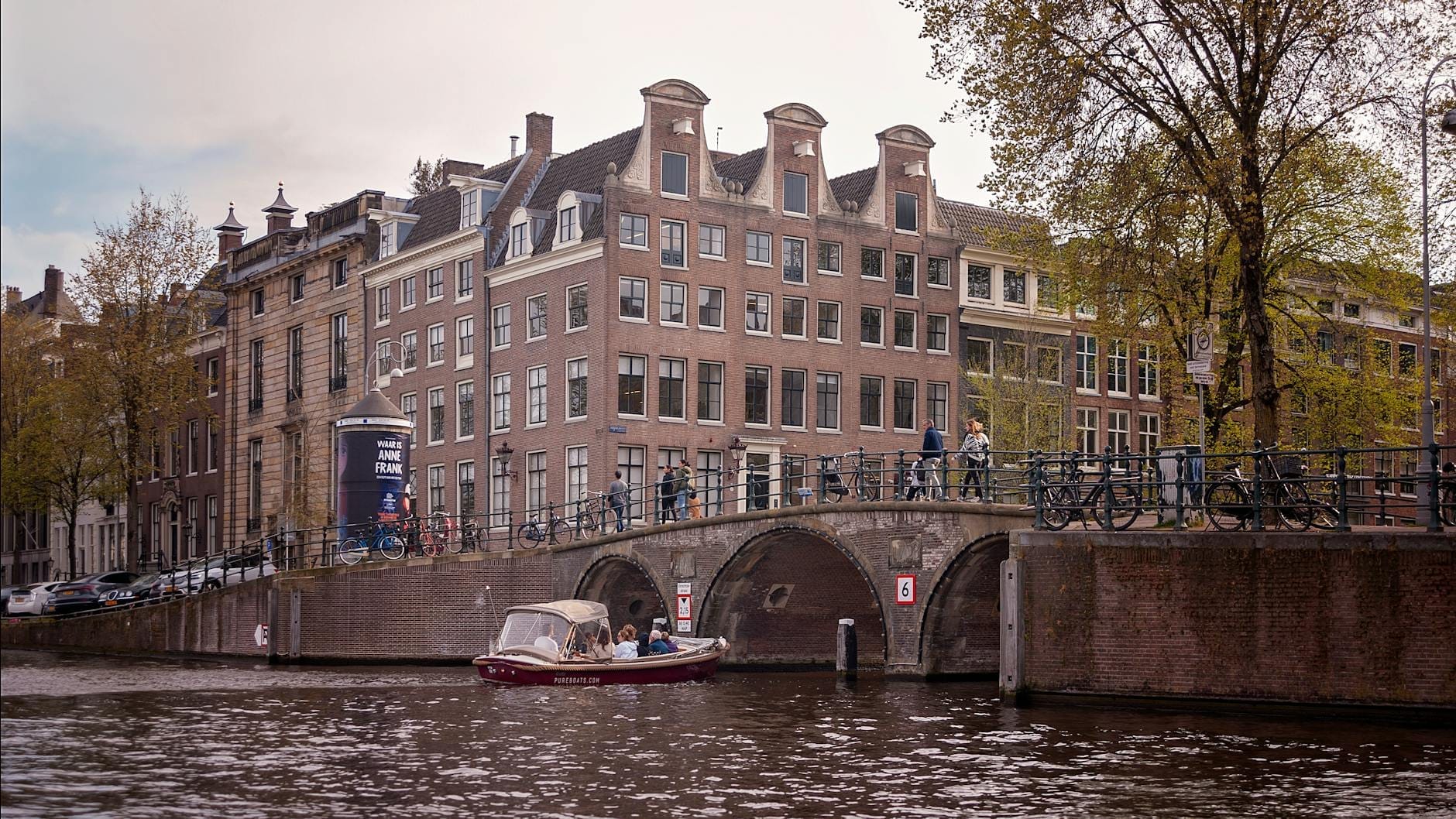
The museum sits in the heart of the Canal Ring, a few minutes' walk from the Westerkerk and the Jordaan neighborhood. The area around the entrance is a narrow pavement beside one of Amsterdam's most-used walking and cycling routes, so arrival feels different from most memorial sites: no grand forecourt, no ceremonial approach, just a city street and a queue.
⚠️ What to skip
Tickets are NOT sold at the door. You must book online at annefrank.org for a specific date and time slot. Tickets sell out weeks in advance, especially in summer. Do not arrive hoping to buy on the day.
The Experience: Moving Through the Building
The visit follows a linear, one-way route through the building. You begin in the ground-floor warehouse space, which has been kept largely bare. Interpretive panels here set the historical context: the rise of the Nazi regime, the German occupation of the Netherlands from 1940, and the progressive restrictions placed on Jewish people in Amsterdam. This section moves at whatever pace you set.
The pivotal moment in the route is the bookcase. The movable bookcase that concealed the entrance to the Achterhuis, the Secret Annex, is in place. You pass through it and climb the steep, narrow staircase behind it. This is the same passage that Otto Frank, Anne, and the others used daily for over two years. The stairs are genuinely steep, at the Dutch residential standard of the era, and low ceilings throughout the annex require taller visitors to duck in places.
The rooms of the Secret Annex are preserved unfurnished, as they were found after the war, following the decision of Otto Frank, Anne's father and the sole survivor among the eight. The walls still carry traces of what the occupants left: pencil marks recording Anne and her sister Margot's heights, magazine pictures Anne had pasted to the wall, a map on which Otto Frank tracked Allied advances. These details carry more weight than any exhibit label could.
Original pages from Anne's diary are displayed in a dedicated case. The handwriting is small, precise, and real. Visitors who have read the diary beforehand often pause here longer than anywhere else.
Tickets & tours
Live prices and dates from our booking partner. If you book, we may earn a commission at no extra cost to you.
Self-guided discovery walk in Amsterdam's Jordaan neighborhood
From 30 €Instant confirmationFree cancellation90-minutes Amsterdam tour with a local
From 73 €Instant confirmationFree cancellationAnne Frank self-guided tour with AI audio and video experience
From 15 €Instant confirmationPrivate World War II tour in Amsterdam
From 60 €Instant confirmationFree cancellation
Crowds, Timing, and the Right Time Slot to Book
The Anne Frank House is one of the most-visited sites in the Netherlands, and the timed-entry system manages flow inside the building, but it does not eliminate the sense of company. Slots in the middle of the day, roughly 10:00 to 16:00, tend to be the most congested. If availability permits, booking an early morning slot (around 9:00) or an evening slot (the museum is currently open daily until 22:00) produces a noticeably quieter experience inside the annex rooms.
Evening visits have a particular quality. The canal outside darkens, foot traffic on the pavement thins, and the building feels more enclosed. Some visitors find this atmosphere fitting; others prefer natural daylight. Both are valid choices, but the evening option is genuinely worth considering if daytime slots are sold out or if you want fewer people in the same space.
💡 Local tip
Book as early as possible, ideally as soon as your travel dates are confirmed. For summer visits (June to August), slots often sell out four to six weeks ahead. Check the official site at annefrank.org/en/museum/tickets/ — no third-party booking is needed or recommended.
Getting There and Practical Logistics
From Amsterdam Centraal, trams 13 and 17 stop at Westermarkt, placing you a two-minute walk from the entrance. The walk from Centraal along the canal takes roughly 20 minutes and passes through the Jordaan, which is a pleasant route if you have time. Cycling is feasible, but bike parking near the museum entrance is limited and the area is heavily trafficked by pedestrians, other cyclists, and tour groups.
If you are combining this visit with other sites in the area, the Westerkerk is immediately adjacent, and the Jordaan neighborhood begins just across the canal, with plenty of cafes and smaller galleries to decompress in after the visit.
On accessibility: the building's historic structure means there are steep staircases and uneven surfaces throughout the original annex portion of the route. An alternative accessible route exists through the modern wing portion, but the steep stairs to and within the Secret Annex itself cannot be bypassed. Check directly with the museum before booking if mobility is a concern, as the experience in the annex rooms is the core of the visit.
Ticket Prices and Entry Requirements
All admission is via timed-entry tickets booked online through the official Anne Frank House website. Tickets are non-transferable and valid only for the specified date and time slot. There is no walk-up ticket sales at the door.
Museumkaart holders and ICOM Card holders pay €1.00, which represents the booking fee component. The European Youth Card (EYC) has a reduced rate; check the official ticket page for the current price. The I amsterdam City Card and standard student cards do not receive a discount here, which surprises some visitors expecting otherwise. For standard adult pricing, check the official ticket page directly, as rates are subject to change.
Note that the Amsterdam City Card, covered in detail in our Amsterdam City Card guide, does not cover entry to the Anne Frank House. Budget accordingly if this site is a priority.
ℹ️ Good to know
Holiday hours differ from regular opening times. Specific exceptions include: 1 Jan (12:00–22:00), 27 Apr (9:00–17:00), 4 May (9:00–17:00), 25 Dec (9:00–17:00), and 31 Dec (9:00–17:00). Some future dates may have modified or closed schedules. Always verify current hours at annefrank.org before your visit.
Historical and Cultural Weight
Anne Frank and her family went into hiding on 6 July 1942, four weeks after Margot Frank received a call-up notice to a Nazi labor camp. They were joined by four others: Hermann and Auguste van Pels with their son Peter, and Fritz Pfeffer. For 25 months, they depended entirely on a small group of helpers, including Miep Gies and Johannes Kleiman, who brought food, news, and supplies at significant personal risk.
On 4 August 1944, the Achterhuis was raided by the Security Police following an anonymous tip that has never been definitively traced. All eight occupants were arrested and deported. Anne and Margot Frank died in Bergen-Belsen in late February or early March 1945, weeks before the camp's liberation. Otto Frank was the only one of the eight to survive the war.
The diary Anne kept during the hiding period was recovered by Miep Gies after the raid and returned to Otto Frank after the war. It was first published in Dutch in 1947. The Anne Frank House opened as a museum in 1960. For deeper context on Amsterdam's wartime history, the nearby Dutch Resistance Museum and the National Holocaust Museum provide essential additional perspectives.
Who This Suits and Who Might Find It Difficult
This is not a site for every traveler, and that is worth saying honestly. The Anne Frank House is deeply affecting, sometimes distressing, and the physical conditions inside the annex, with its cramped rooms, low ceilings, and steep stairs, are not metaphorical. Young children, particularly those under ten, often find the emotional register difficult to process, and parents should consider whether the content and format match their children's readiness.
Visitors who have read the diary beforehand consistently report a richer experience. Even a partial read provides context that the museum's exhibits build on rather than replace. Audioguides are available and help fill gaps for first-time visitors unfamiliar with the history.
Photography inside the museum is not permitted. This is enforced and, once inside, almost universally respected. The absence of phones and cameras in the annex rooms creates a quality of attention that is unusual and, for most visitors, welcome.
Insider Tips
- Book a slot at 9:00 or after 19:00. The mid-morning and afternoon slots are the most crowded, and the timed-entry system controls numbers but not the cumulative sense of being in a small space with many other people. Evening light through the annex windows is also quite different from daylight.
- Read at least part of the diary before you go. The museum assumes some familiarity with Anne's voice and the sequence of events. Visitors who arrive cold sometimes feel the exhibits are fragmentary. Visitors who know the diary feel every detail of the preserved rooms.
- The Museumkaart brings the entry cost down to €1 (the booking fee), making it the most cost-effective way in if you plan to visit multiple Amsterdam museums. The card covers many major institutions, though not all. Check our guide to know whether it makes financial sense for your trip.
- Allow time after your visit before rushing to the next attraction. The experience is heavy, and the canal-side route along the Prinsengracht or a quiet corner in the Jordaan gives useful decompression space. Many visitors underestimate how long the emotional processing takes.
- If your target date is sold out, check back regularly in the days before your visit. Cancellations do occur and slots reappear. The official site is the only place to check; third-party resellers are not legitimate sources for tickets to this museum.
Who Is Anne Frank House For?
- Travelers with a specific interest in WWII history and the Holocaust
- Readers of Anne Frank's diary visiting for firsthand context
- Adults and older teenagers prepared for emotionally demanding content
- Visitors combining the site with the Dutch Resistance Museum or National Holocaust Museum for a fuller historical picture
- Anyone spending serious time in Amsterdam who wants to understand a defining layer of the city's 20th-century history
Nearby Attractions
Other things to see while in Canal Ring (Grachtengordel):
- Bloemenmarkt (Floating Flower Market)
The Bloemenmarkt sits on a row of fixed barges along the Singel canal, operating since 1862 as the world's only floating flower market. Free to enter and open daily, it sells tulip bulbs, cut flowers, and souvenirs in the heart of Amsterdam's Canal Ring. Here is what you will actually find there.
- Amsterdam Canal Cruises
A canal cruise is one of the most efficient ways to understand Amsterdam's layout and its 17th-century heritage. This guide covers the main operators, departure points, what you'll actually see, and how to pick the right cruise for your trip.
- FOAM Photography Museum
Housed in a 17th-century canal house on Keizersgracht, FOAM Photography Museum (Fotografiemuseum Amsterdam) has been one of Europe's leading photography institutions since it opened in December 2001. Four floors of rotating exhibitions cover documentary work, fine art photography, fashion, and emerging talent, making it a serious cultural stop that rewards repeat visits.
- Houseboat Museum
The Houseboat Museum, or Woonbootmuseum, lets you step aboard the Hendrika Maria, a 23-metre cargo vessel moored on Prinsengracht that has been a houseboat since the 1960s. It is one of the few places in Amsterdam where you can genuinely understand how roughly 2,500 people call the city's canals home. Small, focused, and refreshingly honest about what it is, this is a niche museum that delivers exactly what it promises.
Planning a trip? Discover personalized activities with the Nomado app.