Amsterdam Canal Cruises: What to Expect Before You Board
A canal cruise is one of the most efficient ways to understand Amsterdam's layout and its 17th-century heritage. This guide covers the main operators, departure points, what you'll actually see, and how to pick the right cruise for your trip.
Quick Facts
- Location
- Canal Ring (Grachtengordel), Amsterdam
- Getting There
- Amsterdam Centraal (all trams/metro); Leidseplein (trams 1, 2, 7, 19)
- Time Needed
- 60–100 minutes for a standard cruise
- Cost
- Varies by operator and date; book online for current pricing
- Best for
- First-time visitors, couples, architecture lovers, families
- Official website
- www.lovers.nl
Why See Amsterdam from the Water
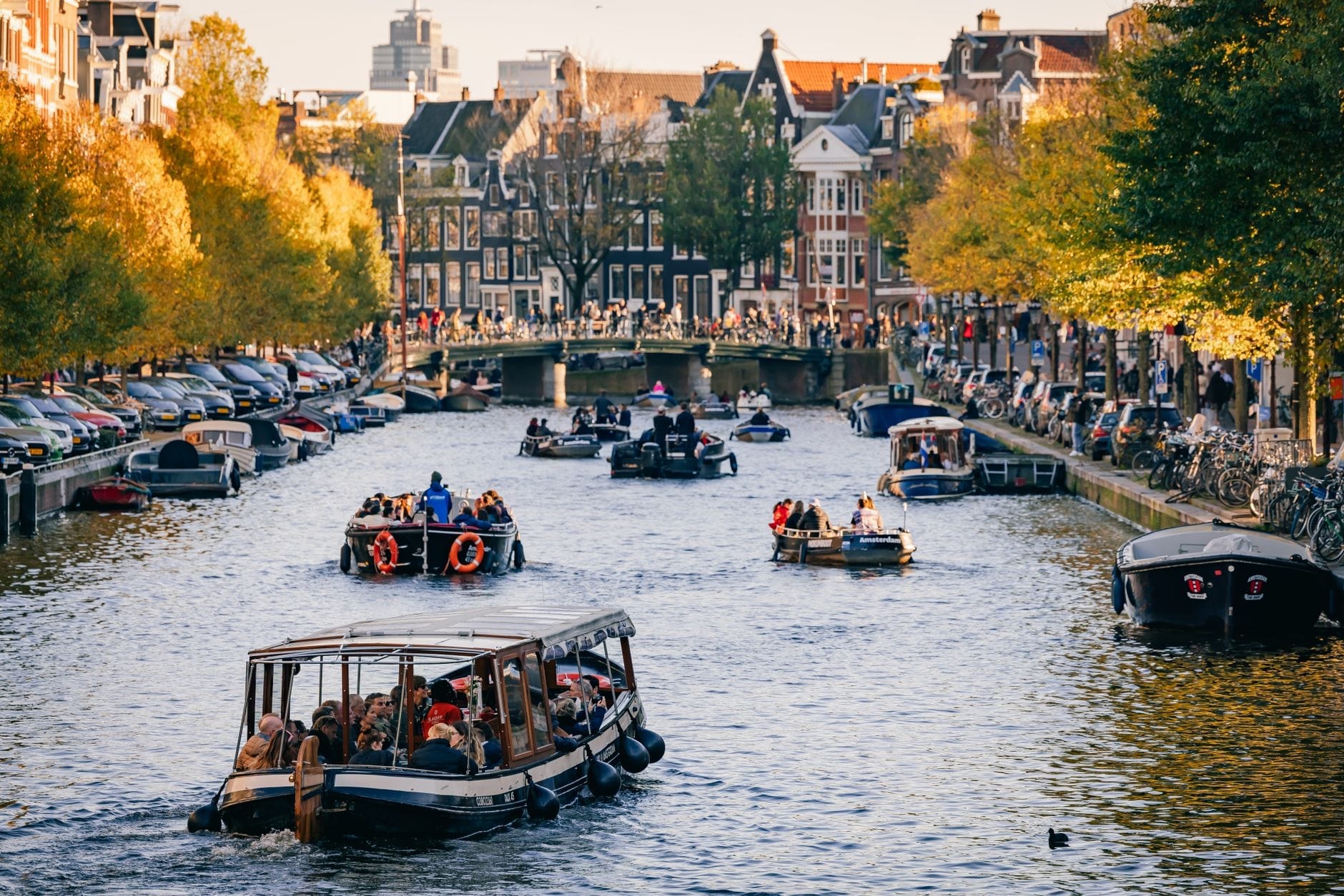
Amsterdam's canal network was largely engineered in the 17th century during the Dutch Golden Age, a period when the city became one of the wealthiest trading ports in the world. The result is a concentric arc of waterways, the Herengracht, Keizersgracht, and Prinsengracht, lined with narrow-fronted merchant houses that lean at odd angles because their foundations have shifted over centuries in the soft peat below. Walking the canal streets gives you one angle. Sitting low on the water gives you another.
From a canal boat, the facades of those 17th-century houses read differently. You see the ornate gable tops that each merchant family chose to distinguish their property, the crane beams that still project from upper floors, and the way Amsterdam's over 1,700 bridges create compressed frames around every stretch of water. The city has over 100 km of canals, and the Canal Ring (Grachtengordel) is a UNESCO World Heritage Site, designated in 2010 as part of the Amsterdam canal district for its outstanding example of planned urban expansion.
💡 Local tip
Booking your cruise online in advance usually secures a better price than buying at the pier, and it means you can choose your preferred departure time without queueing at a busy dock.
The Main Operators and Departure Points
Several operators run regular canal cruises, and the experience varies more than most visitors expect. LOVERS Canal Cruises and Stromma are among the largest, operating glass-topped boats that depart from multiple central locations. Key departure points include Damrak Pier 5 (a short walk from Amsterdam Centraal), Amsterdam Centraal Station itself, Leidseplein, and the Rijksmuseum. This spread of starting points is genuinely useful: if you are already at Museumplein after a morning in the Rijksmuseum, there is no need to backtrack north to Centraal.
Stromma's 100 Highlights Cruise is one of the most commonly booked routes, covering the main canals with an audio guide in multiple languages. Departure frequency is roughly every 30 minutes during peak hours, though the booking calendar on their site shows real-time availability. Smaller operators also run open-boat tours and private charters, which suit visitors who want a quieter or more flexible experience.
If you are comparing options, the Amsterdam canal cruise guide breaks down the main route types, including hop-on hop-off passes and evening dinner cruises, which operate to a different schedule than daytime sightseeing boats.
Tickets & tours
Live prices and dates from our booking partner. If you book, we may earn a commission at no extra cost to you.
Gray Line Canal Cruise with snackbox & Heineken Experience
From 48 €Instant confirmationFree cancellationAmsterdam evening canal cruise
From 18 €Instant confirmationFree cancellationRipley's Believe It or Not! Amsterdam ticket and one-hour canal cruise
From 35 €Instant confirmationFree cancellationAmsterdam City Canal Cruise and Moco Museum Entrance Ticket
From 38 €Instant confirmationFree cancellation
What You Actually See: A Route Breakdown
Most standard cruises cover three to four of the major canals, passing through sections of the Jordaan, the historic Centrum, and sometimes out toward the IJ waterfront. Within the first few minutes of departure from Damrak, you enter narrower waterways where the boat slows noticeably. The engine noise drops, and you begin to hear the city differently: cyclists on bridges overhead, water lapping at worn stone steps, and the occasional burst of music from a houseboat. The smell of the water is mineral and faintly mossy, especially in summer.
Key landmarks you pass on most central routes include the Westerkerk tower, the Anne Frank House facade (visible from the Prinsengracht), the Magere Brug (the famous skinny drawbridge over the Amstel), and clusters of houseboats moored along the quieter stretches of the Brouwersgracht and Reguliersgracht. The Reguliersgracht is particularly noted for its multi-bridge panorama, a classic photographic angle that you can only properly frame from the water.
Amsterdam has over 2,500 houseboats, and seeing them at water level reveals details that are easy to miss on foot. For context on the broader canal network before or after your cruise, the Amsterdam canals guide covers the history of each major waterway in more depth.
How Time of Day Changes the Experience
Morning cruises, particularly before 10:00, offer calmer water and softer light. Fewer boats are competing for space on the canals, so the ride is noticeably smoother and the reflections on the water are sharper. The city is waking up: you will see residents cycling to work on the bridges above, delivery bikes stacked with crates, and the occasional canal boat being loaded with supplies for a houseboat kitchen.
Midday and early afternoon are the busiest periods, especially in summer. The glass-topped boats fill quickly, and the canals can feel congested with competing vessels. If you are visiting between June and August and cannot book a morning slot, an early evening departure is worth considering. From roughly 17:00 onward, the light turns golden and horizontal, which is dramatic against the brick facades. The crowds thin slightly, and the city's post-work rhythm gives the waterways a less transactional atmosphere.
Night cruises are a separate category. Several operators run evening routes where the canal houses are lit and bridges carry strings of light. The effect is atmospheric rather than educational, and the audio guides become less relevant when you cannot see the architectural details clearly. Night cruises work well as an experience in themselves, but they are not a substitute for a daytime route if you actually want to understand what you are looking at.
ℹ️ Good to know
Amsterdam's famous Keukenhof tulip fields are not visible from the canal network, but in spring the city's canal-side gardens and window boxes are at their best. April and May are among the most photogenic months for a daytime cruise.
Practical Information for Getting It Right
Dress in layers regardless of season. Canal boats sit lower than the street, which means you lose the wind protection of buildings, and even a mild day can feel noticeably cool once you are moving on the water. In autumn and winter, bring a proper jacket. Rain is possible at any time of year in Amsterdam; the glass roof on standard sightseeing boats provides full shelter from rain, but open-deck boats do not. Check the format before booking if this matters to you.
Photography from a moving canal boat requires some adjustment. Shooting through glass produces glare and reflection, especially when the sun is high and directly overhead. Some boats have opening sections or outdoor rear decks where you can shoot without glass between you and the subject. Ask at the pier whether this is available on the specific vessel departing at your time. A polarizing filter helps with water reflections if you are using a camera rather than a phone.
Accessibility details are not consistently published by all operators; if you have specific mobility requirements, contact the operator directly before booking. For general guidance on getting around Amsterdam with reduced mobility or with young children, the getting around Amsterdam guide covers transport options across the city.
⚠️ What to skip
Canal water is not clean. Do not let children trail hands over the boat edge, and do not lean equipment over the side. Boats are stable in normal conditions, but standing in the centre of the vessel rather than on the edges is the standard expectation on most operators.
Who Should Skip a Canal Cruise
Canal cruises are not for everyone. If you have already spent several days in Amsterdam and have covered the main canals on foot or by bike, a standard one-hour boat tour will cover mostly familiar ground. Cyclists in particular often feel the walking pace of a canal boat is frustratingly slow compared to exploring the same streets independently.
If you are drawn to cycling as a way to explore, the city's canal-side paths are well-maintained and navigable for most skill levels. The cycling in Amsterdam guide covers rental options, safe routes, and the rules of the road that apply specifically to visitors.
Travelers who struggle with motion sickness in enclosed, slow-moving vehicles may find glass-topped canal boats uncomfortable, particularly when the water is choppy from larger vessels passing nearby. The rocking motion is gentle but persistent, and the enclosed cabin can feel airless when full. Open-air or smaller boats may be a better option in that case.
Insider Tips
- Board at the Rijksmuseum departure point rather than Damrak if you want shorter queues. Most tourists gravitate toward Centraal Station or Damrak; the southern departure points tend to be calmer and the boats fill less quickly.
- Sit on the left side of the boat when departing from Damrak heading south. The canal houses on the Herengracht on that side include some of the most photographed facades in the city, and your position matters more than most people realise.
- The Reguliersgracht seven-bridge panorama is best seen at sunset when the lighting is roughly equal on both sides of the canal. Ask the guide or check your route map to know when the boat will be at this point.
- If you are visiting during the Amsterdam Light Festival (typically November to January), the evening canal routes are transformed. The festival installs illuminated artworks along and above the water, and a cruise is the intended way to see many of the installations at the right angle.
- Some operators allow you to bring your own drinks on board. Check the policy before departure rather than assuming; it varies by operator and boat type.
Who Is Amsterdam Canal Cruises For?
- First-time visitors who want a spatial overview of the canal city before exploring on foot
- Architecture and history enthusiasts with an interest in Dutch Golden Age urban design
- Couples looking for a relaxed, scenic afternoon or evening activity
- Families with young children who need a low-effort way to cover ground
- Photographers who want the seven-bridge and gable-top shots that are only possible from water level
Nearby Attractions
Other things to see while in Canal Ring (Grachtengordel):
- Anne Frank House
The Anne Frank House on Prinsengracht 263 preserves the hidden rooms where Anne Frank and seven others lived in concealment from 1942 to 1944. One of the most significant memorial sites in Europe, it requires advance planning but rewards visitors with an experience that stays with them long after they leave Amsterdam.
- Bloemenmarkt (Floating Flower Market)
The Bloemenmarkt sits on a row of fixed barges along the Singel canal, operating since 1862 as the world's only floating flower market. Free to enter and open daily, it sells tulip bulbs, cut flowers, and souvenirs in the heart of Amsterdam's Canal Ring. Here is what you will actually find there.
- FOAM Photography Museum
Housed in a 17th-century canal house on Keizersgracht, FOAM Photography Museum (Fotografiemuseum Amsterdam) has been one of Europe's leading photography institutions since it opened in December 2001. Four floors of rotating exhibitions cover documentary work, fine art photography, fashion, and emerging talent, making it a serious cultural stop that rewards repeat visits.
- Houseboat Museum
The Houseboat Museum, or Woonbootmuseum, lets you step aboard the Hendrika Maria, a 23-metre cargo vessel moored on Prinsengracht that has been a houseboat since the 1960s. It is one of the few places in Amsterdam where you can genuinely understand how roughly 2,500 people call the city's canals home. Small, focused, and refreshingly honest about what it is, this is a niche museum that delivers exactly what it promises.
Planning a trip? Discover personalized activities with the Nomado app.