Westerkerk: Amsterdam's Great Protestant Church on the Prinsengracht
Built between 1620 and 1631 by architect Hendrick de Keyser, the Westerkerk is one of Amsterdam's most significant 17th-century monuments. Free to enter and located on the Prinsengracht canal at Westermarkt, it sits on the western edge of the Canal Ring, offering a rare chance to step inside a working church of genuine historical weight without paying a cent.
Quick Facts
- Location
- Prinsengracht 281, 1016 GW Amsterdam (Westermarkt, western edge of the Canal Ring)
- Getting There
- Tram stop Westermarkt (lines vary; check current GVB routes)
- Time Needed
- 30–60 minutes for the church interior
- Cost
- Free entry; donations welcome. Westertoren currently closed to visitors due to restoration work.
- Best for
- Architecture lovers, history seekers, Golden Age Amsterdam context
- Official website
- westerkerk.nl
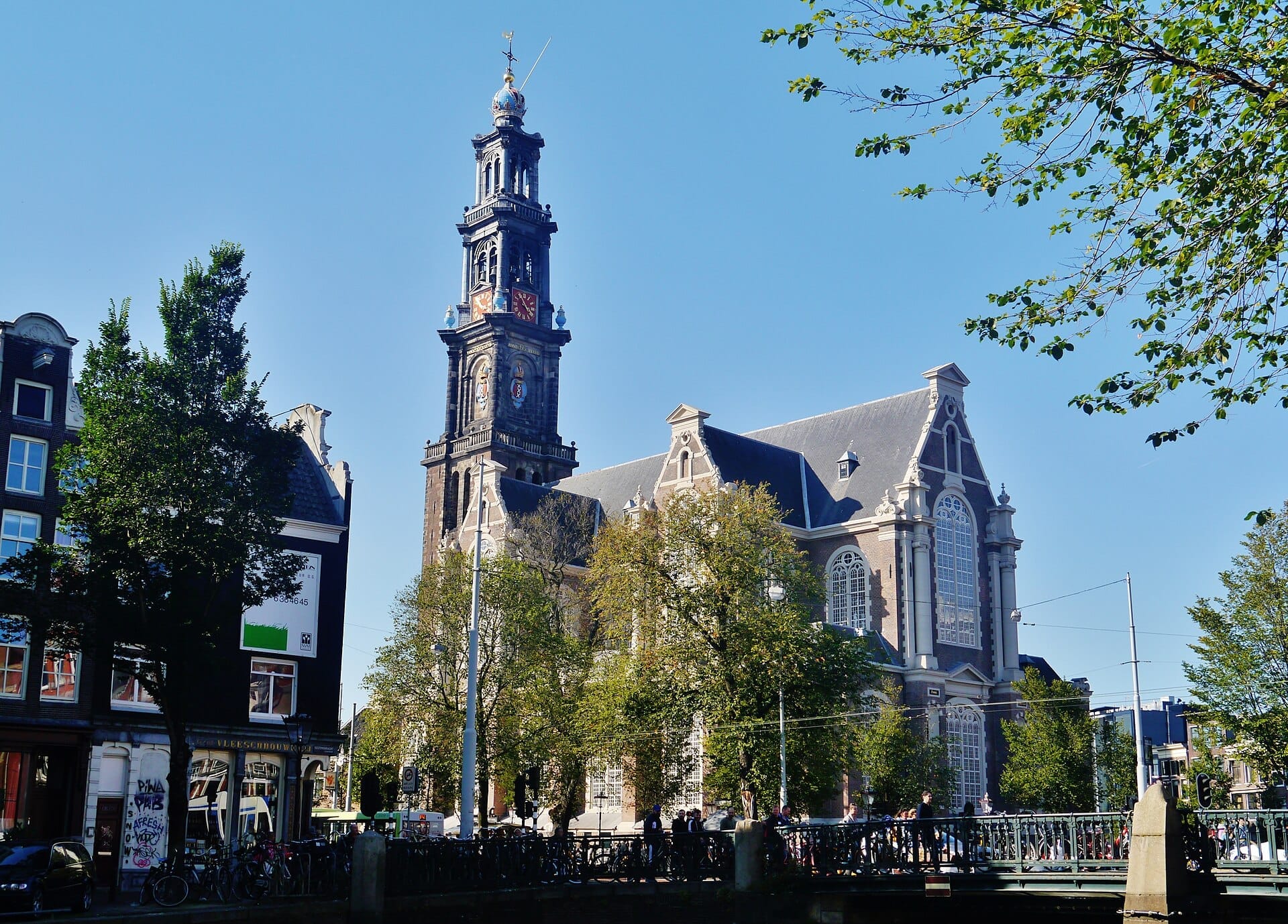
What the Westerkerk Actually Is
The Westerkerk, or Western Church, is a Protestant church of the Reformed tradition completed in 1631 after eleven years of construction. Designed by Hendrick de Keyser, one of the most accomplished architects of the Dutch Golden Age, it remains among the largest Protestant churches in Amsterdam and one of the finest examples of Dutch Renaissance church architecture anywhere in the country. It is not a museum. Services are still held here, and the building continues to function as an active parish church.
The church stands at Westermarkt on the Prinsengracht, at the northern edge of the Jordaan, in a stretch of the Canal Ring included in the UNESCO World Heritage listing for its 17th-century urban design. The exterior tower, crowned with a blue-and-gold imperial crown, has been a navigational landmark for canal-era sailors and a dominant feature of this neighborhood's skyline for nearly four centuries.
ℹ️ Good to know
The Westerkerk tower (Westertoren) is currently closed to visitors due to restoration work. The City of Amsterdam, which owns the tower, has suspended public access. This may change; check westerkerk.nl before visiting if the tower view is a priority.
Architecture: What Hendrick de Keyser Built
Hendrick de Keyser designed the Westerkerk in the Dutch Renaissance style, a blend of classical proportion and Northern European ornament that defined Amsterdam's building culture in the early 1600s. He died in 1621, a decade before construction finished, and the work was completed under his son Pieter de Keyser. The nave measures approximately 48 metres long, 28 metres wide, and reaches about 29 metres to the wooden barrel vaulting overhead.
Inside, the space is striking for its austerity. Protestant theology shaped every decision: whitewashed walls, clear glass windows that flood the nave with flat northern light, and none of the painted altarpieces or gilded decoration you find in Catholic churches of the same era. The effect is less ornate but more spatially honest. The wooden barrel vault is the dominant visual element, and it draws your eye the full length of the nave with quiet authority.
The organ is a notable exception to the plainness. The large Westerkerk organ, with its painted shutters, adds a burst of colour and craftsmanship to the otherwise restrained interior. For those interested in comparing Amsterdam's church architecture across traditions, the nearby Oude Kerk in De Wallen offers a useful counterpoint: a medieval Catholic structure later repurposed for Reformed worship, with a very different spatial character.
Tickets & tours
Live prices and dates from our booking partner. If you book, we may earn a commission at no extra cost to you.
Gray Line Canal Cruise with snackbox & Heineken Experience
From 48 €Instant confirmationFree cancellationAmsterdam evening canal cruise
From 18 €Instant confirmationFree cancellationJewish Museum and Portuguese Synagogue entrance ticket
From 20 €Instant confirmationFree cancellationAdmission ticket for Artis Royal Zoo and Micropia
From 39 €Instant confirmationFree cancellation
Historical Weight: Rembrandt and the Golden Age
The Westerkerk carries one name above all others: Rembrandt van Rijn was buried here in 1669, though his exact grave location within the church has never been confirmed. He was living nearby in poverty at the time of his death, and the burial record exists, but the precise spot remains unmarked and unknown. A commemorative plaque acknowledges his connection to the church, but visitors expecting a definitive monument to the painter will find only ambiguity, which is, in its own way, historically accurate.
The church also figures in the diary of Anne Frank. The Westerkerk's carillon bells are audible in the immediate area, and Anne Frank wrote about hearing the bells from her hiding place on the Prinsengracht. The Anne Frank House is roughly 50 metres from the church entrance, making the two sites natural companions in a single visit.
What a Visit Feels Like, Hour by Hour
The church opens to tourists Monday through Friday from 11:00 to 15:00. Arrive close to opening time if you want the interior largely to yourself. By noon, small groups filter through from the Anne Frank House queue nearby, and the space can feel crowded in the narrow aisles between pews. The light inside is at its best on clear mornings, when it enters low through the east-facing windows and catches the pale stone of the columns.
Outside, the Westermarkt square fronting the church is busy at almost any hour. The Saturday Noordermarkt and the area's general foot traffic mean the square rarely empties. The church exterior is best photographed from the far bank of the Prinsengracht, where you can get the full facade and tower in frame. Early mornings, before 9:00, the canal-side is quiet and the reflection in the water is at its sharpest.
On weekdays, the carillon plays at scheduled intervals. The bells are loud and clear at close range, a sound that has defined this corner of the city for centuries. If you are standing inside when they ring, the resonance through the stone is worth pausing for.
💡 Local tip
The church closes occasionally for services, private events, or without advance notice. Always verify current hours at westerkerk.nl before making it a fixed point in your itinerary.
Getting There and Practical Logistics
The Westerkerk is located at Prinsengracht 281, at the corner of Westermarkt. The main visitor entrance during current restoration work is at Prinsengracht 279, at the side of Westermarkt. Trams serving the Westermarkt stop run along the nearby routes; check current GVB schedules and stop locations, as Amsterdam's tram network periodically changes. The church is also an easy walk from Amsterdam Centraal, roughly 15 to 20 minutes on foot via the western side of the historic centre.
If you are cycling, which is the most practical way to navigate this part of the city, there are bike racks along the Prinsengracht. The surrounding Canal Ring is one of Amsterdam's most pleasant cycling areas. The cycling in Amsterdam guide covers the rules and routes worth knowing before you get on a bike here.
The church interior at ground level is generally accessible for visitors with mobility considerations, as the floor is flat and there are no steps at the main entrance during the current visitor access arrangement. The tower, which involves a steep climb, is closed and therefore not a relevant accessibility question at present.
Context in the Canal Ring
The Westerkerk sits within the Canal Ring, the UNESCO-listed grid of concentric waterways that Amsterdam built outward during the 17th century. The church was conceived as part of that expansion, intended to serve the new residential neighborhoods being developed to the west of the medieval city. Walking from the Westerkerk south along the Prinsengracht takes you through some of the most intact stretches of that original urban plan.
The immediate neighborhood blends seamlessly with the Jordaan to the west, one of Amsterdam's most densely historic residential areas. The streets around Westermarkt have cafes, small shops, and the kind of low-key commercial activity that makes the area worth wandering before or after the church. The Noordermarkt, a short walk north, hosts a Saturday farmers market and antiques market that draws a local crowd.
Honest Assessment: Is It Worth Your Time?
For most visitors, the Westerkerk rewards a 30 to 45 minute stop rather than a dedicated half-day trip. The interior is significant but not overwhelming in scale, and with the tower closed, the main draw is the architecture, the historical associations with Rembrandt and Anne Frank, and the experience of standing inside a church that has shaped this corner of Amsterdam since the early 1600s. That is genuinely worthwhile.
Anyone expecting lavish decoration, a rooftop view, or an interactive museum experience will be disappointed. The Westerkerk is a working church that happens to be historically important. It is spare, Protestant, and austere in its presentation. If that matches what you are looking for, it is one of the most authentic free experiences in central Amsterdam.
Travelers building a broader Amsterdam itinerary might pair this with the Anne Frank House (book tickets well in advance), a walk through the Jordaan, and a stop at one of the canal-side cafes nearby. The 3-day Amsterdam itinerary places the Westerkerk in the context of a practical daily plan if you are working out how to sequence your time.
Insider Tips
- The exterior tower's imperial crown is best seen from across the Prinsengracht. Cross to the far bank and walk a short distance south for the cleanest angle without parked bikes or market stalls cluttering the foreground.
- The Anne Frank House tickets sell out weeks in advance. If you are visiting both sites in the same morning, book the Anne Frank House first and treat the Westerkerk as a flexible add-on around that time slot.
- Guided tours of the church can be arranged through the church office, including group and school visits. These offer more depth than a self-guided walk, particularly on the organ's history and the building's construction. Contact westerkerk.nl to arrange.
- The carillon bells ring at fixed intervals. If you are inside the church when they sound, stay still for a moment. The acoustic effect through the stone vault is one of the quieter sensory experiences this part of Amsterdam offers.
- Saturday mornings bring the Noordermarkt farmers and antiques market to the nearby square. Combining both in a single morning, with a walk along the Prinsengracht between them, makes for a very good half-day without spending much money.
Who Is Westerkerk For?
- Architecture and urban history enthusiasts interested in Dutch Golden Age design
- Visitors following the Anne Frank or Rembrandt trail through Amsterdam
- Budget-conscious travelers looking for meaningful, free cultural stops
- Photographers working the Canal Ring in early morning light
- Anyone wanting quiet interior space after the sensory overload of central Amsterdam
Nearby Attractions
Other things to see while in Canal Ring (Grachtengordel):
- Anne Frank House
The Anne Frank House on Prinsengracht 263 preserves the hidden rooms where Anne Frank and seven others lived in concealment from 1942 to 1944. One of the most significant memorial sites in Europe, it requires advance planning but rewards visitors with an experience that stays with them long after they leave Amsterdam.
- Bloemenmarkt (Floating Flower Market)
The Bloemenmarkt sits on a row of fixed barges along the Singel canal, operating since 1862 as the world's only floating flower market. Free to enter and open daily, it sells tulip bulbs, cut flowers, and souvenirs in the heart of Amsterdam's Canal Ring. Here is what you will actually find there.
- Amsterdam Canal Cruises
A canal cruise is one of the most efficient ways to understand Amsterdam's layout and its 17th-century heritage. This guide covers the main operators, departure points, what you'll actually see, and how to pick the right cruise for your trip.
- FOAM Photography Museum
Housed in a 17th-century canal house on Keizersgracht, FOAM Photography Museum (Fotografiemuseum Amsterdam) has been one of Europe's leading photography institutions since it opened in December 2001. Four floors of rotating exhibitions cover documentary work, fine art photography, fashion, and emerging talent, making it a serious cultural stop that rewards repeat visits.
Planning a trip? Discover personalized activities with the Nomado app.