Vondelpark: Amsterdam's Great Urban Park
Vondelpark is a 47-hectare public park in the Oud-Zuid district, free to enter at any hour. With tree-lined paths, open meadows, rose gardens, and outdoor cafes, it functions as Amsterdam's collective backyard, drawing locals and visitors alike across every season.
Quick Facts
- Location
- Vondelpark, 1071 AA Amsterdam (Oud-Zuid, border with Amsterdam-West)
- Getting There
- Tram 2, 5, 12, 13, 17 to Leidseplein, then a 2-5 min walk to the park entrance
- Time Needed
- 1–3 hours depending on pace; a full circuit of the park is roughly 3 km
- Cost
- Free. No admission fee, open at all times
- Best for
- Morning runs, picnic afternoons, cycling, people-watching, family outings
- Official website
- www.amsterdam.nl/vondelpark
What Vondelpark Actually Is
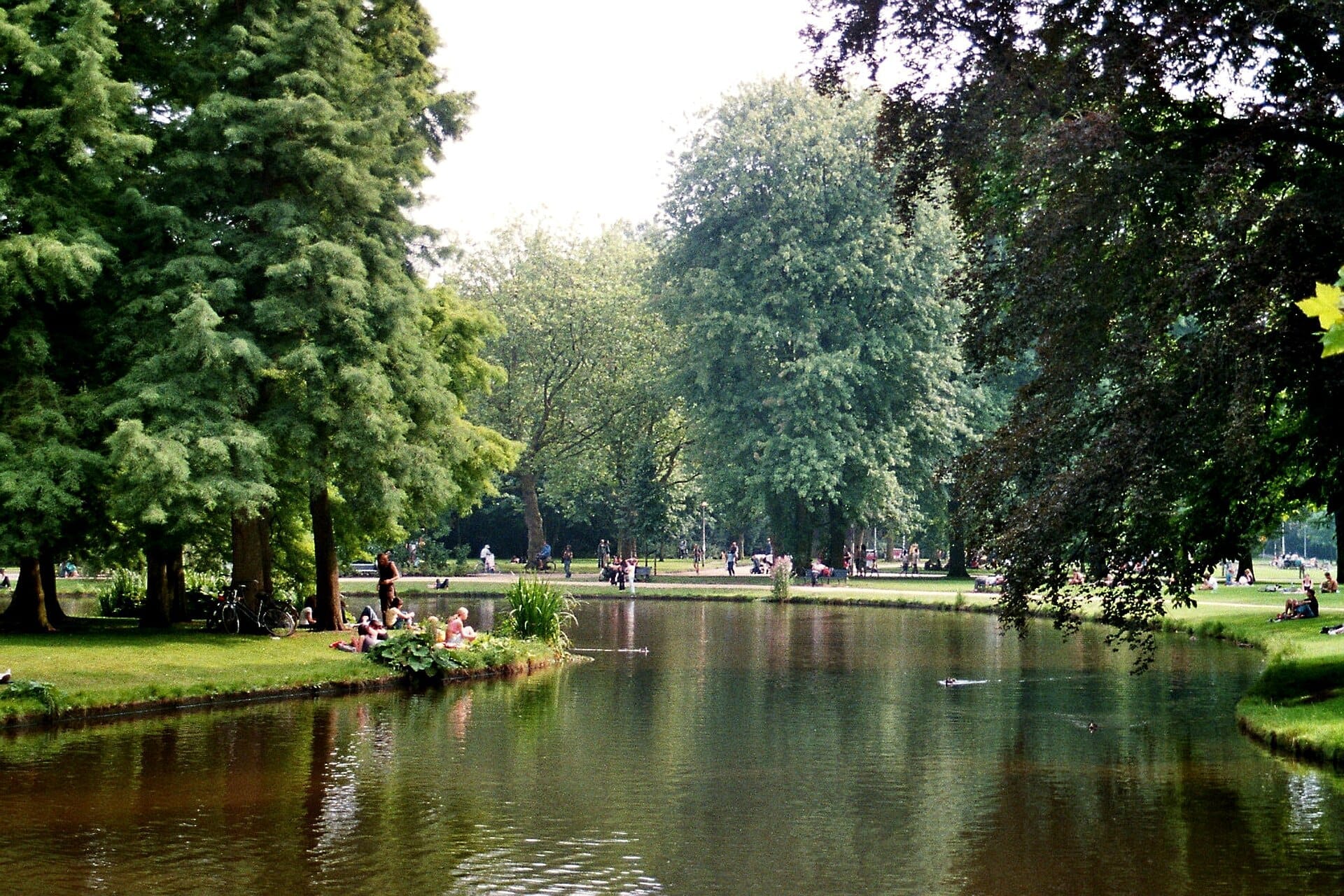
Vondelpark is the largest and most-visited park in central Amsterdam, covering about 47 hectares (around 116 acres) and stretching roughly 1.5 kilometres from Stadhouderskade in the east to Amstelveenseweg in the west. It sits just south of the canal ring in the Oud-Zuid district, within easy walking distance of the Rijksmuseum and the Van Gogh Museum. The park is freely accessible to the public at all hours, with no gates, no tickets, and no closing time.
With around 10 million visits per year, Vondelpark is one of the most-used urban green spaces in the Netherlands. That figure sounds overwhelming, but the park absorbs crowds better than you might expect: the long, narrow layout, multiple entrances, and varied terrain distribute people across wide lawns, wooded paths, and quieter ponds without producing a single bottleneck.
💡 Local tip
The park's main eastern entrance at Stadhouderskade (near Leidseplein) is the most trafficked. If you enter from the western end near Amstelveenseweg, you'll encounter a noticeably calmer, more residential feel.
A Short History: From New Park to National Monument
The park opened in 1865 under the unremarkable name Het Nieuwe Park. Two years later, in 1867, a statue of the 17th-century Dutch poet Joost van den Vondel was installed near the main entrance, and the park was later renamed Vondelpark in his honour. Vondel is considered the greatest Dutch-language poet and playwright of his era, roughly the Dutch equivalent of Shakespeare, which gives the park a cultural weight that goes beyond landscaping.
The design follows the English landscape garden tradition: irregular paths, naturalistic pond edges, open meadows, and clusters of trees chosen for visual contrast rather than symmetry. The original designers, J.D. and L.P. Zocher, used the same approach across multiple Dutch parks in the 19th century. The result is a park that feels like it grew naturally rather than being imposed on the land. Vondelpark was designated a national monument in 1996, which restricts major alterations to its layout and historic structures.
Tickets & tours
Live prices and dates from our booking partner. If you book, we may earn a commission at no extra cost to you.
Gray Line Canal Cruise with snackbox & Heineken Experience
From 48 €Instant confirmationFree cancellationAmsterdam evening canal cruise
From 18 €Instant confirmationFree cancellationJewish Museum and Portuguese Synagogue entrance ticket
From 20 €Instant confirmationFree cancellationAdmission ticket for Artis Royal Zoo and Micropia
From 39 €Instant confirmationFree cancellation
How the Park Changes Through the Day
Early mornings, particularly on weekdays, the park belongs almost entirely to Amsterdam residents. Joggers loop the perimeter on the asphalt paths before 8:00. Dog walkers congregate near the lawns. The light is flat and northern, filtering through the canopy, and the main sounds are birds and bicycle tyres on wet paths. The air near the ponds carries a faint green-water smell that fades as temperatures rise.
By mid-morning on a warm day, the dynamic shifts. Students with laptops settle on the grass. Cyclists pass through in steady streams. The Rose Garden near the middle of the park, which contains several hundred varieties, becomes a slow-moving photo scene. Families with small children appear around the playgrounds, of which there are several scattered across the park.
Weekend afternoons in summer are a different experience altogether. The central meadow fills with picnic blankets, footballs, frisbees, and portable speakers. The outdoor terrace at the Vondelpark Openluchttheater (Open Air Theatre), which hosts free concerts and performances during summer months, draws a dedicated crowd. At these peak hours, the eastern half of the park near the main entrance can feel genuinely crowded. The western sections stay noticeably quieter.
ℹ️ Good to know
The Vondelpark Openluchttheater runs free outdoor performances from late spring through August, including theatre, comedy, and concerts. No tickets are needed, though seating fills quickly for popular acts. Check the programme in advance at the theatre's own website.
What to See and Do Inside the Park
Walking and Cycling the Paths
The main circuit path runs along the perimeter of the park on asphalt and is suitable for both walking and cycling. Cycling is permitted on asphalt paths only; scooters, mopeds, and motor vehicles are prohibited inside the park. Inline skaters are also a regular presence, particularly on weekend mornings when the main paths are used for group skate sessions. The full outer loop is approximately 3.3 kilometres, which takes around 40 minutes at a relaxed walking pace.
If you plan to cycle across the park as part of a longer ride, it works well as a connector between the canal ring and the southern residential neighbourhoods. For dedicated cycling routes through Amsterdam more broadly, the cycling in Amsterdam guide covers options across the city.
The Rose Garden and Ponds
The formal rose garden sits roughly midway along the park and is at its best from late May through July. It contains a large number of named rose varieties, laid out in a structured pattern that contrasts with the more naturalistic planting elsewhere. The smell on a warm afternoon is genuinely strong. Surrounding ponds support coots, herons, parakeets (a well-established feral population), and various ducks. The ponds are not swimming areas.
Cafes and Food
Vondelpark has several cafes operating within the park, including long-established spots with outdoor terraces. Prices are higher than neighbourhood cafes outside the park, as expected for a high-footfall tourist-adjacent location. The quality ranges from adequate to very good depending on the spot. Bringing your own food and drink is entirely normal: the park has no restrictions on picnicking, and you'll see elaborate spreads on summer weekends alongside simple sandwiches.
Getting There
The most straightforward route from Amsterdam Centraal is by tram to Leidseplein. Several tram lines serve this stop, and the walk from Leidseplein into the park takes about two to five minutes via Overtoom or Stadhouderskade. The eastern entrance near the main Vondel statue is the one most visitors reach first.
Vondelpark sits immediately north of the Oud-Zuid cultural quarter. From the Rijksmuseum or the Van Gogh Museum, the park's southern edge is a 5-minute walk. This makes it a practical stop between museum visits, particularly when you need open air after a long gallery circuit.
Accessibility within the park is generally good on the main asphalt paths. Uneven grass and gravel sections may present difficulty for wheelchair users, but the primary circuit path is maintained and reasonably flat. Dogs are welcome in most of the park but must be on a leash near playgrounds and designated natural meadows, and are not permitted inside playgrounds themselves.
Seasonal Considerations
Spring, from April through May, is a compelling time to visit. The park greens up quickly, the rose garden begins to open, and the surrounding Oud-Zuid streets are full of tulips in private gardens. This overlaps with Amsterdam's spring season, when the city sees some of its most pleasant conditions before the summer crowds fully arrive.
Summer weekends are the busiest period by a significant margin. If crowds make you uncomfortable, early morning visits on any day, or weekday afternoons, are materially quieter. Autumn brings a sharp reduction in visitors while the park itself looks excellent: the tree canopy turns across the full colour range through October and November, and low morning light cuts across the ponds at an angle that summer never produces.
Winter is the honest test of how much you want green space versus conditions. The park remains open and is used by locals for morning runs and dog walks, but most casual tourists skip it in favour of indoor options. For context on what the city looks like in the colder months, the Amsterdam in winter guide covers the trade-offs clearly.
⚠️ What to skip
Amsterdam's weather can change quickly regardless of season. The park has limited shelter from rain. A compact rain layer is worth packing on any day where clouds are present, particularly in spring and autumn.
Photography Notes
The park photographs well in the hour after sunrise: the paths are mostly empty, the light is soft and directional, and the reflections on the ponds are undisturbed. The Rose Garden works best in late morning before harsh midday light flattens the texture of the flowers. The statue of Joost van den Vondel near the main entrance is a clear compositional anchor if you want an establishing shot that contextualises the park's history.
Avoid weekend midday if you want images without crowds in frame. The open theatre area photographs interestingly during performances, but check whether filming or photography is restricted for the specific act.
Who Might Want to Skip Vondelpark
Vondelpark is not a destination for people seeking dramatic landscape, significant architecture, or cultural programming as the main draw. It is a pleasant, well-maintained urban park that serves Amsterdam's residents daily and provides visitors with a functional green break from the city's denser areas. If your time in Amsterdam is limited to two or three days and your priority is art, history, or canal architecture, the park works better as a walkthrough than a dedicated stop.
Travellers with limited time who still want a meaningful open-air experience might prefer starting with the Amsterdamse Bos, a much larger forested area southwest of the city with more varied terrain, though it requires a longer transit journey to reach.
Insider Tips
- Enter from the western Amstelveenseweg side for immediate quiet. Most visitors arrive from Leidseplein in the east, so the gradient from busy to calm runs west across the park's length.
- The inline skating scene on Sunday mornings draws a regular crowd of experienced skaters who use the main path as a circuit. Worth watching if you arrive between 9:00 and 11:00, though the path does get narrower near the eastern third.
- The park's feral ring-necked parakeets, descended from escaped pets, are now a fixture. You'll hear them before you see them: loud, bright-green birds in the canopy that have no native counterpart in Dutch wildlife.
- Several cafes near the eastern entrance have terraces that face southwest, which means they catch late-afternoon sun for longer than you'd expect. A practical detail for anyone planning an end-of-day stop.
- Vondelpark was a centre of the 1960s counterculture movement in Amsterdam. The lawns were effectively an open-air gathering ground and camping area for youth travellers during that period. The park still carries traces of that permissive social atmosphere.
Who Is Vondelpark For?
- Families with young children, thanks to multiple playgrounds spread across the park
- Cyclists and runners looking for a car-free circuit with a consistent surface
- Travellers combining a morning walk with nearby museum visits at the Rijksmuseum or Van Gogh Museum
- Summer visitors who want free outdoor entertainment at the Open Air Theatre
- Anyone who wants to observe everyday Amsterdam life rather than tourist infrastructure
Nearby Attractions
Other things to see while in Oud-Zuid:
- Royal Concertgebouw
Opened in 1888, the Royal Concertgebouw is one of the world's most acoustically celebrated concert halls and a cornerstone of Amsterdam's cultural life. From grand evening symphony performances to intimate Sunday morning concerts, a visit here is an experience that goes well beyond a typical night out.
- Foodhallen Amsterdam
Housed in a converted 1902 tram depot in Amsterdam's Oud-West, Foodhallen Amsterdam brings together 20+ food and drink concepts under one industrial roof. Entry is free, the crowd is local-heavy, and the quality is noticeably higher than a typical food court.
- Moco Museum
Moco Museum occupies a striking 1904 villa steps from the Rijksmuseum, presenting modern and contemporary art including major works by Banksy, Jean-Michel Basquiat, and rotating immersive exhibitions. It is compact, crowd-friendly when timed well, and offers a genuinely different energy from the city's larger institutions.
- PC Hooftstraat
PC Hooftstraat is Amsterdam's most prestigious shopping address, lined with flagship stores from the world's top fashion and lifestyle brands. Located in the leafy Oud-Zuid district, steps from the Rijksmuseum and Vondelpark, it offers a composed, unhurried alternative to the city's crowded shopping corridors.
Planning a trip? Discover personalized activities with the Nomado app.