Van Gogh Museum Amsterdam: Everything You Need to Know Before You Visit
The Van Gogh Museum holds the world's largest collection of Vincent van Gogh's works, including over 200 paintings and 400 drawings, housed in a landmark building on Museumplein. It is one of Amsterdam's most visited attractions, and knowing what to expect makes the difference between a rewarding experience and an overwhelming one.
Quick Facts
- Location
- Museumplein 6, 1071 DJ Amsterdam (Oud-Zuid)
- Getting There
- Tram 3, 5, 12 to Museumplein; Tram 5, 12 to Concertgebouw
- Time Needed
- 2 to 3 hours for a thorough visit
- Cost
- Adults €25 / Under 18 free. Museumkaart valid.
- Best for
- Art lovers, history enthusiasts, first-time Amsterdam visitors
- Official website
- www.vangoghmuseum.nl/en
What the Van Gogh Museum Actually Is
The Van Gogh Museum is a purpose-built art institution dedicated entirely to Vincent van Gogh and his immediate contemporaries. It opened on 2 June 1973 on Museumplein, Amsterdam's cultural square, and quickly became one of the most attended museums in the world. That status brings crowds, but also serious curatorial depth: this is not a greatest-hits sampler of an artist's work, but an archive-scale presentation of a single painter's output.
The collection spans more than 200 paintings, over 400 drawings, and over 750 personal letters, most of them to his brother Theo. Organized chronologically, it lets visitors follow Van Gogh's development from the dark, labored canvases of his Dutch period in the early 1880s to the electric brushwork of his Arles and Saint-Rémy years. Few museums let you trace an artist's evolution this completely.
ℹ️ Good to know
All tickets must be booked online in advance. The museum operates a timed-entry system and strongly advises advance booking; same-day on-site ticket sales are not generally available. Book as early as possible, especially for summer visits or Friday evenings.
The Buildings: Rietveld and Kurokawa
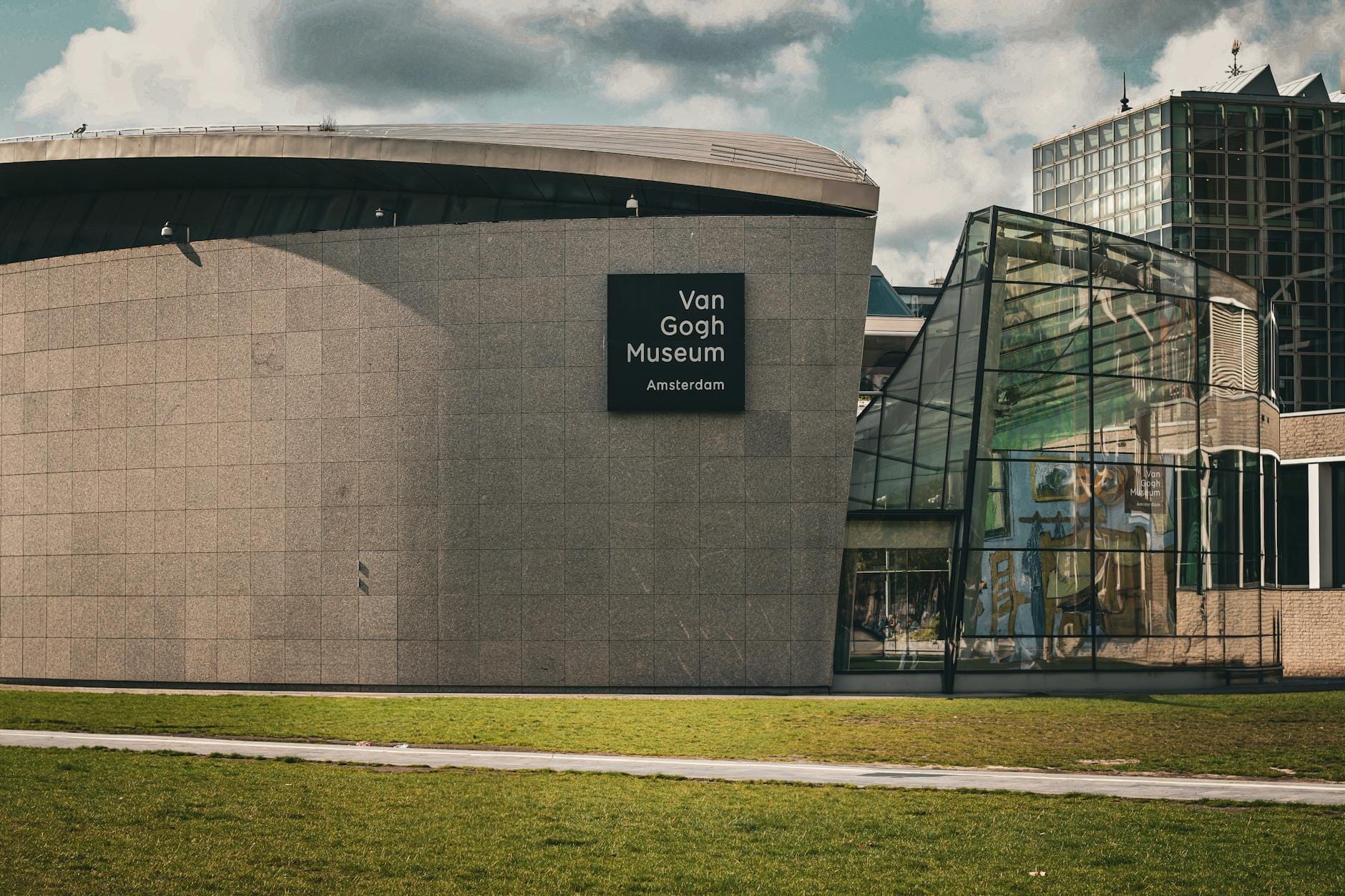
The main building was designed by Dutch architect Gerrit Rietveld, a key figure in the De Stijl movement. Rietveld died in 1964 before it was completed, and the building was finished according to his plans. Its restrained, geometric exterior feels deliberately understated, as if deferring attention to what is inside. The entrance foyer is light and open, with natural light filtering into the galleries above.
A separate exhibition wing, connected underground, was added later and designed by Japanese architect Kisho Kurokawa. Its curved, stone-clad exterior is visually distinct from Rietveld's rectilinear block, and the contrast between the two buildings is worth a moment's attention before you enter. The Kurokawa wing hosts temporary exhibitions, which are often ticketed separately and require checking the museum's schedule before your visit.
The museum sits on Museumplein, which it shares with the Rijksmuseum and the Stedelijk Museum. If you are planning a full day in Oud-Zuid's cultural district, all three are within comfortable walking distance of each other.
Tickets & tours
Live prices and dates from our booking partner. If you book, we may earn a commission at no extra cost to you.
Van Gogh Museum self-guided audio tour with ticket
From 69 €Instant confirmationVan Gogh Museum Semi-Private Guided Tour with Reserved Entry
From 94 €Instant confirmationFree cancellationBlue Boat Company City Canal Cruise With Van Gogh museum
From 0 €Instant confirmationVan Gogh & Rembrandt in Amsterdam entrance ticket
From 0 €Instant confirmation
What You Will See Inside
The permanent collection is organized across multiple floors of the Rietveld building, following Van Gogh's life chronologically. The journey begins with works from his time in the Netherlands, including studies of peasant life and early portraits with a notably heavy, almost brown palette. These rooms tend to move quickly as most visitors are heading for the later work, but the early canvases are worth slowing down for if you want to understand the distance Van Gogh traveled as a painter.
The middle floors present his Paris years, when exposure to Impressionism and the work of artists like Toulouse-Lautrec and Seurat pushed his color into a new register. Then come the Arles rooms: the sunflowers, the bedroom, the portraits with their fever-bright yellows and blues. These are the paintings most visitors have come specifically to see, and the galleries around them tend to be the most crowded. The scale of paintings like 'The Bedroom' often surprises people who have only seen them reproduced.
The letters are displayed at intervals throughout the collection, printed in translation alongside key works. They are unexpectedly compelling, particularly where Van Gogh describes in plain language exactly what he was trying to do with a painting you are standing in front of. Allow time for these rather than rushing past them.
💡 Local tip
The museum also holds works by contemporaries including Gauguin, Monet, and Toulouse-Lautrec, which appear in context with Van Gogh's own canvases. These are not afterthoughts: they explain what Van Gogh was responding to and make the collection significantly more instructive.
Crowds, Timing, and When to Visit
The Van Gogh Museum is one of Amsterdam's most visited attractions, and Museumplein in high season (roughly April through August) fills up quickly. Even with timed entry, the key galleries around 'The Bedroom' and the Sunflowers series tend to concentrate visitors in the same rooms at the same time. Expect some shoulder-to-shoulder viewing in those areas, particularly mid-morning on weekends.
Friday evenings, when the museum often stays open until 21:00, are a consistently useful option. By early evening, the density of visitors drops noticeably, the light through the galleries shifts, and the experience becomes more contemplative. If you have any flexibility in your schedule, a Friday evening visit is among the better practical decisions you can make at this museum.
Opening hours typically run daily from 09:00 to 18:00, with many Fridays extended until 21:00 depending on the season and date. From November through December, the museum generally closes at 17:00 or 18:00 depending on the specific date, with Friday late openings continuing on most nights. Hours around Christmas and New Year's Eve are adjusted separately. Always check the official schedule for the precise dates of your visit, as hours vary within months.
⚠️ What to skip
Visiting without a pre-booked timed-entry ticket is generally not possible, as the museum sells tickets primarily online and most days sell out in advance. If you arrive without a reservation, you will be turned away regardless of queue length or availability on the day.
Getting There and Practical Logistics
Trams 3, 5, and 12 stop at Museumplein, and trams 5 and 12 serve the Concertgebouw stop, both within a short walk of the museum entrance. From Amsterdam Centraal, trams on these routes take roughly 15 to 20 minutes depending on traffic. Bus routes 347 and 397 also serve the area.
If you are cycling, bike parking is available around Museumplein. Amsterdam is well set up for cycling across the city, and the route from the canal ring to Oud-Zuid is straightforward and largely flat. See our guide to cycling in Amsterdam for practical routing tips.
Drivers can use the Q-Park underground car park beneath Museumplein, with entrance via Van Baerlestraat. Parking in this area is expensive and space is limited during peak periods; public transport or cycling is almost always the more practical choice.
The museum states that it is accessible to all visitors. For specific information on lifts, wheelchair access, and audio guides, check the accessibility section of the official website before your visit. The Rietveld building's floors are connected by lifts, and staff assistance is available.
Tickets, Prices, and Passes
Adult admission is €25. Visitors under 18 enter free. The Museumkaart, VriendenLoterij VIP-KAART, ICOM card, Rembrandt card, Stadspas, and Vincent's Friends membership all grant free entry, but cardholders still need to book a timed-entry slot online before arriving.
If you plan to visit multiple major Amsterdam museums in a short period, the Museumkaart pays for itself quickly. The Amsterdam City Card is another option worth evaluating depending on how much of the city's museum circuit you intend to cover.
All standard tickets are issued digitally and can be scanned from a mobile device or printout at the entrance. Make sure your confirmation is accessible on your phone before arriving, as connection in the entrance queue can be unpredictable.
Temporary exhibitions in the Kurokawa wing sometimes require a separate ticket or an add-on to the standard admission. Check what is showing during your dates and whether it interests you, as the wing occasionally hosts major loan exhibitions that significantly expand the visit.
Photography, the Museum Shop, and What to Skip
Photography without flash is permitted in designated areas, but not in all permanent collection galleries. The lighting is generally good for phone cameras in the main rooms, though the paintings behind glass in a few areas can create reflections. The Kurokawa wing has its own photography rules that vary by exhibition.
The museum shop near the entrance is genuinely well-stocked, with a wide range of prints, books, and reproductions. It is not the kind of museum shop you skip. The print selection in particular covers the collection in detail, including less-reproduced works from the early period. Expect higher-than-average quality for this type of retail.
Who might want to reconsider: if you have a strong general interest in Dutch Golden Age painting but minimal interest in Van Gogh specifically, your time may be better spent at the Rijksmuseum, which covers a far broader sweep of Dutch art history. The Van Gogh Museum is comprehensive precisely because it is narrow in scope, and that intensity is the point for the right visitor.
Visitors traveling with young children should know that the galleries are quiet and the content is not interactive. The museum is manageable with older children who have an interest in art, but it is not configured as a family activity space. For family-oriented options nearby, Amsterdam with kids outlines better-suited alternatives across the city.
Insider Tips
- Book the earliest available timed-entry slot if you want to experience the key galleries with fewer people around. The first hour after opening tends to be the calmest window of the day.
- Friday evenings (until 21:00) attract a fraction of the daytime crowd. This is consistently the most comfortable time to visit if you want space in front of the major works.
- The letters displayed alongside paintings are worth reading in full rather than skimming. Van Gogh's descriptions of his own intentions are precise and often reframe what you are looking at.
- If you hold a Museumkaart, you still need to reserve a timed-entry slot online. Many visitors assume their card works as a walk-in pass and are turned away at the door.
- The Kurokawa wing's temporary exhibitions are separately scheduled and sometimes separately ticketed. Check the museum's exhibitions page before your visit so you are not caught off-guard at the entrance.
Who Is Van Gogh Museum For?
- Art enthusiasts wanting comprehensive, scholarly engagement with Van Gogh's full body of work
- First-time Amsterdam visitors for whom the museum is a genuine priority rather than an obligation
- Travelers with a specific interest in Post-Impressionism and its development
- Students and researchers interested in primary sources, including Van Gogh's letters
- Anyone who wants to understand the context of some of the most recognizable paintings in Western art
Nearby Attractions
Other things to see while in Oud-Zuid:
- Royal Concertgebouw
Opened in 1888, the Royal Concertgebouw is one of the world's most acoustically celebrated concert halls and a cornerstone of Amsterdam's cultural life. From grand evening symphony performances to intimate Sunday morning concerts, a visit here is an experience that goes well beyond a typical night out.
- Foodhallen Amsterdam
Housed in a converted 1902 tram depot in Amsterdam's Oud-West, Foodhallen Amsterdam brings together 20+ food and drink concepts under one industrial roof. Entry is free, the crowd is local-heavy, and the quality is noticeably higher than a typical food court.
- Moco Museum
Moco Museum occupies a striking 1904 villa steps from the Rijksmuseum, presenting modern and contemporary art including major works by Banksy, Jean-Michel Basquiat, and rotating immersive exhibitions. It is compact, crowd-friendly when timed well, and offers a genuinely different energy from the city's larger institutions.
- PC Hooftstraat
PC Hooftstraat is Amsterdam's most prestigious shopping address, lined with flagship stores from the world's top fashion and lifestyle brands. Located in the leafy Oud-Zuid district, steps from the Rijksmuseum and Vondelpark, it offers a composed, unhurried alternative to the city's crowded shopping corridors.
Planning a trip? Discover personalized activities with the Nomado app.