Stedelijk Museum Amsterdam: The Complete Guide to the City's Modern Art Powerhouse
The Stedelijk Museum Amsterdam holds one of Europe's most significant collections of modern and contemporary art and design, with around 90,000 objects spanning from the late 19th century to today. Located on Museumplein alongside the Rijksmuseum and Van Gogh Museum, it rewards visitors who want something beyond the Golden Age crowds.
Quick Facts
- Location
- Museumplein 10, 1071 DJ Amsterdam (Oud-Zuid)
- Getting There
- Trams 2, 5, 12 or buses 170, 172 to Museumplein
- Time Needed
- 2 to 3 hours for a focused visit; half a day for the full collection
- Cost
- Adults €22.50 | Students & CJP €12.50 | Under 18 free | Museumkaart & I amsterdam City Card: free
- Best for
- Design enthusiasts, contemporary art lovers, architecture watchers, and travelers who find the Van Gogh Museum too crowded
- Official website
- www.stedelijk.nl
What Is the Stedelijk Museum Amsterdam?
The Stedelijk Museum Amsterdam is the Netherlands' foremost institution for modern and contemporary art and design. Founded in 1874 and opened in its purpose-built Neo-Renaissance building in 1895, it sits at the southern edge of Museumplein, flanked by the Rijksmuseum to one side and the Van Gogh Museum to the other. The collection runs to approximately 90,000 objects: paintings, sculptures, photographs, graphic design, applied arts, and digital works that trace the arc of art history from the late 1800s to the present day.
What separates the Stedelijk from its neighbors is its scope in time and discipline. Where the Rijksmuseum anchors itself to the Dutch Golden Age and the Van Gogh Museum tells one artist's story, the Stedelijk moves forward, covering Mondrian, Malevich, Chagall, de Kooning, Francis Bacon, Jean Tinguely, Marlene Dumas, and dozens of other figures who reshaped how we see the world across the 20th and 21st centuries. Design and applied arts are given equal footing alongside fine art, which makes the museum unusually coherent: you feel the connections between a Bauhaus chair, a Rietveld sideboard, and the abstract canvases hanging nearby.
💡 Local tip
If you hold a Museumkaart or I amsterdam City Card, entry to the Stedelijk is free. Given the €22.50 adult ticket price, these passes pay for themselves quickly if you plan to visit two or more Amsterdam museums. Check the Amsterdam City Card guide before you book.
The Building: Old Wing, New Bathtub
The Stedelijk occupies two very different structures that share one address. The original 1895 building, designed by Adriaan Willem Weissman, is a stately brick structure with arched windows and decorative terracotta detailing, consistent with the civic ambition of late-19th-century Amsterdam. Step through the main entrance and the proportions feel serious, even ceremonial, which suits the older parts of the collection well.
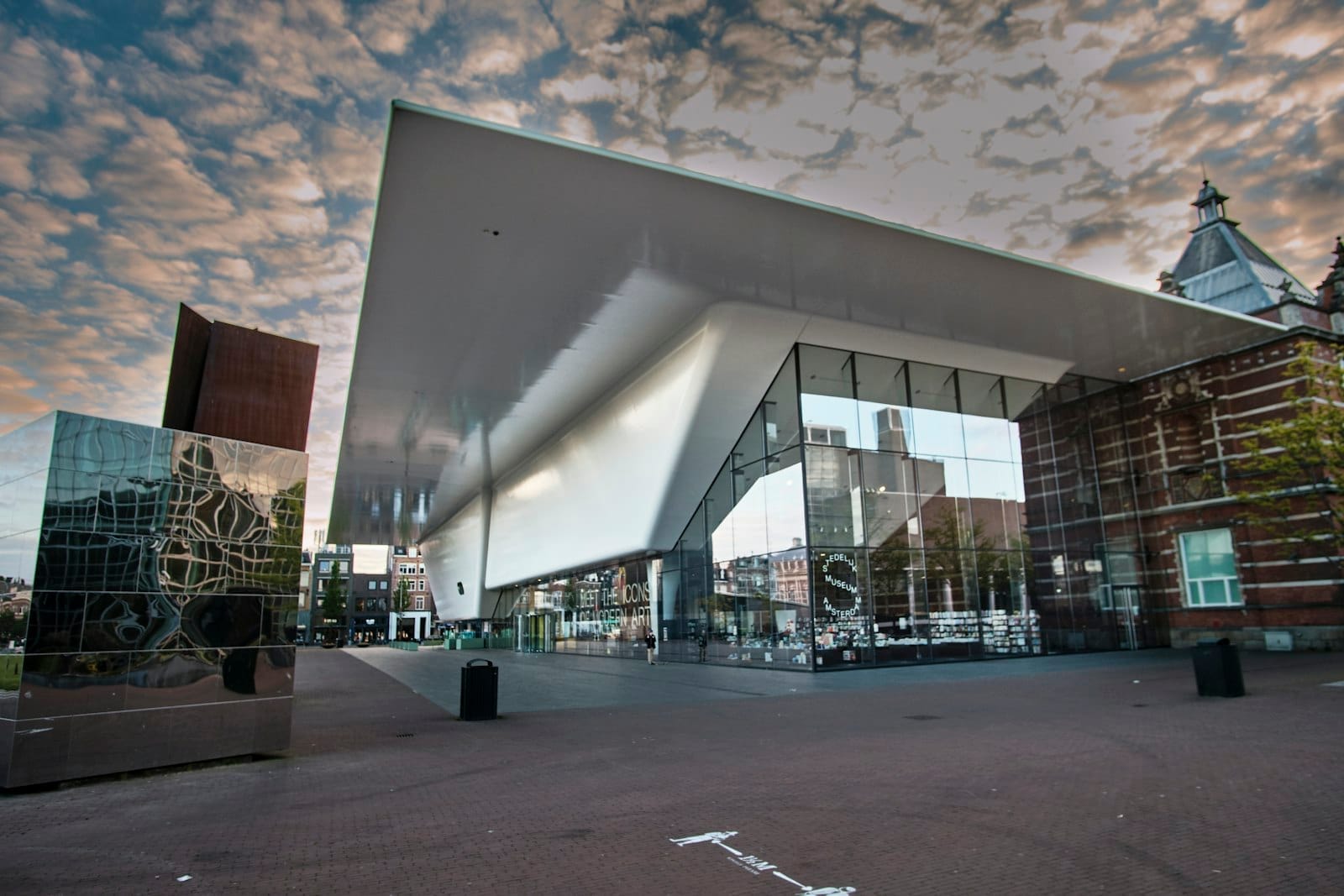
Behind the historic wing sits a drastically different extension completed in 2012 and designed by the firm Benthem Crouwel Architects. Nicknamed 'the bathtub' by locals, it is a large white polyester-composite volume that floats above the street level and wraps around the back of the old building. The contrast is deliberate and, depending on your taste, either intellectually stimulating or visually jarring. Either way, the new wing provides the Stedelijk with the open, flexible, column-free gallery space that contemporary art often demands. It is also where you will find the largest and most ambitious temporary exhibitions.
The building sits within the broader cultural concentration of Oud-Zuid, Amsterdam's most architecturally distinguished southern district. On the same square you can hear the Concertgebouw orchestra warming up through open windows on a summer afternoon, and the Rijksmuseum's Gothic spires are visible from the Stedelijk's front steps. If you want to understand how the city thinks about culture, Museumplein is the right place to start.
Tickets & tours
Live prices and dates from our booking partner. If you book, we may earn a commission at no extra cost to you.
The Collection: What You Will Actually See
The Stedelijk's permanent collection is organized thematically and chronologically, though the arrangement shifts as rooms rotate to accommodate the temporary program. Highlights that appear reliably in the permanent galleries include a strong group of works by Kazimir Malevich, whose Suprematist paintings arrived in Amsterdam under unusual historical circumstances in the 1920s and have been connected to the museum ever since. Piet Mondrian's evolution from representational landscapes into pure geometric abstraction is documented across several works, giving you a rare chance to see the progression rather than just the iconic end result.
The applied design collection is one of the museum's quieter strengths. Rietveld furniture, Sandberg's typographic poster work, and pieces from the De Stijl movement are presented in context with fine art, which makes the conceptual links feel natural rather than forced. The photography and graphic design holdings are substantial, and the Stedelijk has historically been one of the few major European institutions to take Dutch graphic design seriously as a collected discipline.
Contemporary works occupy much of the new wing, with rotating selections from artists including Marlene Dumas, whose large-format figurative paintings have a visceral quality that photographs poorly and rewards standing in front of in person. The museum's temporary exhibition program is consistently strong, often bringing in major international survey shows or retrospectives that would otherwise require travel to London or New York.
ℹ️ Good to know
The Stedelijk's shop and sculpture garden can be visited without a museum ticket. If you are short on time or budget, a walk through the garden and a browse of the design-focused shop still gives you a feel for the institution and is a worthwhile 20-minute stop.
When to Visit and How the Experience Changes by Time of Day
The museum opens daily at 10:00 and closes at 18:00, with last entry at 17:45. It operates 365 days a year, which makes it a reliable option even on public holidays when other venues are shut. Morning visits, particularly from opening until around 11:30, are the calmest. The galleries in the old wing feel genuinely quiet at this hour, with enough space to stand back from larger canvases and look without being jostled.
Midday brings an influx of visitors, particularly school groups on weekdays from September through June. The new wing absorbs crowds reasonably well given its scale, but the narrower corridors of the 1895 building can become congested between noon and 14:00. Late afternoon, roughly 15:30 onward, sees a second quieter window as day-trippers move toward dinner and the visitor volume drops noticeably. The light through the original building's tall arched windows is warmer in the afternoon, which makes this a good time for looking at the older painting collection.
Weather affects the calculus on Museumplein. On clear days, the square outside fills with cyclists, picnickers, and people sitting at the outdoor terraces of the nearby cafes. On rainy days, the Stedelijk, Van Gogh Museum, and Rijksmuseum all see surges in walk-up visitors simultaneously. If you arrive without pre-booked tickets during wet weather in peak season, expect queues. Book online in advance to avoid the line entirely.
Getting There and Getting Around the Area
Trams 2, 5, and 12 all stop at or very near Museumplein, connecting the square to Amsterdam Centraal and the central canal ring in around 15 to 20 minutes. Buses 170 and 172 also serve the area. From the tram stop it is a short walk across the square to the museum entrance on the north side of the building. The address is Museumplein 10.
Cycling to the Stedelijk is straightforward if you are comfortable with Amsterdam traffic. Bike parking is available around Museumplein, though it fills up quickly on weekends. For visitors combining the Stedelijk with the Van Gogh Museum and Rijksmuseum in a single day, planning the sequence matters: start at whichever museum requires the most physical energy, because Museumplein fatigue is real. Three major museums back to back is ambitious; two with a proper lunch break is more satisfying.
If you are arriving from Amsterdam-Noord via the IJ ferry and want to cross the city, note that the direct tram connection from Centraal to Museumplein is the most convenient route. For broader orientation on Amsterdam's transit system, the getting around Amsterdam guide covers all transport options in detail.
Photography, Accessibility, and Practical Notes
Photography for personal, non-commercial use is generally permitted in the permanent collection galleries, though specific temporary exhibitions may restrict this. Flash photography is not permitted. The natural light in the old wing creates strong conditions for documenting the texture of paintings, particularly in morning hours. The new wing's diffused overhead lighting is more even but less characterful.
The museum states a commitment to accessibility for all visitors and provides a FAQ and contact address (reserveringen@stedelijk.nl) for specific access requirements. For detailed step-free access information, lift locations, and facility specifics, consulting the museum's own visit pages before arrival is advisable. The new wing's open floor plan is generally easier to navigate than the older sections of the building.
Visitors considering multiple major Amsterdam museums should calculate whether the I amsterdam City Card makes financial sense. At €22.50 per adult for the Stedelijk alone, combining it with one or two other paid museums can make the card worthwhile depending on your itinerary.
Who Should Think Twice
The Stedelijk is not for everyone, and there is no point pretending otherwise. Visitors who primarily want Dutch Golden Age painting, Vermeer, Rembrandt, and Hals, will find almost nothing of that here. The collection begins where the traditional canon ends. Children under ten may enjoy the open spaces and large-scale works in the new wing, but the museum offers less interactivity than the NEMO Science Museum or Artis Zoo nearby. Adults who are genuinely indifferent to modern and contemporary art will find the ticket price hard to justify.
The museum can also feel unevenly curated on days when major temporary exhibitions close and the next has not yet opened. Before visiting, it is worth checking the current exhibition calendar on the official site to confirm what is showing.
Insider Tips
- The Stedelijk's sculpture garden on the south side of the building is free to enter and often overlooked. It provides a calm place to sit between museums and frequently displays works that are not shown in the main galleries.
- If a major retrospective is running in the new wing, book a morning slot on a Tuesday or Wednesday. These are the quietest days of the week for Amsterdam museums as a whole, and the contrast with a busy Saturday is significant.
- The museum shop stocks an unusually strong selection of design monographs, typography books, and exhibition catalogues that are difficult to find elsewhere in Amsterdam. It is worth browsing even if you skip the paid galleries.
- The Stedelijk's audio guide app can be downloaded before your visit, which means you can orient yourself on the tram ride over and spend less time reading wall text inside.
- If you are visiting Museumplein on a clear evening, the square itself is worth crossing slowly on the way out. The illuminated facades of the Rijksmuseum and Stedelijk reflect in the long rectangular pond at the square's center, and this is one of the better free sights in the neighborhood.
Who Is Stedelijk Museum Amsterdam For?
- Contemporary art and design enthusiasts who want depth beyond the Dutch Masters
- Architecture watchers interested in the contrast between Weissman's 1895 Neo-Renaissance building and Benthem Crouwel's 2012 extension
- Travelers on a Museumkaart or I amsterdam City Card looking to maximize their pass
- Visitors doing a full Museumplein day and wanting a third major institution after the Rijksmuseum and Van Gogh Museum
- Anyone following the history of European modernism, particularly De Stijl, Suprematism, and postwar abstraction
Nearby Attractions
Other things to see while in Oud-Zuid:
- Royal Concertgebouw
Opened in 1888, the Royal Concertgebouw is one of the world's most acoustically celebrated concert halls and a cornerstone of Amsterdam's cultural life. From grand evening symphony performances to intimate Sunday morning concerts, a visit here is an experience that goes well beyond a typical night out.
- Foodhallen Amsterdam
Housed in a converted 1902 tram depot in Amsterdam's Oud-West, Foodhallen Amsterdam brings together 20+ food and drink concepts under one industrial roof. Entry is free, the crowd is local-heavy, and the quality is noticeably higher than a typical food court.
- Moco Museum
Moco Museum occupies a striking 1904 villa steps from the Rijksmuseum, presenting modern and contemporary art including major works by Banksy, Jean-Michel Basquiat, and rotating immersive exhibitions. It is compact, crowd-friendly when timed well, and offers a genuinely different energy from the city's larger institutions.
- PC Hooftstraat
PC Hooftstraat is Amsterdam's most prestigious shopping address, lined with flagship stores from the world's top fashion and lifestyle brands. Located in the leafy Oud-Zuid district, steps from the Rijksmuseum and Vondelpark, it offers a composed, unhurried alternative to the city's crowded shopping corridors.
Planning a trip? Discover personalized activities with the Nomado app.