Molly Malone Statue: Dublin's Most Photographed Bronze
Cast in bronze and planted on Suffolk Street, the Molly Malone statue is one of Dublin's most recognisable public sculptures. Free to visit at any hour, it commemorates the legendary fishmonger of Irish song and marks the southern edge of the city's busiest pedestrian corridor.
Quick Facts
- Location
- Suffolk Street, Dublin 2 (near Trinity College)
- Getting There
- Short walk from Westmoreland Street bus stops; Luas Green Line at St Stephen's Green
- Time Needed
- 10–20 minutes
- Cost
- Free, no ticket required
- Best for
- First-time visitors, literary and cultural walkers, photography
- Official website
- www.visitdublin.com/molly-malone
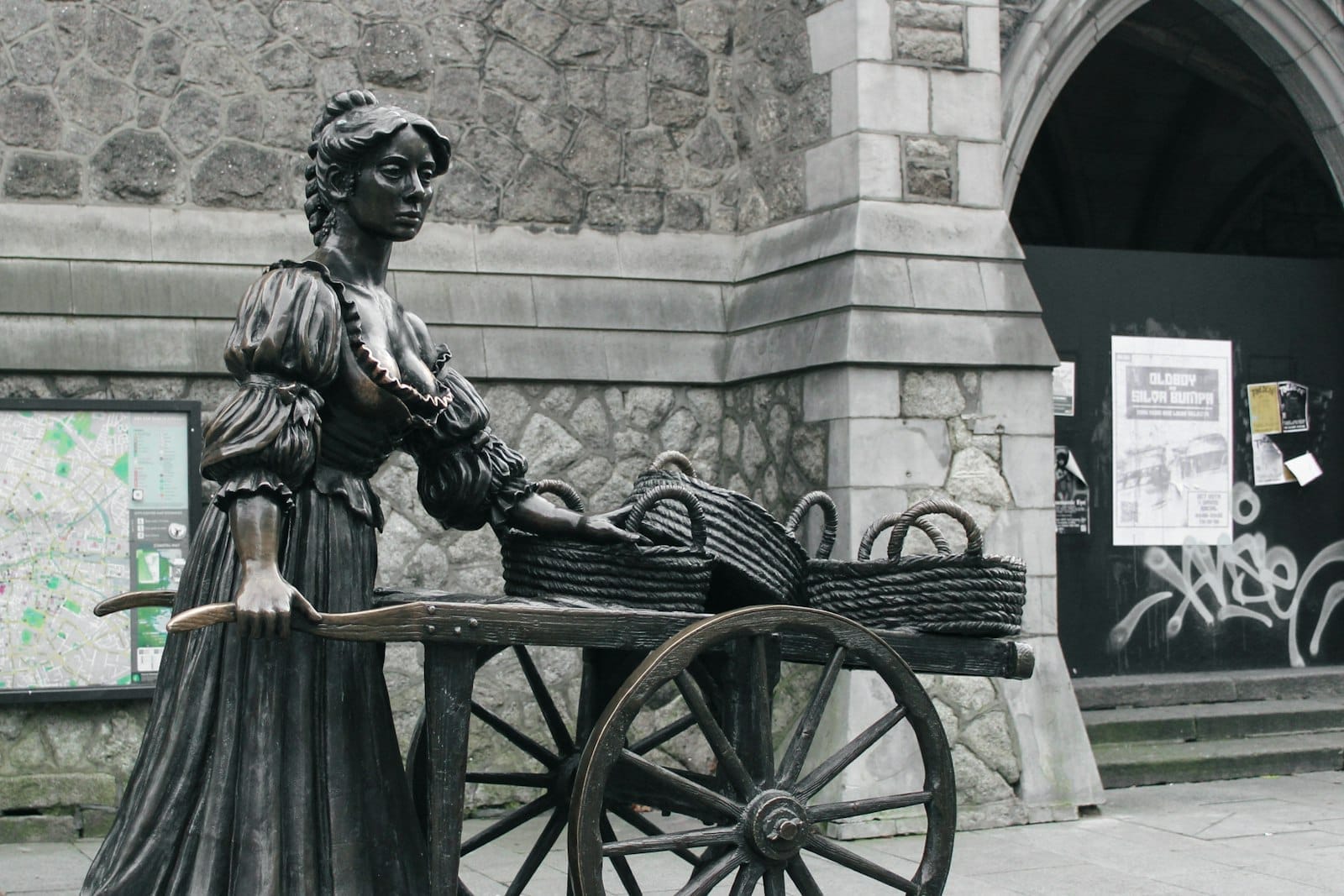
What You're Looking At
The Molly Malone statue stands on Suffolk Street in front of the former St Andrew's Church, just off Dame Street and a short walk from Grafton Street and the front entrance of Trinity College. Unveiled in 1988 as part of Dublin's Millennium celebrations, the bronze figure depicts a young woman pushing a flat-bedded cart stacked with shellfish. She wears a low-cut dress and looks downward, as though calling out to passing customers rather than posing for a portrait. The cart carries two large barrels and a scattering of molluscs. The whole composition sits at roughly human scale, which makes it feel grounded and approachable rather than monumental.
The sculpture was created by Arklow-born artist Jeanne Rynhart. It was originally installed on Grafton Street, then relocated to its current position on Suffolk Street in July 2014 during Luas Cross City construction works. The move was contentious among some locals who felt Grafton Street was her natural home, but Suffolk Street has proven to be a practical and high-footfall spot that keeps her visible to the thousands of visitors moving between Trinity College and the city centre.
ℹ️ Good to know
The statue is outdoors and accessible at all hours, every day of the year. No booking, ticket, or entry is required.
The Story Behind the Song
Molly Malone is the central figure of the ballad 'Cockles and Mussels,' often referred to simply as 'Molly Malone' or 'In Dublin's Fair City.' The song tells of a fishmonger who worked the streets of Dublin, died young of a fever, and whose ghost continues to wheel her barrow through the city. It has become so embedded in Dublin's cultural identity that it is sometimes called the unofficial anthem of the city, sung at sporting events, pub sessions, and on occasions of civic pride.
Whether Molly Malone was a real historical figure is genuinely disputed. Some researchers have pointed to parish records suggesting a Mary Malone who lived in Dublin in the 17th century, while others treat her entirely as a folk invention. Dublin City Council has designated June 13th as 'Molly Malone Day,' though this is a civic gesture rather than a historically grounded date. The statue does not resolve the debate; it simply puts a face to the song and gives visitors something to anchor the story to.
If Dublin's literary and folk traditions interest you, the statue works well as a starting point for a longer walk. The Dublin literary trail passes through this part of the city and connects several culturally significant stops within walking distance.
Tickets & tours
Hand-picked options from our booking partner. Prices are indicative; availability and final rates are confirmed when you complete your booking.
Giant's Causeway, Dark Hedges, and Belfast Tour from Dublin
From 85 €Instant confirmationFree cancellationDublin self-guided audio tour
From 10 €Instant confirmationBird of Prey, Cliffs of Moher and Aillwee Cave from Dublin
From 201 €Instant confirmationFree cancellationGame of Thrones Studio tour with return transfer from Dublin
From 63 €Instant confirmationFree cancellation
What It's Like to Visit at Different Times of Day
Early morning, Suffolk Street is almost quiet. The shutters are still down on the tourist shops, and Molly stands in relatively clear space. This is the best time for photographs: the light from the east catches the bronze at a warm angle, and you will not be competing with tour groups. The surrounding Georgian shopfronts and the distinctive red-brick facade of the former Dublin Tourism offices (in a converted church building at the top of the street) give the scene a pleasantly old-Dublin quality.
By mid-morning and through the afternoon, the area becomes one of the densest pedestrian corridors in the city. Groups cluster around the statue for photos, and there is a near-constant rotation of visitors taking turns beside her. The cart and the decolletage of the figure have attracted decades of affectionate (and sometimes crude) commentary from locals; the nickname 'the tart with the cart' has been in circulation since the 1980s. This is said without malice and reflects a Dubliner's habit of puncturing civic pomposity with irreverence.
By evening, the surrounding streets take on a different character. Grafton Street performers wrap up, and Suffolk Street quietens into a passage between the city's main pub and restaurant areas. The statue is lit at night, which makes it visible but somewhat flattens the bronze into an orange glow. The late-evening visit is peaceful but not the most photogenic.
💡 Local tip
For the clearest photos without strangers in frame, arrive before 9am. The statue faces roughly south-southeast, so morning light falls on the front of the figure.
Practical Walkthrough: Getting There and Getting the Most from the Visit
Suffolk Street is about a two-minute walk from the front gate of Trinity College Dublin, and about the same distance from the top of Grafton Street. If you are coming by Luas, the Green Line stop at St Stephen's Green is a seven-minute walk. Multiple Dublin Bus routes stop on Westmoreland Street and College Street, just around the corner. The statue is at street level with no steps or barriers, making it straightforwardly accessible for visitors with mobility considerations.
The statue works naturally as part of a short city-centre loop. From here, you can walk to Trinity College Dublin in under five minutes, or continue down Grafton Street toward St Stephen's Green. For visitors interested in history, Christ Church is a longer walk west, while the National Museum is a short trip south via Kildare Street.
There is no dedicated parking nearby, and this part of Dublin city centre is not suited to arriving by car. Public transport or walking from a central accommodation point is strongly recommended. The surrounding streets have multiple cafes and coffee shops if you want to sit nearby before or after.
Photography Tips
The statue is compact and sits at roughly eye level, which means a standard smartphone at close range works well. The challenge is the surrounding urban noise: signage, parked bikes, and passing pedestrians frequently appear in the frame. Shooting from a lower angle and pointing slightly upward can help isolate the figure against the sky or the church building behind. A wide lens at close range captures both the figure and the cart. A tighter crop focusing on the face and the shellfish gives a more intimate result.
The bronze has developed a moderate patina over the years, with some surfaces polished bright by repeated touching. This contrast between the dark oxidised areas and the rubbed-bright surfaces actually works well in photographs, giving the figure texture and life. The cart handles and the tops of the barrels are the most-touched points and show the most contrast.
⚠️ What to skip
On busy summer afternoons, the statue can be surrounded by tour groups for extended periods. If you are on a tight schedule, the early morning window is much more reliable for a clear visit.
Is It Worth the Stop?
The Molly Malone statue is genuinely one of those attractions that delivers more when you know the context and less if you arrive expecting a grand spectacle. As a bronze sculpture, it is skillfully made and humanly scaled, but it is not large, not hidden, and not difficult to find. The visit itself takes around ten to fifteen minutes unless you linger to read about the song or the artist.
For first-time visitors to Dublin, it functions as a useful cultural anchor: a place to start understanding how the city relates to its own mythology and self-image. The song, the debate over whether Molly was real, the irreverent nickname, the relocation controversy: all of these small stories add up to something that says something true about Dublin. For repeat visitors or those with deep interest in sculpture or history, it is a brief checkpoint rather than a destination in its own right.
If you are building a broader itinerary around the area, the 3 days in Dublin guide covers how this neighbourhood fits into a sensible sequence of visits. Those prioritising free attractions will find the free things to do in Dublin guide helpful for planning the rest of the day around this stop.
Who Might Want to Skip This
Visitors who have already explored Dublin thoroughly on previous trips and are seeking less-visited corners of the city may find this stop redundant. It sits on one of the most heavily trafficked tourist routes in Ireland, and the experience on a busy summer afternoon can feel closer to a queue than a cultural encounter. Travellers with no connection to the song or Irish folk culture may find the statue pleasant but unmemorable. That is not a failure of the attraction; it simply reflects that public monuments reward context.
Insider Tips
- The former Dublin tourism office is located in a converted church building just steps from the statue on Suffolk Street. While it no longer operates as a central visitor office, the building remains a useful landmark when orienting yourself in the city centre.
- The nickname 'the tart with the cart' is widely used by Dubliners and is said with affection. If you use it in conversation, locals will generally appreciate that you know the local idiom.
- June 13th is officially Molly Malone Day in Dublin. If your visit coincides with this date, there are sometimes small civic events or musical performances near the statue.
- Look at the base of the statue for the plaque details, including the 1988 unveiling date and the artist's name. These small inscriptions are easy to miss when the area is crowded but add a layer of detail to the visit.
- The original placement on Grafton Street is still remembered and debated by locals. Asking a Dubliner their opinion on the relocation is a reliable conversation starter.
Who Is Molly Malone Statue For?
- First-time visitors wanting a cultural orientation point in the city centre
- Walkers following the literary or historical trail through central Dublin
- Families with children who enjoy stories and folk traditions
- Photography enthusiasts working on a Dublin street-level portrait series
- Anyone spending a morning around Grafton Street and Trinity College who has fifteen minutes to spare
Nearby Attractions
Other things to see while in St Stephen's Green & Grafton Street:
- George's Street Arcade
Built in 1881 as Ireland's first purpose-built shopping centre (later rebuilt after an 1892 fire), George's Street Arcade is a red-brick Victorian market hall on South Great George's Street, Dublin 2. Free to enter and open daily, it houses a mix of vintage clothing, records, antiques, food stalls, and independent retailers beneath a soaring glazed roof.
- Grafton Street
Grafton Street is Dublin's most recognisable shopping street, running 500 metres through the heart of the city from St Stephen's Green to College Green. Pedestrianised in the early 1980s, it draws everyone from commuters and coffee-seekers to tourists and street musicians. Entry is free and the street is open daily.
- Iveagh Gardens
Tucked behind the National Concert Hall on Clonmel Street, Iveagh Gardens is a free, formally designed Victorian park covering around 5 acres in the heart of Dublin 2. Opened to the public after years of restoration, it offers fountains, a rosarium, a cascade waterfall, and woodland walks with a fraction of the foot traffic you'll find at nearby St. Stephen's Green.
- Little Museum of Dublin
Housed in a Georgian townhouse at 15 St. Stephen's Green, the Little Museum of Dublin distills over a century of city life into a compact series of rooms and thousands of donated artefacts. Entry is by guided tour only, making this one of Dublin's most intimate and unexpectedly absorbing cultural experiences.