La Défense: Paris's Glass-and-Steel City Beyond the Boulevard
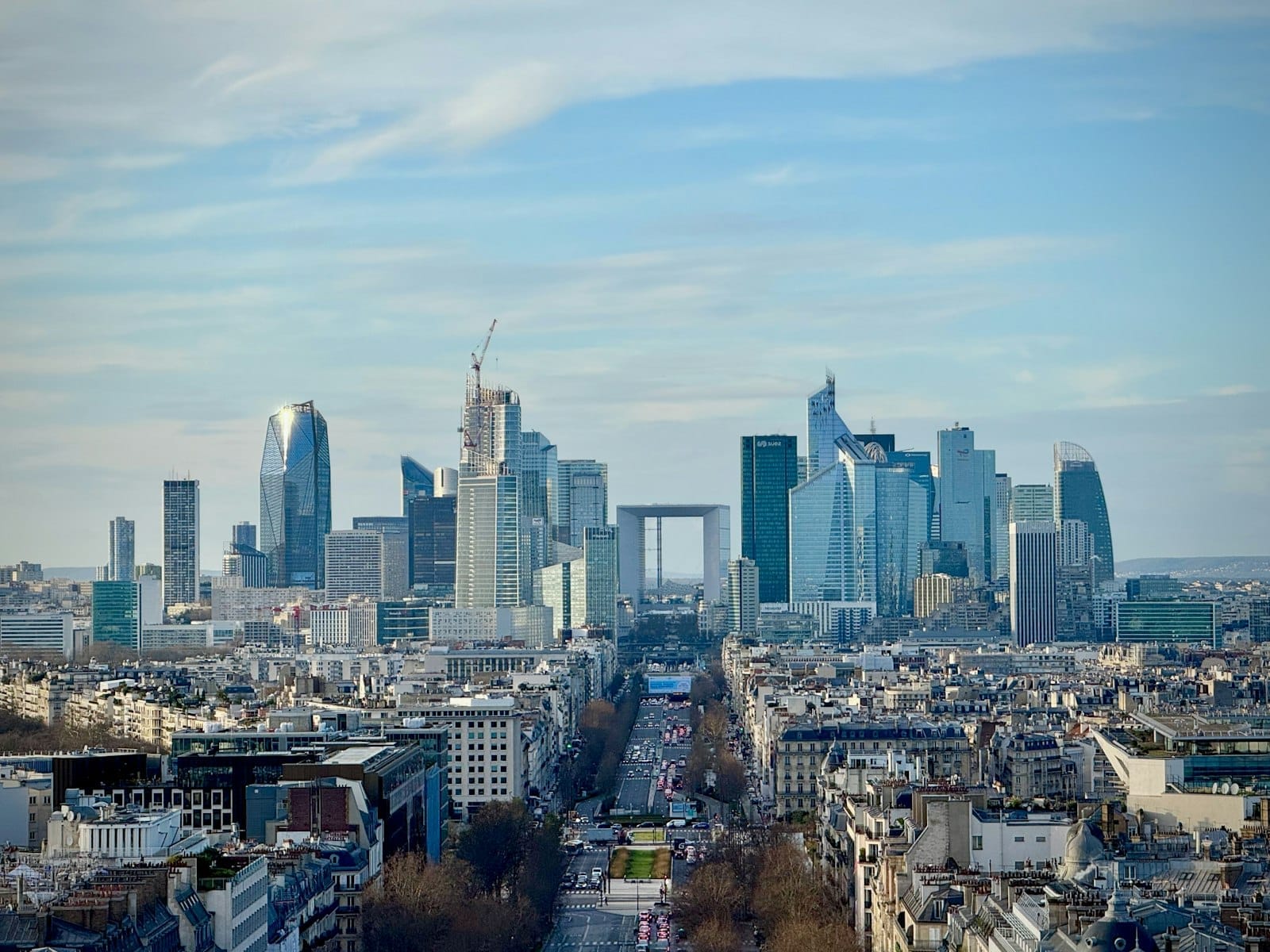
La Défense is Europe's largest purpose-built business district, rising just west of Paris with over 70 skyscrapers, the monumental Grande Arche, a pedestrian esplanade covered in open-air sculptures, and one of the city's most striking urban panoramas. Entry to the public esplanade is free, and the whole district offers a sharply different perspective on Paris than the postcard version.
Quick Facts
- Location
- Courbevoie / Puteaux / Nanterre, Hauts-de-Seine (western edge of Greater Paris)
- Getting There
- La Défense – Grande Arche (RER A, Métro Line 1, Tram T2)
- Time Needed
- 1.5 to 3 hours for the esplanade; add 1 hour for the Grande Arche interior
- Cost
- Free (esplanade and sculpture walk); Grande Arche: check current prices on site (previously around €7-€12), free for children under 6
- Best for
- Architecture lovers, photographers, urban explorers, and anyone curious about modern Paris
- Official website
- parisladefense.com
What La Défense Actually Is
Paris La Défense is Europe's largest purpose-built business district, occupying roughly 560 hectares on the western fringe of the Paris metropolitan area, split across the communes of Courbevoie, Puteaux, and Nanterre in the Hauts-de-Seine département. Its over 70 skyscrapers hold some around 3.5 million square metres of office space, making it a genuine financial capital in its own right, home to the European headquarters of dozens of multinational corporations. Yet it is also, surprisingly, a place worth visiting for its own sake.
The district's name does not come from military fortification or defensive walls. It comes from a bronze sculpture, La Défense de Paris (1883), by Louis-Ernest Barrias, which was installed in the area to commemorate the soldiers who defended Paris during the Franco-Prussian War of 1870–71. When the modern development project launched in 1958, planners simply adopted the name of the statue already standing there. That original statue still stands near the esplanade today, an easy detail to miss amid the towers.
For travelers planning a broader exploration of Paris's architectural heritage, the contrast between La Défense and historic districts like Le Marais or the grand boulevards of the Opéra district is one of the most instructive things Paris has to offer.
The Grande Arche: The District's Defining Monument
The Grande Arche de la Défense is the visual anchor of the entire district, and one of the most architecturally audacious structures in France. Completed in 1989 for the bicentennial of the French Revolution and inaugurated by President François Mitterrand, it was designed by Danish architect Johann Otto von Spreckelsen as a hollow cube of white Carrara marble and glass, 110 metres tall, 108 metres wide, and 112 metres deep. The hollow centre is large enough to contain Notre-Dame Cathedral.
The Arche sits at the western end of the Grand Axe, the historic axis that runs from the Louvre through the Tuileries, along the Champs-Élysées, through the Arc de Triomphe, and continues west all the way to La Défense. Crucially, von Spreckelsen deliberately rotated the building 6.3 degrees off the axis, both for structural reasons related to underground infrastructure and to give the monument a sense of autonomous identity rather than simple alignment. The effect, visible from the esplanade, is subtle but deliberate.
ℹ️ Good to know
Grande Arche tickets: check current prices on site (previously €7.50 full, €6 reduced), free for children under 6. Closed January 1, May 1, and December 25. The Arche now houses a photojournalism gallery of around 1,200 square metres, an auditorium, and a restaurant after extensive renovations that concluded in 2017.
Standing beneath the Grande Arche and looking back east along the Grand Axe is one of the great urban perspectives in Paris, arguably more dramatic than many of the classic views from the Arc de Triomphe or the Eiffel Tower. The entire historical spine of the city lines up in a single vanishing point, with the Arche framing it like a window.
Tickets & tours
Hand-picked options from our booking partner. Prices are indicative; availability and final rates are confirmed when you complete your booking.
Paris Essential dinner cruise at 6.15pm
From 99 €Instant confirmationFree cancellationEiffel Tower reserved elevator entrance to 2nd floor with walking tour and Seine cruise
From 94 €Instant confirmationFree cancellationBest of Paris city tour with Eiffel Tower lunch and Seine cruise
From 144 €Instant confirmationFree cancellationBike tour of Versailles Palace with skip-the-line tickets
From 109 €Instant confirmationFree cancellation
The Esplanade: An Open-Air Sculpture Museum
Beneath the towers, the Esplanade de La Défense is an entirely pedestrianized deck, roughly 1.2 kilometres long, that sits above a subterranean network of roads, rail lines, and parking infrastructure. Cars are effectively invisible here. What you walk through instead is a broad, windswept plaza dotted with dozens of permanent works of public art, including pieces by Joan Miró, Alexander Calder, and Jean Dubuffet. The sheer density of outdoor sculpture makes this one of the largest open-air art collections in Europe, and almost nobody treats it as such.
The most recognizable piece is Calder's large red stabile, mounted near the central esplanade. Miró's contribution, a colourful figurative sculpture, sits near the CNIT building. Dubuffet's Le Bel Costume (1988) is a colossal black-and-white painted form that looks like it belongs in a cartoon strip and is wildly out of scale with its surroundings, which is entirely the point. Walking the full length of the esplanade without stopping takes around 20 minutes, but factoring in stopping to read plaques and circle the sculptures, expect 45 minutes to an hour.
💡 Local tip
Pick up a free sculpture map from the Paris La Défense information kiosk near the Grande Arche parvis. The map plots all permanent artworks with artist names and dates, transforming a casual walk into a structured itinerary.
The CNIT building at the eastern end of the esplanade is worth noting on its own terms. Built in 1958 as a trade exhibition hall, it was the first major structure of the La Défense development. Its shell-shaped concrete vault, spanning 218 metres without interior supports, was an engineering landmark at the time and remains one of the largest thin-shell concrete structures in the world. It now functions as a hotel, conference centre, and shopping complex, but the original vault is still visible from the entrance hall.
How the District Changes by Time of Day
La Défense is, at its core, a working office district, and visiting at different times produces radically different experiences. On weekday mornings between 8:00 and 9:30, the esplanade fills with tens of thousands of commuters moving from the RER and Métro exits toward the towers. The pace is purposeful and fast, the coffee kiosks do serious business, and the scale of the district suddenly becomes clear when you realize how many people it absorbs every morning.
By midday on a weekday, office workers fill the esplanade benches and the outdoor terraces of the cafés and restaurants along the parvis. The atmosphere shifts from transactional to almost relaxed. This is actually a good time to visit: the district is populated but not chaotic, and the lunch crowd gives the plaza a lived-in energy rather than the empty grandeur it has at weekends.
Weekend visits offer the clearest view of the architecture and sculpture, since the esplanade is significantly quieter, but the absence of the working crowds makes the scale feel slightly inhuman. Summer weekend evenings are the exception: the esplanade hosts outdoor events, pop-up markets, and concerts under a seasonal program, and the western light at golden hour is exceptional for photography, with the Grande Arche glowing white against a fading sky.
Winter visits come with one significant variable: wind. The esplanade is exposed at height and funnels cold air in from the west. In December and January, even moderate temperatures feel considerably colder than in central Paris. Bring a wind layer if you visit between November and March.
Getting There and Navigating the District
La Défense – Grande Arche station is the main entry point, served by RER Line A (direct from Châtelet–Les Halles in around 15 minutes), Métro Line 1 (from the Louvre–Rivoli or Champs-Élysées–Clemenceau stops in around 20–25 minutes), and Tram T2. This makes it one of the most accessible destinations on the western edge of Greater Paris. The station exits deposit you directly onto the lower level of the esplanade, from which escalators and stairs bring you up to the main pedestrian deck.
Drivers can reach La Défense via the A14 motorway, with parking available underground, but there is no particular advantage to arriving by car given the exceptional rail connections. For context on navigating the broader Paris transport system, see the guide to getting around Paris.
💡 Local tip
A standard Paris Métro/RER ticket (Zone 1–3) covers travel to La Défense from central Paris. No special pass is needed. If you have a Navigo weekly pass or a tourist travel pass, it is already included.
Once on the esplanade, orientation is straightforward: the Grande Arche marks the western end, the CNIT building marks the eastern end, and all pedestrian movement happens on the deck above the roads. There are no traffic crossings to manage and no cars to watch for. The entire esplanade is accessible to wheelchair users, and the main station has lifts connecting all levels. The one practical challenge for wheelchair users is the uneven paving in some sections of the older esplanade, particularly near the eastern CNIT end.
Photography at La Défense
La Défense is underused as a photography destination for visitors to Paris, which is a genuine oversight. The geometric density of the towers creates perspectives that are almost impossible to find elsewhere in France: glass curtain walls reflecting each other, the Grande Arche as a frame for the Parisian skyline, and the interplay between the clean modernist geometry and the older stone buildings at the eastern edge of the esplanade.
The standard shot from the base of the Grande Arche looking east toward the Arc de Triomphe and the Eiffel Tower is excellent in late afternoon light, when the low sun highlights the towers on either side of the axis. For an overview of the best photography locations across the city, the best photo spots in Paris guide covers where La Défense fits within the broader photographic landscape of the city.
A less-photographed angle: stand at the very base of the Grande Arche and aim the camera straight up into the hollow cube. The perspective is vertiginous and the white marble surfaces produce clean, high-contrast images even in overcast conditions. Blue-sky days produce the most dramatic contrast between the white structure and the sky above.
Honest Assessment: Is La Défense Worth Your Time?
La Défense occupies a strange position in the Paris travel conversation: it appears on bucket lists mainly as a backdrop for the Grande Arche photo, and some visitors arrive expecting something warmer or more historically resonant than what it delivers. If you are visiting Paris primarily for its Haussmann boulevards, its cafés, and its medieval or Belle Époque architecture, La Défense may feel like a long detour to look at office buildings.
But that framing misses what makes it interesting. Paris is exceptional precisely because its urban fabric is so tightly controlled that a district this deliberately modern and this uncompromisingly vertical exists only here, at the city's western edge, rather than being scattered throughout. La Défense is the result of a political and planning decision to concentrate modernity in one place rather than allow it to interrupt the historic centre. Understanding that decision helps explain the whole of Paris, not just this neighbourhood.
It also makes for a genuinely useful half-day when combined with a visit to the Fondation Louis Vuitton in the nearby Bois de Boulogne, or as a final stop when returning from day trips west of Paris. On its own, 1.5 to 2 hours is usually enough for a focused visit.
⚠️ What to skip
La Défense has limited appeal for young children unless they enjoy open spaces for running around. The sculpture walk can engage curious kids, but there are no dedicated family facilities on the esplanade itself. For family-focused Paris attractions, the nearby Cité des Sciences in the 19th arrondissement is a far better option.
Insider Tips
- The view from the top floor of the Grande Arche is less dramatic than the view from the base looking east. Save the entry fee and spend the time walking the esplanade to the CNIT end for the reverse perspective.
- Most visitors arrive at the Grande Arche end and turn around. Walk the full length of the esplanade east toward the CNIT building to find the older, less-photographed sculpture installations and a much quieter end of the district.
- The Quatre Temps shopping mall, connected directly to the station, is one of the largest in France. It is useful for a rainy-day stop or a practical lunch, and its food court on the upper level is significantly cheaper than the esplanade restaurants.
- La Défense hosts outdoor events and summer evening concerts on the esplanade. Check the official Paris La Défense website before your visit to see whether any public programming coincides with your stay.
- If you visit at dusk on a clear evening, the towers light up gradually and the Grand Axe perspective back toward the Arc de Triomphe and Eiffel Tower, with the Arche framing the glow of central Paris, is the single best image the district offers.
Who Is La Défense For?
- Architecture and urban planning enthusiasts who want to see how Paris handles the tension between modernism and historic preservation
- Photographers looking for geometric, glass-and-steel perspectives that do not appear elsewhere in the city
- Travelers on a second or third Paris trip who have already covered the Haussmann landmarks and want a different register
- People interested in public art, given the density and quality of the outdoor sculpture collection
- Visitors combining La Défense with a western Paris itinerary that includes the Fondation Louis Vuitton or Bois de Boulogne
Nearby Attractions
Combine your visit with:
- Bois de Vincennes
Covering nearly 1,000 hectares on the eastern edge of Paris, the Bois de Vincennes is the city's largest green space, combining ancient woodland, three lakes, a botanical garden, a world-class zoo, and a medieval royal castle. It rewards both casual afternoon strollers and full-day explorers.
- Château de Fontainebleau
Older than Versailles and used by more French monarchs, the Château de Fontainebleau is a UNESCO World Heritage palace 55 km southeast of Paris. With over 1,900 rooms, free formal gardens, and a manageable crowd count compared to other royal sites, it rewards visitors who make the 40-minute train trip from Paris.
- Château de Vaux-le-Vicomte
Built between 1656 and 1661 for finance minister Nicolas Fouquet, Château de Vaux-le-Vicomte is the largest privately owned château in France. Its formal gardens, gilded state rooms, and extraordinary backstory make it one of the most rewarding half-day trips from Paris.
- Château de Vincennes
Rising at the eastern edge of Paris, Château de Vincennes is one of the most complete medieval royal fortresses in Europe. Home to France's tallest medieval keep and a stunning Gothic chapel, it rewards visitors who venture beyond the tourist centre with centuries of largely undisturbed royal history.