Fondation Louis Vuitton: Where Architecture Becomes the First Exhibit
Designed by Frank Gehry and inaugurated in 2014, the Fondation Louis Vuitton is one of the most architecturally striking contemporary art museums in Europe. Sitting at the edge of Bois de Boulogne, it pairs major international exhibitions with a building that commands as much attention as the art inside.
Quick Facts
- Location
- 8 avenue du Mahatma Gandhi, 75116 Paris — Bois de Boulogne, next to Jardin d'Acclimatation
- Getting There
- Métro Line 1: Les Sablons, then a 13-min walk; or free electric shuttle from Charles de Gaulle-Étoile (Exit 2, 44 avenue de Friedland) every 15–20 min
- Time Needed
- 2–3 hours for the building and a major exhibition; add 30–45 min if you walk the Jardin d'Acclimatation
- Cost
- From €18 adults; €10 for under-26s and students; €5 for under-18s; free for under-3s, disabled visitors with companion. Ticket includes Jardin d'Acclimatation entry. Book online.
- Best for
- Contemporary art lovers, architecture enthusiasts, design-focused travellers, photographers
- Official website
- www.fondationlouisvuitton.fr/en
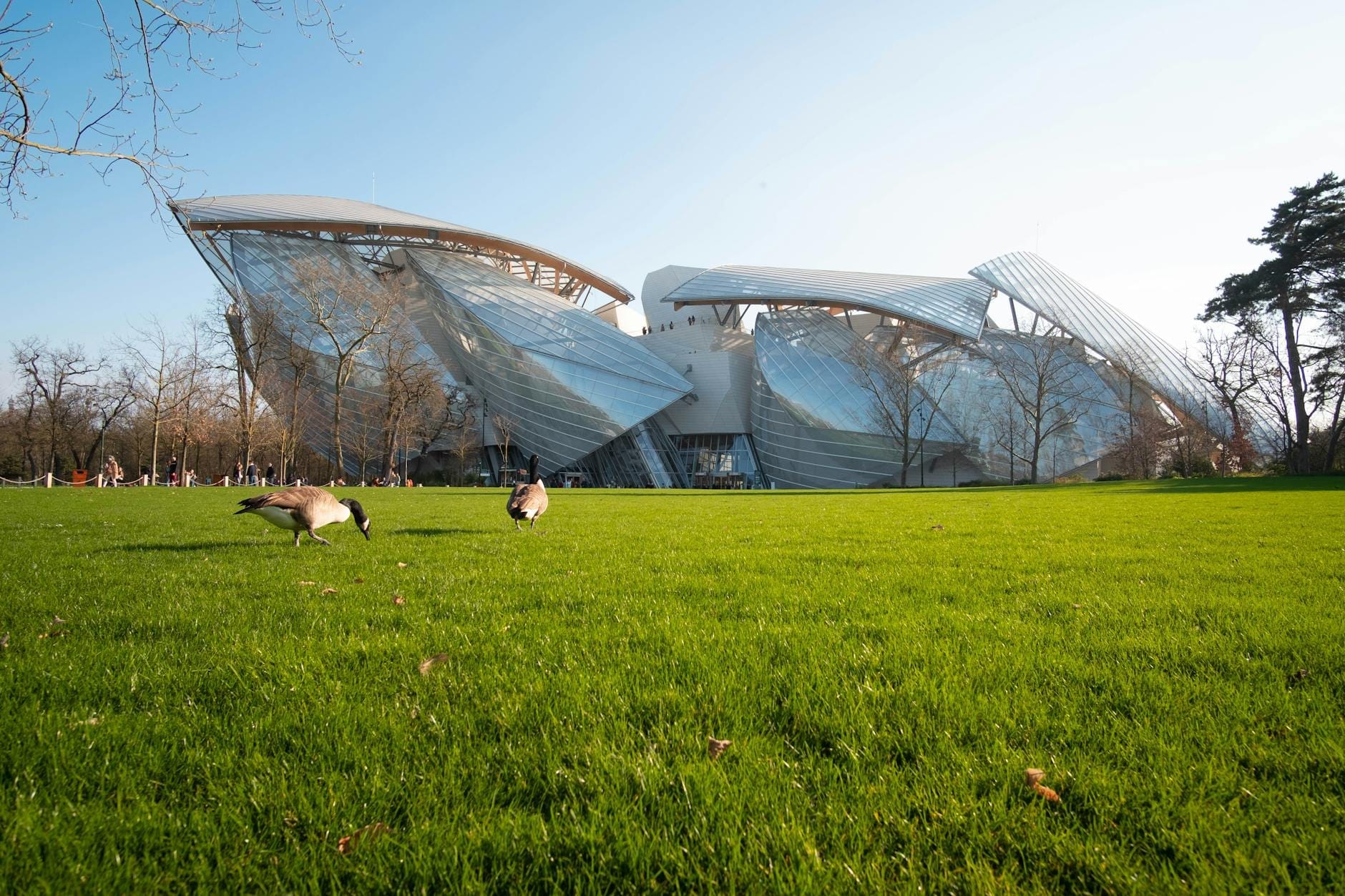
A Building That Stops You Before You Even Buy a Ticket
The Fondation Louis Vuitton announces itself from a distance. As you come through the tree line of Bois de Boulogne, the building appears as a cluster of enormous glass sails catching the light — part greenhouse, part ship, part sculpture. Designed by Pritzker Prize-winning architect Frank Gehry and inaugurated on 11 October 2014, it is one of the most formally ambitious structures built in Paris in the last 50 years. Nothing else in the city quite prepares you for it.
Gehry's design consists of twelve immense glass panels — curved, overlapping, and framing an inner structure of white concrete galleries he calls 'the iceberg.' The interplay between the transparent outer skin and the solid core means the building looks different from every angle and in every light condition. On a clear morning, the glass blazes white. By afternoon, it deepens into blue. On an overcast day, it blurs into the surrounding forest like something imagined rather than built.
💡 Local tip
The electric shuttle from Charles de Gaulle-Étoile (Exit 2, 44 avenue de Friedland) departs every 15–20 minutes during opening hours and is included with your admission ticket. It saves a 13-minute walk through the park and drops you directly at the entrance. Download the free Fondation Louis Vuitton app before you go — it includes architectural commentary and curator interviews that significantly deepen the visit.
The Fondation was incorporated on 31 October 2006 and occupies a one-hectare site leased in December 2006 within the wooded parkland of the Bois de Boulogne in western Paris. Its full legal name is Fondation d'Entreprise Louis Vuitton. From the very first announcement, its purpose was dual: to give the LVMH group a physical home for its art collection, and to contribute a major public cultural institution to Paris. Eight years of construction and a budget widely reported in the hundreds of millions of euros later, it succeeded on both counts.
Inside the Iceberg: Galleries, Light, and Scale
Once you step through the entrance and into the building's lower levels, the character shifts from spectacle to concentration. The 'iceberg' galleries are white-walled, precisely lit spaces arranged across multiple floors — serious rooms for serious work. Permanent commissions by artists including Ellsworth Kelly, Taryn Simon, Sarah Morris, and Olafur Eliasson are integrated into the architecture itself, not hung as afterthoughts. Kelly's 'Spectrum VIII,' for example, fills an entire wall with eleven monumental colored panels, requiring a room scaled to receive it.
The temporary exhibition programme rotates through major international names. Past shows have included retrospectives of Jean-Michel Basquiat, Egon Schiele, Gerhard Richter, and Charlotte Perriand. The scale of the programming matches the ambition of the building — these are not modest group shows, but large-scale retrospectives that would hold their own at any institution in New York or London.
Between gallery levels, terraces open onto the forest. These intermediate spaces — where the glass sails rise above you and the trees press in from the outside — are among the most distinctive in the building. They function as decompression zones between the intense focus of the art rooms and the sensory drama of the exterior. On a weekday morning, they are almost entirely quiet.
ℹ️ Good to know
Liquids including water bottles are not permitted inside the building. The Le Frank Restaurant (ground floor) and a bookshop are accessible with a valid admission ticket. The bookshop closes 15 minutes before the Fondation's closing time.
Tickets & tours
Hand-picked options from our booking partner. Prices are indicative; availability and final rates are confirmed when you complete your booking.
Private tour of the Louvre, Notre-Dame and Cite & Saint-Louis Islands
From 285 €Instant confirmationFree cancellationParis Essential dinner cruise at 6.15pm
From 99 €Instant confirmationFree cancellationEiffel Tower reserved elevator entrance to 2nd floor with walking tour and Seine cruise
From 94 €Instant confirmationFree cancellationBest of Paris city tour with Eiffel Tower lunch and Seine cruise
From 144 €Instant confirmationFree cancellation
When to Visit and How the Experience Changes
Weekday mornings, particularly Tuesday through Thursday, offer the least crowded conditions. Weekend afternoons draw a noticeably larger crowd — families from the nearby 16th arrondissement, architecture students, and tourists who have bundled the visit with a walk through Bois de Boulogne. The difference is significant: with fewer people, you can stand in front of a major work for as long as you want; on a busy Saturday afternoon, the timed entry system keeps the galleries from overflowing, but the terraces and circulation spaces fill up quickly.
The building's relationship with natural light makes the time of day matter more here than in most museums. Morning light floods the eastern terraces and the upper gallery levels. By mid-afternoon, the western glass sails glow from the inside out. Photographers should note that exterior shots are best in the hour after opening or in the late afternoon; midday light in summer creates harsh reflections across the glass panels.
For Paris in general, spring and autumn are the most comfortable seasons — and that holds here too. October and November bring a particular drama: the surrounding beeches turn copper and the filtered light through the trees contrasts sharply with the building's white and glass. Summer is perfectly viable but the queues for the shuttle can lengthen, and the upper terraces bake in direct sun.
Getting There: The Shuttle Makes the Difference
The address — 8 avenue du Mahatma Gandhi, 75116 Paris — sits inside Bois de Boulogne and is not directly on a Métro line. The closest station is Les Sablons on Line 1, a 13-minute walk through the park. That walk is pleasant in good weather, but the free electric shuttle from Charles de Gaulle-Étoile (Métro Lines 1, 2, and 6; RER A) is the more practical option for most visitors. The shuttle departs from Exit 2, at 44 avenue de Friedland, every 15 to 20 minutes during opening hours, and the ticket office will confirm the current schedule.
The Fondation is about 3 kilometres west of the Arc de Triomphe. If you are combining it with the Champs-Élysées area, the shuttle means that detour adds only 30–40 minutes of travel time. Visitors heading from the Left Bank should take Métro Line 1 to Les Sablons or Charles de Gaulle-Étoile — it is one of the more straightforward crossings in the city. For a broader look at navigating Paris by public transit, the Métro is nearly always the fastest option.
Tickets, Concessions, and What Your Entry Includes
The standard adult ticket covers all open gallery spaces (permanent commissions and the current temporary exhibition) as well as entry to Jardin d'Acclimatation, the large leisure park immediately adjacent to the building. At €16 for adults, the pricing reflects an institution that positions itself alongside major Parisian museums rather than as an added luxury. Reduced rates of €10 apply to under-26s, students, teachers, artists, and job seekers on presentation of valid ID. Children aged 3–17 pay €5. Under-3s, disabled visitors with an accompanying person, and accredited journalists enter free.
Note that the Paris Museum Pass does not cover the Fondation Louis Vuitton — this is a private foundation, not a state institution. If you are planning a trip centred on Paris's major museums, it is worth checking our breakdown of whether the Paris Museum Pass is worth it before you buy. Tickets for the Fondation should be booked in advance online; the traditional ticket office at the entrance is an option, but online booking avoids uncertainty at the door, particularly during major retrospectives.
⚠️ What to skip
Opening hours vary by exhibition and season — they are not fixed year-round. Always confirm current hours on the official website before visiting. The Fondation's phone line is +33 (0)1 40 69 96 00, reachable Monday to Friday, 10 a.m. to 6 p.m.
Frank Gehry's Design: What to Look For
If you have visited Gehry's Guggenheim Bilbao or the Walt Disney Concert Hall in Los Angeles, the Fondation will feel like a close relative — but its woodland setting and the extraordinary delicacy of the glass work set it apart. The building covers approximately 11,700 square metres across 11 gallery spaces and 11 terraces. The glass panels are not flat; each is individually curved, and the engineering required to suspend them above the concrete galleries involved collaboration between Gehry Partners and the French engineering firm SETEC.
Walking around the exterior perimeter before entering rewards patience. The northwest corner shows the building at its most layered, with three or four glass sails stacked above each other, the forest visible through and between them. The south-facing facade reflects the ornamental pond in front of the entrance on still days, doubling the structure into something that looks genuinely unreal. Come back to this view on your way out — after two hours inside, the scale registers differently.
For visitors who want to situate the Fondation within Paris's broader contemporary art landscape, the Palais de Tokyo in the nearby 16th arrondissement takes a deliberately rougher, more experimental approach to the same territory. The two institutions make an instructive pairing — refined institutional permanence on one side, raw curatorial risk on the other.
Accessibility, Practicalities, and What to Bring
The building is fully accessible for visitors with reduced mobility. Disabled visitors accompanied by one person enter free on presentation of relevant documentation. The free app (iOS and Android) includes an audioguide function and works offline once downloaded, which matters given that building's thick glass does not guarantee strong signal inside. Wear comfortable shoes: the building is arranged across multiple levels connected by ramps and stairs, and the terraces involve uneven surfaces.
Photography is permitted in most areas (flash and tripods are generally not). The terraces offer the best angles for architectural shots — specifically the upper levels where the glass canopy curves overhead and the forest stretches away below. For a broader look at the city's most photogenic spaces, the Fondation consistently features in any honest shortlist.
The Le Frank Restaurant, overseen by celebrated chef Jean-Louis Nomicos, serves lunch and dinner and is accessible with a valid admission ticket. It occupies a glass-enclosed space at the base of the building with views into the garden. Reservation is advisable for dinner. If you plan to explore more of the western edge of the city, the Champs-Élysées and Trocadéro area is a natural extension of the same day — the shuttle drops you back at Place de l'Étoile, directly on the Champs-Élysées axis.
Insider Tips
- Book timed-entry tickets online at least a day in advance during major retrospectives — the building's capacity is genuinely limited, and turning up without a ticket on a busy weekend means waiting or being turned away.
- The free electric shuttle is the most comfortable way to arrive, but the 13-minute walk from Les Sablons through Bois de Boulogne is worth taking at least one way — the building's reveal through the trees is part of the experience.
- Arrive at opening time to get the terraces to yourself. The upper terrace levels are nearly deserted in the first 45 minutes of the day, and the light on the glass canopy is at its most dramatic in the morning.
- The app's architectural commentary is genuinely useful and goes well beyond generic audioguide content — download it on Wi-Fi before you leave your accommodation, as connectivity inside the building can be unreliable.
- If the current temporary exhibition does not interest you, the permanent commissions alone justify a shorter visit at the reduced architecture-only rate. Ellsworth Kelly's ground-floor installation and Olafur Eliasson's grotto-like 'Inside the Horizon' are the two most frequently cited highlights.
Who Is Fondation Louis Vuitton For?
- Contemporary art enthusiasts who want to see major international retrospectives in a serious institutional setting
- Architecture lovers: Gehry's building is among the most ambitious private commissions in 21st-century Europe
- Photographers looking for a subject that rewards repeated angles and changing light throughout the day
- Families with children over 6 — the building itself sparks genuine curiosity, and combined admission with Jardin d'Acclimatation gives younger visitors more to do
- Visitors wanting to escape central Paris for a few hours without leaving the city — the Bois de Boulogne setting feels genuinely removed from the urban centre
Nearby Attractions
Combine your visit with:
- Bois de Vincennes
Covering nearly 1,000 hectares on the eastern edge of Paris, the Bois de Vincennes is the city's largest green space, combining ancient woodland, three lakes, a botanical garden, a world-class zoo, and a medieval royal castle. It rewards both casual afternoon strollers and full-day explorers.
- Château de Fontainebleau
Older than Versailles and used by more French monarchs, the Château de Fontainebleau is a UNESCO World Heritage palace 55 km southeast of Paris. With over 1,900 rooms, free formal gardens, and a manageable crowd count compared to other royal sites, it rewards visitors who make the 40-minute train trip from Paris.
- Château de Vaux-le-Vicomte
Built between 1656 and 1661 for finance minister Nicolas Fouquet, Château de Vaux-le-Vicomte is the largest privately owned château in France. Its formal gardens, gilded state rooms, and extraordinary backstory make it one of the most rewarding half-day trips from Paris.
- Château de Vincennes
Rising at the eastern edge of Paris, Château de Vincennes is one of the most complete medieval royal fortresses in Europe. Home to France's tallest medieval keep and a stunning Gothic chapel, it rewards visitors who venture beyond the tourist centre with centuries of largely undisturbed royal history.