Harold Washington Library Center: Chicago's Postmodern Giant Worth Exploring
The Harold Washington Library Center at 400 S. State Street is one of the most architecturally striking buildings in Chicago's Loop, and it costs nothing to walk through the doors. At approximately 756,000 square feet, it is often described as the largest public library building in the world — and many visitors have no idea it's there.
Quick Facts
- Location
- 400 S. State Street, Chicago, IL 60605 (Loop)
- Getting There
- CTA 'L' — Brown, Orange, Pink, Purple lines to Harold Washington Library–State/Van Buren; Red/Blue lines to Jackson
- Time Needed
- 45 minutes to 2 hours depending on interest
- Cost
- Free admission
- Best for
- Architecture lovers, readers, rainy-day explorers, solo travelers
- Official website
- www.chipublib.org/locations/34
What Is the Harold Washington Library Center?
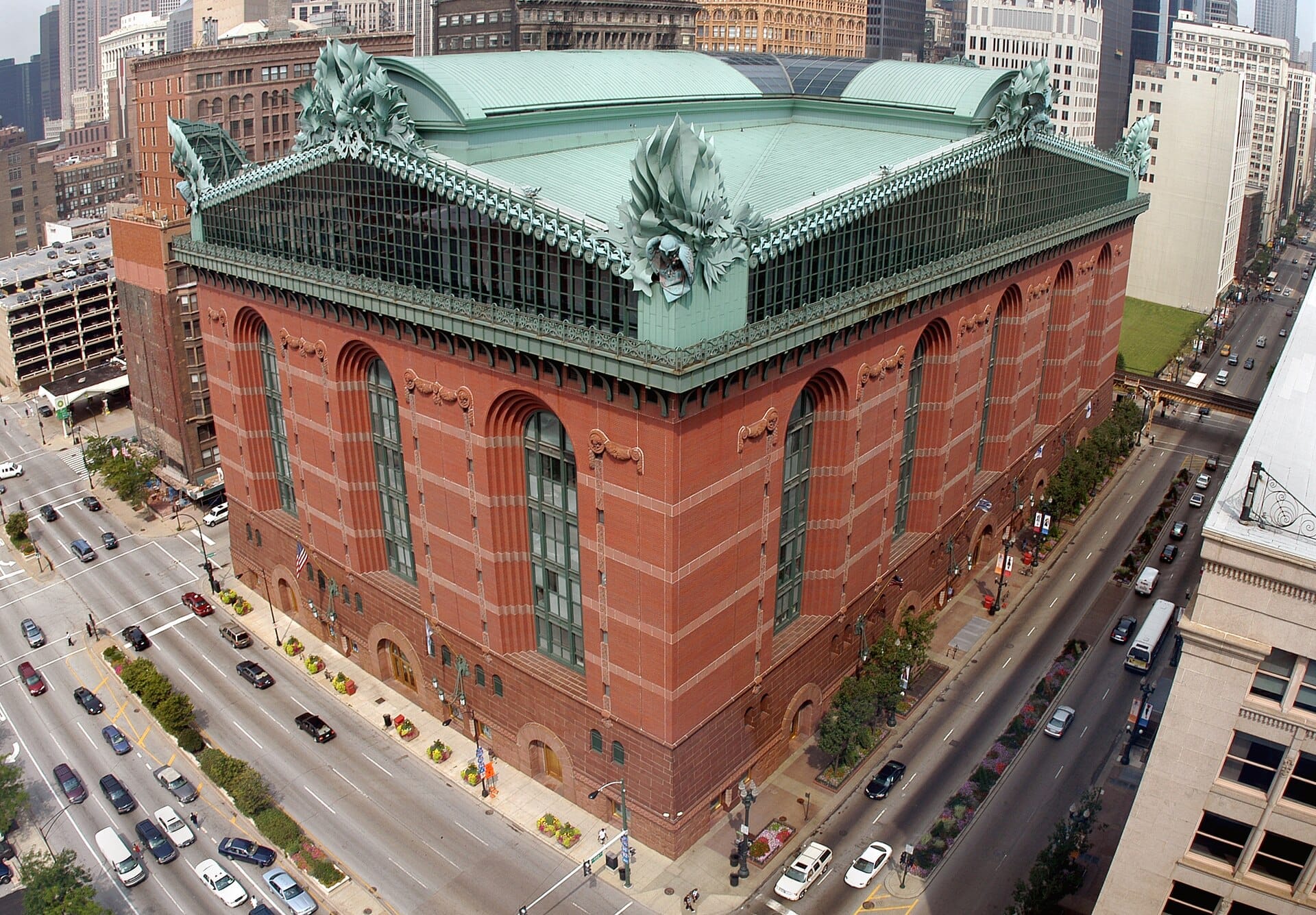
The Harold Washington Library Center is Chicago's central public library, located at 400 S. State Street in the Loop. Completed in 1991 and named for Chicago's first Black mayor, Harold Washington, the building was designed by the firm Hammond, Beeby & Babka in a Postmodern style that deliberately references historical Chicago architecture — think classical cornices, arched windows, and ornate decorative owls perched at the roofline. The result is a building that looks like it was assembled from the greatest hits of the city's 19th-century commercial architecture, then scaled up to an almost theatrical degree.
At approximately 756,640 square feet across ten floors, the Chicago Loop Alliance describes it as the largest public library building in the world. That claim is contested by some international contenders depending on how you measure it, but standing at the corner of State and Congress, the sheer mass of the building is undeniable. It occupies a full city block, and its presence on the streetscape is confident to the point of being confrontational — which, given the postmodern debates of the late 1980s that surrounded its design competition, seems entirely intentional.
💡 Local tip
Admission is completely free. No library card is required to enter and explore the building, use the reading rooms, or attend public programs. You only need a card to borrow materials.
The Architecture: Owls, Cornices, and a Roof Garden
Before going inside, spend a few minutes on the exterior. The facade is clad in red granite and red brick, with large arched windows on the upper floors that echo the ornamental ironwork of Chicago's old commercial buildings. The most distinctive feature is the roofline: enormous sheet-metal owls, each standing several feet tall, crown the building's corners and pediments. They are a reference to the owl as a traditional symbol of wisdom and knowledge, and up close they look both grand and slightly absurd — which is part of the point.
The building sits within one of the most architecturally dense blocks in the country. A short walk north puts you near the Chicago Architecture Center, which offers context on the Loop's broader building history. The library itself is frequently included in architecture tours as an example of how postmodernism landed in Chicago — with more drama than most cities were willing to tolerate at the time.
The rooftop Winter Garden on the ninth floor is a genuinely unexpected space: a skylit atrium with barrel-vaulted glass ceilings, ornamental ironwork, and a kind of hushed grandeur that makes it feel more like a concert hall than a library floor. It is used for events and quiet reading, and the quality of light on a sunny morning is exceptional. This is the floor that most casual visitors miss entirely, and it is the one most worth seeking out.
Tickets & tours
Hand-picked options from our booking partner. Prices are indicative; availability and final rates are confirmed when you complete your booking.
Chicago city center walking audio tour
From 5 €Instant confirmationArchitecture cruise on the Chicago River from Michigan Ave
From 39 €Instant confirmationFree cancellationGo City | Chicago All-Inclusive Pass
From 127 €Instant confirmationFree cancellationiFLY Chicago Lincoln Park indoor skydiving experience
From 126 €Instant confirmationFree cancellation
Inside the Building: What You Actually Find
The ground floor functions as a busy transit point for Loop workers picking up holds, using computers, or cutting through from State Street. The energy here is practical rather than contemplative — there is foot traffic, the hum of a working urban library, and the faint smell of old paper mixing with coffee from a small café near the entrance. It does not feel like a tourist attraction, which is actually a point in its favor.
Upper floors are progressively quieter. The third floor houses the children's library; the fifth floor has the Assistive Resources Center and Assistive Technology Room, designed for users with visual impairments or physical limitations. The seventh and eighth floors contain the main reading rooms and subject collections, with ceilings high enough and windows large enough to give them a genuinely monumental quality. On a weekday afternoon, these rooms are occupied mostly by students, researchers, and people who clearly come here regularly — the crowd thins considerably above the fourth floor.
The Thomas Hughes Children’s Library occupies the entire second floor and is worth a look even for adults traveling without children. It is designed with the same architectural care as the rest of the building, with custom furniture and a scale that does not condescend to its intended audience.
ℹ️ Good to know
Opening hours: Mon–Thu 9:00 AM–8:00 PM, Fri–Sat 9:00 AM–5:00 PM, Sun 1:00 PM–5:00 PM. Verify current hours at chipublib.org before visiting, as holiday closures apply.
How the Experience Changes by Time of Day
Mornings on weekdays are the calmest window. The building generally opens at 9:00 AM, and for the first hour or two, the crowds are thin enough that you can move through the upper floors and the Winter Garden with almost no other visitors around. The rooftop atrium catches morning light from the east, and without the ambient noise of a full library, the acoustic quality of the space becomes noticeable — footsteps echo slightly, and the silence feels earned.
Midday and early afternoon on weekdays bring the most activity: students with laptops, lunch-break visitors from nearby offices, and occasional school groups. The ground floor becomes crowded near the elevators. If you are here primarily for the architecture and reading rooms rather than library services, arriving before 11:00 AM or after 3:00 PM on a weekday will give you a noticeably different experience.
Weekend afternoons are quieter than you might expect, given the Loop's foot traffic. Saturday mornings before noon can be surprisingly peaceful. Sunday hours are shorter (1:00 PM–5:00 PM), and the building has a different atmosphere on Sunday — less purposeful, more exploratory, with visitors who seem to be there for the space itself rather than a specific errand.
Harold Washington: The Mayor Behind the Name
Harold Washington served as Chicago's mayor from April 29, 1983, until his death in office on November 25, 1987. He was the city's first African American mayor and won two elections in contests that reflected deep divisions in Chicago's political culture at the time. Naming the central library after him was a deliberate act of civic recognition, and his portrait and legacy are referenced throughout the building's public spaces.
The building is not a museum about Washington, but it carries his name with some weight. If you want more context on Chicago's political and cultural history, the Chicago History Museum in Lincoln Park provides a more complete treatment of the city's twentieth-century story, including the Washington era.
Getting There and Practical Notes
The library is straightforward to reach by public transit. The Brown, Orange, Pink, and Purple lines all stop at Harold Washington Library–State/Van Buren, directly in front of the building. The Red and Blue lines stop at Jackson, about two to three blocks north. The building is also walkable from Millennium Park in about ten minutes heading south on State Street.
The building is ADA compliant, with elevators serving all floors and an Assistive Resources Center on the fifth floor. Restrooms are available on multiple floors. There is no coat check, but the reading rooms on upper floors have lockers. Bags are not typically searched, but the library does have security staff at the entrance.
Photography is generally permitted in public areas of the building, including the Winter Garden. The rooftop atrium photographs well in natural light; bring a wide-angle lens or use your phone's ultra-wide mode if you want to capture the full scale of the vaulted ceiling. For broader context on Chicago's photogenic architecture, the Chicago architecture guide covers the Loop's most significant buildings in detail.
⚠️ What to skip
The library closes on major public holidays. Check the Chicago Public Library website before planning a visit around a long weekend.
Honest Assessment: Is It Worth Your Time?
For travelers with a genuine interest in architecture or urban libraries, the Harold Washington Library Center is one of the more underappreciated stops in the Loop. The Winter Garden alone is worth the detour — there are very few free interior spaces of that scale and quality anywhere in the city. The building's exterior is among the most discussed pieces of postmodern architecture in the United States, for better or worse, and seeing it in person settles debates that photographs leave open.
For travelers focused primarily on conventional sightseeing and short on time, this is not a priority. There is no single exhibit to see, no single view to photograph. The value here is cumulative: the building rewards slow exploration rather than a quick pass-through. If your Loop itinerary is already full with the Art Institute of Chicago and Cloud Gate, the library makes a natural addition given that it is free and a ten-minute walk away — but it probably should not displace those if time is tight.
Travelers who are indifferent to architecture and have no specific library needs will likely find the experience underwhelming. It is, at the end of the day, a functioning public library that happens to be housed in an extraordinary building. If that sentence does not interest you, it probably will not be your highlight.
Insider Tips
- Take the elevator directly to the ninth floor Winter Garden before doing anything else. Most visitors never make it past the third floor, which means the atrium is often nearly empty even when the building is busy below.
- The building's ornamental owls on the exterior are much larger than they appear from street level — step back to the opposite sidewalk on Ida B. Wells Drive for the best full-facade view and to appreciate the roofline scale.
- The library hosts regular free public programs including author talks, film screenings, and cultural events. Check the Chicago Public Library events calendar online before your visit; it is possible to time your trip to coincide with a free evening program.
- If you are visiting in winter, the building is genuinely useful as a warm, free, central refuge. The upper reading rooms on the seventh and eighth floors have the kind of sustained quiet that is hard to find in the Loop.
- The building sits one block east of the CTA's elevated tracks on Wabash, so if you are on the platform waiting for a Brown or Orange Line train, look south — the library's ornamental roofline is clearly visible from the tracks.
Who Is Harold Washington Library Center For?
- Architecture enthusiasts interested in postmodern design and Chicago's building history
- Solo travelers looking for a free, unhurried space to absorb the city's urban fabric
- Visitors on a tight budget who want a genuinely impressive interior without paying admission
- Families with older children interested in one of the largest children's library floors in the country
- Travelers seeking shelter from extreme weather — the Loop gets cold and wet, and this building offers free, dignified respite
Nearby Attractions
Other things to see while in The Loop:
- Art Institute of Chicago
One of the largest and most visited art museums in the United States, the Art Institute of Chicago anchors the eastern edge of the Loop with a collection of over 300,000 works spanning 5,000 years. From Georges Seurat's pointillist masterpiece to Grant Wood's American Gothic, the highlights alone demand the better part of a day.
- Buckingham Fountain
The Clarence Buckingham Memorial Fountain is one of the largest decorative fountains in the world, sitting at the heart of Grant Park since 1927. Free to visit during its seasonal run from spring through mid-October, it puts on hourly water displays and a nightly illuminated show that draws crowds from across the city.
- Chicago Architecture Center
Housed in Mies van der Rohe's One Illinois Center on the Chicago River, the Chicago Architecture Center packs nearly 10,000 square feet of exhibition space, a landmark scale model of the city, and access to some of the country's most informative architecture tours. It's the most comprehensive entry point into understanding what makes Chicago's skyline one of the world's most significant.
- Chicago Architecture Foundation River Cruise
The Chicago Architecture Center River Cruise aboard Chicago's First Lady is the most authoritative way to read the city's skyline. In 90 minutes, trained docents walk you through more than 40 landmark buildings across all three branches of the Chicago River, connecting architectural styles to the human decisions that shaped them.