National September 11 Memorial: Visiting the Reflecting Pools
The National September 11 Memorial occupies the original footprints of the Twin Towers in Lower Manhattan. The outdoor reflecting pools are free and open daily from 8:00 a.m. to 8:00 p.m. This page covers the memorial plaza; for the underground museum, see our separate museum guide.
Quick Facts
- Location
- 180 Greenwich Street, Lower Manhattan, New York, NY 10007
- Getting There
- Cortlandt St (R/W) approx. 3 min walk; Chambers St (1/2/3) approx. 8–10 min walk
- Time Needed
- 30–60 min for the outdoor memorial; 2–3 hours for the museum
- Cost
- Outdoor memorial: free. Museum tickets: US$36 for adults (verify current pricing at 911memorial.org). Limited free evening tickets available online.
- Best for
- Reflective visitors, history and architecture enthusiasts, first-time NYC visitors seeking context about the city
- Official website
- www.911memorial.org
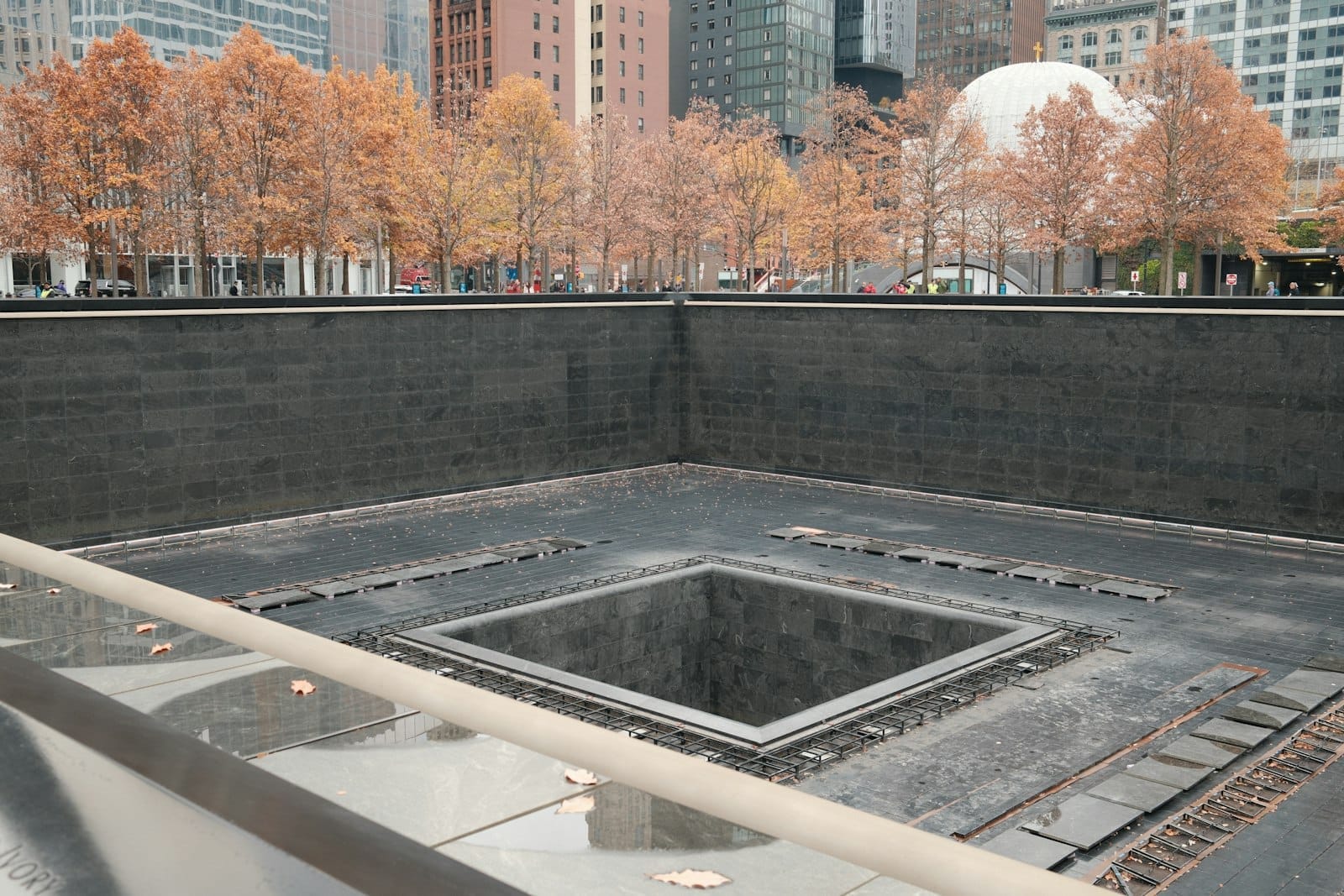
What You Are Walking Into
The National September 11 Memorial & Museum sits on eight acres of the 16-acre World Trade Center complex in Lower Manhattan, directly on the ground where the North and South Towers stood before September 11, 2001. It is not a typical tourist attraction in any conventional sense. It is a functioning memorial, a burial site for the unidentified remains of many victims, and one of the most visited landmarks in the United States. Understanding that distinction shapes every decision about how and when to visit.
The site has two separate components with very different characters. The outdoor memorial, officially the Reflecting Absence memorial designed by architect Michael Arad and landscape architect Peter Walker, consists of two massive square voids set precisely in the footprints of the original towers. Water falls continuously from all four edges of each pool into a lower basin, then drops again into a smaller square void at the center. The effect is of water disappearing into the earth. The names of all 2,983 victims killed in the September 11, 2001 attacks and the February 26, 1993 World Trade Center bombing are cut into bronze parapets surrounding the pools. The outdoor memorial is free and accessible every day.
Below ground, the museum follows the original slurry wall foundations of the towers. It is a separate ticketed experience, reached via the glass and steel Snohetta-designed pavilion on the memorial plaza. The museum opened to the public on May 21, 2014, about three years after the outdoor memorial first welcomed visitors on September 12, 2011.
ℹ️ Good to know
The outdoor memorial pools are free to visit daily from 8:00 a.m. to 8:00 p.m. The museum (Wednesday through Monday, 9:00 a.m. to 7:00 p.m., closed Tuesdays except on the anniversary of September 11) requires a separate timed ticket. Book in advance online, especially in summer and around September 11.
The Outdoor Memorial: Atmosphere at Different Hours
Early morning, roughly 9:00 to 10:30 a.m., is the most subdued and contemplative time to visit the memorial pools. The sound of falling water is the dominant sensory experience, a constant deep roar that somehow manages to muffle the surrounding city. The oak trees planted across the plaza, part of Peter Walker's design, cast dappled morning light across the bronze parapets. At this hour, many visitors are local workers passing through on their commute, pausing briefly, which gives the space an air of ordinary but meaningful daily ritual.
By midday, the plaza fills considerably. School groups arrive, tour operators congregate near the museum pavilion, and the lines at the museum entrance lengthen. The social noise increases, though the sound of the waterfalls still carries. Midday in summer also means direct sunlight on open granite paving with limited shade away from the trees, so light clothing and water matter.
Late afternoon, after 4:00 p.m., sees a secondary wave of visitors, but evening is genuinely different. As the light fades, small lights illuminate the names in the bronze parapet, and the water takes on a darker, heavier quality. By 7:30 or 8:00 p.m. in summer, the plaza thins out considerably. If the emotional weight of the space is something you want to sit with quietly, evening is when that becomes possible.
The surrounding plaza is part of the broader World Trade Center campus, which includes the Oculus transportation hub and retail center immediately to the east. If you are combining the memorial with other Lower Manhattan sights, the Oculus at the World Trade Center is directly adjacent and worth seeing for its Santiago Calatrava architecture, though the contrast in tone between the two spaces is striking.
Tickets & tours
Hand-picked options from our booking partner. Prices are indicative; availability and final rates are confirmed when you complete your booking.
911 Memorial Museum and Lady Liberty Cruise of NYC
From 69 €Instant confirmationFree cancellationVIP Access 911 Memorial and Museum Admission with Lady Liberty cruise
From 77 €Instant confirmationFree cancellationNew York 9-11 Memorial Tickets and In-App Audio Tour
From 60 €Instant confirmation9-11 Ground Zero walking tour: St. Paul's Chapel, Firefighter's Memorial Wall and 9-11 Memorial
From 33 €Instant confirmationFree cancellation
The Museum: What You Actually Encounter Underground
Entering the museum pavilion, you descend via a long ramp that passes the original steel trident columns salvaged from the North Tower's facade. These columns, roughly seven stories tall, are the first objects you encounter at scale, and they set the register for everything that follows. The museum is built largely below street level, down into the original foundation, and the architecture does not let you forget that you are standing inside what was once the base of the world's tallest buildings.
The permanent collection divides into the historical exhibition, which reconstructs the timeline and context of the attacks using artifacts, audio, and video, and the memorial exhibition, which documents the individual lives of every victim. The historical section contains recovered objects, fire department equipment, sections of the original antenna, and a substantial amount of documentary footage. Some of this footage is graphic. The museum is explicit about this in its signage, marking certain areas as sensitive and providing spaces for visitors who need to step away.
The Tribute Walk through the memorial exhibition is built around individual stories: photographs, voice recordings, handwritten notes, and personal objects belonging to the victims. This section affects visitors differently than the historical galleries. Families of victims have dedicated benches and quiet spaces throughout the museum. On busy days, particularly weekends in summer, the galleries can feel crowded in ways that work against quiet reflection. If the museum visit matters to you, book a weekday morning slot.
⚠️ What to skip
The museum contains graphic images and audio related to the attacks, including footage filmed on September 11, 2001. It is not recommended for young children. Visitors experiencing grief, trauma, or anxiety should note that the descent into the foundation level can feel claustrophobic in crowded conditions.
Historical and Design Context
Construction on the memorial began on March 13, 2006, following an international design competition that drew over 5,200 entries. Michael Arad's winning concept, originally titled Reflecting Absence, was developed in collaboration with Peter Walker and Partners. The design was chosen specifically because it did not attempt to replace or rebuild upward from the site, but instead marked absence, the void left by destruction, as the central act of remembrance.
Each pool measures approximately one acre. The North Pool occupies the footprint of One World Trade Center (WTC 1), the original North Tower. The South Pool occupies the footprint of Two World Trade Center (WTC 2), the South Tower. The names on the bronze parapets are not arranged alphabetically. Instead, the memorial uses a system called meaningful adjacency, placing victims near people they were with at the time, colleagues from the same company, passengers on the same flight, first responders who worked together, at the request of victims' families.
The architectural character of Lower Manhattan has changed substantially since 2001. One World Trade Center, substantially completed in 2013 and rising to 1,776 feet, now anchors the skyline just north of the memorial plaza. For a sense of how the entire rebuilt district fits together, the New York City architecture guide covers the World Trade Center complex in detail alongside other major buildings across the city.
Practical Walkthrough: Getting There and Moving Around
The most direct subway access is the Cortlandt Street station on the R and W lines, about a three-minute walk to the memorial entrance. The Chambers Street station on the 1, 2, and 3 lines is slightly further, roughly eight to ten minutes on foot. The WTC Cortlandt station on the 1 line is also adjacent to the memorial plaza. The Fulton Street complex, which connects multiple lines, is a short walk east and is well-signed from street level.
The memorial plaza is fully accessible, with step-free paths throughout. The museum pavilion and underground galleries have elevators, and the official site advises visitors with specific accessibility requirements to contact the museum directly for detailed assistance. Large bags are subject to security screening at the museum entrance, similar to an airport checkpoint. Allow extra time for this, especially during peak hours.
If you are spending a full day in Lower Manhattan, the Battery Park and the Staten Island Ferry terminal are within walking distance to the south, offering a free ride with views of the harbor and the Statue of Liberty. The Wall Street financial district is immediately to the east.
Photography at the outdoor memorial is permitted. Inside the museum, photography is allowed in most areas but restricted in some sections, particularly the Foundation Hall and certain sensitive exhibit spaces. Signs mark these clearly. Using a phone as a camera is practically universal here and draws no special attention, but loud group photography or selfie behavior reads as dissonant in this environment and tends to generate visible discomfort among other visitors.
Who Should Visit and Who Might Reconsider
The 9/11 Memorial is one of the most significant public spaces built in the United States in the last fifty years. For visitors coming to New York City with any interest in contemporary history, civic architecture, or the social memory of trauma, it earns its place on an itinerary. Even a 30-minute stop at the outdoor pools, with no museum visit, provides a meaningful spatial and emotional encounter with the site. For first-time visitors to the city who want to understand why Lower Manhattan feels the way it does, the first-time visitor guide to New York City contextualizes this alongside other essential experiences.
The museum, however, is not for everyone. Visitors who experienced personal loss on September 11, parents with young children, or anyone currently dealing with grief or anxiety should approach the museum component with care. It is immersive and at times deliberately difficult. That is by design, and it is the right design choice, but it means the museum asks something of its visitors that most attractions do not.
Visitors looking primarily for sightseeing, iconic skyline photos, or a fast walk-through experience may find the emotional register of the memorial uncomfortable rather than fulfilling. The space resists casual consumption. If your priority is views over Lower Manhattan rather than reflective engagement, the observatory at One World Trade Center or other viewpoints may suit the visit better.
💡 Local tip
Weekday mornings are the best time for a considered visit. Arrive when the memorial opens at 8:00 a.m. to experience the pools with minimal crowds. If you plan to enter the museum, book your timed-entry ticket online in advance at 911memorial.org to avoid same-day sellouts, especially between May and October.
Insider Tips
- Free museum tickets are occasionally released for certain evening time slots on the official 911memorial.org website, typically on a first-come, first-served basis. Check the site directly in advance rather than relying on third-party sources for current availability.
- The bronze name parapets use the meaningful adjacency system, grouping victims who were connected in life. If you are visiting to find a specific person's name, the memorial's official website has a searchable map that shows exactly where each name appears around the pools.
- The Survivor Tree, a Callery pear tree that was recovered from the rubble, nursed back to health at a Bronx nursery, and replanted on the memorial plaza, stands in the southwest corner of the site. It is easy to walk past without context but worth seeking out.
- If you visit on a weekday evening after 6:00 p.m., the plaza empties noticeably and the pools take on a completely different quality. The sound of the water is cleaner, the light on the names is more visible, and the space operates closer to the contemplative experience it was designed for.
- Security lines at the museum entrance can run 20 to 30 minutes during peak summer weekends. Packing light, with a small bag rather than a large backpack, moves you through screening considerably faster.
Who Is National September 11 Memorial For?
- Visitors with a serious interest in 20th and 21st-century American history
- Architecture and urban design enthusiasts studying post-disaster civic reconstruction
- Adults and older teenagers making a first or return trip to New York City who want to understand the context of Lower Manhattan
- Travelers willing to spend two to three hours in a sustained, emotionally engaged experience rather than a quick stop
- Anyone who wants to pay personal respects or find a specific victim's name
Nearby Attractions
Other things to see while in Lower Manhattan:
- National September 11 Museum
The National September 11 Museum sits beneath the World Trade Center memorial plaza in Lower Manhattan. The 110,000-square-foot underground museum documents the attacks of September 11, 2001, and February 26, 1993, and is one of the most emotionally significant museum experiences in the United States. The outdoor memorial pools are free; museum admission requires a timed ticket.
- Battery Park
Perched at the southernmost tip of Manhattan, The Battery is a free waterfront park offering sweeping views of New York Harbor, access to the Statue of Liberty and Ellis Island ferries, and nearly four centuries of layered history. It works well at any hour, but rewards those who arrive early.
- Ellis Island National Museum of Immigration
Ellis Island National Museum of Immigration sits in New York Harbor on ground that shaped American history more than almost any other. Reached only by ferry, it offers a deeply affecting look at the 12 million immigrants who passed through between 1892 and 1954, housed in a landmark Beaux-Arts building that has been meticulously restored.
- Governors Island
Governors Island sits just 800 yards off the tip of Lower Manhattan, yet feels worlds apart from the city. A former military post turned public park, its 172 acres offer sweeping harbor views, fort ruins, art installations, cycling paths, and some of the most relaxed open space in New York.