Wall Street & the Financial District: America's Most Famous Street
Wall Street is a short but symbolically enormous stretch of Lower Manhattan where Dutch colonial history, neoclassical architecture, and global finance collide. The streets are free to walk, open around the clock, and far more interesting in person than most visitors expect.
Quick Facts
- Location
- Wall St, Financial District, Lower Manhattan, NY 10005
- Getting There
- Wall St (2, 3, 4, 5 trains); Broad St (J, Z trains)
- Time Needed
- 1–2 hours for a self-guided walk; half a day with nearby landmarks
- Cost
- Free to walk; optional guided tours at varying prices
- Best for
- History buffs, architecture lovers, first-time NYC visitors
- Official website
- www.nyctourism.com/attractions-tours/wall-street
What Wall Street Actually Is
Wall Street is a short, narrow corridor in Lower Manhattan that runs roughly seven city blocks from Broadway in the west to the East River. Physically, it is unremarkable by skyscraper standards: canyon-like, often shadowed, with sidewalks that feel squeezed between monumental stone facades. But its name carries a weight that no other street in the United States can match. As the symbolic center of American capitalism and home to the New York Stock Exchange, it draws visitors who come simply to stand on it and take a photograph next to the Charging Bull.
The Financial District, which wraps around Wall Street across roughly half a square mile from Battery Park to Chambers Street, is the broader neighborhood. It contains Federal Hall, Trinity Church, the 9/11 Memorial, and the Oculus transit hub among many other landmarks. Visiting Wall Street in isolation means missing most of what makes this corner of Manhattan worth the trip.
ℹ️ Good to know
The streets here are public city streets, generally accessible 24 hours a day with no admission fee. The New York Stock Exchange building is not open to public tours.
A Brief History Worth Knowing Before You Arrive
The street takes its name from a defensive wooden wall erected by Dutch colonists in 1653 as the northern boundary of New Amsterdam, their settlement at the tip of Manhattan Island. The British demolished that wall in 1699, but the name stayed. By the late 18th century, traders were conducting business under a buttonwood tree near what is now 68 Wall Street, and in 1792 a group of merchants formalized their agreement into what would eventually become the New York Stock Exchange.
The architecture you see today is largely a product of the late 19th and early 20th centuries, when competing financial institutions built temples of commerce designed to project permanence and authority. Federal Hall National Memorial, at the corner of Wall and Nassau Streets, stands on the site where George Washington took the first presidential oath of office in 1789. The current building, completed in 1842, is a Greek Revival structure now administered by the National Park Service and free to enter.
Trinity Church, at the western end of Wall Street where it meets Broadway, was founded as a parish in 1697. The current neo-Gothic structure dates to 1846. For a time it was the tallest building in New York City. Its churchyard contains some of the oldest legible gravestones in Manhattan, including the tomb of Alexander Hamilton. For more on the district's remarkable architectural history, the New York City architecture guide covers the Financial District in broader context.
Tickets & tours
Hand-picked options from our booking partner. Prices are indicative; availability and final rates are confirmed when you complete your booking.
9-11 Ground Zero walking tour: St. Paul's Chapel, Firefighter's Memorial Wall and 9-11 Memorial
From 33 €Instant confirmationFree cancellationNYC 9-11 Memorial, Wall Street, and Statue of liberty walking tour
From 59 €Instant confirmationFree cancellationWall Street self-guided walking tour in New York
From 13 €Instant confirmationFree cancellationFrom Wall Street to the World Trade Center walking tour
From 30 €Instant confirmationFree cancellation
What You See Walking the Street
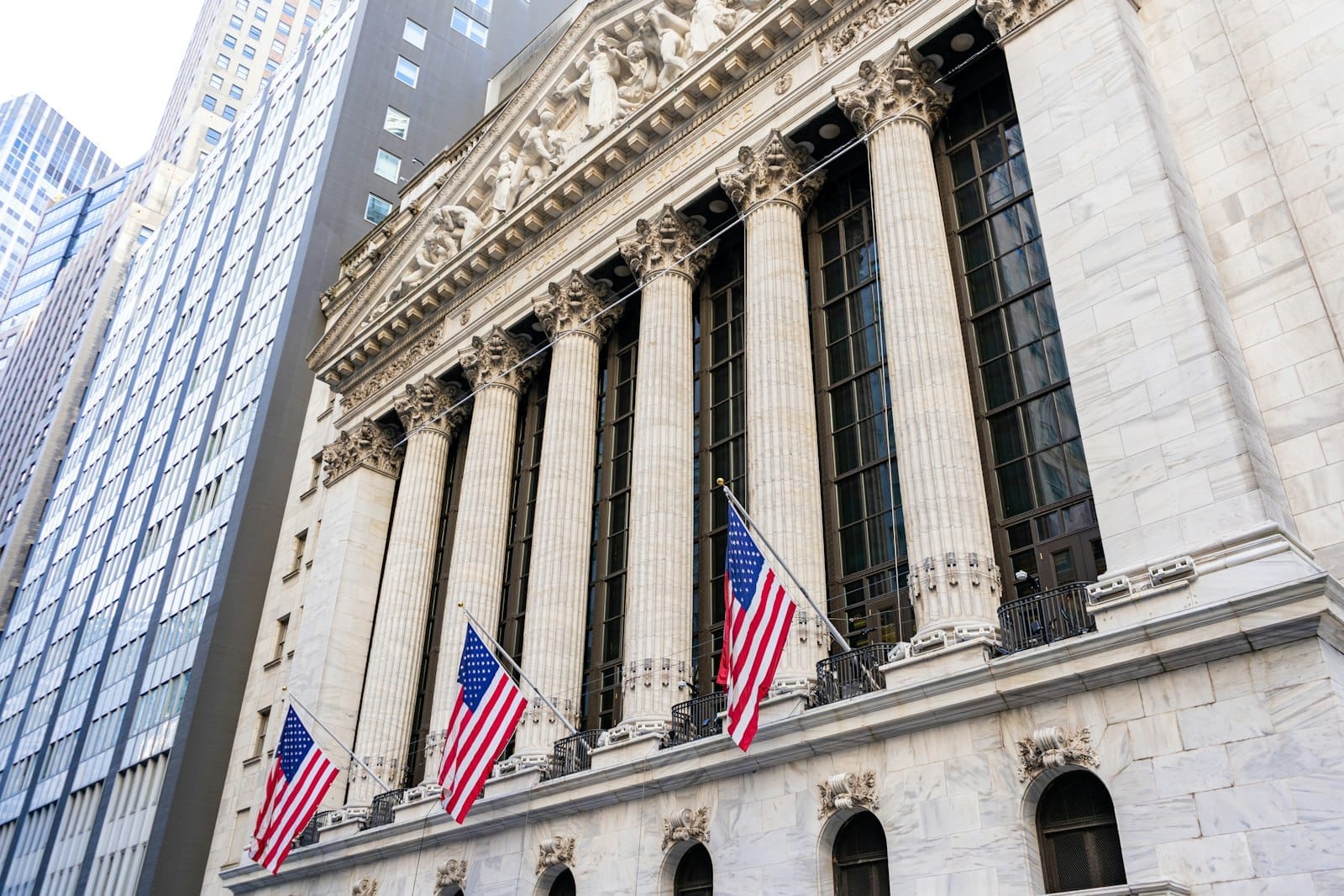
Entering Wall Street from Broadway puts you immediately between two of the neighborhood's most-photographed facades. To your left, Federal Hall's massive Doric columns frame a statue of Washington. Directly ahead, the New York Stock Exchange at 11 Wall Street presents its own colonnaded Beaux-Arts front, completed in 1903, draped occasionally with enormous American flags. Security barriers and armed guards surround the NYSE perimeter; this is as close as visitors get.
The street itself is narrow enough that looking straight up gives you a genuine sense of enclosure. The buildings lean toward each other at the top, and on cloudy days the sky between them disappears entirely. On sunny mornings, light reaches the street only in limited windows before the towers block it again. The stone underfoot is often damp in cooler months from condensation rolling off the buildings.
The Charging Bull sculpture, which most visitors associate with Wall Street, is actually located about two blocks away at Bowling Green. It was installed without official permission in December 1989 by artist Arturo Di Modica and has remained ever since. The Fearless Girl statue, installed in 2017, stands in front of the NYSE on Broad Street — about two blocks from the Bull. Both attract steady queues for photographs throughout the day, though they are not adjacent.
How the Experience Changes by Time of Day
The Financial District is one of the few Manhattan neighborhoods where time of day fundamentally changes what the experience feels like. On weekday mornings between 7:30 and 9:30 a.m., the streets fill with finance workers moving with purpose: coffee cups, earbuds, suits. The energy is focused and fast. Food carts appear on corners. The smell of coffee and warm bagels mixes with exhaust from idling delivery trucks. This is when the area feels genuinely alive as a working district rather than a tourist site.
By midday the crowds thin slightly as workers disappear into offices. Tourists fill the space they leave behind. Afternoons on weekdays can feel oddly quiet for such a famous place, which is actually ideal for unhurried photography of the facades and street-level details. Around 4 to 5:30 p.m., the outbound rush returns: crowded subway stairs, suited workers cutting quickly toward the Fulton Street or Broad Street stations.
Weekends are a different animal entirely. The Financial District on a Saturday morning is nearly empty. The streets that buzzed with thousands of commuters are quiet enough to hear pigeons on the ledges. This emptiness is genuinely eerie and worth experiencing, though it also means most retail and casual dining options are closed or operating reduced hours. Sunday afternoons are somewhat busier as tourists from elsewhere in Manhattan make their way down.
💡 Local tip
For the best photos of the NYSE facade and Federal Hall, go on a weekday morning before 9 a.m. The light comes in from the east, the crowds are manageable, and you can see both buildings clearly without tour groups blocking the foreground.
Extending Your Visit: The Surrounding Financial District
Wall Street on its own takes 20 minutes to walk end to end. The stronger case for coming to this part of Manhattan is the density of significant attractions within a 10-minute walk. The 9/11 Memorial and its reflecting pools are six blocks northwest, offering a sombre and architecturally striking counterpoint to the financial grandeur of Wall Street. Admission to the outdoor memorial is free; the museum charges a separate entry fee.
To the south, Battery Park offers open waterfront space, harbor views, and the ferry terminal for Ellis Island and the Statue of Liberty. Walking from Wall Street to the park takes around eight minutes and provides a natural endpoint to a south-to-north or north-to-south exploration of the neighborhood. On a clear day the harbor view from the park's waterfront is among the most historically resonant in the city.
The Oculus at the World Trade Center is worth seeing as a piece of contemporary architecture regardless of your interest in transit. Santiago Calatrava's white steel structure functions as a transit hub and shopping center but reads as sculpture from both inside and outside. The interior is particularly striking on sunny days when light pours through the central skylight. It connects directly to the WTC Cortlandt subway station.
If the area sparks broader curiosity about Lower Manhattan, the National Museum of the American Indian at the Alexander Hamilton U.S. Custom House near Bowling Green is free to enter and consistently undervisited. The Custom House itself, completed in 1907, is one of the finest Beaux-Arts buildings in New York.
Practical Notes for Visitors
Getting here by subway is straightforward. The Wall St station (2, 3, 4, 5 trains) drops you at the corner of Wall and William Streets, one block from the NYSE. The Broad St station (J, Z trains) puts you on Broad Street directly in front of the exchange. Both are standard subway fare with no surcharge.
The sidewalks in this part of Lower Manhattan are narrower and more uneven than in Midtown, reflecting the older street grid. Most major intersections have curb cuts, but visitors with mobility considerations should be aware that some side streets have limited width and occasional construction scaffolding. Federal Hall and the Charging Bull area at Bowling Green are generally accessible, but individual attraction accessibility varies and should be verified in advance.
Weather matters here more than in open parks. The canyon effect of the Financial District streets means wind accelerates between buildings in winter and shade keeps temperatures cooler even in summer. A jacket is advisable outside of peak summer months. Rain turns the narrow stone sidewalks slick quickly, so comfortable waterproof footwear is worth considering.
⚠️ What to skip
Security checkpoints around the NYSE and nearby federal buildings are a permanent feature of this neighborhood. Do not attempt to photograph security personnel or enter restricted zones around the exchange. Bags are occasionally checked near Federal Hall.
If this is your first visit to New York City overall, Wall Street fits naturally into a broader Lower Manhattan day that also includes the 9/11 Memorial, the Oculus, and a walk across the Brooklyn Bridge. The first-time visitor guide to New York City outlines how to organize that kind of day efficiently.
Who Should Consider Skipping It
Wall Street is not a conventional tourist attraction with programming, exhibits, or performances. If you are traveling with young children who need activity and engagement, the street itself offers little to hold their attention. Families with kids would get more from the 9/11 Memorial pools or a ride on the Staten Island Ferry, which costs nothing and delivers panoramic harbor views.
Visitors who have seen the area on screen and expect dramatic trading floor energy or ticker tape will be disappointed. The trading floor of the NYSE has not been publicly accessible for years, and the street outside the exchange looks more like a security perimeter than a hub of frenzied commerce. If financial history is the real draw, consider pairing the walk with a stop at the Museum of American Finance at 48 Wall Street, which provides the contextual depth the street itself does not.
Insider Tips
- Federal Hall National Memorial is free to enter and almost always less crowded than its exterior suggests. The interior rotunda, where Washington's inauguration is commemorated, is genuinely impressive and takes about 20 minutes to explore.
- The graveyard at Trinity Church is open to visitors and contains legible 18th-century headstones. It is among the older historic churchyards in Manhattan and oddly peaceful given its location.
- If you want a clear photograph of the Charging Bull without other tourists in frame, arrive before 8 a.m. on a weekday. By 10 a.m. on any day, queues for photos form and the area around it becomes congested.
- The stone facades along Wall Street and Exchange Place have dozens of carved details, friezes, and inscriptions that most visitors never look up to notice. Bring or use a zoom camera lens to catch them from street level.
- The Elevated Acre at 55 Water Street is a little-known rooftop park one block east of the Financial District's main strip, offering a quiet elevated space with East River views and no admission fee.
Who Is Wall Street & the Financial District For?
- History and architecture enthusiasts who want to understand how American commerce shaped physical space
- First-time New York City visitors building a Lower Manhattan day that connects multiple major landmarks
- Photographers interested in early-morning urban canyon shots with dramatic light and empty streets
- Travelers combining the Financial District with the 9/11 Memorial and Brooklyn Bridge in a single day
- Visitors who appreciate landmark areas that are genuinely free to explore without booking or ticketing
Nearby Attractions
Other things to see while in Lower Manhattan:
- National September 11 Memorial
The National September 11 Memorial occupies the original footprints of the Twin Towers in Lower Manhattan. The outdoor reflecting pools are free and open daily from 8:00 a.m. to 8:00 p.m. This page covers the memorial plaza; for the underground museum, see our separate museum guide.
- National September 11 Museum
The National September 11 Museum sits beneath the World Trade Center memorial plaza in Lower Manhattan. The 110,000-square-foot underground museum documents the attacks of September 11, 2001, and February 26, 1993, and is one of the most emotionally significant museum experiences in the United States. The outdoor memorial pools are free; museum admission requires a timed ticket.
- Battery Park
Perched at the southernmost tip of Manhattan, The Battery is a free waterfront park offering sweeping views of New York Harbor, access to the Statue of Liberty and Ellis Island ferries, and nearly four centuries of layered history. It works well at any hour, but rewards those who arrive early.
- Ellis Island National Museum of Immigration
Ellis Island National Museum of Immigration sits in New York Harbor on ground that shaped American history more than almost any other. Reached only by ferry, it offers a deeply affecting look at the 12 million immigrants who passed through between 1892 and 1954, housed in a landmark Beaux-Arts building that has been meticulously restored.